❌

Normal view

Crypto May Be Better Off Without CLARITY Act, Says Bitwise CIO: β€˜Too Big to Crush’

1 October 2026 at 22:04

Crypto may have benefited from the failure of the US CLARITY Act, according to Bitwise Chief Investment Officer Matt Hougan.

The CLARITY Act failed to get the 60 votes needed to move forward in the US Senate after years of negotiations. But instead of hurting the crypto market, its failure was followed by a strong rally across several digital assets.

Unexpected Wins in Washington

Both Bitcoin and Ethereum rose about 11% after the vote. Some other tokens posted much bigger gains. NEAR jumped 125%, Uniswap rose 49%, and Avalanche gained 44%, according to Hougan. The reaction may seem surprising because the crypto industry had strongly supported the bill. Hougan said the industry wanted the legal certainty that CLARITY promised. But added that the final version also included several compromises that could have created new restrictions for crypto companies.

One major area is stablecoins. The exec explained that the proposed legislation would have restricted platforms from paying customers interest or rewards on stablecoin balances. With the bill now stalled, existing stablecoin rules remain in place. Hougan said this could benefit companies such as Coinbase, which use stablecoin rewards to attract users.

CLARITY would have created a national licensing system for spot crypto exchanges. It also could have placed limits on the way exchanges combine trading and brokerage services. With the bill gone, established exchanges such as Coinbase and Kraken avoid those changes for now.

Instead of waiting for new legislation and lengthy studies, the SEC recently allowed certain tokenized US stocks to trade through blockchain-based systems under temporary rules, which, according to Hougan, could give tokenization companies a chance to test the technology in real markets sooner.

Revenue-generating tokens are another area that has benefited from clearer regulatory guidance. Several tokens, including NEAR and Uniswap, have gained strongly while using protocol revenue for token buybacks. The SEC has also clarified that, once a blockchain network is functional, announcing a buyback program does not by itself turn a token into a security.

There is still a major risk as regulation can change when a new administration takes office. A future SEC or CFTC leadership could take a tougher approach to crypto. Despite this, Hougan expects β€œcrypto to be too big to crush.”

Progress Under Existing Rules

Michael Saylor, co-founder and former CEO of Strategy, also sees the failure differently. He recently argued that crypto may be better served by working with supportive regulators at the SEC, CFTC, Treasury, and banking agencies than accepting the restrictions included in the bill’s final version.

Saylor believes the sector should use the next few years to build compliant crypto products under existing rules instead of rushing to accept a compromise simply to get legislation passed. His focus is on products that can lower costs, expand access, and give users more control over their money.

The post Crypto May Be Better Off Without CLARITY Act, Says Bitwise CIO: β€˜Too Big to Crush’ appeared first on CryptoPotato.

Ethereum Price Prediction: $3K Is Still in Play, But ETH Must Clear This Key Hurdle First

30 September 2026 at 16:13

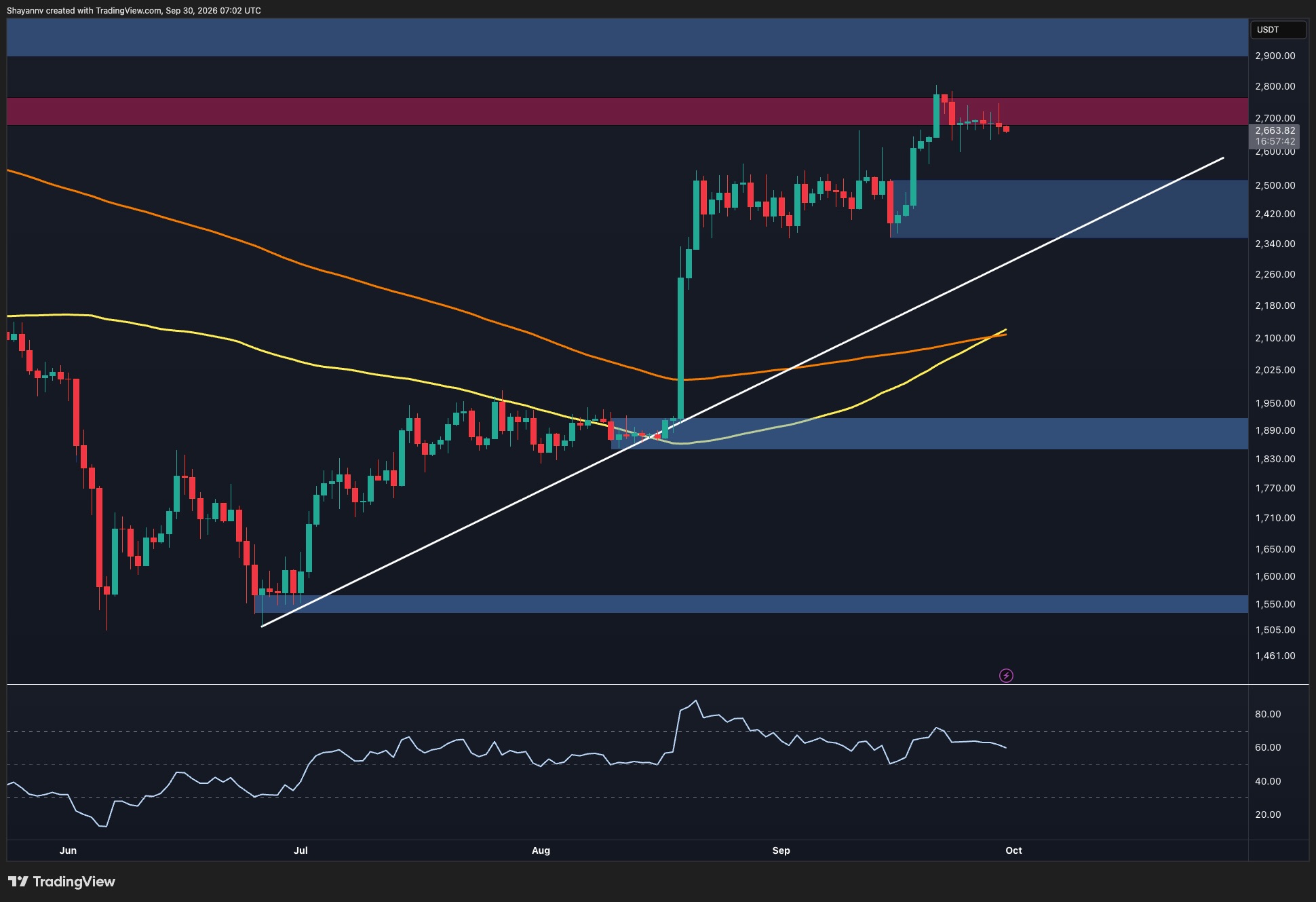
Ethereum’s rally has stalled beneath a key supply zone, with Ρ‚Ρ…Π΅ ассСт trading slightly above $2.7K as buyers attempt to preserve the recent bullish structure. The broader recovery remains intact, but weakening short-term momentum leaves the market vulnerable to a deeper pullback before another breakout attempt.

Ethereum Price Analysis: The Daily Chart

On the daily timeframe, Ethereum has entered a consolidation phase after its strong advance from the $1.85K–$1.92K support zone. The rally briefly pushed toward $2.8K, but selling pressure around the $2.68K–$2.77K resistance zone prevented a sustained breakout. Recent candles are clustered near the lower boundary of this zone, suggesting that buyers have yet to absorb the overhead supply.

Nevertheless, the broader structure remains constructive. ETH continues to trade above the rising trendline, and both displayed moving averages, with the yellow average crossing above the orange average around $2.1K. This bullish crossover supports the recovery outlook, although the RSI has eased toward 60, indicating that momentum has cooled while remaining above neutral.

A sustained breakout above the $2.77K resistance boundary and the recent $2.8K high could open the way toward the $2.9K–$3K resistance zone. Conversely, continued rejection would bring the $2.35K–$2.51K demand zone into focus, where the rising trendline provides additional technical confluence.

ETH/USDT 4-Hour Chart

The 4-hour chart highlights repeated rejections from the $2.68K–$2.77K supply zone, while an ascending support trendline has helped maintain progressively higher lows. ETH is now testing this trendline around $2.65K–$2.66K after another unsuccessful attempt to sustain a move into resistance.

Holding this support could allow buyers to challenge the $2.72K–$2.77K resistance area again. However, a convincing bullish continuation would require a sustained break above the supply zone and the recent highs near $2.8K.

A decisive break below the ascending trendline would weaken the immediate bullish structure and expose the $2.6K support area, followed by the earlier swing low around $2.56K. If selling pressure extends, the highlighted $2.44K–$2.48K demand zone would become the next important area for buyers to defend.

Sentiment Analysis

The Binance ETH/USDT liquidation heatmap shows substantial estimated liquidation concentrations on both sides of the current price. The most prominent nearby downside band sits around $2.62K, with additional concentrations extending toward $2.55K–$2.6K. Above price, a strong cluster is visible around $2.75K–$2.78K, alongside a broader concentration toward $2.8K.

This positioning places Ethereum between two meaningful liquidation pools. A loss of the 4-hour ascending support could expose the $2.62K cluster, where long liquidations may amplify the decline. Conversely, reclaiming the nearby resistance zone could bring the overhead $2.75K–$2.8K liquidity into play and potentially accelerate an upward move through short liquidations.

The heatmap does not establish which side will be reached first. However, its alignment with the technical levels suggests that a break from the current consolidation could trigger a sharper move as leveraged positions unwind.

The post Ethereum Price Prediction: $3K Is Still in Play, But ETH Must Clear This Key Hurdle First appeared first on CryptoPotato.

Arthur Hayes Predicts Ethereum Will Reach $10K by Year-End

30 September 2026 at 15:21

Arthur Hayes, the former CEO of BitMEX, told an interviewer at KBW 2026 in Seoul that he expects to see Ethereum hit $10,000 by the end of the year.

That’s more than three times the current price near $2,700, with ETH still trading about 46% below its all-time high.

The $10K Case for Ethereum

In a clip CoinDesk posted on X from the KBW2026 event, Hayes gave a direct answer when asked for his Ethereum price prediction:

β€œ$10,000 by the end of the year.”

He added that he likes ETH because he can put a large amount of money into it without expecting a sudden 75% loss from an exploit.Β Hayes also addressed why Ethereum has lagged other networks at different points of the cycle, putting it all down to narratives. He pointed to Solana capturing the meme coin narrative and rising quickly, while Ethereum had become slower as competing blockchains took some of the activity.

β€œObviously, Ethereum pioneered this whole decentralized computer thing and then was the victim of its own success, was slow and whatever,” he said. β€œAnd there were other challengers that picked up the slack.”

Still, he argued that Ethereum remains the most secure layer one because it has the largest market capitalization.

Hayes’s own ETH trades have not always been well-timed. In August, he sold 2,365 ETH at about $1,821, a loss of $241,000, after buying 7,213 ETH at an average of $1,923. And that was not the first time. In July, he sold 5,900 units for nearly $10 million after buying them days earlier for $10.58 million, incurring a loss of more than $600,000.

At the time of writing, the cryptocurrency was down 1% over 24 hours and nearly 3% in the last seven days, but was still up more than 11% across two weeks and 9% higher than where it was a month ago.

The investor’s $10,000 forecast requires ETH to gain roughly 3.7 times its current price, and that gap is notable because the token is still about 46% below its $4,946 all-time high.

ETF Flows Keep Ethereum in Focus

Ethereum’s quarterly record looks different from its short-term pullback. Coinglass data shows it gained just under 70% in the third quarter of 2026 after falling 29.26% in Q1 and 25.28% in Q2.

Meanwhile, spot ETF activity added another source of buying, with Ethereum ETFs recording $892 million in net inflows during September, with only one trading day left in the month.

However, the streak of daily inflows that started on September 18 ended yesterday with a $2.8 million outflow, while the previous week brought $689.9 million of net inflows. The activity has lifted cumulative inflows to $13.95 billion.

The post Arthur Hayes Predicts Ethereum Will Reach $10K by Year-End appeared first on CryptoPotato.

❌