
❌

Reading view

Crypto May Be Better Off Without CLARITY Act, Says Bitwise CIO: ‘Too Big to Crush’

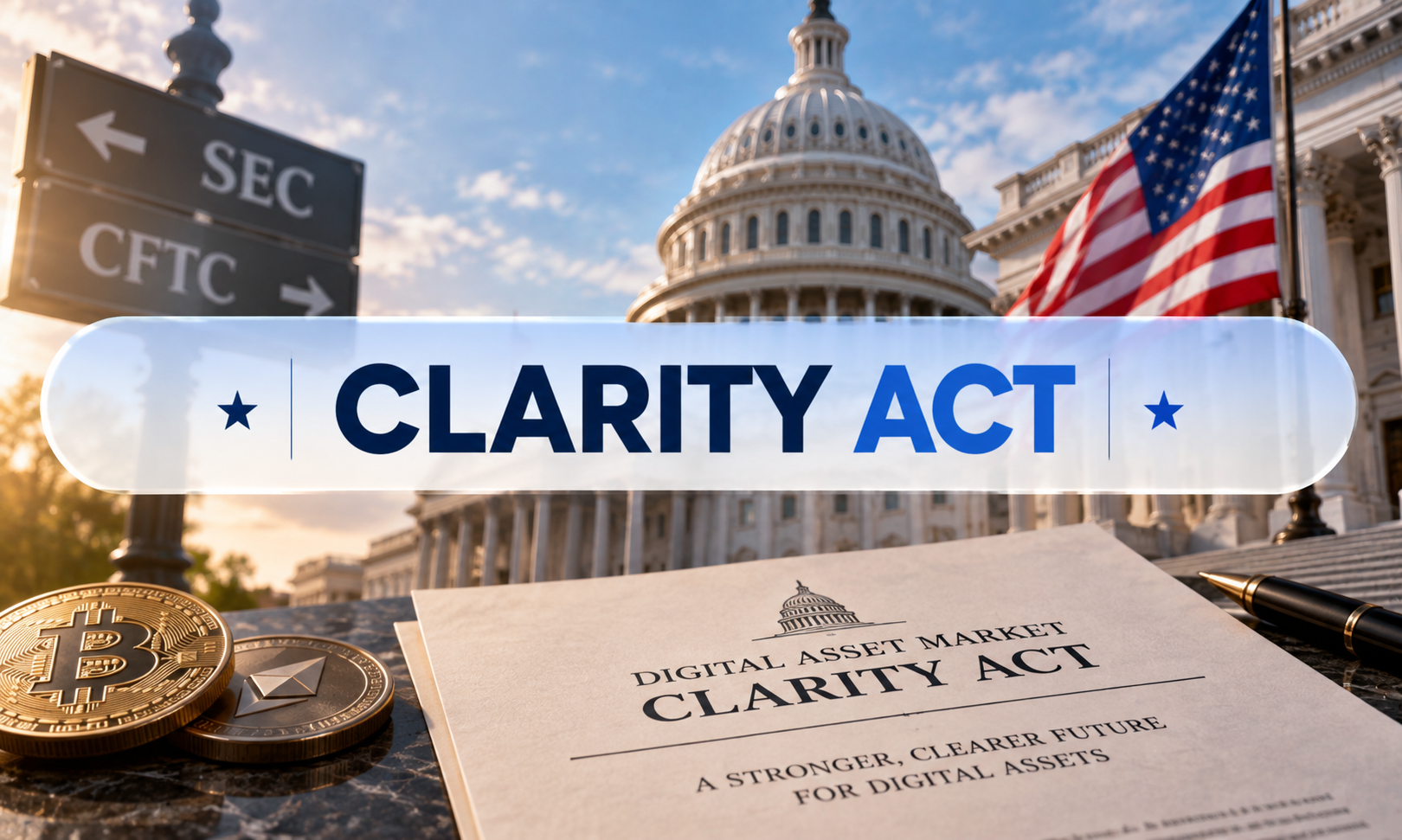
Crypto may have benefited from the failure of the US CLARITY Act, according to Bitwise Chief Investment Officer Matt Hougan.

The CLARITY Act failed to get the 60 votes needed to move forward in the US Senate after years of negotiations. But instead of hurting the crypto market, its failure was followed by a strong rally across several digital assets.

Unexpected Wins in Washington

Both Bitcoin and Ethereum rose about 11% after the vote. Some other tokens posted much bigger gains. NEAR jumped 125%, Uniswap rose 49%, and Avalanche gained 44%, according to Hougan. The reaction may seem surprising because the crypto industry had strongly supported the bill. Hougan said the industry wanted the legal certainty that CLARITY promised. But added that the final version also included several compromises that could have created new restrictions for crypto companies.

One major area is stablecoins. The exec explained that the proposed legislation would have restricted platforms from paying customers interest or rewards on stablecoin balances. With the bill now stalled, existing stablecoin rules remain in place. Hougan said this could benefit companies such as Coinbase, which use stablecoin rewards to attract users.

CLARITY would have created a national licensing system for spot crypto exchanges. It also could have placed limits on the way exchanges combine trading and brokerage services. With the bill gone, established exchanges such as Coinbase and Kraken avoid those changes for now.

Instead of waiting for new legislation and lengthy studies, the SEC recently allowed certain tokenized US stocks to trade through blockchain-based systems under temporary rules, which, according to Hougan, could give tokenization companies a chance to test the technology in real markets sooner.

Revenue-generating tokens are another area that has benefited from clearer regulatory guidance. Several tokens, including NEAR and Uniswap, have gained strongly while using protocol revenue for token buybacks. The SEC has also clarified that, once a blockchain network is functional, announcing a buyback program does not by itself turn a token into a security.

There is still a major risk as regulation can change when a new administration takes office. A future SEC or CFTC leadership could take a tougher approach to crypto. Despite this, Hougan expects “crypto to be too big to crush.”

Progress Under Existing Rules

Michael Saylor, co-founder and former CEO of Strategy, also sees the failure differently. He recently argued that crypto may be better served by working with supportive regulators at the SEC, CFTC, Treasury, and banking agencies than accepting the restrictions included in the bill’s final version.

Saylor believes the sector should use the next few years to build compliant crypto products under existing rules instead of rushing to accept a compromise simply to get legislation passed. His focus is on products that can lower costs, expand access, and give users more control over their money.

The post Crypto May Be Better Off Without CLARITY Act, Says Bitwise CIO: ‘Too Big to Crush’ appeared first on CryptoPotato.

  •  

Why Bitcoin Is Starting Q4 on Stronger Footing Than Traditional Markets

Bitcoin outperformed stocks and gold in September as it entered the fourth quarter on a high note, according to Santiment. The world’s largest crypto asset gained around 8% during the month. In comparison, the S&P 500 saw little movement, while gold fell by more than 6%.

Several altcoins also recovered as investor interest returned to the market.

What Changed in September?

Fresh capital inflows supported Bitcoin’s rally. US-listed spot BTC exchange-traded funds (ETFs) attracted billions of dollars in September, including several large inflow days toward the end of the month. Meanwhile, Strategy added another 1,665 BTC to its holdings, which was indicative of continued corporate accumulation. Strive also expanded its corporate Bitcoin holdings by purchasing 1,107 for $94.5 million.

Improving economic conditions also helped the market. US inflation data for August came in below expectations, easing pressure on Treasury yields as well as reducing concerns about another Federal Reserve rate hike. While stock markets showed a limited response, cryptocurrencies recorded stronger gains following months of weak sentiment and heavy short positions.

Santiment found that crypto markets are entering Q4 with several potential growth drivers.

“Continued ETF demand, corporate accumulation, improving regulatory clarity, and renewed altcoin participation give traders reasons to stay optimistic.”

But while higher yields and crowded leverage can still create sharp pullbacks, the analytics firm stated that “crypto currently has catalysts that traditional assets simply haven’t matched.”

What’s Next?

Bitcoin is stuck just below $86,000, and Crypto Patel thinks this level could decide where the asset heads next. If BTC breaks above this level and holds, a move toward $100,000 could be back on the table. If it fails, however, traders will be watching $82,886, $80,300, and $76,400 for support. BIT Research’s latest report, meanwhile, has put a much bigger number on Bitcoin’s current cycle. The firm said that the bear market has likely ended and predicted an upside range of $185,000 to $215,000.

Whale wallets are also stacking up. In fact, wallets holding 10 to 10,000 BTC added 41,025 coins in just 10 days, pushing their total holdings to 13.64 million.

Bitcoin’s longer-term setup is still looking healthy as the MVRV Z-Score remained above its 365-day moving average. That level has historically acted as support during broader rallies. It doesn’t mean BTC is guaranteed to keep climbing, though. Short-term pullbacks can still hit, and they could be sharp.

For now, the bigger thing to watch is whether the Z-Score can hold above that average. If it does, CryptoQuant’s analysis states that the broader valuation trend remains supportive of further upside. A sustained break below the 365-day average would be a different story and could signal that the longer-term structure is starting to weaken.

The post Why Bitcoin Is Starting Q4 on Stronger Footing Than Traditional Markets appeared first on CryptoPotato.

  •  

Altcoin Trading Volume Hits 4x Bitcoin as One Trader Says He’s Out

The altcoin market is showing signs of overheating, as spot trading volume is now four times higher than that of Bitcoin. The sharp rise in activity has also pushed leverage higher across the market.

This has prompted one trader to take profits and reduce exposure to altcoins.

Bitcoin Over Altcoins?

Doctor Profit said ONDO was sold with a 73% profit, while HBAR was closed with a smaller gain. XRP remains on watch, with a possible entry planned at a better price. The trader said there is no interest in buying altcoins while market conditions remain this hot. He also called altcoins a “great distraction and liquidity grab” and went on to add,

“This is why I’m out of Alts!”

Instead, the trader is betting on a Bitcoin correction, reiterating his previous stance. A short position was opened at $86,200, and additional short orders were placed between $86,500 and $89,500.

While he remains bullish overall, Doctor Profit had previously pointed to a potential pullback toward $79,000, near the 50-week moving average, before the broader uptrend continues. The analyst had flagged bearish signals across RSI, MACD/PPO, and MFI, while ADX showed weaker trend strength.

Warning Signs Emerge

A few days earlier, Darkfost also identified a few warning signs. According to the analyst, Total2, which tracks the altcoin market cap including Ethereum, absorbed more than $371 billion in inflows since June 2026. This is a 45% increase in just a few months.

The shift is also visible across Binance, where 87% of listed altcoins are trading above their 200-day moving average. That is a major change from August, when 80% were still below the crucial trend level. Darkfost explained that the move is indicative of a growing euphoria around altcoins, something that has historically been difficult to sustain for long.

Another signal is the rise in altcoin deposits to exchanges. Weekly deposit transactions have climbed above 22,700 on Binance and 8,300 on Coinbase, with another 32,000 or so across other platforms. The numbers are still below the levels seen early in the previous bull cycle. However, Darkfost also pointed to a developing bearish divergence on Total2’s RSI, which suggests that the altcoin momentum could be starting to cool after the recent surge.

The post Altcoin Trading Volume Hits 4x Bitcoin as One Trader Says He’s Out appeared first on CryptoPotato.

  •  

MetaMask Confirms Security Incident and Begins Validator Exits to Protect Client Assets

MetaMask is investigating an undisclosed security incident affecting part of its infrastructure, but it says it has found no immediate threat to user wallets.

The crypto wallet provider said it is working with external security advisers and partners to contain and fix the issue.

MetaMask Exits Affected Validators

As a precaution, MetaMask is exiting affected validators linked to its non-custodial staking operations. The company asserted that it does not control withdrawal keys for client stakes. This means customer assets remain under the control of the respective clients.

Lido separately confirmed the infrastructure compromise and revealed that precautionary steps were taken to protect client assets related to its operated Ethereum validators.

“These steps include exiting its Ethereum (ETH) validators in the Lido protocol, and will likely incur foregone rewards as well as possible downtime penalties should validators be taken offline in the near future to reduce risks related to potential network penalties. Relevant validators have begun the exit process, with the final validators expected to be exited (but not fully withdrawn) by the end of October 7th, 2026.”

The incident comes as a large amount of ETH was moved from a wallet linked to Ethereum co-founder Joseph Lubin. Blockchain tracker Lookonchain reported that the wallet transferred 133,298 ETH, worth over $356 million, to a new wallet. The transfer took place around the same time as MetaMask’s security announcement. However, there is no information showing that the ETH movement is connected to the MetaMask incident.

Potential Risks

There’s already some back-and-forth over how serious the incident really is. For instance, Andy Cavanaugh of The Rollup suggested the situation could be “far worse than people are expecting,” including the possibility of ETH being stuck through a liquid staking provider.

Security researcher Taylor Monahan wasn’t buying it. She called the claim a “crackhead set of assumptions” while arguing that MetaMask’s response looks more like a normal security precaution.

The disruption comes just weeks after Consensys announced a major split that will turn MetaMask into a separate company focused on consumer finance. The restructuring is expected to be completed by the end of 2026, ending more than a decade of MetaMask operating under the Consensys umbrella.

The post MetaMask Confirms Security Incident and Begins Validator Exits to Protect Client Assets appeared first on CryptoPotato.

  •  

Bitcoin’s Biggest Holders Ramp Up Buying While Retail Traders Remain Flat

Bitcoin climbed above $87,400 last week, but the rally has since lost momentum. The world’s largest cryptocurrency then tested the $83,000 range before it surged past the upper boundary of its weekly range at $85,000.

Amidst the stagnation, larger holders are increasing their holdings again.

Whale Accumulation Returns

According to blockchain analytics platform Santiment, wallets holding between 10 and 10,000 BTC added 41,025 units over the past 10 days. Their total balance has now reached 13.64 million BTC, equal to about 67.93% of Bitcoin’s total supply. Santiment explained that these whale and shark wallets are now at their highest holdings since the market rally in mid-August.

There is a clear difference between large and small holders. Wallets holding less than 0.01 BTC have remained mostly unchanged during the same period. Santiment revealed that stronger market conditions have historically appeared when larger holders accumulate while smaller traders sell.

However, the analytics firm said the current pattern is not a guaranteed signal for Bitcoin’s price. Market watchers will likely focus on whether large holders continue adding BTC and whether retail investors begin reducing their positions. The trend could provide another indicator of changing market sentiment in the coming days.

Adding to the bullish picture, BIT Research said Bitcoin’s bear market may have already ended. The firm identified the cycle low in late July after the asset held above $62,900 and showed signs of weakening downside momentum. Since then, BTC has reclaimed key levels, including its 21-week moving average at $69,272, and moved above its March 2024 high of $73,084.

The report also highlighted Bitcoin’s cost basis. The True Market Mean currently stands at $76,897, which essentially means that the typical holder is back in profit. This could reduce selling pressure from investors looking to exit at break-even. The firm expects an upside range of $185,000 to $215,000 in its bullish scenario.

However, crypto analyst Doctor Profit speculated a short-term pullback before BTC’s next move higher. He pointed to bearish signals across several indicators, including RSI, MACD/PPO, and MFI, while also noting weaker trend strength on the ADX indicator.

ETF Inflows and Corporate Buying

Even as the market moves through a quieter stretch, institutional demand is still showing up. US-listed spot Bitcoin ETFs, for instance, attracted a whopping $2.4 billion last week. This week started at a slower pace, but the flow has remained positive. The funds raked in just over $31 million on Monday and another $66 million on Tuesday.

Corporate buyers have also stayed active. Strategy added another 1,665 BTC over the past week. The company paid an average of $85,681 per coin, taking its total holdings to 847,666 units. Strive has added to the buying activity as well. CEO Matt Cole said the company spent $94.5 million on 1,107 BTC at an average price of $85,400. Its total holdings have now reached 27,462.

The post Bitcoin’s Biggest Holders Ramp Up Buying While Retail Traders Remain Flat appeared first on CryptoPotato.

  •  

Bitcoin Fell After Four US Midterms: Could 2026 Break the Pattern?

US midterm elections have a history of making investors nervous and markets more volatile. According to Ali Martinez, Bitcoin could face more volatility after this year’s highly anticipated event.

In a recent post, the analyst noted that BTC fell 72% after the 2010 midterms, 65% after 2014, 52% after 2018, and 27% after 2022. While this pattern does not prove the elections caused the declines,  the historical moves are worth watching ahead of November 3, 2026.

Four Midterms, Four Drops

Martinez also highlighted Bitcoin’s fourth-quarter performance in previous midterm years. BTC gained 391% in Q4 2010 but fell 16.7% in 2014, 42.16% in 2018, and 14.75% in 2022. This data indicates the possibility of increased volatility as the fourth quarter begins.

$73,000 area was flagged as an important level to watch. According to his analysis, this zone represents Bitcoin’s short-term holder cost basis and could act as support if the market sees a post-election decline.

Prediction markets such as Kalshi and Polymarket show Democrats maintaining an advantage over Republicans. The latter’s loss in the 2026 midterms could create fresh uncertainty for the crypto market. Democrats could gain control of the House, Senate, or both, which would make crypto-friendly regulation harder to advance. The CLARITY Act, which aimed to create clearer and lighter rules for digital assets, already failed to clear the Senate in September.

Reset Soon?

Amid all the midterm uncertainty, a Bitcoin pullback appears to be on the cards. For instance, pseudonymous trader “bee” believes the crypto asset may be setting up for a larger move, but sees a possible pullback before the next major rally.

BTC is currently trading between the 50-week moving average near $77,600 and the 100-week moving average around $89,700. The 200-week moving average sits lower, near $66,000. Bitcoin could first hold its current range and climb toward $90,000. A break above the 100-week moving average may attract more liquidity and push BTC higher. However, the trader expects momentum could weaken around the $90,000-$95,000 area.

From there, BTC risks rotating back toward $75,000-$77,000. “bee” isn’t the only one anticipating a correction. Doctor Profit also expects the asset to retest $79,000 before continuing higher.

The post Bitcoin Fell After Four US Midterms: Could 2026 Break the Pattern? appeared first on CryptoPotato.

  •  

Zcash (ZEC) Gains 1,000% and Still Has Room to Grow, Grayscale Research Says

ZCash has been on a wild ride in the past year or so. The privacy-centric crypto asset has rallied by more than 1,000% within this timeframe, while most other alts have stalled.

Despite this short-term instability and stall near $1,400, ZEC accumulation continues.

More Room to Capture Market Share

A whale has been accumulating the cryptocurrency across multiple wallets over the past week, according to Onchain Labs. The main wallet received around 41,690 ZEC and moved about 18,730 out, which leaves a net balance of roughly 22,960 tokens, worth $31.7 million. The wallet also received another 4,200 ZEC, which is approximately $5.84 million.

Amidst this accumulation spree, Grayscale Head of Research Zach Pandl said that the token may have more room to grow. ZEC has climbed from around $60 to roughly $1,700 in a year before its most recent pullback. Pandl said the move does not necessarily mean the token has reached a valuation ceiling but reflects its low starting point and its potential market size.

Zcash and Bitcoin are both part of the Currencies Crypto Sector. This group includes blockchain projects focused mainly on digital currency use cases. Bitcoin remains the largest asset in the sector. Zcash, however, has increased its market share significantly over the past year. It was worth less than 0.1% of BTC’s market capitalization a year ago. Today, that figure stands around 1.5%.

According to Pandl, if ZEC continues to provide strong privacy capabilities, it could capture more market share from competing cryptocurrencies.

“We think Zcash can continue to capture market share.”

Pandl had previously said that artificial intelligence could trigger a new wave of concerns around financial privacy, and expects AI to create new privacy risks, especially for transparent public blockchains. Bitcoin transactions, for example, are publicly recorded and can potentially be linked to real-world identities. Pandl believes this could increase demand for privacy-focused blockchain solutions, with Zcash emerging as one potential option.

ETFs Face Fresh Pressure

The picture for US-listed Zcash ETFs has been less encouraging. These investment products recorded zero net flows for three straight days from September 23 to 25. Activity turned negative this week. The funds posted their largest single-day outflow so far on Monday, with around $8.12 million leaving.

Despite the recent outflows, the ETFs still hold about 3.75% of Zcash’s total supply, even though they launched only a month ago.

The post Zcash (ZEC) Gains 1,000% and Still Has Room to Grow, Grayscale Research Says appeared first on CryptoPotato.

  •  

Major Ripple (XRP) Partnership Targeting Brazil’s $22 Trillion Financial Market Infrastructure

CSD BR and Ripple have partnered to use blockchain technology in Brazil’s financial market infrastructure.

In the first phase, the XRP Ledger will be used to record and audit financial assets.

Ripple-CSD BR Deal

The project will initially focus on investment fund shares from BTG Pactual. Under the new model, selected financial assets will be tokenized and mirrored on the XRP Ledger. The assets will use the Multi-Purpose Token (MPT) standard. The blockchain will not replace CSD BR’s existing infrastructure but will provide an additional way to check and audit asset records.

Authorized participants will be able to verify records on the blockchain in near real time. The companies said this is expected to improve transparency and traceability. It could also support more automation and efficiency in financial market processes. The system will operate on a permissioned basis. Access will be limited to eligible corporate and banking clients in Brazil. Participants will also be subject to Know Your Customer (KYC) and anti-money laundering (AML) requirements.

CSD BR will retain control over the issuance and administration of the assets. It will also handle important governance functions, such as authorizing participants, freezing individual assets, and reversing transactions when regulators or courts require it.

Ripple’s custody infrastructure will work with the native capabilities of the XRP Ledger. The goal is to create an environment where tokenized financial assets can be handled while existing regulatory requirements remain in place.

Further expansion beyond the initial mirroring phase is also in the cards. The two companies plan to assess the use of blockchain for native asset issuance and trading between authorized participants. Future assets could include Real Estate Receivables Certificates, known as CRI, and Agribusiness Receivables Certificates, or CRA. Both are important parts of Brazil’s fixed-income market. Adding stronger confidentiality features is also part of the platform’s future development plans.

In a statement, Silvio Pegado, Managing Director of Ripple for Latin America, said,

“Moving beyond pilots and proofs of concept to a live record-keeping infrastructure in a national capital market is a major milestone for the industry. This partnership shows how distributed ledger technology can be safely incorporated into critical financial infrastructure in a regulated way.”

AI Push

Ripple has also been expanding its use of AI in corporate treasury operations through GSmart. As CryptoPotato reported earlier this month, the platform now covers forecasting, liquidity, risk, reconciliation, and reporting. Its approach keeps financial calculations separate from AI analysis. Deterministic engines handle the calculations, while AI reviews company policies, identifies patterns, and explains recommended actions.

The system does not execute those actions without human approval.

The post Major Ripple (XRP) Partnership Targeting Brazil’s $22 Trillion Financial Market Infrastructure appeared first on CryptoPotato.

  •  

Apple Patches iOS Flaw That Could Let Attackers Run Malicious Code on iPhones

Apple has released iOS 26.7.1 and iPadOS 26.7.1 on September 28th with a security fix for a serious vulnerability that could allow attackers to run arbitrary code on affected devices.

The tech giant said the issue involves an out-of-bounds write in CoreGraphics and added that the flaw could be triggered by processing a specially crafted file.

SlowMist Warns Crypto Users

Apple confirmed that it may have been exploited in an “extremely sophisticated attack” against specific targeted individuals on iOS versions before iOS 27.

Meanwhile, SlowMist said the vulnerability is relevant to iOS attack activity it has been tracking. The security firm also warned that crypto users should pay particular attention. It urged them to update their Apple devices and avoid suspicious links, files, and app installation prompts. Users should also be careful when downloading apps or opening content from unknown sources.

The vulnerability affects a range of Apple devices, including iPhone 11 and later models, along with several recent iPad models.

Malicious FomoPeek iOS App

A week earlier, SlowMist had reported an iOS-related security threat involving the FomoPeek app. The security firm said it received multiple reports of users losing digital assets and found that affected users had suffered private key exposure. Some had previously installed FomoPeek versions 1.1 and 1.2.

A joint investigation by SlowMist and OKX’s security teams found malicious code inside the app. According to the investigation, FomoPeek contained an iOS kernel exploitation framework with eight attack methods. The framework could reportedly select an exploit based on the device model and iOS version.

Affected versions included iOS 12.0-18.7 and iOS 26.0-26.1. If successful, the exploit could escape the iOS sandbox and access Keychain data and files from other apps. This could expose private keys, seed phrases, login credentials, as well as other sensitive information. Hidden server connections were also found that could receive remote commands, with the attack functionality reportedly running automatically at regular intervals.

Earlier this year, Apple was sued by three people for allegedly promoting a fake version of the Sparrow Wallet crypto app through its App Store. The fake app reportedly drained a total of $1.8 million from the victims’ wallets between May and August 2025.

The post Apple Patches iOS Flaw That Could Let Attackers Run Malicious Code on iPhones appeared first on CryptoPotato.

  •  
❌