Key takeaways De Amerikaanse marine heeft Boeing een contract ter waarde van 16,7 miljoen dollar (14,5 miljoen euro) gegund voor het coördineren van de ontmanteling van de productiefaciliteiten voor de EA-18G Growler en de F/A-18E/F Super Hornet. Deze overeenkomst met een vaste prijs, gefinancierd uit de aankoopbudgetten voor 2024, verplicht het lucht- en ruimtevaartbedrijf tot […]
The US Navy announced Boeing has been awarded a multi-billion-dollar contract to produce its F/A-XX aircraft. The fighter will revolutionize advancements in open mission systems architecture, advanced mission systems and operational reach and capacity. F/A-XX is intended to replace the service’s fleet of F/A-18 Super Hornets.
“It’s an honor to be selected to produce the Navy’s first sixth-generation platform. Backed by decades of work, bolstered by game-changing innovations and solidified by the investments we’ve made in new facilities uniquely suited to build multiple products with next generation capabilities, our dedicated and talented team is ready to execute this critical program,” said Steve Parker, president and chief executive officer, Boeing Defense, Space & Security, in a company news release.
“Delivering two advanced fighters in parallel was always our plan, and we invested accordingly. We are ready and able to build multiple concurrent future combat aircraft franchise programs,” said Parker.
Construction continues on Boeing’s secure manufacturing facility, the largest in the U.S. Located in St. Louis, the facility will be part of the world’s most advanced, all-digital aerospace design and manufacturing system.
“Investment in facilities is just one part of the story; we’re also investing in technology and people so that we can deliver for our customers,” Parker added.
The technical and programmatic details of F/A-XX remain classified under US national security and export laws.
Northrop Grumman Vs Boeing
Noteworthy, only Northrop Grumman and Boeing were left to race one against the other in the US Navy Next Generation Air Dominance (NGAD) sixth-generation fighter jet program aimed at replacing F/A-18E/F and EA-18G aircraft by means of a new air superiority fighter.
The Navy released this artist’s rendering of the Boeing F/A-XX, highlighting the Navy’s 6th-generation fighter intended to replace the service’s fleet of F/A-18 Super Hornets. Artist rendering: NAVAIR Public Release SPR-2026-0601.
As already reported in March 2025, the proposal submitted by Lockheed Martin to the service did not satisfy the US Navy’s criteria, a source with knowledge on the matter explained to Breaking Defense. What we know is that up to November 2024 proposals were evaluated by the service but as of today is not clear when Lockheed Martin was knocked out of the project. However, the company was no longer proceeding with any bid.
If Northrop Grumman had won the F/A-XX contract it would be the first fighter built by the company since the iconic F-14 Tomcat; instead since Boeing won the F/A-XX contract its facility in St. Louis will see a brighter future given that the company builds fighters in that facility.
Core attribute
According to a statement released in April 2025 by Rear Adm. Michael Donnelly, director of the Air Warfare division for the CNO, a “core attribute” of the F/A-XX is expected to be its range, up to “probably” 125 percent “of the range that we’re currently seeing today to give us better flexibility [and] operational reach.”
In a written testimony to Congress in May 2022, Navy officials said that the service NGAD program is meant to expand the range for carrier-based operations.
“The NGAD [family of systems] will replace the F/A-18E/F Block II aircraft as they begin to reach end of service life in the 2030s and leverage Manned-Unmanned Teaming (MUM-T) in order to provide increased lethality and survivability,” reads joint testimony from Department of Navy acquisition officials. “F/A-XX is the strike fighter component of the NGAD FoS that will be the ‘Quarterback’ of the MUM-T concept, directing multiple tactical platforms at the leading edge of the battlespace.”
Since the F-14 Tomcat interceptor left the inventory in 2006 the effective combat radius of the carrier air wing has contracted. Since the Pentagon’s strategy focused on the Indo-Pacific and the need to counter China in a potential conflict, the Navy has had to explore ways to extend the range of carrier operations due to the vastness of the region. The MQ-25A Stingray unmanned carrier tanker will nominally increase the combat radius.
This model is available from AirModels – CLICK HERE TO GET YOURS
The U.S. Navy said that two Naval Aviators ejected from their EA-18G Growler following an arresting gear failure aboard the USS Eisenhower aircraft carrier and were promptly recovered by search and rescue forces.
The U.S. Navy announced that a recovery mishap aboard the USS Dwight D. Eisenhower (CVN 69) resulted in two Naval Aviators assigned to Carrier Air Wing (CVW) 3 ejecting from their aircraft. The service says that both were promptly recovered by search and rescue (SAR) forces and were safely returned to the ship to be evaluated by medical personnel.
Additionally, four shipboard personnel were also injured during the mishap and are receiving medical care. However, one Sailor is being evacuated to a Norfolk-area hospital for treatment of non-life-threatening injuries.
DSTY613 (MH-60S) brought the injured into Sentara Norfolk General Hospital last night.
The mishap happened at approximately 6:18 p.m. EDT on Sept. 28, 2026, as the Nimitz-class aircraft carrier was sailing off the coast of Virginia. According to USNI News, the USS Eisenhower is currently at sea for a carrier qualifications campaign, and left Naval Station Norfolk in the afternoon of Sept. 28.
The service did not release details about the aircraft involved in the mishap and whether it went overboard or stopped on the deck. The ejection of two Naval Aviators seemingly points to either the F/A-18F Super Hornet or the EA-18G Growler, the only two types of twin-seater aircraft currently in service with Carrier Air Wings.
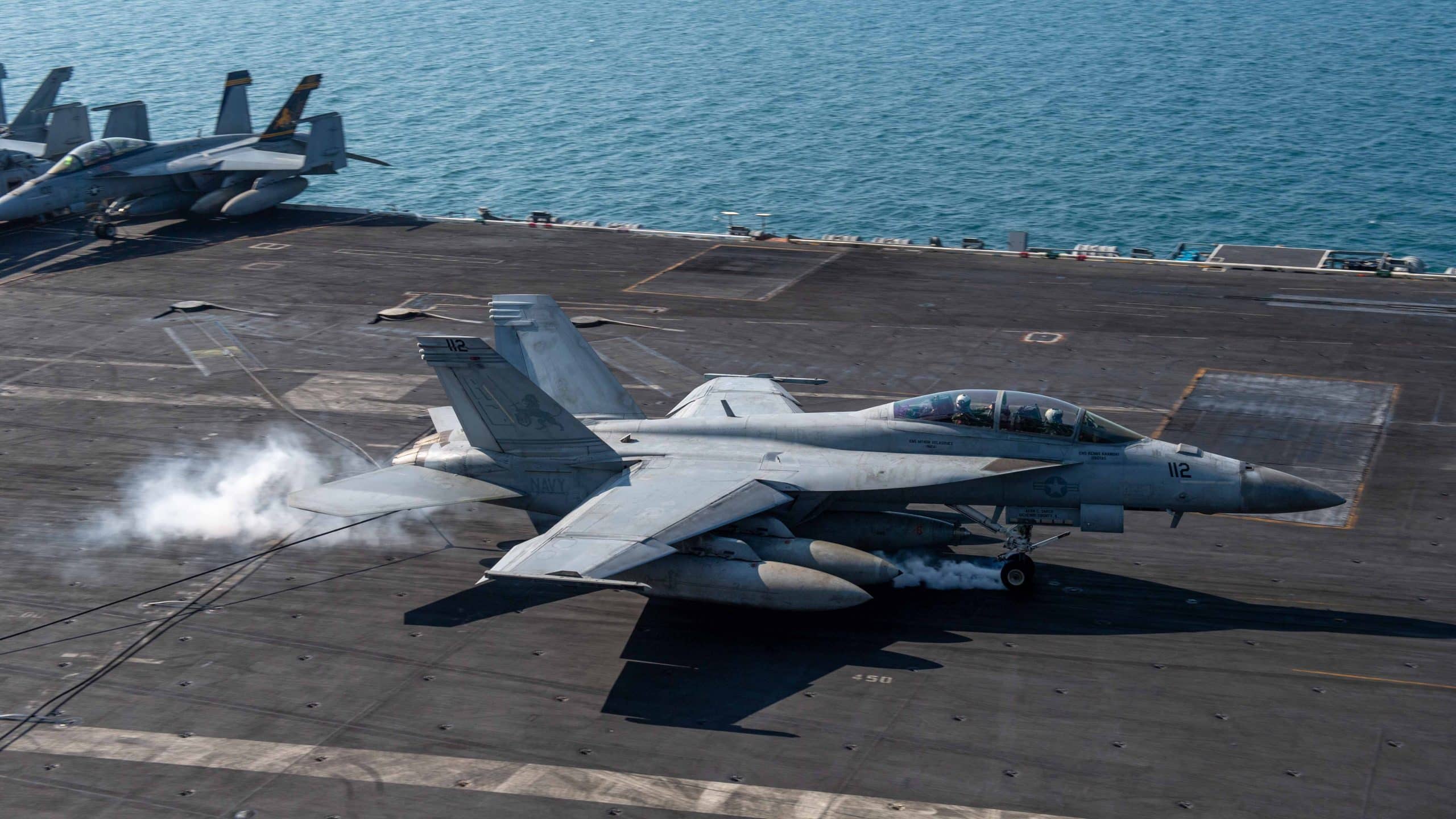
An F/A-18F Super Hornet, attached to the “Fighting Swordsmen” of Strike Fighter Squadron (VFA) 32, lands on the flight deck of the Nimitz-class aircraft carrier USS Dwight D. Eisenhower (CVN 69) in the Arabian Gulf, Dec. 10, 2023. | Source: U.S. Navy photo by Petty Officer 3rd Class Nicholas Rodriguez
CVW 3 is assigned one squadron of each aircraft, the Strike Fighter Squadron (VFA) 32 “Swordsmen” and the Electronic Attack Squadron (VAQ) 130 “Zappers,” respectively. The Navy did not mention the squadron involved.
In the past, similar outcomes have resulted from rare mishaps in which an arresting cable snapped during an arrested landing and struck deck personnel as it recoiled, much like a whip suddenly released under tension. However, we can’t confirm that this is what happened in this case, as the Navy has not released specific details about the mishap.
The carrier recently completed its Planned Incremental Availability (PIA) at Norfolk Naval Shipyard. A PIA is a scheduled period for an aircraft carrier to undergo extensive maintenance, repairs and modernization to meet future operational demands, spanning a wide array of overhauls and inspections.
Update
The U.S. Navy confirmed that the aircraft involved was an E/A-18G Growler attached to the “Zappers” of Electronic Attack Squadron (VAQ) 130. The two Naval Aviators were forced to eject following an arresting gear failure and were promptly recovered by search-and-rescue personnel assigned to Helicopter Sea Combat Squadron (HSC) 7.
UPDATE 1: At 6:18 p.m. EDT on Sept. 28, a mishap involving an E/A-18G Growler, attached to VAQ-130, occurred during aircraft recovery operations aboard the aircraft carrier USS Dwight D. Eisenhower (CVN 69) off the coast of Virginia.
The service said that a total of eight Sailors were evaluated by ship’s medical personnel following the incident, while one Sailor was flown to a Norfolk-area hospital for treatment of non-life-threatening injuries. The two aviators and two additional Sailors injured on the flight deck were flown to Naval Medical Center Portsmouth for follow-on evaluation.
An investigation into the causes of the mishap is ongoing.

 Login