
❌

Reading view

X-Energy Just Went Public in 2026. Here's How It Stacks Up Against Oklo, NuScale, and BWX Technologies.

Key Points

X-Energy (NASDAQ: XE), a developer of small modular reactors (SMRs), went public at $23 per share on April 24. But today, it trades at just $14. Let's see why X-Energy's stock dropped below its IPO price, and how it compares to three other popular nuclear energy stocks: Oklo (NYSE: OKLO), NuScale (NYSE: SMR), and BWX Technologies (NYSE: BWXT).

What does X-Energy do?

X-Energy's Xe-100 SMRs are much smaller than conventional nuclear reactors. A single Xe-100 generates only 80 MWe, whereas traditional reactors generate over 1,000 MWe. However, the Xe-100 can be deployed in modular "four packs" to expand a plant's capacity.

Missed AI’s "Act 1"? Act 2 Could Be 15x Bigger. Most investors think they missed the AI boat because they didn't buy Nvidia in 2005. But according to our analysts, we’re only at the end of "Act 1"β€”the R&D phase. "Act 2" is the global rollout. Continue Β»

Electrical transmission towers.

Image source: Getty Images.

SMRs can be more easily deployed in remote and off-grid areas. It's already landed major deals with Amazon, Dow, and Energy Northwest (a joint operating agency for public utility districts and municipalities across Washington state).

X-Energy has been scaling up its fuel production capacity to meet that demand, but it doesn't expect to deploy its first commercial reactors until the early 2030s. In 2025, the company still generated $109 million in revenue from its engineering services, government grants, and technical partnerships, while posting a net loss of $390 million. For 2026, analysts expect its revenue to rise another 94% to $212 million as its net loss widens to $430 million.

With a market cap of $4.1 billion, X-Energy trades at 19 times this year's sales. So even though it's dropped nearly 40% below its IPO price, it still can't be considered a bargain.

How does X-Energy compare to Oklo, NuScale, and BWX?

Oklo, NuScale, and BWX are also developing smaller nuclear reactors, but they've all adopted different technologies and strategies. Oklo develops microreactors, which are even smaller and only generate 1.5 MWe. They can also be chained together in their modular plants.

NuScale, which produces a 77 MWe SMR, is more comparable to X-Energy. But NuScale still uses conventional light-water reactor (LWR) technology and standard uranium rods. In contrast, X-Energy's Xe-100 uses high-temperature gas-cooled reactors (HTGRs) that consume TRISO (tri-structural isotropic) particle fuel. That key difference enables the Xe-100 to withstand much higher temperatures than NuScale's water-cooled SMRs.

Even though HTGR microreactors could be much safer than conventional reactors, the U.S. Nuclear Regulatory Commission (NRC) has only approved LWR designs (including NuScale's) so far. NuScale also expects to deploy its first microreactors in the early 2030s.

BWX -- the only large-scale manufacturer of specialized nuclear components, fuel systems, and naval reactor systems in North America -- sells smaller, transportable microreactors that generate 1-5 MWe. But that's only a small part of its massive business, which generates most of its revenue by selling reactors, fuel, and nuclear components to the U.S. Navy.

Is X-Energy's stock worth buying today?

X-Energy has several glaring weaknesses. First, it depends on a specific TRISO pebble fuel that isn't as readily available as uranium. To scale its business, it needs to ramp up the production of that proprietary fuel through its TRISO-X subsidiary.

Second, it trails far behind NuScale and other LWR SMR makers in regulatory clearance. Since TRISO pebble fuel is a newer and untested technology, the NRC will need to view it through a different lens before approving its first reactor designs. Lastly, X-Energy will remain overshadowed by bigger and more profitable nuclear giants -- like BWX -- in this unforgiving market for speculative, unprofitable companies trading at premium valuations.

While X-Energy's stock might take off once it clears its regulatory hurdles, increases its fuel production, and starts deploying its first commercial reactors, it will remain under pressure as long as rising Treasury yields continue to drive investors away from riskier stocks. Therefore, I'd avoid X-Energy and stick with more resilient market leaders like BWX.

Should you buy stock in X-Energy right now?

Before you buy stock in X-Energy, consider this:

The Motley Fool Stock Advisor analyst team just identified what they believe are the 10 best stocks for investors to buy now… and X-Energy wasn’t one of them. The 10 stocks that made the cut could produce monster returns in the coming years.

Consider when Netflix made this list on December 17, 2004... if you invested $1,000 at the time of our recommendation, you’d have $375,240!* Or when Nvidia made this list on April 15, 2005... if you invested $1,000 at the time of our recommendation, you’d have $1,403,292!*

Now, it’s worth noting Stock Advisor’s total average return is 932% β€” a market-crushing outperformance compared to 211% for the S&P 500. Don't miss the latest top 10 list, available with Stock Advisor, and join an investing community built by individual investors for individual investors.

See the 10 stocks Β»

*Stock Advisor returns as of October 1, 2026.

Leo Sun has positions in Amazon. The Motley Fool has positions in and recommends Amazon and BWX Technologies. The Motley Fool recommends NuScale Power. The Motley Fool has a disclosure policy.

  •  

Alphabet vs. Amazon vs. Microsoft: Which "Magnificent Seven" Stock Is the Better Buy Right Now?

Key Points

  • The ways consumers and companies use computing technologies is a big reason for the performance disparities between these tech giants.

  • Although the underlying dynamic will change again at some point, that shift is at least a couple of years away.

The truth is, in the long run, you'd probably be just fine with any of them. If you've only got room in your portfolio right now for one new position among "Magnificent Seven" members Alphabet (NASDAQ: GOOG)(NASDAQ: GOOGL), Amazon (NASDAQ: AMZN), and Microsoft (NASDAQ: MSFT), however, it should arguably be Google parent Alphabet. Here's why.

Why not Microsoft or Amazon?

If you already hold stakes in Amazon or Microsoft, you're hardly doomed. Microsoft remains the centerpiece of the personal and professional computing business, and Amazon is still the king of e-commerce as well as the leader in the cloud computing market.

Missed Nvidia in 2009? This Rare Signal Is Flashing Again. In 2009, a "Double Down" signal flashed for a little-known chipmaker called Nvidia. For the first time in years, that same "Total Conviction" signal is flashing for a company 1/100th the size of Nvidia. Continue Β»

In a valuation environment that leaves no room for error or weakness, however, those two bring company-specific concerns to the table that could turn into stumbling blocks.

An investor sitting at a desk in front of a laptop is reading a printed document.

Image source: Getty Images.

For Microsoft, the key concern is its waning relevancy within the workplace, or for that matter, at home. Although its productivity software titles like Word and Excel are still popular enough, Microsoft Office's dominance in the basic enterprise software arena continues to wane. It's ceding ground to Google Workspace, which is increasingly seen as less restrictive to use.

The company's also losing ground on the chat-based AI assistant front. Sure, Microsoft recently touted the fact that its Copilot app serves 30 million paying Microsoft 365 Copilot customers.

Yet take a look at the details. While this professional version of Copilot integrates nicely into the cloud-based/subscription-based version of Microsoft Office 365, the AI tool isn't necessarily being sought out by users. Rather, many of these subscribers are being added to existing Office 365 subscriptions, whether those subscribers asked for it or not (very likely at nominal additional costs). And it's still tethered to productivity software that's slowly losing market share. Meanwhile, the free-to-use consumer-facing version of Copilot only accounts for about 3% of the AI chatbot market while ChatGPT boasts a commanding share of 79%, according to data from Statcounter.

Statcounter adds that Microsoft's flagship operating system, Windows, is also losing ground. It slid to a record low market share of 63% in August thanks to soaring use of Apple's OS and even open-source Linux, both of which reached record market shares that month. In this vein, Microsoft has now reported two consecutive quarterly declines in Windows' revenue.

Connect the dots. It's not doing anything "wrong," per se. Microsoft's cloud business appears to be thriving, in fact, with revenues up 27% year over year a quarter ago, thanks to AI-driven demand. The company's just running into headwinds on too many other fronts -- even its video gaming arm, which suffered a 10% slump in revenue for the quarter ending in June.

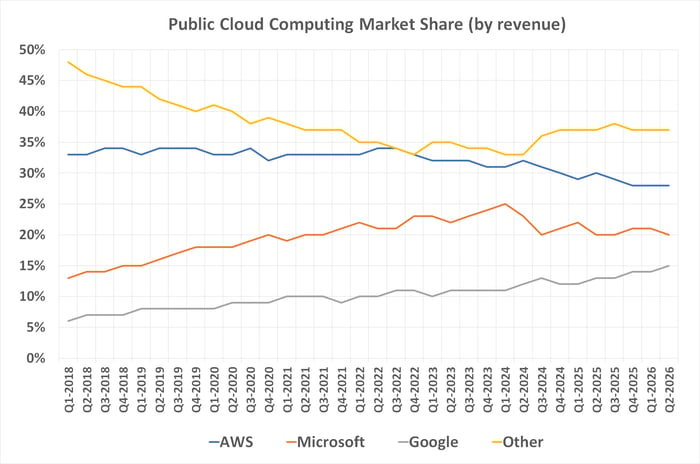
As for Amazon, the worry is simpler and far more straightforward. It's planning on spending an enormous sum on capital investments this year -- mostly on AI infrastructure -- with no assurance that this capex will curb the deterioration in its share of the cloud computing market. Though it's on pace to shell out $220 billion on capital expenditures in fiscal 2026, numbers from Synergy Research Group indicate Amazon Web Services' market share has continued shrinking from 2020's peak of 34% to 28% as of Q2 of this year. Microsoft Azure has also been sliding, by the way. Meanwhile, third-place Google Cloud has been gaining share.

Microsoft and Amazon are both losing cloud computing market share to Alphabet's Google.

Data source: Synergy Research Group. Chart by author.

Sure, there's more to both companies than their cloud businesses. But it's difficult to deny that every technology company is prioritizing the cloud opportunities being driven by AI's growth. These two names aren't knocking it out of the park on this front.

Why Alphabet

Google parent Alphabet is knocking it out of the park on the cloud computing front, of course, reporting 82% year-over-year revenue growth for this arm during the second quarter. Whatever it's doing (particularly as it pertains to AI) is clearly working.

Moreover, unlike Microsoft and Amazon, everything else Alphabet is doing is also working well.

Take its search business as an example. Google's advertising revenue -- including YouTube -- grew by more than 14% during the second quarter, with search-based advertising revenue specifically improving 15%. Subscription-based revenue and device revenue (Google makes its own smartphones and owns the Android mobile operating system, which funnels people to the Play Store) grew by more than 15% year over year.

The company is demonstrating strength in ways that don't appear directly on its income statement, too. Statcounter's numbers suggest that Android is at least maintaining its leading share of 67% of the worldwide mobile operating system market. And within the United States, TV ratings agency Nielsen reports YouTube is the most-watched streaming platform in terms of total viewing time, and is growing its share largely at the expense of venerable Netflix.

This leadership doesn't directly generate revenue. It does, however, confirm that Alphabet is doing the things that generate revenue, and doing them well.

Now, and for a while

This won't always be the case, of course. There was a time when Microsoft could do nothing wrong. Ditto for Amazon. Those times may come again for those two, just as a time may come when macro conditions don't favor Alphabet's strengths as much.

The environment right now and for the foreseeable future, however, is one that favors Google's parent far more than it does the iconic software and e-commerce giants.

The personal computing space has been democratized, for instance, not just by more hardware choices (mobile devices are now viable alternatives to traditional desktops and laptops), but also by the wider adoption of options other than Windows or Microsoft's productivity software. Amazon's early lack of in-house technological development capabilities, meanwhile, is still a key reason its cloud business is losing share to Alphabet.

Alphabet, conversely, entered this era of connected computing ideally positioned. Not only is Google Search a perfect jumping-off point for Alphabet's AI-powered chat assistant, Gemini, but the demand for more mobile computing has turned Android into a critical platform. Recently rising streaming subscription prices have also made YouTube more attractive as a free-to-use alternative.

This backdrop and these conditions will eventually change. They aren't apt to change for a while, though, which means they should provide sustained tailwinds for Alphabet. Yes, the stock has essentially drifted since May, but this dynamic is much bigger than a few tepid months.

Should you buy stock in Alphabet right now?

Before you buy stock in Alphabet, consider this:

The Motley Fool Stock Advisor analyst team just identified what they believe are the 10 best stocks for investors to buy now… and Alphabet wasn’t one of them. The 10 stocks that made the cut could produce monster returns in the coming years.

Consider when Netflix made this list on December 17, 2004... if you invested $1,000 at the time of our recommendation, you’d have $375,240!* Or when Nvidia made this list on April 15, 2005... if you invested $1,000 at the time of our recommendation, you’d have $1,403,292!*

Now, it’s worth noting Stock Advisor’s total average return is 933% β€” a market-crushing outperformance compared to 211% for the S&P 500. Don't miss the latest top 10 list, available with Stock Advisor, and join an investing community built by individual investors for individual investors.

See the 10 stocks Β»

*Stock Advisor returns as of October 1, 2026.

James Brumley has positions in Alphabet. The Motley Fool has positions in and recommends Alphabet, Amazon, Microsoft, and Netflix. The Motley Fool has a disclosure policy.

  •  

October Could Be a Huge Month for the Stock Market. Here's Why.

Key Points

  • If the AI hyperscalers offer up capital expenditure projections for next year, those forecasts could move a lot of big tech stocks.

  • The second half of the month is when investors can expect bigger stock price moves.

Investors have survived September, the historically worst month of the year for stock market returns. Outside of February (which has an average return that's just barely negative), September is the only month to average a negative return for the S&P 500 (SNPINDEX: ^GSPC). The S&P 500 was actually positive for September this year, although it wasn't a very large positive gain -- less than 1%. However, that primes the market for October.

The S&P 500 has averaged about a 0.9% positive return in October, making it one of the better months (although not as good as November or December). I think there's a huge opportunity coming in October, and it could send the market skyrocketing.

Missed Nvidia in 2009? This Rare Signal Is Flashing Again. In 2009, a "Double Down" signal flashed for a little-known chipmaker called Nvidia. For the first time in years, that same "Total Conviction" signal is flashing for a company 1/100th the size of Nvidia. Continue Β»

A rising stock chart seen in the reflection of an investor's glasses.

Image source: Getty Images.

October has some major catalysts coming

October is the start of the fourth quarter, which means companies will start to report their third-quarter results. There are some highly anticipated Q3 earnings reports coming out soon, including many of the AI hyperscalers. We'll get updated on how businesses like Alphabet (NASDAQ: GOOG) (NASDAQ: GOOGL), Amazon (NASDAQ: AMZN), and Microsoft (NASDAQ: MSFT) are doing in the second half of the month, and what they say could shape how the market performs through the end of 2026.

These three tech megacaps are spending hundreds of billions of dollars to build new AI computing capacity in data centers. So far, the growth rates their respective cloud computing businesses have put up have made these investments worth it. This trio may decide to use their next earnings reports to reveal 2027 capital expenditure guidance, which could cause the markets to decline or soar based on the extent to which these three are planning on spending.

It's already widely assumed that these three will increase their capital expenditures in 2027, but the question remains as to how much. I think they will make hefty hikes to their capex budgets, but that they will justify that spending by reporting further massive revenue growth from their cloud computing divisions.

Take Alphabet's Google Cloud, for example. In Q2, its revenue rose 82% year over year, and it delivered a 36% operating margin. That's an incredible business, and if Alphabet has customer demand for more capacity (which it does), it should be commended for heavily investing in this business unit. I expect Amazon and Microsoft to say the same thing, which could send their shares skyrocketing. This would also have positive implications for chip providers like Nvidia, Taiwan Semiconductor Manufacturing, and Broadcom, which also make up a hefty portion of the value of the stock market.

If the giant tech companies that account for more than a third of the value of the S&P 500 perform well, they should pull the rest of the market up with them and make October 2026 a fantastic month on Wall Street.

Should you buy stock in Alphabet right now?

Before you buy stock in Alphabet, consider this:

The Motley Fool Stock Advisor analyst team just identified what they believe are the 10 best stocks for investors to buy now… and Alphabet wasn’t one of them. The 10 stocks that made the cut could produce monster returns in the coming years.

Consider when Netflix made this list on December 17, 2004... if you invested $1,000 at the time of our recommendation, you’d have $375,240!* Or when Nvidia made this list on April 15, 2005... if you invested $1,000 at the time of our recommendation, you’d have $1,403,292!*

Now, it’s worth noting Stock Advisor’s total average return is 933% β€” a market-crushing outperformance compared to 211% for the S&P 500. Don't miss the latest top 10 list, available with Stock Advisor, and join an investing community built by individual investors for individual investors.

See the 10 stocks Β»

*Stock Advisor returns as of October 1, 2026.

Keithen Drury has positions in Alphabet, Amazon, Broadcom, Microsoft, Nvidia, and Taiwan Semiconductor Manufacturing. The Motley Fool has positions in and recommends Alphabet, Amazon, Broadcom, Microsoft, Nvidia, and Taiwan Semiconductor Manufacturing. The Motley Fool has a disclosure policy.

  •  
❌