❌

Reading view

THORChain Accuses CoinGecko of Statistical Foul on Bitcoin DEX Volumes

Key Highlights

  • CoinGecko ranks ChangeNOW as the top Bitcoin DEX with ~99.8% market share, a designation THORChain says is inaccurate.
  • THORChain claims more than $118 billion in native BTC swaps since launch, yet it does not appear in the Bitcoin DEX category.
  • The protocol points to 100+ independent node operators and millions in bonded RUNE securing non-custodial swaps as the core distinction.

THORChain, a cross-chain DEX protocol, has publicly challenged crypto market data source website CoinGecko over how it defines and ranks “Bitcoin DEXs.” The protocol argued that the current list elevates custodial services while excluding the only protocol to process large-scale, non-custodial native BTC swaps.

The dispute follows CoinGecko data showing ChangeNOW controlling nearly all reported Bitcoin DEX volume, despite operating as a custodial intermediary.

Quick question for @CoinGecko: what's the definition of a Bitcoin DEX?

Your rankings show ChangeNOW at #1 with 99.8% market share. But ChangeNOW is a custodial aggregator, not a decentralised exchange.
Magic Eden is listed but trades Runes NFTs, not Bitcoin swaps.

THORChain has… pic.twitter.com/4wdTI4wVOr

— THORChain (@THORChain) January 30, 2026

ChangeNOW listing brings backlash

THORChain questioned CoinGecko’s criteria after the data site listed ChangeNOW, described by THORChain as a custodial aggregator, rather than a dominant Bitcoin DEX.

The protocol also highlighted Magic Eden’s inclusion, noting its activity centers on Runes NFTs rather than native Bitcoin swaps. According to THORChain, labeling such platforms as “decentralized” misrepresents where on-chain Bitcoin liquidity actually exists.

THORChain says the omission creates a “statistical blackout” that understates Bitcoin DeFi. Despite processing $118 billion in native cross-chain volume since 2019, its Bitcoin pools are unranked in the specific Bitcoin DEX subcategory. 

According to CoinGecko data, total volume across all DEXs hovers near $10.42 billion in the last 24 hours, representing 6.8% shares in global DeFi activity.

Nodes versus custodians

THORChain maintained that a validator-based system, secured by more than 100 independent node operators and roughly $51.28 million in bonded RUNE, cannot be grouped with services that custody user funds behind internal accounts.

From the protocol’s perspective, the issue isn’t rankings but definitions. If custodial aggregators qualify as “DEXs,” it says, then the label itself has lost meaning and needs to be reworked to reflect how decentralization actually functions on-chain.

CoinGecko has long been a widely trusted data source in the crypto market, used by traders, analysts, and developers to track prices, volumes, and on-chain activity across thousands of assets. The company is reportedly valued at around $500 million, reflecting its role in crypto market infrastructure and the growing competition in data and analytics.

Market context

THORChain’s RUNE is currently trading around $0.49, with roughly $37 million in daily volume and a market cap near $175 million, according to CoinMarketCap. The dispute comes as Bitcoin DeFi gains attention and data platforms face scrutiny over methodology, especially as CoinGecko itself is reportedly exploring strategic options amid a tougher data market.

Also read: XRP Ledger Token Escrow Amendment Enters Activation Countdown

  •  

Why Justin Sun Thinks Trillions Will Move to TRON in 2026

Key Highlights

  • Justin Sun said TRON wants to work with major TradFi players to bring “trillions” in tokenized dollars and assets on-chain in 2026.
  • TRON’s stablecoin rail is already massive, with USDT supply on the network sitting around $83B.
  • TRX remains under pressure near $0.29, reinforcing the gap between network usage and token value capture.

Justin Sun, founder of the TRON network, says 2026 will be the year when major tradefi leaders, like asset manager BlackRock and stock exchanges Nasdaq and NYSE, begin to push for settlements and tokenized assets on the blockchain. Sun wants to position TRON as the settlement layer for that shift.

In an interview on January 29, Sun said TRON could support trillions of dollars in on-chain settlement as early as 2026. “Our focus is to support stablecoins, issuers, and developers with low fees and high throughput, and to keep upgrading the network so it can handle much larger settlement volumes in the future,” he said.

Stablecoin powers TRON’s trillion-dollar vision

For Sun, the signal of TRON’s relevance is not its native token TRX, but the scale of value moving across the network. USDT circulating on TRON has surpassed $83 billion, far exceeding the market value of TRX itself.

TRON's Total Market Capitalization
TRON’s Total Market Capitalization. Source: DefiLlama

The network is built as a neutral infrastructure, prioritizing throughput, low fees, and reliability, while allowing applications and stablecoins to capture most of the economic value. This design has turned it into one of the most widely used settlement networks, especially for remittances and high-frequency stablecoin transfers.

A bid to become a global settlement layer

Looking ahead, TRON aims to serve as a bridge between traditional finance and blockchain-based settlement. Sun said the network plans to work with major financial institutions and market infrastructure providers, including exchanges and asset managers, to support 24/7 settlement of tokenized dollars and securities.

If assets are to be traded and settled continuously across regions, from Asia to Africa, blockchain rails become unavoidable. In Justin’s view, stablecoins will be central to the transition, and TRON aims to be the network processing this flow.

Scaling for institutional volumes

To support that vision, TRON developers are exploring transaction batching and settlement-layer upgrades aimed at handling institutional-scale volumes more efficiently. Sun said these changes are critical if the network is to support millions of high-value transactions daily without sacrificing speed or cost.

TRON already processes an estimated tens of billions of dollars in daily transfer value, and the founder framed upcoming improvements as preparation for a much larger load rather than speculative growth.

Earlier this week, the network surpassed 4.59 million active accounts, marking a 36% increase month over month. The surge has been driven largely by the firm’s token dominance in USDT settlement and its recent Base integration, even as TRX price action remains under pressure.

High usage, muted price response

Despite growing activity, TRX has struggled to reflect that adoption. The token is trading near $0.29, down on the week, even as daily active accounts and transaction counts continue to rise.

TRX Price Chart
TRX Price Chart. Source: TradingView

Analysts say TRON’s fee model limits direct TRX demand, pushing growth toward stablecoin activity rather than price appreciation.

Sun acknowledged the gap but maintained that infrastructure-first growth is deliberate. Previous decisions, like cutting network fees by 60% in 2025, were framed as long-term investments in usage rather than short-term revenue optimization.

The founder also said Tron’s long-term ambition is to become a global settlement layer capable of hosting trillions of dollars in real-world financial assets, aligning with initiatives already being explored by major institutions like Nasdaq. 

According to him, traditional stock exchanges are moving toward 24/7, on-chain settlement infrastructure, and TRON aims to position itself as the blockchain network that can support that scale.

Also read: Hyperliquid Slashes Team Payouts 98% to Protect HYPE Floor

  •  

Nubank’s US Bank Approval Signals Broader Crypto Expansion

Key Highlights

  • The OCC has granted Nubank conditional approval to form a U.S. national bank.
  • The charter could enable regulated crypto custody and digital asset services.
  • The move favors full federal oversight over partnership-based expansion.

Nubank, one of Brazil’s most valuable companies, received conditional approval from the Office of the Comptroller of the Currency (OCC) to form a U.S. national bank. The approval, announced on Thursday, marks a major step that could expand its role in digital asset custody and crypto-adjacent services.

The move positions fintech to operate directly under U.S. federal oversight rather than relying on partnerships as it scales its presence in the world’s largest financial market.

A regulatory gateway to digital assets

Once fully licensed, Nubank would be able to fill other licenses to offer digital asset custody alongside deposits, cards, and lending. This would place the firm among a small group of federally regulated institutions capable of combining traditional banking with crypto infrastructure in the U.S., a space regulators have historically treated with caution.

The approval remains conditional, with additional sign-offs required from the FDIC and the Federal Reserve. Nubank said it expects to capitalize the bank within 12 months and open it within 18 months, following standard OCC requirements.

US expansion and crypto footprint

The conditional approval strengthens Nubank’s presence in the U.S., where Nu Holdings Ltd. (NU) is already listed on Nasdaq. Shares are trading at $18.02, down 3.92%, as the fintech moves closer to operating under a full federal banking framework.

In 2025, Nubank hired Michael Rihani, formerly of Coinbase, to lead its crypto division. Together, the Nasdaq listing, bank approval, and crypto hires signal a push to expand regulated digital asset services in the U.S.

Institutional strategy over partnerships

By pursuing a full national bank charter, Nubank is opting for direct regulatory alignment instead of operating crypto services through intermediaries. This approach strengthens its credibility with regulators and institutional partners while giving it more control over products such as custody, payments, and potentially tokenized financial services.

Company executives have framed the decision as a long-term infrastructure play rather than a short-term expansion, signaling a focus on compliance-first growth in the U.S.

“When we started over a decade ago, our goal was to prove that technology and design could fundamentally change how people interact with their money. Today, this conditional approval validates our ability to scale that mission into the world’s largest financial market under a comprehensive federal framework,” said David Vélez, Founder and CEO of Nubank.

Global scale behind the US push

Nubank currently serves more than 127 million customers across Brazil, Mexico, and Colombia, where it already operates under strict local regulation. Its U.S. entry builds on that foundation, potentially allowing crypto-related products developed under a federal framework to scale across multiple markets over time.

The strategy also follows recent crypto-focused hires and product expansions, reinforcing the view that Nubank is laying groundwork for deeper digital asset integration rather than treating crypto as a peripheral feature.

Also read: US DOJ Forfeits $400M from Dark Web’s Biggest Cryptocurrency Mixer

  •  

Midnight Takes Privacy Off the Internet With Satellite Messaging

Key Highlights

  • Midnight and Spacecoin are exploring a peer-to-peer messaging system routed through decentralized satellites.
  • The stack removes phone numbers, servers, and terrestrial ISPs from the privacy equation.
  • The same infrastructure could extend to finance, healthcare, and sensitive cross-border data.

Midnight Foundation, a privacy-enhancing blockchain, and Spacecoin, a decentralized satellite internet provider, are partnering to push private communication beyond the reach of traditional censorship into orbit. The collaboration focuses on developing peer-to-peer communication that operates over low-Earth orbit (LEO) satellites, reducing dependence on centralized internet providers while preserving user privacy at multiple layers of the stack.

According to the announcement, Spacecoin’s satellite network coordinated through blockchain-based infrastructure will provide the connectivity layer, while Midnight’s zero-knowledge (ZK) privacy framework will protect message content, user identities, locations, and communication patterns.

Midnight 🤝 @spacecoin

We’re excited to announce we're partnering with Spacecoin to explore a privacy-enhancing, peer-to-peer messaging platform built on decentralized satellite infrastructure.

By combining Spacecoin’s low-Earth orbit satellite infrastructure and… https://t.co/FXCAMSvnKr pic.twitter.com/CWSegLSQve

— Midnight (@MidnightNtwrk) January 29, 2026

Unlike traditional encrypted messaging apps that still rely on centralized servers, the proposed system aims to eliminate single points of control that can be censored, monitored, or shut down.

Cutting the Earth-bound “kill switch”

Internet shutdowns in countries like Uganda and Iran have shown how quickly governments can silence digital communication by pulling centralized levers. Spacecoin’s decentralized satellite network is designed to route data without relying on national gateways, keeping connectivity alive even during nationwide blackouts.

Because the network is coordinated through blockchain logic rather than a single operator, there is no obvious choke point to subpoena or shut down.

Privacy without metadata trails

Most “secure” messaging apps still leak who you talk to, when, and from where. Midnight’s zero-knowledge system tackles that gap directly. Users can prove they are authorized to send or receive messages without revealing phone numbers, IP addresses, or physical coordinates to the network itself.

“Privacy is not a feature or a privilege — it is a fundamental human right. To protect this right, we need to think beyond the application layer. If the underlying infrastructure itself is exploitable, true privacy does not exist,” said Fahmi Syed, President of the Midnight Foundation.

That approach turns privacy into a default property of the system rather than a promise made by a service provider.

Direct-to-device, no servers required

Unlike satellite internet services that depend on proprietary dishes, Spacecoin is exploring direct smartphone connectivity using 5G non-terrestrial network (NTN) standards. When paired with Midnight’s serverless architecture, the result is a communication layer with no central servers to seize, monitor, or quietly compromise.

The goal is resilience by design: fewer trust assumptions, fewer intermediaries, and fewer points of failure.

Recently, Spacecoin partnered with World Liberty Financial to use satellites for decentralized finance, expanding access to the internet and financial services. The company has launched three satellites to provide internet access without relying on traditional providers.

The announcement arrives amid volatility for both projects’ tokens. NIGHT is trading near $0.054, down about 4.8% on the week, while SPACE fell sharply to $0.011 over the same period despite elevated trading volume.

The partnership itself is still exploratory, but it signals a longer-term bet: pushing privacy beyond apps and into sovereign, censorship-resistant infrastructure.

Also read: AVAX Retests $11 Support, Can It Bounce Back to $13?

  •  

Hyperliquid Slashes Team Payouts 98% to Protect HYPE Floor

Key Highlights

  • Hyperliquid cut its February team token distribution to ~140,400 HYPE, down 98% from early projections near 9M tokens per month.
  • The move follows January’s already reduced 1.2M HYPE payout and removes a potential $300M+ monthly supply overhang.
  • The decision coincides with record open interest near $790M and a ~58% weekly rally in HYPE.

Hyperliquid, a decentralized exchange, is sharply reducing near-term token supply as it moves to protect HYPE’s price floor following a rapid rally. A message shared by a team member on Discord this week shows that only 140,400 HYPE will be unstaked and distributed to team members on February 6, marking a drop from prior months.

Initial projections had pointed to roughly 9 million HYPE per month entering circulation, a level that analysts warned could overwhelm spot demand. January’s distribution was already cut to 1.2 million tokens, making February’s payout an additional 88% drop month-over-month.

WTF lmao

Initially it was supposed to be 9M $HYPE ($290M) each month.

Then it was reduced to 1.2M $HYPE ($38.7M) the following month.

And now it’s down to 140k $HYPE ($4.5M) this month.

What a goated team.

Hyperliquid. pic.twitter.com/tjBEEuEkDU

— Alex (@alex_hunter20) January 29, 2026

Zero-VC structure enables unilateral supply control

Unlike many derivatives platforms, Hyperliquid launched without venture capital backing. This gives the core team the ability to alter or cancel vesting schedules without negotiating with external investors.

This supply move lands in a market where most HYPE is already constrained. Data from DeFiLlama shows roughly 59.25% of the token supply is locked, with only 40.75% circulating, meaning the team’s decision further tightens an already limited float.

Token Availability
Token Availability. Source: Defillama

In this context, cutting distributions doesn’t just reduce emissions, it amplifies the supply squeeze underpinning Hyperliquid’s current price structure. By doing so, the team is effectively absorbing short-term opportunity costs to avoid introducing heavy sell pressure during a sensitive phase of price discovery.

Liquidity tightens as demand accelerates

The timing of the cut aligns closely with a rise in activity across Hyperliquid’s markets. Open interest has climbed toward $790 million, while trading volumes have surged alongside the rollout of HIP-3 perpetuals, including traditional assets such as gold and silver.

Reducing token emissions as leverage and participation increase creates a deliberate supply-demand imbalance. With fewer tokens entering circulation, incremental demand has a greater impact on price, reinforcing upward momentum rather than diluting it.

A signal of long-term alignment

At current prices, the change means the team is passing on what would have been massive monthly payouts. Instead of relying on token unlocks, Hyperliquid is leaning on protocol revenue, estimated at around $844 million in 2025, to keep things running.

According to CoinMarketCap, HYPE is trading around $33.69 after a sharp 58% weekly rally, pushing its market capitalization to roughly $10.2 billion. Trading volume remains elevated near $757 million over 24 hours, reflecting heavy positioning even as activity cooled slightly day over day.

The priority is clear. Rather than cashing out early, the team is choosing to limit supply and avoid putting extra pressure on the market. It’s a different approach from many 2024 launches, where heavy unlocks quickly weighed on price. For now, Hyperliquid is signaling that protecting HYPE’s market structure comes first.

Also read: Crypto Trader Makes $2M in 24 Hours on Hyperliquid Amid HYPE Rally

  •  

Multiplifi TVL Surges to $187M as RWA Pipeline Floods Protocol

Key Highlights

  • Multiplifi’s TVL jumped to roughly $187M, tripling in less than a week.
  • On-chain data shows that most of the inflow occurred in a single day, not through gradual deposits.
  • The surge was driven by rwaUSD activation and Centrifuge-backed RWA pipelines, not DeFi incentives.

Multiplifi, the DeFi protocol, has seen its total value locked (TVL) surge to nearly $187 million this week after a single large on-chain inflow reshaped the protocol’s balance sheet almost overnight. The jump occurred as tokenized real-world assets were moved into the platform, following Multiplifi’s integration with Centrifuge and the launch of rwaUSD, rather than through steady user deposits.

The timing suggests a pipeline deployment of institutional assets, marking a deliberate shift in how capital is entering the protocol.

TVL Per Chain
TVL Per Chain. Source: DefiLlama

RWAUSD emerges as the largest TVL component

Token composition data shows that roughly 67% of Multiplifi’s TVL is now concentrated in rwaUSD, a stablecoin backed 1:1 by short-term U.S. Treasuries, dollar deposits, and cash equivalents. The asset is issued by BitGo, with branding and ecosystem services provided by World Liberty Financial.

Tokens Breakdown
Tokens Breakdown. Source: DefiLlama

The rwaUSD has grown fast. In the past 30 days, its market cap reached $4.93 billion, while monthly transfer volume jumped above $32 billion. Active addresses nearly doubled in the same period, reinforcing that the capital flowing into Multiplifi is operational liquidity rather than idle TVL.

Speculative chatter is happening on social media that the TVL surge stems from its strategic shift toward infrastructure-focused partnerships rather than traditional farming. Users point to the newly launched $50M RWA-backed stablecoin vault, a collaboration with AFI Protocol on Base, as the likely catalyst for this massive liquidity influx.

Seems this was the reason @multiplifi TVL surged soo much.

Thinking multiplifi would do more partnerships like this. Infra as opposed to the normal stablefarms we know.

Also today is the last day to sell your crystals. So sell now if you have thoughts of selling.

gMultipli https://t.co/9xGR1NVtpN pic.twitter.com/XoMviOnjqT

— Jux (@Jameel69420) January 28, 2026

RWA momentum extends beyond one protocol

Multiplifi’s partnership with Centrifuge brings tokenized AAA CLO exposure, including JAAA, alongside tokenized equity and Treasury instruments into a unified collateral framework. Instead of farming incentives, the protocol positions itself as infrastructure: enabling yield on tokenized stocks, borrowing against them, and turning RWAs into productive balance-sheet assets.

The surge comes amid broader expansion in tokenized real-world assets. Over the past 30 days, total on-chain RWA value climbed to $24.02 billion, with asset holders up more than 34%, according to RWA.xyz. Tokenized Treasuries, private credit, and equities are increasingly being treated as long-duration infrastructure flows rather than speculative DeFi rotations.

Solana’s real-world asset (RWA) ecosystem has crossed $1 billion in on-chain value, marking a key milestone for tokenized finance on public blockchains. The growth is coming from tokenized Treasury funds and yield products, which tend to be longer-term and help keep on-chain activity steady even as markets cool.

In that context, Multiplifi’s TVL jump looks less like a one-off anomaly and more like a preview. As large RWA pipelines move on-chain, growth may arrive in blocks—not drips—reshaping how TVL should be interpreted across DeFi.

Also read: Ethereum To Rollout ERC-8004 On Mainnet To Empower AI Agents

  •  

Bitcoin And Ethereum Hit Core Walls As Institutional Capital Bleeds

Key Highlights

  • BTC is pinned below the $90,000–$93,000 ceiling as sellers defend the zone.
  • ETH is struggling to reclaim $3,200, with $3,400 emerging as the cleaner trend reset level.
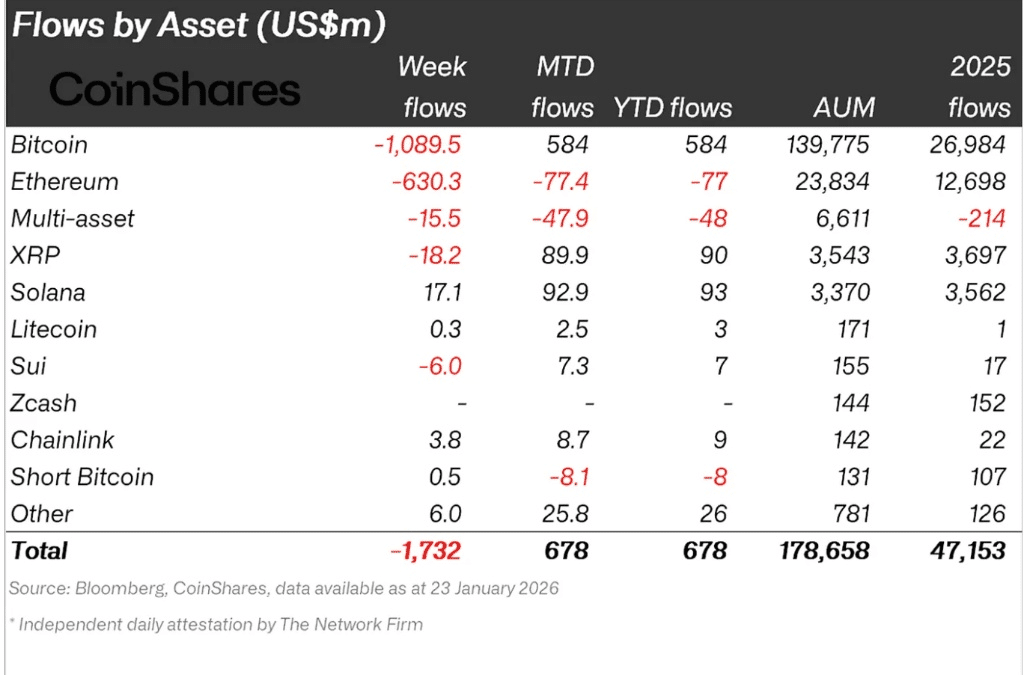
  • U.S. crypto ETFs saw about $1.8B in weekly outflows, signaling broad de-risking, not rotation.

Bitcoin (BTC) and Ethereum (ETH) are stalling near $89,000 and $2,900 as institutional capital continues to exit the market. Both assets remain capped by key resistance levels, with price stability masking a broader shift toward risk reduction.

Between January 19 and 23, roughly $1.8 billion flowed out of U.S. crypto ETFs, the largest weekly outflow since late 2025. At the same time, on-chain data shows rising exchange inflows, increasing realized losses, and falling derivatives leverage, pointing to a market moving decisively from profit-taking into active de-risking.

A market stabilizing, not recovering

Bitcoin’s slide toward $89,782 reflects sustained selling pressure. Repeated failures in the $90,000–$93,000 range confirm that demand has not been strong enough to reclaim higher ground.

Bitcoin Price Chart
Bitcoin Price Chart. Source: TradingView

From its October 2025 all-time high (ATH) of approximately $125,000, BTC has seen a significant drop of 30%. The Relative Strength Index (RSI) is currently sitting at 46.56, indicating a neutral-to-bearish momentum that lacks the “oversold” signal needed for a sharp reversal.

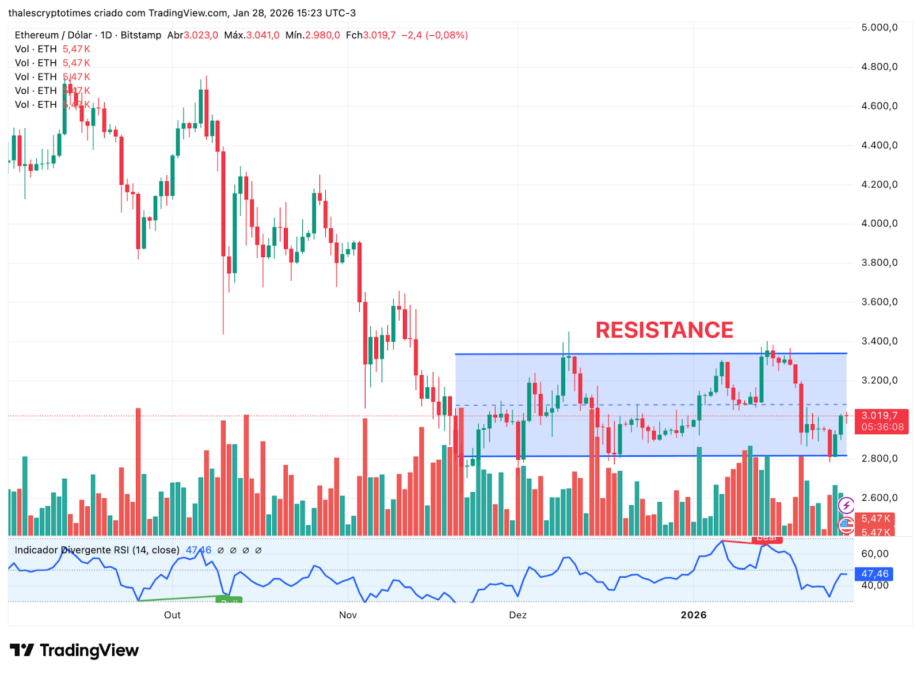
On the other hand, Ethereum is hovering near $3,000, but failing to reclaim the $3,300 area that would signal real momentum returning.

Ethereum Price Chart
Ethereum Price Chart. Source: TradingView

Ethereum is down about 42% from its ATH near $4,800. Its Relative Strength Index (RSI) of 46.34 confirms a similar lack of buying pressure at these local resistance zones.

Both assets are now sitting in a “dead zone” where buyers are present, but not aggressive, and sellers don’t need to do much to keep the lid on.

Technically, momentum has cooled. The RSIs of BTC and ETH read neutral-to-soft rather than “washed out.” Markets typically need either fresh demand or true exhaustion selling to reverse cleanly. Right now, neither is obvious.

The ceiling is technical, and the pressure is flow

The $1.8 billion weekly outflow from U.S. ETFs suggests institutions aren’t simply trimming profits. They are reducing risk exposure into strength and using liquidity windows to exit.

Flows By Asset
Flows By Asset. Source: Coinshares

That’s a classic “loss-realization” phase: prices can stop falling fast, but money is still walking out the door.

Despite the recent weekly crash, 2026 started on a high note for Ethereum, which reached $11 billion in YTD inflows by mid-January, outperforming Bitcoin on a proportional basis relative to assets under management.

Stabilization after tough Q4, but momentum still lags

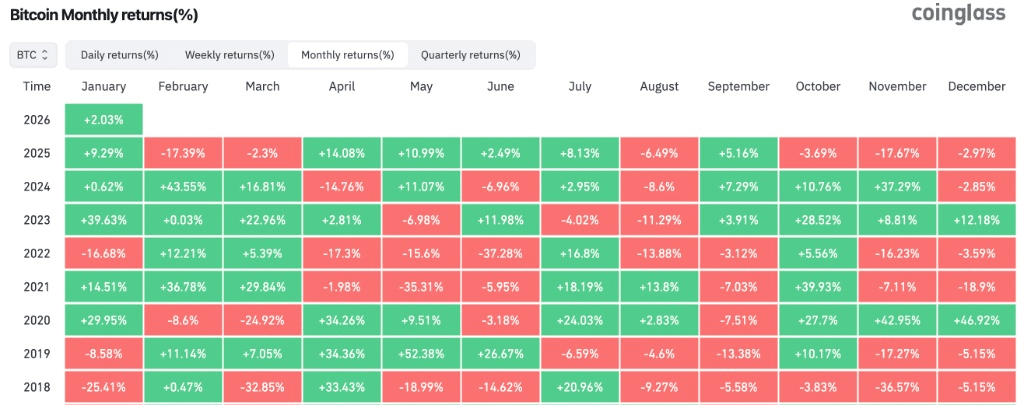
Bitcoin has started 2026 on a steadier footing after a brutal end to last year. Following sharp losses in November and December, BTC is up about 2% in January, signaling stabilization rather than a rebound.

Bitcoin Monthly Return
Bitcoin Monthly Return. Source: Coinglass

While Bitcoin remains roughly 30% below its late-2025 peak near $128,000, year-to-date inflows of around $678 million suggest institutional support is still stronger than in prior bear markets.

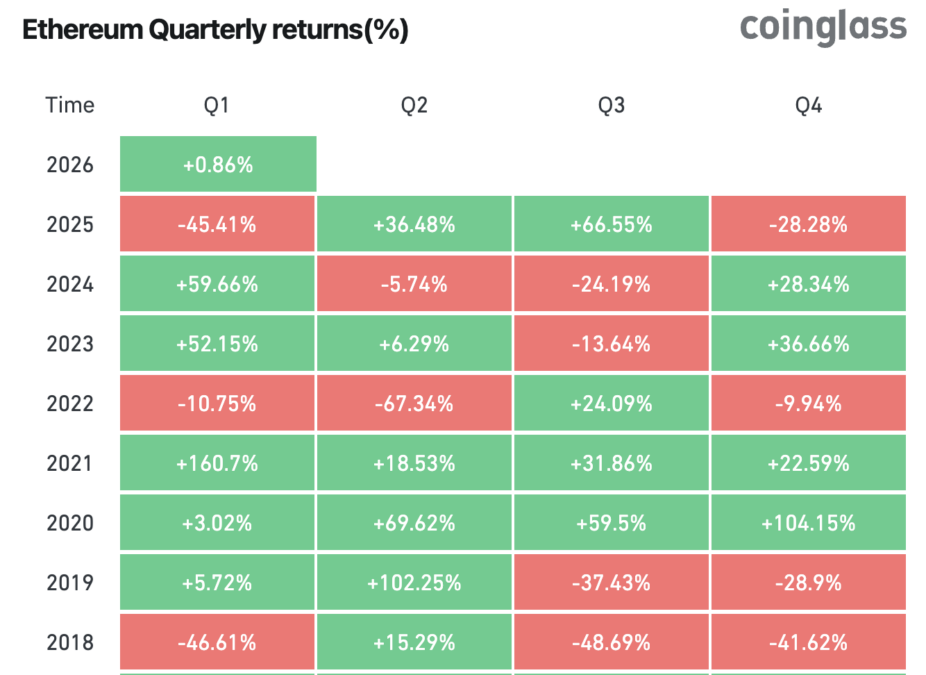
Ethereum is seeing a similar, weaker recovery. After a 28% drop in Q4 2025, ETH is up just 0.9% in January, with choppy price action and about $630 million in recent weekly outflows. The market continues to struggle to reclaim the $3,000 level.

Ethereum Monthly Return
Ethereum Monthly Return. Source: Coinglass

Despite being roughly 42% off its highs, Ethereum pulled in about $12.6 billion of inflows over 2025, pointing to lingering institutional interest, just not enough yet to drive a sustained breakout.

ETF flows turn risk-off in January

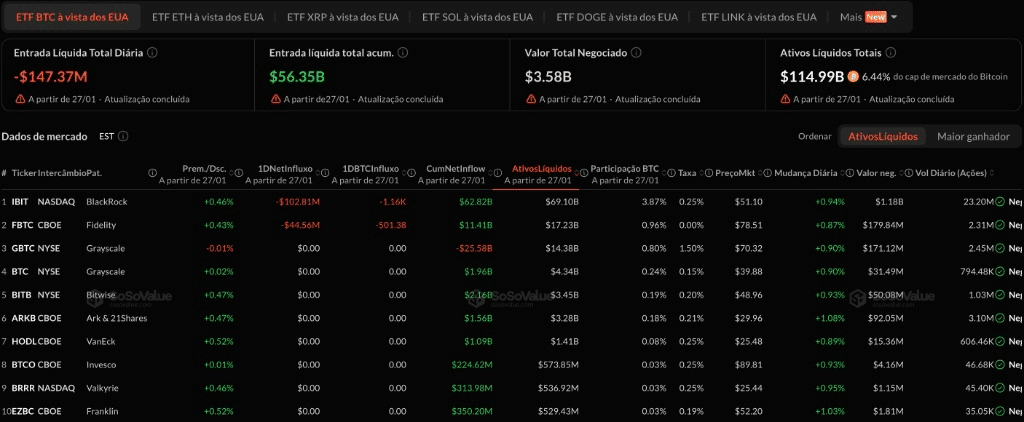
U.S. spot Bitcoin ETFs reversed sharply in January, posting about $1.33 billion in net outflows for the week ending January 23, the worst since early 2025 and a sharp flip from the prior week’s inflows. The sell-off peaked on January 21 with a $709 million single-day redemption, signaling broad institutional de-risking.

BTC Spot ETFs
BTC Spot ETFs. Source: SoSoValue

BlackRock’s IBIT showed late-month resilience with a $15.9 million inflow on January 26 and still leads with $63.4 billion in cumulative inflows. Meanwhile, Fidelity’s FBTC and Grayscale’s GBTC saw the heaviest exits, highlighting how ETF demand remains fragile as Bitcoin trades below key resistance.

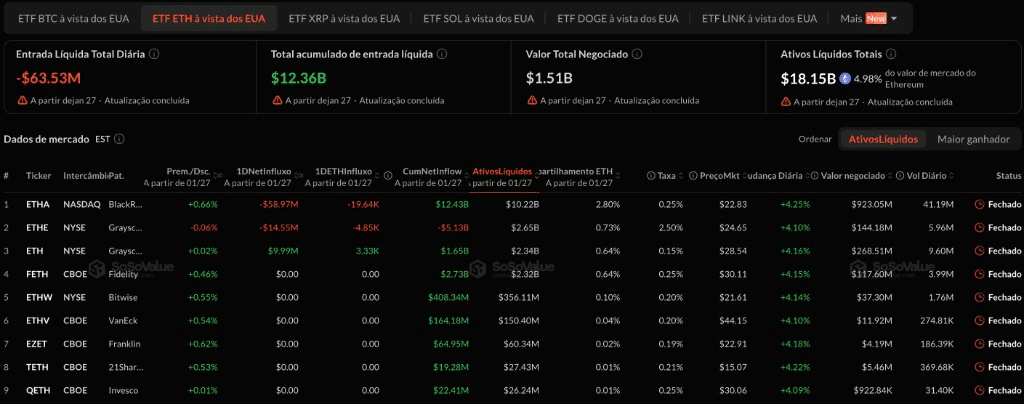
Ethereum spot ETFs followed Bitcoin into risk-off mode, logging $611 million in net outflows for the week of January 19–23. The pullback erased much of January’s early gains after a $229.9 million single-day redemption on January 20, underscoring choppy institutional positioning around current price levels.

ETH Spot ETFs
ETH Spot ETFs. Source: SoSoValue

BlackRock’s ETHA led withdrawals with $432 million exiting over the week, though it still holds $12.4 billion in cumulative inflows. Fidelity’s FETH and Grayscale’s ETHE also saw steady redemptions, while Grayscale’s mini ETH product was a rare bright spot. Despite the volatility, total ETH ETF AUM sits near $18.1 billion, suggesting long-term institutional interest remains intact even as short-term risk is trimmed.

What would change the setup

Bitcoin and Ethereum are no longer just consolidating; they are being stress-tested. With BTC pinned near $89,000 and ETH struggling around $2,900, both assets remain trapped beneath heavy resistance as institutional flows turn decisively defensive.

The $1.8 billion pulled from U.S. crypto ETFs in a single week signals a shift from passive profit-taking to active risk reduction, marking a broader loss-realization phase. Until flows stabilize and these core ceilings are reclaimed, rallies are likely to fade quickly, leaving the market in a fragile balance between consolidation and deeper downside.

Also read: Ethereum Stakers Wait 61 Days for 2.8% Yield: Why Demand Is Rising

  •  

1inch Drops 20% After $14M Wallet Exit Triggers Sell-Off

Key Highlights

  • 1INCH fell roughly 20% after a single wallet sold its full remaining allocation.
  • The address received 15M tokens through early team/investor vesting.
  • 1inch said no team or treasury wallets were involved in the sale.

The 1inch Network token (1INCH) dropped nearly 20% this week after on-chain data showed an investor’s wallet liquidating its remaining vested tokens in a single $14M transaction. The sale hit thin liquidity on Ethereum markets, sparking panic selling that erased close to $40 million in market value.

The move came despite a public statement from 1inch denying that any tokens were sold by the team, treasury, or wallets under its control.

Vesting wallet exit, not random volatility

Blockchain data shows the selling address had previously received around 15 million 1INCH tokens through early team or investor vesting. Over time, portions of that allocation had already been distributed. This week’s transaction marked a full exit of the remaining balance.

Wallet Transfers Data
Wallet Transfers Data. Source: Arkham Intelligence

While the wallet is not controlled by the 1inch team, its history ties it directly to early allocations, making the sell-off look less like market noise and more like a delayed vesting unwind finally hitting thin liquidity. 

Thin liquidity meant one large exit quickly snowballed into fear-driven selling, pushing the price down far more than the initial sale alone would suggest.

1inch denies team involvement

In response to speculation, 1inch stated that the sell-off did not come from team wallets, treasury multisigs, or any entities it controls. The project stressed that third-party holders trade independently and are outside its reach.

Statement

With respect to yesterday’s activity, no 1INCH was sold from wallets controlled by 1inch entities or our team, or our treasury multisigs. We do not control third-party holdings or their trading decisions.

Our mission and vision remain unchanged. It is that focus which…

— 1inch (@1inch) January 28, 2026

The team also said nothing has changed internally. The roadmap is intact, operations are ongoing, and the team plans to revisit parts of its tokenomics later this year to make the system more resilient when liquidity thins out.

Market reaction overshadows fundamentals

At the time of writing, 1INCH was hovering around $0.116, down around 20% from recent highs, even though nothing broke. The decline occurred without any exploit, outage, or partnership fallout.

1INCH Daily Price Chart
1INCH Daily Price Chart. Source: TradingView

Throughout 2025, 1INCH steadily slid, ending the year down nearly 64%. The decline reflected ongoing vesting pressure and fading demand for DeFi governance tokens, with the latest sell-off accelerating an already established trend.

1INCH Monthly Price Chart
1INCH Monthly Price Chart. Source: TradingView

The weakness in price has persisted even as 1inch continued shipping new integrations. In mid-2025, the protocol added support for Uniswap’s Unichain, expanding swap routing and MEV protection and extending its developer tooling.

While 1inch framed the incident as unrelated to internal activity, the on-chain evidence tells a narrower story. In this case, the sell-off was driven by an early investor having a large amount of tokens vested in the project, which raised concerns for the community and traders.

Also read: 4.5 Million Users, Zero Price Growth: What’s Wrong With Tron?

  •  

Ripple Launches Treasury Platform to Target Enterprise Cash

Key Highlights

  • Ripple is positioning itself to compete directly for enterprise treasury workflows, not just cross-border payments.
  • The GTreasury integration brings four decades of CFO-grade tooling into Ripple’s digital asset stack.
  • The move targets idle corporate liquidity, aiming to activate capital through real-time settlement and yield optimization.

Ripple, a U.S.-based enterprise blockchain developer, has unveiled Ripple Treasury, which is powered by its recently acquired GTreasury platform, marking a strategic push into the $120 trillion global corporate treasury market.

The launch, announced on Wednesday, positions the blockchain infrastructure firm to target Fortune 500 finance teams worldwide. The firm aims to modernize how companies manage, move, and deploy liquidity by replacing slow, bank-centric systems with real-time, blockchain-based infrastructure.

Today, we're proud to introduce Ripple Treasury, Powered by GTreasury: the world's first comprehensive treasury platform combining 40 years of proven enterprise expertise with cutting-edge digital asset infrastructure.

Many finance teams are stuck managing growing complexity… pic.twitter.com/4scNUggARS

— GTreasury (@GTreasury) January 27, 2026

A calculated strike at idle capital

At the core of Ripple’s strategy is how hundreds of billions of dollars sit idle every day inside corporate balance sheets, trapped by slow settlement cycles, pre-funding requirements, and fragmented banking infrastructure. Ripple estimates that around $700 billion in corporate capital remains effectively stagnant, not because companies want it that way, but because legacy systems leave them few alternatives.

By absorbing GTreasury and rolling out Ripple Treasury as a unified platform, Ripple is positioning itself as an operating system for CFOs, one that spans traditional cash, digital assets, and real-time liquidity management under a single roof.

What Ripple Treasury changes for users

Ripple Treasury shifts treasury operations from fragmented systems to a single, always-on platform. By merging GTreasury’s enterprise tooling with Ripple’s blockchain rails, finance teams gain real-time visibility across cash, FX exposure, payments, and digital assets, without being limited by banking hours or geography.

For day-to-day operations, the most significant changes are speed and control, according to the official release. Cross-border payments settle in seconds instead of days, FX risk is compressed to near-zero during transfers, and companies no longer need to pre-fund overseas accounts just to keep vendors paid on time. In practice, users gain:

  • One view across fiat, stablecoins, and tokenized assets
  • 24/7 settlement and liquidity, including weekends
  • Reduced FX exposure and faster vendor payments
  • Yield generation on cash that previously sat idle

The result is a treasury stack designed to operate at internet speed rather than traditional banking speed.

Beyond cross-border payments

Ripple’s purchase of GTreasury marks its third major acquisition in 2025, following deals for Hidden Road and the stablecoin platform Rail. Together, these moves signal a shift beyond bank-focused payments toward a broader role as a full-stack financial infrastructure provider for large enterprises.

If successful, Ripple Treasury could reshape how Fortune 500 companies manage cash, turning treasury from a back-office safeguard into an active tool for unlocking and deploying capital.

For Ripple, the goal is to modernize how corporations move and deploy money, and the rest of enterprise finance will follow.

Also read: Ripple Enters Saudi Banking Sandbox With Riyad Bank’s Jeel

  •  

ABTC Expands Treasury To 5,843 BTC As Corporate Buying Ramps Up

Key Highlights

  • American Bitcoin raised its Bitcoin reserves to about 5,843 BTC as corporate accumulation trends accelerate alongside Strategy Inc.
  • The company’s BTC yield has reached roughly 116% since its Nasdaq debut, driven by steady reserve growth.
  • ABTC shares moved higher following the treasury update, extending recent momentum in the stock.

Trump family-backed Bitcoin mining firm American Bitcoin Corp. (ABTC) expanded its Bitcoin reserves to roughly 5,843 BTC, according to a treasury update released this week. The move reflects a broader accumulation trend led by firms like Strategy Inc and includes purchases made through January 25, 2026, following the company’s most recent Bitcoin buy earlier this month.

In an X post on Wednesday, Eric Trump praised the company’s accumulation strategy, writing, “​​$ABTC is leading the charge, building America’s Bitcoin infrastructure faster than anyone.”

In 4 months and 22 days since our public debut on NASDAQ, American Bitcoin Corp (@ABTC) has sprinted past company after company:

30. DeFi Technologies — 2,452 BTC (passed September 2, 2025)

29. The Smarter Web Company PLC — 2,674 BTC (passed September 8, 2025)

28. Capital B —… pic.twitter.com/CHxT3eQ2T1

— Eric Trump (@EricTrump) January 27, 2026

ABTC treasury growth and BTC yield

American Bitcoin said its BTC yield reached about 116% since its Nasdaq debut. The figure is based on the company’s Satoshis Per Share metric, which shows how much Bitcoin backs each outstanding share.

Bitcoin Treasury Update
Bitcoin Treasury Update. Source: American Bitcoin

As of late January, SPS climbed to 586 satoshis per share, up sharply from levels recorded at listing. The steady increase reflects a combination of direct Bitcoin purchases and operational gains rather than short-term trading activity.

Market reaction

Shares of American Bitcoin Corp. traded higher following the disclosure, rising 5.8% after reports of the January 25 reserve increase. The move extended a period of elevated volatility, as investors continue to price ABTC largely as a proxy for Bitcoin exposure.

ABTC Price Chart
ABTC Price Chart. Source: Nasdaq

Even after the recent pop, the shares are still far from past highs, underscoring how ABTC’s price moves tend to mirror crypto market sentiment more than classic stock fundamentals.

The same sharp jump happens every Monday when Strategy CEO Michael Saylor announces new BTC purchases. Yesterday, the notice seemed to drive prices 2.1% up.

MSTR Price Chart
MSTR Price Chart. Source: Yahoo Finance

The update follows American Bitcoin’s shift after its September 2025 Nasdaq listing, when it leaned fully into a Bitcoin treasury model and began judging progress by how much BTC backs each share, rather than by traditional operating metrics.

A smaller stack, a similar playbook

With roughly 5,843 BTC on its balance sheet, American Bitcoin now sits around 18th among public Bitcoin holders, according to BitcoinTreasuries. Its market cap hovers near $1 billion, putting it in the mid-cap tier of Bitcoin treasury companies. That scale is modest compared to the giants on the top 3 holders, but the strategy is familiar.

Just yesterday, Strategy Inc. added 2,932 BTC for about $264 million, pushing its total holdings to 712,647 BTC, or roughly 3.4% of Bitcoin’s fixed supply. Strategy’s approach is relentless and mechanical: constant capital recycling, steady equity issuance, and zero concern for short-term price moves.

American Bitcoin is playing the same game, just on a very different board. Where Strategy leverages massive access to capital markets, American Bitcoin is focused on incremental accumulation and growing Bitcoin per share as its core.

Also read: BlackRock Files for iShares Bitcoin Premium Income ETF

  •  
❌