❌

Reading view

DOJ Emails Reveal Jeffrey Epstein Invested $3M in Coinbase in 2014

Key Highlights

  • Jeffrey Epstein invested $3 million in Coinbase in 2014 after working with Brock Pierce and Blockchain Capital.
  • Epstein sold half of his Coinbase stake in 2018, receiving nearly $15 million, while keeping the other half.
  • Epstein had meetings with top crypto and tech figures, including Michael J. Saylor and Reid Hoffman.

Newly released emails from the U.S. Department of Justice (DOJ) revealed that Jeffrey Epstein made a $3 million investment in the cryptocurrency exchange Coinbase in December 2014. For the unversed, Epstein, an influential American financier, later became widely known for serious crimes, including sex trafficking of minors. He also had strong ties with people in politics and the technology sector.

The recently released emails reveal that the investment was arranged through Brock Pierce, co-founder of Tether and Blockchain Capital, and that Coinbase co-founder Fred Ehrsam was aware of the arrangement.

In one message dated December 3, 2014, Ehrsam wrote, “I have a gap between noon and 3pm today, but again, not crucial for me, but would be nice to meet him if convenient. Is it important for him?”

Epstein’s Coinbase investment and cash-out

According to the documents, the investment took place in 2014 when Coinbase was valued at $400 million. Today, the exchange is worth about $51 billion. 

In 2018, Epstein sold half of his Coinbase equity back to Blockchain Capital, receiving nearly $15 million, while retaining the other half of his stake. Brock Pierce confirmed the transaction in emails and at one point questioned whether the deal was fully completed, suggesting some confusion over the arrangement.

Epstein also had connections with other cryptocurrency ventures. The emails show he invested in Blockstream, a company co-founded by early Bitcoin developer Adam Back. He also met with prominent figures in tech and finance, including former U.S. Treasury Secretary Larry Summers, at his Manhattan townhouse to discuss Bitcoin. 

Pierce described the Coinbase fundraising round as “the most platinum-plated deal in the space.”

Epstein also asked LinkedIn founder Reid Hoffman for advice on how much he should invest. Hoffman replied, “I probably wouldn’t play. But I may not be up-to-date on interesting internal news.”

Tax concerns and other connections 

Epstein-related filings show he was concerned about cryptocurrency taxation in the United States. In a February 2018 email, he asked former White House advisor Steve Bannon for guidance on how the Treasury Department would respond to crypto-related questions.

Epstein’s involvement in cryptocurrency came after he was convicted in 2008 for procuring a child for prostitution and soliciting a prostitute, making him a registered sex offender at the time of the Coinbase investment. The newly unsealed records highlight his connections to wealthy investors and the early cryptocurrency world, without alleging any criminal wrongdoing in these deals.

Other high-profile figures appear in the email records, including Michael J. Saylor, Executive Chairman of Strategy, who was mentioned in a 2010 email from Hollywood publicist Peggy Siegal. The email described Saylor attending a charity event after giving a $25,000 donation. The records have caused discussions online about Epstein’s influence in the crypto space.

Also Read: XRP Maxis Blame Bitcoiners for Linking Ripple to Epstein Files

  •  

Hyperliquid Expands HyperCore With Outcome Trading in HIP-4 Upgrade

Key Highlights

  • Hyperliquid launched HIP-4, a protocol for outcome and prediction market trading.
  • HIP-4 contracts are fully collateralized, dated, and trade without leverage or liquidations.
  • Hyperliquid’s token HYPE jumped over 8% after the announcement, reaching around $32.29.

Hyperliquid, a decentralized exchange, announced the launch of HIP-4, a new protocol that will allow outcome trading on its platform. The feature will let users trade prediction markets and options-like contracts that are fully collateralized and settle within a fixed range.

HyperCore, Hyperliquid’s main trading engine, will support this new mode to expand activity and offer more trading options. The platform plans to offer a safer option for users who want to avoid risky leverage trading.

The launch is currently in the testnet stage, and live markets will come after testing is done. Additionally, HIP-4 will initially use USDH, Hyperliquid’s native stablecoin, to settle trades. Later, it will allow users to freely create new trading pairs without restrictions.

HyperCore will support outcome trading (HIP-4). Outcomes are fully collateralized contracts that settle within a fixed range. They are a general-purpose primitive that are useful for applications such as prediction markets and bounded options-like instruments. There has been…

— Hyperliquid (@HyperliquidX) February 2, 2026

Details of the HIP-4 contracts

The new contracts in HIP-4 will be dated and allow derivative trading without leverage or liquidations. This design makes it less risky than traditional margin trading markets. The outcome contracts are general-purpose primitives, meaning developers can build prediction markets or other options-like instruments on top of HyperCore. 

Hyperliquid plans to offer permissionless deployment at the end stage, allowing new outcome pairs to be created freely by users.

HIP-4 comes after the success of HIP-3, which allowed the quick creation of markets like silver and gold trading on-chain. HIP-3 became highly active in just days and showed that the platform can support fast-growing markets.

HYPE token up 8% in 24 hours

Hyperliquid’s native token, HYPE, was quick to react to the announcement. At the time of writing, the token is trading for $32.29, up 8% in the last 24 hours. In the past week, the token has gained more than 35%, despite the recent overall market crash.

Hyperliquid HYPE Price Chart
Hyperliquid HYPE Price Chart | Source: CoinMarketCap

The recent update would likely increase adoption by attracting both leveraged and non-leveraged traders. The platform has already grown in market depth and even competes with Binance in trading volumes, though recent BTC open interest fell to $1.77 billion, with $4.97 billion in total open interest. 

Even after recent market losses, HIP-3 still has more than $1 billion in open interest and $4.8 billion in trading activity.

Since last week, HIP-3 markets reached new all-time highs of $1B in open interest and $4.8B in 24-hour volume. https://t.co/SdOcpcgDO2

— Hyperliquid (@HyperliquidX) February 2, 2026

Hyperliquid is positioning HIP-4 to capture attention in the prediction markets space, which is currently active on other networks. Once the testing phase is complete, the platform will use objective settlement sources to ensure transparent and reliable outcomes.

Also Read: Hyperliquid Slashes Team Payouts 98% to Protect HYPE Floor

  •  

Shiba Inu Drops to Multi-Year Low: Can It Recover?

Key Highlights

  • Shiba Inu (SHIB) fell to $0.0000069, its lowest price since June 2023, after the January 31 crypto market crash.
  • SHIB’s burn rate has slowed, and Shibarium TVL dropped to $393,000, signaling weak network activity.
  • Liquidations added selling pressure, keeping SHIB under strong bearish pressure.

Shiba Inu (SHIB), one of the well-known meme cryptocurrencies, saw its price fall sharply during the weekend market sell-off after Bitcoin (BTC) dropped below $80,000 for the first time since April 2025.

The market crash caused panic across the market, and SHIB was one of the coins hit the most. Its price fell to $0.00000616, which is the lowest level it has seen since June 2023. After that, it made a small recovery and now trades for $0.0000069, up about 5% from the previous day. Trading volume also fell, sliding about 22% to roughly $167 million in volume in the last 24 hours.

SHIB Price Chart
SHIB Price Chart | Source: CoinMarketCap

SHIB falls as traders panic sell

The drop came during a period of weak sentiment across the crypto space. In recent months, many traders have closed their positions with meme coins facing heavy selling pressure. In fact, SHIB has lost more than 9.49% over the past seven days.

Liquidations also added to the decline. According to Coinglass, around $196,390 in long positions were wiped out in 24 hours as traders betting on a price going up were forced to sell. Futures trading volume fell 18% to around $221 million, while open interest surged 6% to $76.56 million. In short, there are mixed expectations among traders at the moment.

Burn activity slows sharply

Another major issue has been the slowdown in SHIB’s burn activity. Burning means sending tokens to dead wallets so they are removed from circulation. This is believed to create scarcity for the token, which could drive the price up.

Shibburn, a tracker that monitors the token’s burns, reported that on January 31, zero SHIB was sent to dead wallets, meaning no supply was removed. This was surprising because just two days earlier, the burn rate jumped over 500%. However, the burn rate has increased by 480% in the last 24 hours.

A single transaction alone removed 1,887,367 SHIB tokens, briefly giving investors some hope for stronger deflationary pressure. However, SHIB still has a huge supply. More than 585 trillion tokens are still in circulation, and trillions more are locked in staking.

Another concern is the drop in activity on Shibarium, the layer-2 network linked to Shiba Inu. According to DeFiLlama, Shibarium’s Total Value Locked (TVL) has dropped to about $393,000, the lowest level ever recorded. This is a steep fall from a peak of more than $6 million in December 2024, showing a decline of over 41% in the last 24 hours and about 93% in just over a year.

Lower TVL often points to reduced user activity and less capital flowing through the network.

SHIB taps 2023 support: can it recover?

SHIB is now trading in a price zone that previously acted as support before its rise in late 2023. This is also its lowest support level since 2021. The current price is showing the daily candle rejecting off the support level. 

A solid bullish candle close above the level could spark a rally. Moreover, the 4-hour time frame also displayed multiple rejections, followed by an engulfing candle, suggesting a bullish move. Additionally, the Relative Strength Index (RSI) is currently at 40, while the moving average is at 36. This means the bears are still in control of the market.

SHIB Daily Price Action
SHIB Daily Price Action | Source: TradingView

In short, Shiba Inu may continue to face bearish pressure if the current price sentiment does not shift to bullish. A break below the current support zone could lead to a downtrend that could be hard to recover from.

Also Read: BitMine Boosts Treasury With 41,000+ ETH as Ethereum Prices Drop

  •  

BitMine Boosts Treasury With 41,000+ ETH as Ethereum Prices Drop

Key Highlights

  • Bitmine added 41,788 ETH to its holdings last week, expanding its treasury despite Ethereum falling to $2,300.
  • The company’s total assets are valued at $10.7 billion, including 4.28 ETH, 193 BTC, cash, and equity stakes.
  • Bitmine has 2.9M ETH staked, earning $188M annually, with its MAVAN network set to increase its reward further.

Bitmine Immersion Technologies, Inc., an Ethereum (ETH) treasury firm, purchased 41,788 ETH last week amid the recent price decline. The company now holds around 4,285,125 ETH, worth $10.1 billion at the current price.

This represents roughly 3.55% of the total ETH supply, making Bitmine the largest Ethereum treasury in the world and the second largest crypto treasury overall, after MicroStrategy. 

Additionally, the firm holds 193 Bitcoin (BTC), about $586 million in cash, a $200 million stake in Beast Industries, and a $20 million stake in Eightco Holding, according to an update released on Monday.

The purchase comes as Ethereum faces selling pressure. The price dropped sharply over the weekend, falling below $2,500 and briefly touching $2,187 before bouncing back. Currently, ETH is trading at $2,374, up 3.05% in the last 24 hours but down 17.79% in the last seven days.

Ethereum Price Chart
Ethereum Price Chart | Source: CoinMarketCap

Previous Ethereum purchases and rewards

Earlier, on January 21, Bitmine purchased 35,228 ETH, which was after another 24,266 ETH from a week before its annual shareholder meeting on January 15.

The company has also staked 2,897,459 ETH, worth about $6.7 billion, generating annual staking revenue of around $188 million.

Once Bitmine’s Made in America Validator Network (MAVAN) becomes fully operational in early 2026, staking rewards could reach $374 million per year (using 2.81% CESR), which is equal to more than $1 million per day.

“This will be the ‘best-in-class’ solution offering secure staking infrastructure and will be deployed in early calendar 2026. Bitmine is currently working with 3 staking providers as the Company moves towards unveiling MAVAN in 2026,” Lee said.

Bitmine’s stock activity 

Bitmine (BMNR) is currently trading at $23.80, about a 6% drop in the last 24 hours, according to Yahoo Finance. The company said it ranks #105 among all U.S.-listed stocks by average daily trading dollar volume, with around $1.1 billion traded daily over the last five days, which places it ahead of many established companies. 

In its press release, the company highlighted that the changes in U.S. regulation, including the passing of the GENIUS Act and the SEC’s Project Crypto, could help digital assets become more widely used in finance.

Sitting on $6.6 billion in unrealized losses

As of the last week of January, Bitmine’s total holdings were worth about $12.8 billion combined. However, the recent market crash has reduced the value of its Ethereum holding, leaving the firm with an estimated unrealized loss of about $6.6 billion.

🚨New: Tom Lee’s ( @fundstrat ) Ethereum treasury company BitMine ($BMNR) is sitting on about $6.6 billion in unrealized ETH losses, putting it on track to become the fifth largest documented principal trading loss in history if the position is sold. pic.twitter.com/2ELqO5eA0R

— SolanaFloor (@SolanaFloor) February 2, 2026

Chairman Thomas “Tom” Lee mentioned this in the press release, noting, “ETH prices have dropped sharply in the past month from approximately $3,000 to approximately $2,300.” However, he added that Ethereum activity is strong, with 2.5 million daily transactions and 1 million active addresses per day.

Lee said the company believes the cryptocurrency is essential for the future of finance. With MAVAN and its growing treasury, Bitmine is positioning itself as a major player in the crypto and digital finance world.

Also Read: Ethereum To Rollout ERC-8004 On Mainnet To Empower AI Agents

  •  

Bitcoin Down Below $80K: Why Are Strategy Shares Up, Will They Remain?

Key Highlights

  • Strategy’s stock rose about 4.55% even though Bitcoin fell 7% and dropped below the $80,000 level.
  • The company holds 712,647 BTC, about 3.4% of all Bitcoin, so its stock usually moves with Bitcoin’s price.
  • Analysts warned the stock could fall, while Peter Schiff criticized Strategy’s Bitcoin plan after the firm reported a $17.44 billion unrealized loss in Q4 2025.

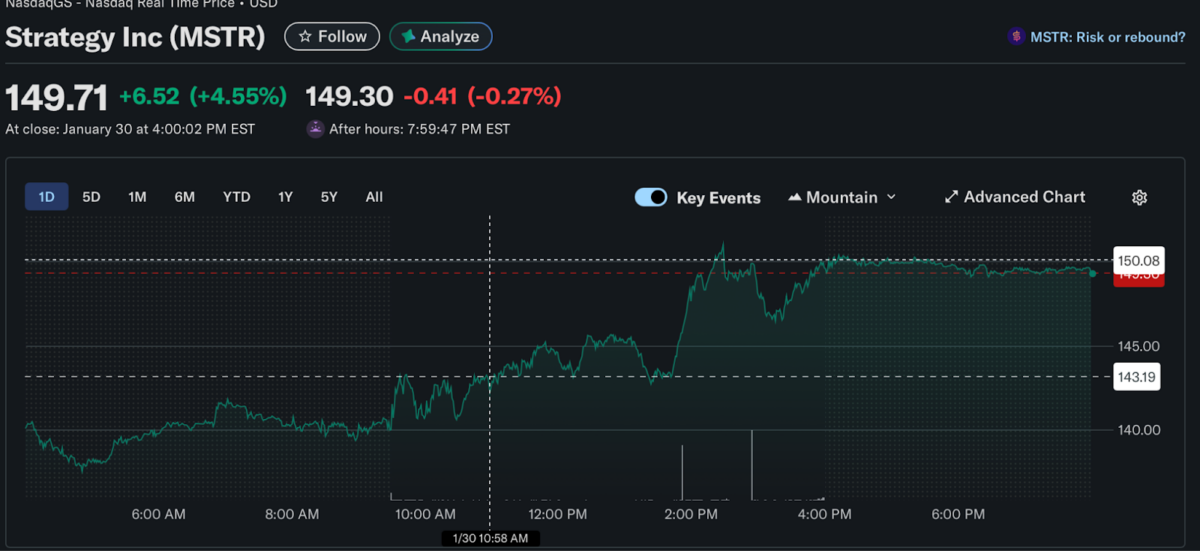
Shares of Strategy Inc. (NASDAQ: MSTR), the Bitcoin-focused treasury firm, finished Friday’s session up 4.55% at $149.71, while Bitcoin (BTC) continued selling off after-hours and through Saturday, slipping below the $80,000 support level. Now the question is, will Strategy share maintain its value, or will it follow Bitcoin?

Unlike Bitcoin, which trades 24/7, U.S. equities do not trade on weekends. As a result, MSTR has not yet reacted to Bitcoin’s latest leg down.

Bitcoin is currently trading around $77,756, down from a daily high of $84,230. The cryptocurrency has fallen nearly 13% over the past week, while daily trading volume dropped 12% to $62 billion, according to CoinMarketCap.

This difference in price correlation is surprising considering the fact that the company’s stock moves amid Bitcoin price swings. The company holds 712,647 BTC, which is roughly 3.4% of the total Bitcoin supply. With that volume, the stock usually moves closely with Bitcoin’s price action, making MSTR’s rise unusual.

Strategy MSTR Price Chart
Strategy MSTR Price Chart | Source: Yahoo Finance

The move suggests that short-term market sentiment may be influencing the stock differently from Bitcoin. Some investors may see the recent Bitcoin sell-off as an opportunity to buy Strategy shares at lower levels.

Analysts warn of potential downside

Analysts are keeping a close eye on the stock. In a recent post on X, market analyst Aksel Kibar said the MSTR chart is displaying a “long-forming topping structure” on the weekly chart and could drop to $120. He added that the recent price swings are forming lower highs, which is a sign that the price could be trading downwards. The stock recently traded slightly below its 52-week low before rebounding.

$MSTR The amount of heat I got for posting that bearish setup. What was I thinking? https://t.co/mpQrmRpkic pic.twitter.com/sTQ9wut2nd

— Aksel Kibar, CMT (@TechCharts) January 29, 2026

Despite the recent bounce, MSTR is still down more than 7% for the year. Analyst Ted Pillows also shared his outlook, noting that the stock has lost its prior monthly upward trend and is trading below key momentum indicators.

Meanwhile, crypto analyst Benjamin Cowen compared the stock’s cycle to previous years, suggesting that it could reach a low point by October 2026. 

Peter Schiff criticizes Strategy’s Bitcoin plan

Economist Peter Schiff also weighed in, criticizing Strategy’s Bitcoin-focused approach. In a post on X, Schiff noted that the stock is “almost 70% below its peak,” seemingly attributing the decline to the company’s Bitcoin treasury plan. He noted that Strategy spent over $52 billion to buy more than 700,000 BTC at an average of $76,000 per coin.

$MSTR closed down 9.5% today, a new 52-week low. The stock is down nearly 70% from its high. @Saylor spent $54 billion over the past five years buying over 712K bitcoin at an average price of just over $76K. His total unrealized gain is less than 11%. Too bad he didn’t buy gold!

— Peter Schiff (@PeterSchiff) January 29, 2026

Schiff pointed out that in Q4 2025, the firm reported an unrealized loss of $17.44 billion after Bitcoin fell 25% in the quarter. He argued that the small 11% gain over five years would have been much larger if the company had invested in gold instead. Schiff added that central banks have continued to accumulate gold because it is seen as a safer store of value.

Strategy’s recent Bitcoin purchase

Earlier this month, Strategy bought 2,932 BTC for $264 million through a stock offering program. The company sold 1.57 million shares, raising $257 million, with $8.17 billion still available for future offerings. 

Despite Bitcoin’s drop, Strategy’s total Bitcoin holdings remain valued at about $59 billion. Other firms with large Bitcoin positions, like Marathon Digital and Japan-based Metaplanet, also saw stock declines, dropping 6.65% and nearly 4%, respectively, in response to Bitcoin’s price movement.

While Strategy’s large Bitcoin holdings make it a key player in the crypto market, they also add risk. The stock can sometimes move differently from Bitcoin in the short term, but long-term results still depend on how Bitcoin performs.

Also Read: Bitcoin Breaks $80K Support, Dragging ETH, SOL, BNB, and ADA Lower

  •  

Bitcoin Breaks $80K Support, Dragging ETH, SOL, BNB, and ADA Lower

Key Highlights

  • Bitcoin dropped to $78,890, down 2.43% in 24 hours, while altcoins like ETH, ADA, BNB, and SOL all fell over 6%.
  • Over $1 billion in crypto positions were liquidated in 24 hours, with major ETF outflows adding more pressure.
  • U.S. spot Bitcoin ETFs recorded $500M+ in daily outflows, intensifying downside pressure.
  • The U.S. government shutdown and volatility in the traditional market also increased uncertainty.

The broader crypto market has turned red today as Bitcoin (BTC), the largest cryptocurrency in the market, fell to $78,890, marking a 2.43% decline in the last 24 hours and breaking the psychological $80,000 level, dragging the altcoin market with it.

Altcoins, including Ethereum (ETH), Cardano (ADA), Binance coin (BNB), and Solana (SOL), all dropped more than 6% during the same period.Overall crypto market valuation has declined by 2.91%, sitting at $2.73 trillion, while trading activity has fallen 25.22% to $135.35 billion, according to CoinMarketCap data. Bitcoin’s own trading volume also dropped by 34%, reaching $50.75 billion.

The crypto market in red
The crypto market in red | Source: CoinMarketCap

A billion dollars wiped out in 24 hours 

The sell-off was triggered by a wave of forced liquidations, wiping out around $1 billion in crypto positions in just 24 hours. According to Coinglass, about 245,103 traders were forced out of their positions as prices fell rapidly.

In this liquidation bloodbath, Ethereum accounted for the largest share of losses at $378 million, while Bitcoin recorded losses of around $184 million.

Long positions dominated the wipeout, with nearly $889 million in bullish bets erased. The liquidation created a fast chain reaction of selling that spread across other major coins.

Total Liquidation in the last 24 hours
Total Liquidation in the last 24 hours | Source: Coinglass

Spot ETF outflow added fuel to the sell-off 

The ETF market was also hit. U.S. spot Bitcoin ETFs added pressure as investors went on a seven-day withdrawal spree. Over $1 billion has been withdrawn during the period.

In the past 24 hours alone, over $500 million was withdrawn. The majority of this was from Blackrock IBIT alone, which saw around $528 million in outflow. Other ETFs, including Fidelity’s CBOE and Ark & 21shares, saw only $7 million and $8 million in inflows.

Spot Bitcoin ETF outflow adding to the sell pressure
Spot Bitcoin ETF outflow adding to the sell pressure | Source: Sosovalue

Spot Ethereum ETFs also recorded similar outflows, with around $253 million being moved from the market. The majority of the withdrawal was from BlackRock, with $157 million in outflows in 24 hours. Fidelity followed with about $95.7 million in outflows, while other ETFs stayed dormant, according to Farside.

U.S. shutdown and traditional market volatility 

The situation was further complicated by the possibility of a partial shutdown of the U.S. government. Lawmakers have failed to vote on a temporary funding plan before recess, which has created uncertainty across the financial market.

Historically, when there is uncertainty in U.S. politics, it slows down trading and reduces liquidity, making leverage positions more vulnerable to forced liquidation.

Traditional markets also saw big swings. U.S. stocks fell sharply in early trading, while gold and silver declined. Gold briefly lost nearly $3 trillion in value, and silver about $750 billion, before partially recovering.

Right now, investors are cautious and pulling money from risky assets, especially crypto.

Also Read: Strategy Stock Slides 11% After Bitcoin Breaks $85K Support

  •  

XRP Maxis Blame Bitcoiners for Linking Ripple to Epstein Files

Key Highlights

  • A 2014 email involving Austin Hill, Joichi Ito, and Reid Hoffman sparked rumors linking Ripple and Stellar to Jeffrey Epstein.
  • Joichi Ito acknowledged past ties to Epstein through MIT Media Lab funding and apologized for his involvement.
  • Ripple CTO Emeritus David Schwartz said there is no evidence that Ripple, Stellar, or their teams had any connection to Epstein.

XRP supporters are criticizing Bitcoin advocates for spreading claims that Ripple is connected to Jeffrey Epstein. The dispute began after the U.S. Department of Justice released millions of files on Epstein on Friday, followed by the circulation of a 2014 email that some interpreted as evidence of an alleged link to Ripple and Stellar. However, XRP supporters have pushed back, arguing that Ripple had nothing to do with Epstein.

😱 Ripple & Stellar in 2014 email from Austin Hill to Jeffrey Epstein:

I've been asked by the other cofounders to reduce or take your allocation away. Ripple, and Jed's new stellar are bad for the ecosystem we are building and it does our company damage to have investors who… pic.twitter.com/qzHQlkqk8n

— 𝗕𝗮𝗻𝗸XRP (@BankXRP) January 31, 2026

Who is Jeffrey Epstein

Jeffrey Epstein was a wealthy American financier who became widely known for serious crimes, including sex trafficking of minors. He had connections with influential figures across business, politics, and the tech world.

Epstein also ran private investment funds and had ties to organizations like MIT Media Lab, where he had donated money through the foundations he controlled. He died in 2019 while in jail awaiting trial. Because of his wealth and connections, individuals and companies that had indirect links to him are often scrutinized, even when there is no evidence of wrongdoing.

What sparked the rumor

The rumor came from a 2014 email that had the names of four people: Austin Hill, Jeffrey Epstein, Joichi Ito, and Reid Hoffman. At the time, Hill was CEO and co-founder of Blockstream, a Bitcoin-focused company. He sent the email to Epstein and Ito, copying Hoffman, who was a Blockstream board member. 

According to crypto influencer Leonidas, the email does not show Ripple working with Epstein but reflects early competition between Bitcoin and projects like Ripple and Stellar. Hill reportedly pressured Epstein and Ito to reduce or remove support for Blockstream unless they “picked a horse” in the crypto race.

My two cents on the Ripple/Stellar Epstein file mention

The email mentions four people:
Austin Hill (author)
Jeffrey Epstein (recipient)
Joichi Ito (recipient)
Reid Hoffman (CC)

Austin Hill was the CEO and co-founder of Blockstream at the time, a company focused on Bitcoin.… https://t.co/mliy9AQI0G pic.twitter.com/vvypjrnUw8

— Leonidas (@LeoHadjiloizou) January 31, 2026

Ripple CTO Emeritus clears the air

Ripple CTO David Schwartz responded to the recent claims, stating that he knows of no “connection between Epstein and Ripple, XRP, or Stellar.” 

In an X post on Saturday, Schwartz said that he knows of no evidence suggesting anyone at Ripple or Stellar ever met Epstein or people closely linked to him.

I don't know of any connections between Jeffrey Epstein and Ripple, XRP, or Stellar. I know of any evidence anyone at Ripple or Stellar ever met with Epstein or anyone closely connected to him. There are some indirect ties between Epstein and people connected to Bitcoin in…

— David 'JoelKatz' Schwartz (@JoelKatz) January 31, 2026

He added that while some tech and people in the crypto industry had indirect links to Epstein, this is not unusual because he knew many wealthy and influential figures. Schwartz said the rumors were caused by misunderstandings of old emails from 2014, which he described as efforts by Bitcoin supporters trying to influence investors during an early competition in the crypto industry.

He also said that back then, few people imagined that giving out most of a cryptocurrency’s supply could later be worth billions of dollars. Schwartz made it clear that criticism of Ripple’s structure has nothing to do with Epstein.

Connection between Joichi Ito, MIT, and Epstein 

Joichi Ito had links across multiple tech and crypto projects. He co-founded Digital Garage, which invested in Blockstream, and served as an advisor to the Stellar Foundation in 2014. He was also connected to Epstein through donations made to the MIT Media Lab.

Ito later issued a public apology, saying, “I take full responsibility for my error in judgment. I am deeply sorry to the survivors, to the Media Lab, and to the MIT community for bringing such a person into our network.” He confirmed the lab received money from Epstein-linked foundations and promised to return the funds or donate an equivalent amount to nonprofit organizations supporting survivors of trafficking.

Also Read: XRP Ledger Token Escrow Amendment Enters Activation Countdown

  •  

XRP Ledger Token Escrow Amendment Enters Activation Countdown

Key Highlights

  • XRP Ledger’s Token Escrow amendment passed with 28 yes votes and starts a two-week activation period.
  • The amendment lets users lock Trustline tokens, MPTs, stablecoins, and meme coins in escrow safely.
  • Issuers must enable specific flags, like Allow Trust Line Locking or Can Escrow, for tokens to be held in escrow.

The XRP Ledger Token Escrow amendment has officially entered its activation period. The update was confirmed by XRP Ledger validator Vet after the proposal reached the required support from network validators.

The proposal has now started its two-week activation timer following an 82.35% consensus, backed by 28 “yes” votes. Data from xrpscan shows the expected activation date is scheduled for February 12, 2026, at 9:21:01 p.m. UTC. A live countdown is already running, showing just under two weeks left before the feature becomes active on the XRP Ledger main network.

Token Escrow amendment is now officially in 2 weeks activation with 28 Yes votes.

Token Escrow allows you to escrow any issued on the XRP Ledger, think of RLUSD, Meme Coins, Real World assets.

Important tool for the ecosystem! https://t.co/AGlSF3x2IY pic.twitter.com/xYxeUpMJg5

— Vet (@Vet_X0) January 29, 2026

In an X post on Friday, Vet explained that this amendment will allow users to place many different tokens into escrow, not just XRP. This includes stablecoins like RLUSD, project tokens, meme coins, and even real-world asset tokens issued on the XRP Ledger.

He described the Token Escrow as an important tool because it gives the ecosystem more ways to lock tokens safely and use them in new financial setups.

“Token Escrow allows you to escrow any issued on the XRP Ledger, think of RLUSD, Meme Coins, Real World assets. Important tool for the ecosystem!” he wrote. 

How Token Escrow works

The amendment extends escrow beyond XRP to fungible tokens, making it possible for Trustline Tokens and Multi-Purpose Tokens (MPTs) to be held in escrow directly on the ledger. The amendment brings changes to ledger objects, transaction types, and transaction processing rules. These updates are designed to support token escrows while still keeping the ledger secure and respecting the controls set by token issuers.

The Token Escrow amendment, also known as XLS-85, allows users to lock tokens in time-based escrows or condition-based escrows without needing a third-party service. This makes it easier for projects to create clear vesting schedules and complete trustless deals directly on the blockchain. A companion fix amendment is also planned to solve a bug linked to transfer fees on multi-purpose tokens. Both changes still require validator approval, with at least 80% consensus needed for final activation.

Important issuer rules also apply. For Trustline Tokens to be escrowed, the issuing account must enable the Allow Trust Line Locking flag. For MPTs, issuers must turn on the Can Escrow and Can Transfer flags when creating the token.

They cannot create escrows with their own issued tokens, but they can still receive escrowed tokens as recipients. If a token requires authorization, the sender must be pre-approved by the issuer before creating an escrow, and both sender and recipient must remain authorized throughout the process.

Recent XRPL upgrades

The amendment comes during a busy period for XRP Ledger development. XRPL recently released version 3.1.0, which includes Single Asset Vaults, a Lending Protocol, and bug fixes.

At the same time, several fixed amendments from XRPL version 3.0.0 have already gone live on the XRP Ledger mainnet. These include:

  • fixTokenEscrowV1 
  • fixIncludeKeyletFields 
  • fixMPTDeliveredAmount 
  • fixAMMClawbackRounding 
  • fixPriceOracleOrder 

The fixTokenEscrowV1 amendment fixes a minor accounting error in the handling of MPT escrows.

Another proposal, the permissioned domains amendment (XLS-80), has also reached a majority vote and is now in its own countdown period, with about 4 days and 18 hours remaining, according to xrpscan data.

All these changes show that the XRP Ledger is moving quickly, with multiple upgrades being introduced and voted on by validators in the coming days.

Also Read: US Court Tosses XRP Investor Lawsuit Against Ripple

  •  

Hong Kong to Start Issuing Stablecoin Licenses to Issuers

Key Highlights

  • Hong Kong will start issuing licenses to stablecoin issuers under its Stablecoin Ordinance.
  • Issuers must follow strict rules, including 100% reserve backing and having an office in Hong Kong.
  • The country is preparing rules for crypto trading, asset management rules, and automatic crypto tax reporting starting in 2028.

Hong Kong is getting ready to officially authorize stablecoin companies. The Hong Kong Monetary Authority (HKMA) is preparing to formally authorize them under its newly implemented Stablecoin Ordinance. The regulator also confirmed that companies can now submit applications to operate legally.

The update was shared by the Secretary for Financial Services and the Treasury, Christopher Hui, during a Legislative Council briefing on Friday. Once approved, companies will be allowed to issue Hong Kong dollar–backed stablecoins under a regulated framework.

Clear rules for stablecoin issuers

The license comes with strict requirements to ensure the system remains safe for users. For instance, the issuer must always have all coins backed by real assets, such as cash and government securities. In addition, they must keep their assets separate from the company’s assets and hold them in a trust account.

Stablecoin holders can redeem their coins at face value without paying extra fees. Companies that have yet to get licensed must also have at least HK$25 million (roughly $3.3 million) in paid-up capital and a physical office in Hong Kong. They also must comply with strict anti-money laundering requirements.

Authorities confirmed that some applications are currently under review, and officials expect to start granting licenses in the first quarter of 2026. Officials say the process is cautious but designed to give businesses a clear roadmap while keeping investors safe.

Expanding crypto oversight

Hong Kong is also preparing to roll out rules for crypto trading platforms, as well as custody services, advisory services, and asset management. A law regarding these areas has already been drafted and will be submitted to the Legislative Council later this year. 

The city is also planning to introduce automatic tax reporting for cryptocurrency transactions starting in 2028, following international rules set by the OECD. This would let authorities share transaction info across borders.

All of these changes in the Hong Kong crypto policies are in line with the country’s 15th Five-Year Plan, which is a strategic roadmap to guide the nation’s economic and social growth as it seeks to maintain its position as the global financial hub.

The changes are designed to protect consumers but also provide a pathway to allow the digital asset market to grow responsibly. Clear rules for reserves, redemption, and custody are meant to prevent market shocks, like those caused by algorithmic stablecoins in other countries.

As a result, Hong Kong is positioning itself as one of the few major financial centers with a clear and regulated path for stablecoin businesses.

Also Read: Why Trump is Taking His Own Government to the Court

  •  

Czech Central Bank Governor Firmly Supports Bitcoin Pilot

Key Highlights

  • Governor Aleš Michl is pushing the financial space to understand and adopt digital assets, especially Bitcoin.
  • The Czech National Bank launched a $1 million pilot to test Bitcoin, stablecoins, and tokenized deposits.
  • The CNB will fully review the pilot in 2–3 years while warning about Bitcoin’s high risks.

The governor of the Czech National Bank (CNB), Aleš Michl, has urged the financial sector to explore Bitcoin and other digital assets in reserves. He said the central bank is taking steps in learning about cryptocurrencies, stablecoins, and tokenized deposits.

In an X post on Friday, Michl wrote, “Don’t fight the future. Build it. Test it. Understand it. See you at @TheBitcoinConf.” He also encouraged banks, investors, and the public to understand these new technologies that could change how traditional financing works.

Don’t fight the future.
Build it. Test it. Understand it.
See you at @TheBitcoinConf.
First central bank testing Bitcoin, USD stablecoins, and tokenised deposits.
Here’s a snapshot of what we’re building at @CNB_cz for the future: https://t.co/9HgMhx4Abp pic.twitter.com/irewD0Qtyj

— Aleš Michl (@MICHLiq_) January 30, 2026

CNB’s push for Bitcoin and digital assets

The comment follows the CNB’s launch of a small Bitcoin and digital asset pilot to learn more about blockchain and the future of finance. The program began in November 2025 with a $1 million test portfolio.

According to the previous report, the goal of the test is not to make any major investment but to understand how the assets work and how they could affect the traditional payment system and reverse management. The project is being done through its special innovation unit called CNB Lab, with a test portfolio including Bitcoin, USD stablecoins, and USD tokenized deposits.

Previously, the bank said Bitcoin was bought on a regulated exchange, and the process took about three weeks because of strict KYC and AML checks. The pilot will test different ways of buying and storing these assets safely. It is also studying how blockchain works in real situations, including key security, approval steps, crisis handling, and compliance rules. The CNB expects a full review of the pilot in the next two to three years.

Michl’s view on Bitcoin 

This is not the first time Governor Michl has been pushing for the adoption of Bitcoin. Last year, he said Bitcoin could be useful for diversifying the bank’s reserves.

“For the diversification of our assets, bitcoin seems good,” he said, adding that it has “zero correlation to bonds” and could be worth considering for a large portfolio. However, he stressed that careful study was still needed before taking any real step in investing.

In another detailed statement, Michl warned that crypto investing is not for everyone. He advised people to be extremely cautious and only invest in things they truly understand. He compared today’s crypto market to the early investment boom in the Czech Republic during the 1990s, when many funds appeared and later collapsed. He explained that the crypto space will likely see both big successes and painful failures.

Michl also made it clear that Bitcoin is highly risky because of its sharp price swings. He said Bitcoin could end up having two extreme outcomes, either becoming very valuable or dropping to zero. Still, he believes central bankers should study it closely instead of ignoring it. “Studying bitcoin won’t harm us – on the contrary, it will strengthen us,” he noted.

CNB flags risks alongside pilot program

The Czech National Bank has recently shared research suggesting Bitcoin could improve returns in some cases. According to CNB backtests, if the bank had held 5% of its reserves in Bitcoin over the past decade, yearly returns could have risen by about 3.5 percentage points. However, volatility would have doubled, showing how unstable such an asset can be.

The CNB also warned citizens about financial dangers. In a recent public notice, the bank urged people to stay alert to fraudsters, online scams, hidden fees, and fake crypto promotions. It also reminded investors not to rely on advice from influencers who may not have their best interests in mind.

Odhalte včas podvodníky a vyvarujte se nástrahám finančního trhu. 🛡️🧨 Praktické rady a užitečné informace, které vám pomohou lépe se orientovat ve světe financí, u nás nově najdete na jednom místě! 👇🏻

➡️ https://t.co/sX4dKsDm5b ⬅️

ONLINE PODVODY
Podvodníci přicházejí s čím dál… pic.twitter.com/opakZkBNeT

— Česká národní banka (@CNB_cz) January 30, 2026

“Always remember to verify the identity of the other party. We regularly issue warnings about entities that show signs of fraud or do not hold the appropriate authorisation from the CNB,” the bank said.

For now, the Bitcoin test remains small, controlled, and focused on learning. The bank says the pilot is meant to gain real experience with blockchain processes, while the final evaluation will take place over the next two to three years.

Also Read: U.S. Government Builds Cash Reserves Ahead of Possible Shutdown

  •  

Strategy Stock Slides 11% After Bitcoin Breaks $85K Support

Key Highlights

  • Strategy Inc.’s stock fell 10%, hitting the bottom of its 52-week range, after Bitcoin dropped below $85,000.
  • The company recently bought 2,932 Bitcoin for $264 million, raising its total holdings to 712,647 BTC.
  • Strategy’s stock tends to mirror Bitcoin’s price movements, often amplifying market swings.

Strategy Inc. (NASDAQ: MSTR), the Bitcoin-focused treasury firm, saw its stock drop sharply on Thursday, falling as much as 11.85% during the afternoon trading session. The stock was currently trading for $140.18, close to the bottom of its 52-week range.

The decline came as Bitcoin (BTC) fell under $85,000, reacting immediately as the company holds a huge amount of Bitcoin; its stock often moves even more strongly than BTC itself. 

MSTR Share Price Chart
MSTR Share Price Chart | Source: Yahoo

Bitcoins fell roughly 6% from the previous day. Earlier this week, it had briefly gone above $90,000 but quickly reversed and fell back. The token is trading around $84,300. At one point, the price was near $83,559, down about 7% in a single day. 

Trading activity also jumped strongly, with volume rising over 35% to above $55 billion, as traders began to close positions by panic selling. Bitcoin’s total market value also dropped by around 6.73% to $1.68 trillion.

Holding 3.4% of Bitcoin’s total supply

Strategy is known today as a “bitcoin treasury firm,” while still running its enterprise analytics software business. Earlier this week, the company purchased 2,932 BTC for $264 million, bringing its total Bitcoin holdings to 712,647 BTC, which is roughly 3.4% of Bitcoin’s fixed supply. 

The firm paid an average price of $90,061 per coin for the recent purchase. Overall, Strategy has spent about $54.2 billion to acquire all its Bitcoin, with an average cost of $76,037 per coin.

The company funded this purchase through its at-the-market stock offering program. Strategy sold about 1.57 million shares of its Class A stock, raising roughly $257 million in net proceeds. It also sold 70,201 shares of its preferred stock, bringing in another $7 million. The company said it still has about $8.17 billion available for future stock issuance under its program. 

At the previous price, the company’s holding was worth around $63 billion. However, with the current market dip, that figure has declined to about $58.95 billion, still more than some countries’ reserves.

Other Bitcoin-holding firms saw similar drops

Marathon Digital, another Bitcoin holding company, saw its stock drop by 6.65% due to the price drop in Bitcoin. The stock is currently trading for $9.67 from an intraday high of $10.2. The company holds about 52,850 BTC, which was valued at approximately $6.12 billion.

Share of Japan-based Metaplanet also fell nearly 4%, according to Yahoo Finance. The drop comes weeks after the company shared that it recorded a 104.6 billion yen (roughly $680 million) loss on its Bitcoin holdings last year. 

In short, companies like Strategy move with Bitcoin like a high-speed mirror. The company’s large Bitcoin holdings make it both powerful in the crypto market and vulnerable to price swings.

Also Read: Gold Prices Crash: Sheds More Than Whole Crypto Market

  •  

Bitcoin Falls Below $85K as $850M Gets Liquidated in Market Sell-Off

Key Highlights

  • Bitcoin dropped below $85,000, falling about 6% in 24 hours and now trading near $84,700 after failing to hold above $90,000.
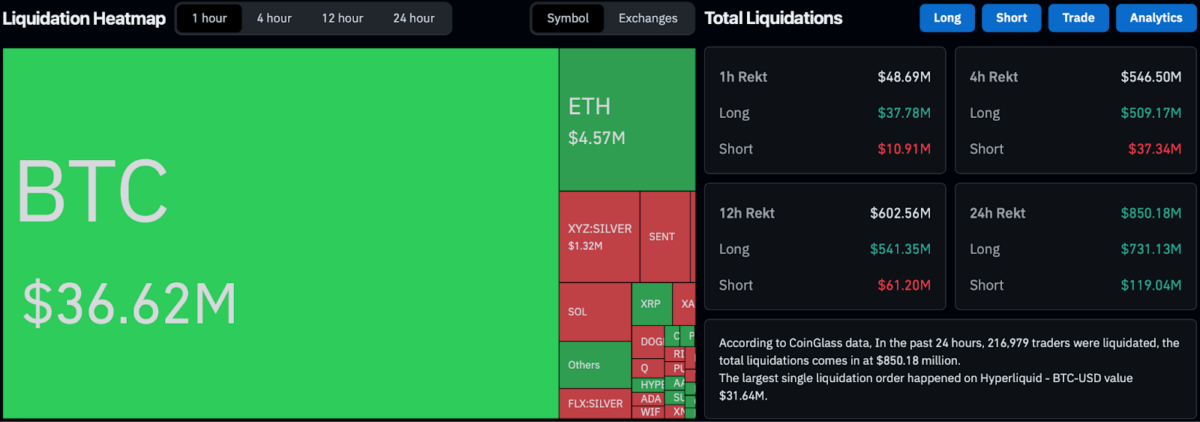
  • Nearly $850 million was liquidated as over 216,000 traders were forced out of their positions.
  • Stock market volatility drove the sell-off, especially after Microsoft shares fell 11%, dragging major indexes down and putting pressure on risk assets like Bitcoin.

Bitcoin (BTC) has fallen below $85,000 again, currently trading near $84,704 after losing roughly 6.15% in the past 24 hours. The drop came after Bitcoin briefly reached highs above $90,000 earlier in the week.

Trading activity is up by 35% in the last 24 hours, resulting in over $55 billion in volume. However, the selling pressure suggests this is just traders selling their positions instead of buying.

This price drop came after the cryptocurrency failed to hold about key technical levels. After briefly crossing $90,000, the token quickly reversed, dropping to lows around $84,416, before moving up slightly. As a result, Bitcoin’s total market capitalization has dropped by 6.73% to $1.68 trillion.

Rate outlook and stock market volatility hit crypto

The drop comes amid recent macro events, including the U.S. Federal Reserve reporting today that the labor market is strong, with unemployment at 4.4%. With this, there was no signal reason for urgent rate cuts, which has influenced investors’ decisions, especially toward Bitcoin, which is seen as a risky asset.

Meanwhile, volatility in traditional markets intensified. Microsoft shares fell more than 11% after the company reported a steep growth in its cloud business, which was weaker than investors expected. This dragged the Nasdaq down by about 1.5%, increasing selling pressure across tech stocks.

The S&P 500 fell 1.2%, while the Dow Jones Industrial Average lost 304 points. The S&P 500 Volatility Index jumped to 19, its second-highest level since November, showing rising uncertainty in the market. At the same time, the DXY index, which tracks the U.S. dollar, rebounded to 96.6, putting extra pressure on risk assets like Bitcoin.

Nearly $850 million liquidated in 24 hours 

This turbulence in the stock market spilled over into the crypto market. Aside from Bitcoin, the overall market felt it, leading to a 4% drop in total market valuation from $2.91 trillion down to $2.87 trillion.

Major altcoins, including Ethereum, Solana, Dogecoin, and Cardano, lost between 5% and 6% during the same period. As a result, 216,843 traders were liquidated from the market. According to CoinGlass, around $849.73 million was liquidated in total. $730 million from the amount came from traders who had bet on prices going up, while $119 million came from short position traders.

Total Market Liquidation
Total Market Liquidation | Source: Coinglass

Corporate Bitcoin holders also felt the impact, with Strategy (MSTR) down 8%, marking its worst day since December 12 and returning to September 2024 levels. Circle (CRCL) and Coinbase (COIN) posted losses between 4% and 8%.

Bitcoin to test key support levels at $80K

Looking at the chart on the daily timeframe, Bitcoin is dropping to $80k, where the nearest support level is located. The price has tested this zone multiple times, which could act as a critical level for stabilization in the coming days.

Bitcoin Daily Price Chart
Bitcoin Daily Price Chart | Source: TradingView

Moreover, the Relative Strength Index (RSI) is at 33, while the moving average is at 46. This confirms that the price is currently controlled by the seller. However, it is approaching an oversold condition, which could act as a stable position for buyers to take over. 

$8 billion in Bitcoin options set to expire

Looking ahead, traders are preparing for Friday’s Bitcoin options expiry, which is expected to be one of the largest this year. Options worth $8.27 billion will expire on Deribit at 8:00 UTC, the world’s largest crypto derivatives exchange. Traders appear bullish heading into the expiry, as the max pain price remains well above the current price at $90,000, with the put-call ratio standing at 0.56, showing more calls than puts.

🚨 Options Expiry Alert 🚨

At 8:00 UTC tomorrow, over $9.5B in crypto options are set to expire.$BTC: $8.27B notional | Put/Call: 0.54 | Max Pain: $90K$ETH: $1.27B notional | Put/Call: 0.74 | Max Pain: $3.1K

BTC is trading sideways just under $90K going into expiry, while… pic.twitter.com/vEXRIaIreO

— Deribit (@DeribitOfficial) January 29, 2026

Options allow traders to lock in prices now for future buying or selling, and the expiry could influence Bitcoin’s price action next week, especially if the Fed signals easier monetary policy.

Also Read: Bitcoin May Surge if Fed Intervenes in Yen, JGB Markets: Arthur Hayes

  •  

AVAX Retests $11 Support, Can It Bounce Back to $13?

Key Highlights

  • AVAX has dropped below $12 and is now trading around $11.07 amid strong selling pressure.
  • Bitcoin’s drop and weak demand are adding more downside risk for AVAX.
  • VanEck launched the first U.S.-listed AVAX ETF, but it hasn’t caused a major price rally yet.

Avalanche (AVAX) is facing renewed pressure after breaking below a key support level near $12. The token is currently trading around $11.07, marking an 8% drop in the last 24 hours from an intraday high of $12.10.

Trading activity has also dropped by 6.18%, recording about $295 million in trading volume, while the market cap sits at $4.8 billion.

AVAX Price Chart
AVAX Price Chart | Source: CoinMarketCap

AVAX’s market structure is pushing bearish momentum as sellers continue to control the trend. Looking at the chart on the daily, the price has initially tapped up the current support zone it is in, which propelled it up to $12.22 before dropping again.

Meanwhile, this downtrend is shared across all altcoins as the overall market dropped by 2.04% to $2.94 trillion in the last 24 hours, influenced by a 2.34% drop in Bitcoin, the largest cryptocurrency, which saw its price fall below $90,000. AVAX happens to be one of the altcoins that is highly influenced by Bitcoin’s price action. If Bitcoin falls, AVAX could face more downside pressure before finding another strong support. 

Analyst Jesse Peralta noted in a recent post on X that the AVAX/BTC pair remains stuck in a descending channel, with risk of falling toward the 0.000110 BTC region if support breaks. This matters because when AVAX cannot outperform Bitcoin, it often drops harder during market pullbacks.

$AVAXBTC looks weak here!

Could drop to 0.000110BTC pic.twitter.com/JXuteZOMcB

— Jesse Peralta (@TheJessePeralta) January 29, 2026

Traders stay cautious despite ETF spotlight

Derivatives are also printing similar pictures. According to Coinglass, AVAX future volume is down 8.33% to $574 million in volume, while its open interest has also dropped by 3.27% to about $463 million. This means that traders are being cautious of the market as they slow down on opening new positions.

AVAX Derivatives Data - Coinglass
AVAX Derivatives Data | Source: Coinglass

At the same time, over $881,000 has been liquidated from the market in the last 24 hours. $838,000 from that amount came from traders who had bet on the price going up, while $42,740 came from short position traders.

Meanwhile, the token is gaining attention in the traditional market as VanEck launched the first U.S.-listed Avalanche ETF on January 26. The ETF, which trades on Nasdaq under the ticker VAVX, is designed to allow investors to get exposure to AVAX without directly buying or holding the token. VanEck has also waived fees on the first $500 million in assets until late February. However, the ETF has not yet triggered a strong price jump.

AVAX heads straight for $10 support level

On the daily chart, AVAX has broken another key support at $11 and is heading toward the weekly support level at $10.94. In short, the price disrespected the $12 support level with a break of structure to the downside despite a short rally from December 2025.

AXAX Weekly Price Chart
AXAX Weekly Price Chart | Source: TradingView

If the current daily candle takes liquidity and rejects, it could spark a possible rally, with momentum to break out above $13 or push the price toward $14.80–$15. However, if the candle closes in a solid, the price would have to test the $10.94 support level to gather enough momentum for a possible rally.

Moreover, the Relative Strength Index (RSI) is currently at 39, while the moving average is at 32. This means that the sellers are still controlling the market, but a switch could happen if it enters an oversold condition.

Also Read: Crypto Trader Makes $2M in 24 Hours on Hyperliquid Amid HYPE Rally

  •  

U.S. Senate Advances Crypto Market Structure Bill in Party-Line Vote

Key Highlights

  • The Senate Agriculture Committee approved a crypto bill in a 12-11 party-line vote, moving it closer to the full Senate.
  • Democrats opposed the vote, and several proposed amendments on ethics, crypto fraud, and federal bailouts were rejected.
  • The bill now needs approval from the Senate Banking Committee and must be merged with the House version before becoming law.

The Senate Agriculture Committee voted on Thursday to move forward with the crypto market structure bill, sending it to the full Senate floor without support from both parties. The committee has reportedly approved the bill in a close 12-11 vote, giving new regulatory powers to the Commodity Futures Trading Commission (CFTC) over digital tokens.

The bill will later need to be merged with another part overseen by the Senate Banking Committee, which focuses on the Securities and Exchange Commission (SEC).

Under Chairman @JohnBoozman’s leadership, the Senate Ag Committee advanced crypto market structure legislation. This is a big move for consumer protection and innovation. pic.twitter.com/w0KpL2WXWM

— Senate Ag Committee Republicans (@SenateAgGOP) January 29, 2026

The vote follows months of delay and discussion between Agriculture Committee Chairman John Boozman, a Republican from Arkansas, and Sen. Cory Booker, a Democrat from New Jersey. However, an agreement was not made, so Boozman moved forward with a Republican-only bill. “There were fundamental policy disagreements,” Boozman said. He added, “It is now time to move this process forward.”

He described the bill as defining digital commodities clearly and providing the CFTC with the resources to take on its new responsibilities.

Democrats oppose party-line votes and amendments

Sen. Cory Booker criticized the GOP-only approach, saying Republicans abandoned the bipartisan process. That frustrates me because I see a bipartisan glide path to land this plane, to punch through the end zone,” he said.

Several Democratic-backed amendments were rejected, including a proposal from Sen. Michael Bennet that would stop federal officials and their families from issuing or endorsing digital assets. Other proposals, including measures to prevent crypto ATM fraud and to stop some crypto firms from getting federal bailouts, were also voted down along party lines.

Senator Amy Klobuchar, the committee’s ranking Democrat, said that while progress was made, more work is needed. “The progress that has been made here is good, but I think we believe that we’re not quite done yet,” she said.

Boozman noted that the bill can still be updated through manager amendments before it reaches the full Senate. He also agreed that the CFTC should have a full team of commissioners as it takes on crypto oversight.

Next steps for crypto oversight

After clearing the Agriculture Committee, the bill must pass the Senate Banking Committee and then be combined with its counterpart from the House. The House has already passed a version of the bill with strong support.

Meanwhile, the White House is expected to host another meeting next week to bring together crypto, banking, and political interests. U.S. President Donald Trump and his representatives have opposed some ethics provisions that Democrats wanted in the bill, citing conflicts of interest concerns.

This development represents one of the furthest steps the crypto industry has achieved in Congress. Last year, the space secured a major victory when the GENIUS Act bill, aimed at regulating stablecoins, was passed into law.

If this new bill is passed, it would give investors more confidence to trade digital assets and spread the adoption of cryptocurrency.

Also Read: Crypto in 401(k)s? SEC Chair Paul Atkins Says ‘Time is Right’

  •  

U.S. Senators Set to Vote on Crypto Market Bill on January 29

Key Highlights

  • Senators are expected to vote on the crypto market bill on Thursday, amid pressure of government shutdown by January 31.
  • Multiple amendments have been filed, including ethics rules for officials and a delay until the CFTC has enough commissioners.
  • Other proposals aim to prevent fraud at crypto ATMs and stop foreign adversaries from participating in U.S. crypto markets.

Bipartisan U.S. senators are preparing to vote on a major crypto market structure bill on Thursday in Washington, D.C., following an earlier delay this week due to bad weather. Lawmakers are expected to appear on Capitol Hill to discuss proposed changes and decide whether to add the bill to the CLARITY Act.

This markup is the first major attempt to advance the bill after the Senate Banking Committee delayed its own markup when Coinbase withdrew its support.

Senators introduce new changes to the bill

Multiple lawmakers have submitted amendments to adjust the bill before a final vote. Senator Michael Bennet of Colorado suggested rules to limit crypto holdings and activities for government officials and their families, which include the U.S. president, the Vice President, and United States Representatives. This is to avoid conflict of interest, though it is not yet clear if the committee will approve this proposal.

Senator Amy Klobuchar of Minnesota filed two amendments. One would delay the bill until the Commodity Futures Trading Commission (CFTC) has at least four commissioners, including two from the minority party. The second amendment narrows the definition of a “retail participant” and clarifies the responsibilities of the Digital Commodity Retail Advocate, a role meant to protect small investors.

Senator Dick Durbin proposed measures to ban bailouts for crypto issues and add rules to stop fraud in crypto ATMs. Meanwhile, Senators Tommy Tuberville and Jerry Moran introduced proposals aimed at limiting foreign adversaries from participating in U.S. crypto markets.

These amendments focus on improving oversight and protecting U.S. investors. Senators will discuss each proposal before voting, and all committee members are expected to attend after the weather is clear.

Push for clear crypto rules

In a video posted on X, Senator Kirsten Gillibrand highlighted the need for clear guidelines for the crypto market. She said the bill is essential so that companies and investors can understand how to follow the law. She highlighted that proper regulations would protect consumers and make sure buyers know the risks.

Common-sense crypto market structure regulation will protect consumers and market players alike.

It's a win-win. pic.twitter.com/NbXeytRFQY

— Kirsten Gillibrand (@SenGillibrand) January 27, 2026

“The need for market structure regulation could not be more important. We need these rules on the road so participants know how to do things legally and appropriately,” she said.

She added that clear rules would help crypto companies continue operating in the U.S., and also support New York’s position as a global financial hub.

The committee will review and vote on each amendment before deciding whether to send the bill to the Senate floor. Some senators, including Roger Marshall and Dick Durbin, expressed that they will not push their credit card swipe fee proposal during the markup. The process will be observed by the crypto space as the Senate faces the government funding deadline, which could lead to a shutdown if not resolved.

Also Read: Kansas Proposes Bitcoin Reserve Using Unclaimed Digital Assets

  •  

US Court Tosses XRP Investor Lawsuit Against Ripple

Key Highlights

  • A federal court dismissed investor Bradley Sostack’s lawsuit against Ripple.
  • The court ruled that XRP sales in 2017 were not a separate offering.
  • The decision follows Ripple’s recent settlement with the SEC and closes another chapter in XRP-related lawsuits.

A U.S. federal appeals court has dismissed a lawsuit against Ripple Labs, the company behind the cryptocurrency XRP, ruling that the case was filed too late under securities law. The lawsuit, brought by investor Bradley Sostack, alleged that Ripple sold XRP as an unregistered security. 

In a recent filing, the Ninth Circuit Court ruled that Ripple started offering XRP to the public in 2013, and U.S. law only allows claims like this to be filed within three years. The court also said that XRP sales in 2017 were not a separate offering. As a result, Ripple does not have to face federal securities claims from the investor.

Investor lawsuit dismissed for being late

Sostack filed his complaint in 2019, six years after XRP was first sold to the public. He argued that the monthly XRP sales from Ripple’s escrow account should count as ongoing offerings. However, the court rejected this claim. It said the 2017 XRP sales were part of the original offering in 2013 and did not reset the three-year time limit for lawsuits.

XRP was created in 2012 through the XRP Ledger. Ripple Labs received 80 billion of the 100 billion tokens that were created. The ledger became available to the public either in 2012 or early 2013. In 2017, Ripple began releasing one billion XRP each month from its holdings. Thousands of users bought XRP during these sales, including via the ledger’s built-in exchange.

Sostack claimed that these later sales made XRP a continuing offering, but the court disagreed, saying all XRP stayed the same and were part of the original sale.

Another legal win for Ripple

This is another major win for Ripple. It follows the firm’s settlement with the U.S. Securities and Exchange Commission (SEC) in August 2025, which ended a nearly five-year legal battle. The agency accused Ripple of raising $1.3 billion by selling XRP without registering it as a security. As part of the settlement, Ripple was ordered to pay a $125 million penalty to the SEC, which had already been placed in escrow.

XRP hasn’t really reacted to the recent development. At the time of writing, the token is trading for $1.90. This is just a modest 0.08% drop from the previous day, with a 14% surge in trading activity reaching about $2.39 billion in trading activity with its market cap sitting at $116 billion.

XRP Price Chart
XRP Price Chart | Source: CoinMarketCap

This dismissal is another big win for Ripple. The case added to the debate that questions whether XRP is an unregistered security, a topic that has caused a lot of talk in the crypto world.

Also Read: Ripple Launches Treasury Platform to Target Enterprise Cash

  •  

Is Crypto Dead In Nigeria? Local Exchange Halts P2P Service

Key Highlights

  • Nigerian crypto exchange Quidax has paused its peer-to-peer (P2P) trading service just five months after launching it.
  • P2P trading helped users trade directly and boost liquidity, but regulators cited fraud and exchange-rate risks.
  • Other services like instant swaps and order-book trading continue, and crypto platforms now face high capital requirements.

Nigeria’s crackdown on crypto exchanges continues to intensify as regulators tighten rules on crypto exchanges. Over the past few years, authorities have increased oversight and placed heavy restrictions on banks, exchanges, and even crypto transfer services like peer-to-peer trading, making it harder for both users and businesses to trade freely. 

The latest development comes from Quidax, a Nigerian crypto exchange that has halted its peer-to-peer (P2P) trading service in the country just five months after it went live, according to a local report.

This decision seemingly follows increased regulatory pressure on crypto platforms, especially those involved in direct user-to-user transactions. It has also sparked a debate in the Nigerian crypto space on whether the government is trying to slow down the use of crypto in the country or turn it off completely.

Why P2P trading became popular in Nigeria

Peer-to-peer trading (P2P) has been one of the most common ways Nigerians transfer money with each other, either locally or internationally. The system allows users to trade directly with one another instead of going through the exchange itself. The payments are usually made through bank transfers, which the platform acts as a meeting point, in many cases, an escrow service.

The trading model made crypto easy for citizens to access and helped keep trading active even during periods when banks were restricted from offering crypto services. It also helped improve liquidity and allowed users to easily find buyers and sellers at any time.

However, the Nigerian regulators have long viewed it as a problem. Authorities claim that the system has been used by criminals to carry out fraud and move illegal money to avoid transaction trails, as well as to influence exchange rates outside official markets.

Quidax’s solution to the issue 

Initially, Quidax tried to address this issue by introducing strict control when it launched its P2P service. Users who wanted to operate as merchants were required to complete full identity checks, including two-factor authentication, and go through an approval process before being allowed to trade. Only verified traders were allowed to post ads and interact with customers.

Still, with the measure, the feature was still suspended, which suggested that the effort was to keep P2P activity within a controlled environment that regulators could monitor. However, even with these safeguards, the P2P feature was still suspended, showing that the effort to comply alone was not enough under the current regulations.

However, the exchange clarified that while P2P trading has been paused, other services remain active. Users can still access instant swaps and order-book trading.

Adoption despite regulatory crackdown

Despite this crackdown on crypto, Nigeria remains the largest crypto market in Africa. From 2024 to 2025 alone, the country processed around $92.1 billion in crypto transactions, which is three times that of other major African countries like South Africa. 

Last year, the House of Representatives, in a public hearing held in Abuja, Nigeria, also urged authorities to stop viewing young Nigerians as internet fraudsters. In a previous report, a member of the house, Olufemi Bamisile, said that the security agencies, including the Economic and Financial Crimes Commission (EFCC) and the Nigeria Financial Intelligence Unit (NFIU), should stop the ‘misplaced aggression on Nigerians that trade crypto,’ saying that not every young person with a crypto wallet is a fraudster.

In short, Nigeria’s crypto market seems to be entering a new phase. Crypto is still active in Nigeria, but platforms are being forced to drop or rethink services that regulators see as risky. For now, P2P trading appears to be the most affected, even as other parts of the market continue to operate.

Also Read: Nigeria to Track Citizens’ Crypto Income Using National ID, TIN

  •  

Japan Seeks Public Opinion On Stablecoin Reserve And Crypto Rules

Key Highlights

  • Japan’s FSA is seeking public opinion on draft rules for stablecoin reserve assets and crypto supervision under the 2025 Payment Services Act amendments.
  • Only certain foreign-issued bonds with high credit ratings and large issuance can back stablecoins under trust structures.
  • Banks, insurance firms, and subsidiaries must clearly explain crypto risks to customers, and foreign stablecoin issuers cannot target Japanese users directly.

Japan’s Financial Services Agency (FSA) is seeking opinions from the public concerning new draft rules that will govern how stablecoins are backed and how crypto-related services are supervised under the country’s updated payments law.

This process is open until February 27, 2026, and follows previous changes on the Payment Services Act, which was passed in June 2025 to set the rules for how money and electronic payments are handled in the country.

In a statement released on Monday, the FSA said it has prepared a set of draft regulatory notices linked to Act No. 66 of 2025. These notices are part of the country’s overhaul of rules that cover its settlement system and electronic payment methods. The agency explained that the drafts are meant to define how regulated stablecoins should be backed and supervised under the law.

Clear rules for stablecoin reserve assets

One major part of the rules focuses on reserve assets used by regulated stablecoins that rely on trust structures. In Japan, companies that issue stablecoins often rely on a structure known as “specified trust beneficiary interests.” The new rules explain how assets under this structure can be invested and what types of financial products are allowed to support stablecoin value.

According to the draft notice, only certain foreign-issued bonds will qualify as reserve assets. The FSA said these bonds must meet two conditions. First, they must carry a very high credit rating and fall within a credit risk category of “1–2” or higher, as assessed by an approved rating agency. Second, the foreign issuer must have a very large bond market, with at least 100 trillion yen in bonds already issued.

New guidelines for banks and subsidiaries

The regulator also released updated supervisory guidelines for banks, insurance companies, and their subsidiaries. A newly added rule says that when a subsidiary offers cryptocurrency intermediation services, it must give customers clear and appropriate explanations about the risk involved.

The FSA said the measure is to prevent people from thinking a crypto product is safe just because it is offered by a well-known financial group.

For companies that want to handle stablecoins issued outside Japan, the draft rules add another requirement. Firms must explain that the foreign issuer will not issue, redeem, or actively promote stablecoins to everyday users in Japan. The FSA said it will also work with overseas regulators to share information about these stablecoins and their issuers.

Japan’s push for a regulated stablecoin market

The consultation is part of Japan’s attempt to build a regulated stablecoin environment. In October 2025, local fintech company JPYC launched what it described as Japan’s first legally recognized yen-backed stablecoin.

The country’s three major banks, MUFG, SMBC, and Mizuho, have also been testing stablecoins and tokenized deposits for payments and settlements, with formal backing from the FSA in December.

With the stablecoin market becoming a thing of interest in the country. Japan is pushing to protect customers by making sure banks and subsidiaries explain risks when offering crypto services. Limiting eligible reserve assets to high-quality foreign bonds reduces financial risk and ensures stability. The FSA said the rules will be finalized after the public comment period ends and will be enforced following the necessary legal steps.

Also Read: Japan May Allow Crypto ETFs by 2028 as Global Markets Move Ahead

  •  
❌