❌

Reading view

SRC supplies radars to General Atomics for UAS airspace surveillance

SRC has received an order from General Atomics Aeronautical Systems (GA-ASI) for two AN/TPQ-49A (Q49A) radar systems configured with Air Surveillance software to support unmanned aircraft testing and ground-based sense-and-avoid (GBSAA) operations.

The radars will be deployed at GA-ASI flight operations sites in El Mirage and Gray Butte, California, providing detection and tracking of cooperative and non-cooperative aircraft operating near uncrewed aerial system (UAS) testing areas. Delivery is expected by the end of October 2026.

The Q49A systems will provide the surveillance sensor component of a broader GBSAA system, giving UAS operators airspace situational awareness for beyond visual line of sight (BVLOS) operations. The ground-based configuration allows surveillance capabilities to be used for UAS that cannot accommodate onboard radar.

SRC said the Q49A provides 3-D target position data and can operate remotely over an IP network, with detection data fed to a central fusion processor. The radar can be installed on tripods, rooftops, towers or vehicles and is designed to operate in low-visibility and night-time conditions.

The company is also advancing FCC Part 87 certification for the Q49A, following completion of the required compliance testing. SRC said certification would support broader use of the radar for civil air surveillance and integration into GBSAA and detect-and-avoid (DAA) architectures for UAS and BVLOS operations.

For more information

https://www.srcinc.com/news-and-events/press/2026/20260929-contract-air-surveillance-radar-uas-operations.html

Image: SRC

The post SRC supplies radars to General Atomics for UAS airspace surveillance first appeared on Unmanned airspace.

  •  

Axon Vision completes ForceField C-UAS live-fire demonstration

Axon Vision has completed a live-fire demonstration of its ForceField counter-uncrewed aerial systems (C-UAS) system in Israel for an unnamed US defence contractor, including multiple kinetic defeats of FPV drone targets.

Representatives of the US contractor travelled to Israel for the demonstration, which evaluated ForceField under operationally representative conditions. Axon Vision said the activity validated the system’s Detect-Understand-Respond cycle, from passive detection and AI-based threat classification and decision support through to kinetic defeat, with operators retaining engagement authority.

ForceField is designed to counter fibre-optic-controlled FPV drones and other aerial threats that cannot be addressed through electronic warfare. The system combines passive day-and-night detection with AI-based analysis and an integrated kinetic response, and can operate without continuous communications or reliance on external detection systems.

Axon Vision said it is working with US defence partners to adapt and integrate its technologies for future C-UAS programmes and platform requirements. A larger-scale demonstration is planned in the US later this year.

The company will also present ForceField and its other AI-powered perception and C-UAS systems at AUSA 2026 in Washington, DC, from 12-14 October.

For more information

Axon Vision

Image: Axon Vision

The September issue of the 2026 Unmanned Airspace Global Counter-UAS Systems Directory is now available. The guide is the world’s only comprehensive, continually updated directory of global C-UAS companies and systems. It itemises over 1,000 C-UAS products and services with performance details, company sales and partnerships arrangements. It is updated every month and broken down into niche sub-sectors (net-capture, missiles, intercept drones, detectors etc) to give C-UAS procurement and industry personnel a unique perspective of global C-UAS technical capabilities and market positions. It is available in word, PDF and excel formats and Unmanned Airspace readers are eligible for a range of discounts. For more information about the Directory please contact the editor Philip Butterworth-Hayes at philip@unmannedairspace.info.

The post Axon Vision completes ForceField C-UAS live-fire demonstration first appeared on Unmanned airspace.

  •  

Netherlands expands CITADEL air defence programme with NOK1.5 billion Kongsberg contract

Kongsberg has signed a contract worth about NOK1.5 billion with the Netherlands to expand the country’s CITADEL air defence programme.

The contract includes several NOMADS systems and additional high-mobility short-range air defence capabilities, as well as an increase in the Netherlands’ NASAMS ground-based air defence capacity.

The new deliveries will increase the overall capacity of the CITADEL programme, which Kongsberg and the Netherlands agreed in 2024.

For more information

https://www.kongsberg.com/news/news-archive/2026/netherlands-expands-air-defence-capacity/

Image: Kongsberg

The post Netherlands expands CITADEL air defence programme with NOK1.5 billion Kongsberg contract first appeared on Unmanned airspace.

  •  

Smart Shooter awarded USD150 million JIATF-401 C-UAS contract

Smart Shooter has been awarded a 36-month, single-award indefinite-delivery/indefinite-quantity (IDIQ) contract by the US Department of War’s Joint Interagency Task Force 401 (JIATF-401), with a maximum ordering ceiling of USD150 million.

The agreement makes Smart Shooter the sole supplier of its SMASH fire-control systems, along with training and related support services covered by the contract. It supports JIATF-401’s Domestic Shield programme and associated missions covering force protection, base defence and counter-UAS requirements in the US and overseas.

The contract covers hardware, software and updates, training and support services. Specific quantities, scope and delivery schedules will be determined through individual delivery orders, meaning the USD150 million ceiling does not represent an immediate purchase or committed order value.

SMASH is a rifle-mounted fire-control system that uses AI, computer vision and target-tracking algorithms to track drones and calculate a firing solution. The system synchronises shot release when the weapon is aligned with the target, while the operator retains the decision to engage. It can also connect with external sensors and battle-management systems.

The agreement follows an earlier Smart Shooter contract with JIATF-401 announced in March 2026. The company said thousands of SMASH systems are already deployed across US military services.

For more information

Smart Shooter

Image: U.S. Marines with 12th LCT train with the SMASH 2000L Smart Optic, Aug 7, 2026 (U.S. Marine Corps photo by Lance Cpl. Camila Garibay).

The September issue of the 2026 Unmanned Airspace Global Counter-UAS Systems Directory is now available. The guide is the world’s only comprehensive, continually updated directory of global C-UAS companies and systems. It itemises over 1,000 C-UAS products and services with performance details, company sales and partnerships arrangements. It is updated every month and broken down into niche sub-sectors (net-capture, missiles, intercept drones, detectors etc) to give C-UAS procurement and industry personnel a unique perspective of global C-UAS technical capabilities and market positions. It is available in word, PDF and excel formats and Unmanned Airspace readers are eligible for a range of discounts. For more information about the Directory please contact the editor Philip Butterworth-Hayes at philip@unmannedairspace.info.

The post Smart Shooter awarded USD150 million JIATF-401 C-UAS contract first appeared on Unmanned airspace.

  •  

Ondas launches long-range Dronebuster REACH C-UAS system

Ondas has launched Dronebuster REACH, a long-range variant of its Dronebuster family of non-kinetic counter-uncrewed aerial systems (C-UAS) technologies, with the first system under contract for delivery to the US Office of Naval Research (ONR).

The system has completed customer acceptance testing and will be used by ONR to support C-UAS research, evaluation and test activities.

REACH uses electronic attack techniques deployed across the Dronebuster range, including command-and-control disruption and GNSS denial, with optional positioning, navigation and timing (PNT) electronic attack. Ondas said the system provides these capabilities at longer range and higher power than its handheld effectors.

REACH is designed to operate as part of a layered C-UAS architecture. It can receive cueing from Ondas’ detect, track and identify (DTI) systems and integrates with the company’s DefenseOS command-and-control software. The architecture can also support handoff to kinetic interception when a non-kinetic effect is insufficient.

Ondas said REACH expands its C-UAS portfolio, which includes Dronebuster handheld and vehicle-mounted systems, DTI detection systems, Sawtooth fixed-site protection, DefenseOS and IonStrike autonomous kinetic interceptors.

For more information

Ondas

Image: REACH by Ondas Sentinel

The September issue of the 2026 Unmanned Airspace Global Counter-UAS Systems Directory is now available. The guide is the world’s only comprehensive, continually updated directory of global C-UAS companies and systems. It itemises over 1,000 C-UAS products and services with performance details, company sales and partnerships arrangements. It is updated every month and broken down into niche sub-sectors (net-capture, missiles, intercept drones, detectors etc) to give C-UAS procurement and industry personnel a unique perspective of global C-UAS technical capabilities and market positions. It is available in word, PDF and excel formats and Unmanned Airspace readers are eligible for a range of discounts. For more information about the Directory please contact the editor Philip Butterworth-Hayes at philip@unmannedairspace.info.

The post Ondas launches long-range Dronebuster REACH C-UAS system first appeared on Unmanned airspace.

  •  

Washington National Guard trains operators on mobile C-UAS systems

More than 40 National Guard members from across the US have completed a 10-day counter-uncrewed aerial systems (C-UAS) master operator course hosted by the Washington National Guard at Camp Murray and Joint Base Lewis-McChord.

The course, held from 14-25 September, trained personnel from civil support teams, air defence artillery units and other organisations to operate the National Guard’s newly fielded mobile C-UAS systems developed by Anduril Industries.

Training covered system assembly, network configuration, sensor calibration, troubleshooting and operation of Anduril’s Lattice software for detecting and tracking unmanned aircraft. Students also worked with Wisp and Pulsar systems and a Long Range Camera Tower as part of the mobile platform.

The course combined classroom instruction, equipment assembly and five days of range operations against different unmanned aircraft and flight patterns. Students were required to build and configure the system, establish its network, calibrate the equipment and operate the software during a practical assessment before being certified as trained operators.

The National Guard said the course forms part of a broader effort to develop C-UAS expertise for homeland defence, major-event security and critical infrastructure protection. It plans to expand future iterations with additional scenarios, drone flight patterns and revised tactics, techniques and procedures.

For more information

National Guard

Image: Service members from multiple Civil Support Teams and Air Defence Artillery units participate in Counter-Small Unmanned Aircraft System, or C-sUAS, training hosted by the 10th Civil Support Team, Washington National Guard, at Joint Base Lewis-McChord, Washington, Sept. 22, 2026 (Photo by Peter Chang). 

The September issue of the 2026 Unmanned Airspace Global Counter-UAS Systems Directory is now available. The guide is the world’s only comprehensive, continually updated directory of global C-UAS companies and systems. It itemises over 1,000 C-UAS products and services with performance details, company sales and partnerships arrangements. It is updated every month and broken down into niche sub-sectors (net-capture, missiles, intercept drones, detectors etc) to give C-UAS procurement and industry personnel a unique perspective of global C-UAS technical capabilities and market positions. It is available in word, PDF and excel formats and Unmanned Airspace readers are eligible for a range of discounts. For more information about the Directory please contact the editor Philip Butterworth-Hayes at philip@unmannedairspace.info.

The post Washington National Guard trains operators on mobile C-UAS systems first appeared on Unmanned airspace.

  •  

Echodyne awarded USD250 million JIATF-401 C-UAS IDIQ contract

Echodyne has been awarded an indefinite-delivery/indefinite-quantity (IDIQ) contract supporting Joint Interagency Task Force 401’s (JIATF-401) Domestic Shield programme, with a maximum ceiling of USD250 million over an ordering period of up to 36 months.

The agreement provides a procurement pathway for Echodyne’s MESA radar systems for counter-UAS missions including force protection, base defence and counter-drone operations in the US and overseas. The radars will also be available through JIATF-401’s counter-uncrewed aerial systems (C-UAS) Marketplace for US and allied customers.

Echodyne’s MESA architecture is a software-defined metamaterials electronically scanned array designed to provide electronic beam steering in a compact solid-state radar. Its EchoShield medium-range radar provides persistent tracks with a 10Hz update rate and angular accuracy of less than 0.5 degrees in azimuth and elevation.

EchoShield uses AI and machine-learning models to classify objects including fixed-wing and multirotor drones. Its size, weight and power characteristics allow it to be deployed in fixed installations, portable configurations and on-the-move operations.

The contract establishes the terms for future orders, with specific requirements and procurement quantities to be determined through individual orders. The USD250 million figure therefore represents the maximum contract ceiling rather than a committed purchase value.

For more information

Echodyne

Image: Echodyne

The September issue of the 2026 Unmanned Airspace Global Counter-UAS Systems Directory is now available. The guide is the world’s only comprehensive, continually updated directory of global C-UAS companies and systems. It itemises over 1,000 C-UAS products and services with performance details, company sales and partnerships arrangements. It is updated every month and broken down into niche sub-sectors (net-capture, missiles, intercept drones, detectors etc) to give C-UAS procurement and industry personnel a unique perspective of global C-UAS technical capabilities and market positions. It is available in word, PDF and excel formats and Unmanned Airspace readers are eligible for a range of discounts. For more information about the Directory please contact the editor Philip Butterworth-Hayes at philip@unmannedairspace.info.

The post Echodyne awarded USD250 million JIATF-401 C-UAS IDIQ contract first appeared on Unmanned airspace.

  •  

Fortem Technologies closes USD50 million Series B led by Lockheed Martin

Fortem Technologies has closed a USD50 million Series B financing round led by Lockheed Martin, with participation from Unusual Machines and other strategic and institutional investors.

Fortem said the funding will support increased production at its Lindon, Utah facility and the expansion of deployments of its SkyDome family of counter-uncrewed aerial systems (C-UAS) systems. The portfolio combines TrueView radar sensors, command-and-control software and DroneHunter autonomous interceptors for detecting, tracking, classifying and defeating aerial threats.

Lockheed Martin committed USD25 million to the initial tranche of the Series B announced earlier this year. The investment also builds on the companies’ work integrating Fortem’s capabilities with Lockheed Martin’s Sanctum counter-UAS architecture.

Fortem said recent activity includes a Department of Homeland Security contract to provide C-UAS protection for venues during the 2026 FIFA World Cup and a US Army contract covering protection of installations worldwide.

In August, Fortem was also selected by the Department of Homeland Security as a prime contractor on its five-year C-UAS hardware and software contract, which has an estimated initial ceiling of USD1.011 billion.

The company said the new funding will allow it to increase manufacturing capacity and support further deployment of its C-UAS systems.

For more information

https://fortemtech.com/press-releases/2026-09-30-fortem-technologies-closes-50m-series-b-financing-led-by-lockheed-martin/

Image: SkyDome® Manager (Fortem Technologies)

The September issue of the 2026 Unmanned Airspace Global Counter-UAS Systems Directory is now available. The guide is the world’s only comprehensive, continually updated directory of global C-UAS companies and systems. It itemises over 1,000 C-UAS products and services with performance details, company sales and partnerships arrangements. It is updated every month and broken down into niche sub-sectors (net-capture, missiles, intercept drones, detectors etc) to give C-UAS procurement and industry personnel a unique perspective of global C-UAS technical capabilities and market positions. It is available in word, PDF and excel formats and Unmanned Airspace readers are eligible for a range of discounts. For more information about the Directory please contact the editor Philip Butterworth-Hayes at philip@unmannedairspace.info.

The post Fortem Technologies closes USD50 million Series B led by Lockheed Martin first appeared on Unmanned airspace.

  •  

Counter-UAS technology at DroneX – Ukraine shines and China surprises

By Philip Butterworth-Hayes

The UK’s DroneX show has turned into a counter-UAS marketplace for Ukrainian and, surprisingly, Chinese companies.

Ukraine’s industry had the biggest and best displays – the hall was dominated by Skyfall (manufacturer of the P-1 Sun interceptor and General Cherry (which makes the Bullet interceptor), both actively exporting to Western nations. According to one Ukrainian industry official, the current life cycle for new battlefield technology developments in Ukraine, including counter-UAS systems, is four months from technology readiness level 6 to industrialisation, seven months of production and six months before obsolescence sets in.
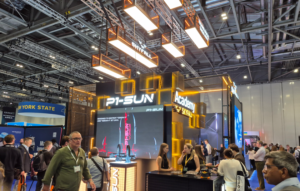
Many front-line Ukrainian units are now suffering from drone system saturation, not just because of the huge numbers and different types now being produced but the time it takes for troops to train on, and support, the new systems coming into operation.

Ukraine is currently building between 500,000 and 800,000 drones a month. In the first nine months of 2026, Ukrainian troops ordered more than 590,000 unmanned aerial vehicles via the government-run Brave1 Market marketplace alone, with interceptors the most commonly ordered.

Another Ukrainian C-UAS supplier with a large stand was TAF Industries, manufacturer of the Octopus-100 interceptor (maximum speed over 300 km/h, a payload of 1.2kg and 15 minutes flight duration), and the Kolibri-i10 (speed of over 200km/h, payload of 0.6 kg and a flight duration of over 20 minutes).

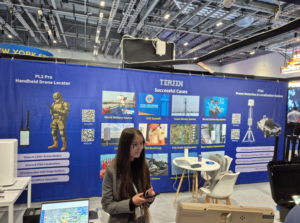
It is unusual to see quite so many Chinese defence and drone companies promoting their products to a western audience, given the supply chain agreements between China and Russia and the highly restricted and legally complex procedures in place for promoting Chinese defence equipment in the UK. While most Chinese exhibitors were at DroneX to promote their battery and component products Terjin Shanghai exhibited its fully integrated RF-based detection, identification, and jamming AI-based low latitude platform while Shengying Technology Co Ltd featured its 7-inch FPV interceptor with AI-assisted guidance, delivering up to 300 km/h and a 300 g payload capacity.
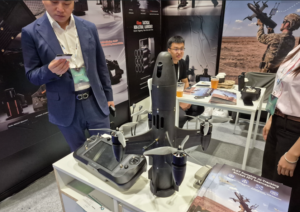
 

C-UAS interceptors are becoming smaller and faster. Denmark’s XTRAFLY 10-inch VTOL high-speed interceptor has an impressive top speed of 390km/h and an endurance of 35 minutes. The UK’s OMD has built a 5 inch interceptor with a 400 plus km/h speed and an endurance of 10 minutes and a 7 inch version with a speed of 300 km/h and an endurance of 25 minutes.
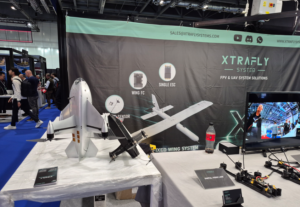
Singapore was also well represented in the C-UAS space. DroneSense and Inphoeni both had large stands to promote fully integrated detect, classify and mitigate C-UAS systems.

The September issue of the 2026 Unmanned Airspace Global Counter-UAS Systems Directory is now available. The guide is the world’s only comprehensive, continually updated directory of global C-UAS companies and systems. It itemises over 1,000 C-UAS products and services with performance details, company sales and partnerships arrangements. It is updated every month and broken down into niche sub-sectors (net-capture, missiles, intercept drones, detectors etc) to give C-UAS procurement and industry personnel a unique perspective of global C-UAS technical capabilities and market positions. It is available in word, PDF and excel formats and Unmanned Airspace readers are eligible for a range of discounts. For more information about the Directory please contact the editor Philip Butterworth-Hayes at philip@unmannedairspace.info.


The post Counter-UAS technology at DroneX – Ukraine shines and China surprises first appeared on Unmanned airspace.

  •  

SkyDrive announces plans for 146 Osaka rooftop vertiports

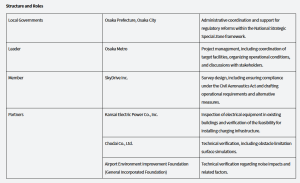
Japanese eVTOL developer SkyDrive reports it will launch a feasibility study to repurpose existing rooftop emergency landing sites in Osaka City as eVTOL vertiports. This project, part of the Cabinet Office’s Super City Initiative, will be conducted with collaborating partners including Chodai Co Ltd, Kansai Electric Power Co Inc, and Organization of Airport Facilitation, said the company in a press release.

The project will conduct a phased evaluation to determine the viability and prospects of repurposing existing building rooftop emergency landing zones in Osaka City into operational vertiports for eVTOL aircraft, focusing on the following core areas:

The study involves evaluating high-rise structures in Osaka City that feature established emergency landing zones (identified by an “H” symbol). By utilizing airspace maps, the project will categorize and examine flight operations by district and confirm compliance with Civil Aeronautics Act standards. The project will analyze locations where building-induced winds occur to clarify safe weather and operational requirements. Additionally, it will simulate noise levels during takeoff, landing and flight.

“To evaluate the feasibility of establishing alternate vertiports for eVTOLs, the survey will assess floor load capacities to withstand aircraft landings, map out passenger movement flows during flight diversions, and establish logistics for transporting aircraft in cases of mechanical failure,” said the company. “Additionally, it will evaluate the feasibility of installing charging infrastructure, determine necessary upgrades or new installations for power receiving and transforming equipment, and calculate estimated project costs.”

SkyDrive and its partners will consult with relevant organizations, including the Osaka Municipal Fire Department, to draft emergency scenarios and coexistence rules that balance the original purpose of “disaster response and lifesaving operations” with “ensuring safety in the daily operation of eVTOL.”

Following their collaboration at the Expo 2025 Osaka, SkyDrive and Osaka Metro are working toward the commercial launch of eVTOL services by approximately 2028 within Osaka Prefecture and Osaka City, areas recognized by the Cabinet Office as “Super City National Strategic Special Zones” for their commitment to an “optimally mobile society” through advanced technology. A significant obstacle to the widespread adoption of this next-generation mobility is the scarcity of vertiport hubs. Establishing new takeoff and landing sites from the ground up is particularly impractical in dense urban centers where available open space is severely limited, said the company.

Currently, Osaka City contains 146 rooftop “emergency landing sites” (marked with an H), primarily on buildings over 100 meters tall as required by local fire safety regulations. While these sites constitute an established infrastructure network — complete with reinforced flooring, fire suppression systems, and lighting — their utilization is presently limited to emergency disaster relief. These valuable assets remain exclusively for emergency use because securing commercial passenger transport permits for their use as alternate vertiports, remains a significant regulatory challenge.


The 146 existing rooftop emergency helipads across Osaka City were designed exclusively for disaster response, unlike most previous eVTOL hub projects that centered on constructing new infrastructure. “Consequently, comprehensive operational guidelines and targeted regulatory frameworks for converting these sites into commercial vertiports are still being developed,” said SkyDrive. “A central element of this initiative combines desktop research with direct on-site building assessments. This dual approach provides the concrete operational and safety data required to obtain regulatory clearances. Ultimately, the insights gained will inform future vertiport construction standards. By adapting this methodology to other regions with comparable needs, we seek to accelerate the broader integration of next-generation mobility into daily life.”

The company has also announced the appointments of Taiji Ono as executive vice president and head of global business, and Gonzalo Ramos as global commercial officer. “Under this new executive leadership structure, SkyDrive will accelerate its preparations for commercial operation and service launches in Japan and around the world, specifically advancing route development and establishing operational frameworks,” said SkyDrive

For more information

https://skydrive.co.jp/en/news/73083/#:~:text=Building%20on%20its,Editor%E2%80%99s%20Notes%3A

SkyDrive Strengthens Executive Leadership to Accelerate Global Commercialization and Business Expansion – SkyDrive Inc.

(Image: SkyDrive)

The post SkyDrive announces plans for 146 Osaka rooftop vertiports first appeared on Unmanned airspace.

  •  
❌