But investor sentiment tells a very different story.
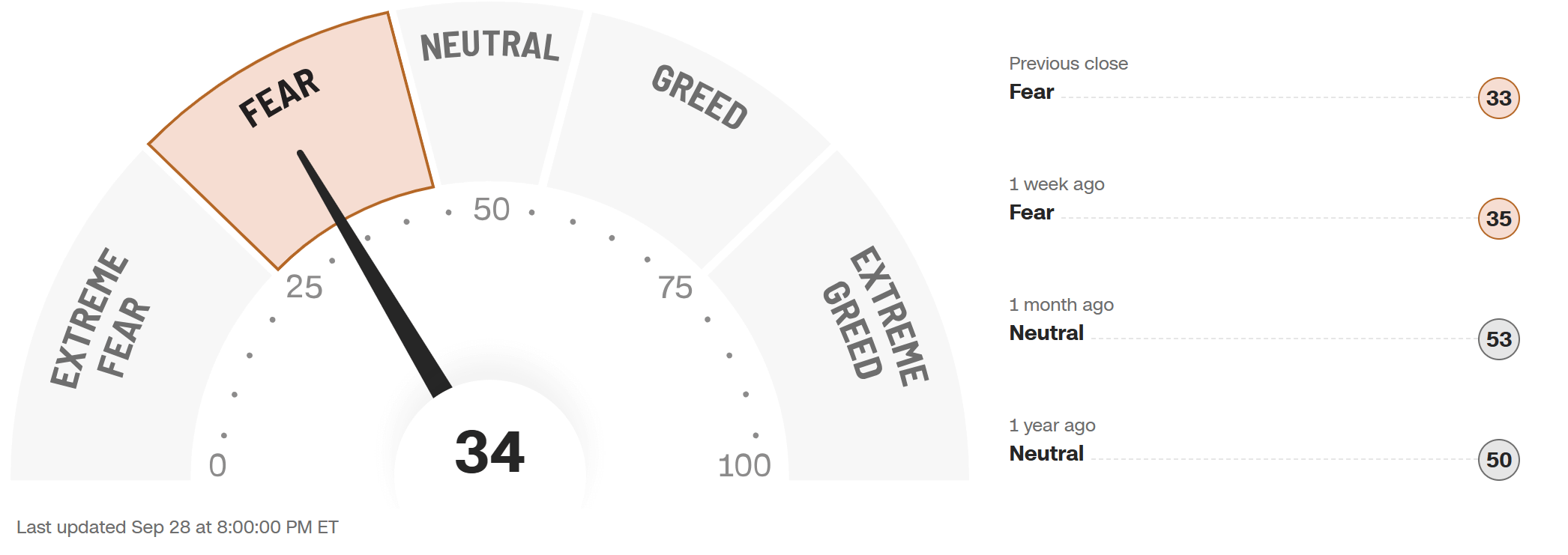
The Fear & Greed Index is currently at 34, Fear.
That’s up slightly from 35 last week, but still firmly in fear territory. Just one month ago, the index was at 53, in Neutral.
So what is going on?
The S&P 500 closed at 7,743 on September 25, close to its all-time high.
Yet underneath the surface, the market looks much weaker.
Two of the seven components in the Fear & Greed Index are particularly telling.
As of September 23, stock price strength scored 2 and stock price breadth scored 0. Both are deep in extreme fear territory.
In simple terms:
A relatively small number of huge companies are keeping the index near its highs, while a much larger number of individual stocks are struggling.
And that’s exactly where I think things get interesting.
The index isn’t on sale, but a lot of individual quality businesses are.
All five companies below have fallen significantly from their highs.
More importantly, in each case, the business itself is still performing.
That gap between the business and the stock price is what we’re looking for.
This is not investment advice. Always do your own research and make your own investment decisions.
Invest in Quality is a reader-supported publication. To receive new posts and support my work, consider becoming a free or paid subscriber.
Top 5 Quality Buys, September 2026 🚀
1. Fair Isaac 💳
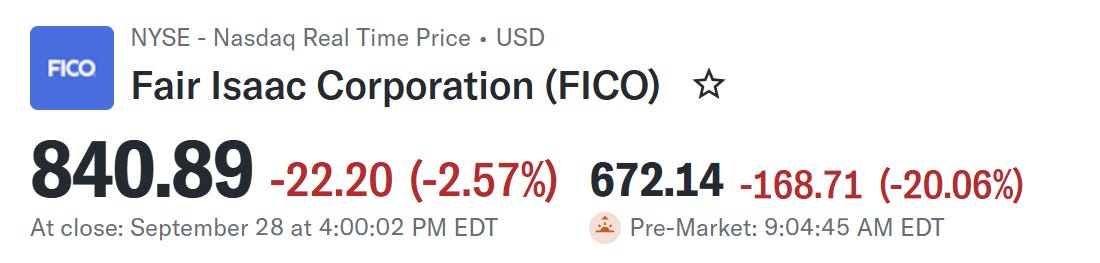
Note: As of this writing, Fair Isaac is -20% in the pre market:
Sending the stock price to $672. So what is going on?
The US housing regulator just made it much easier for mortgage lenders to use VantageScore, a rival credit score that’s far cheaper than FICO’s.
On top of that, one of the big credit bureaus promised to keep VantageScore at just 99 cents per score until the end of 2028.
Investors worry FICO can no longer keep raising its prices, and those price increases have been its main source of growth
A great business facing a real threat.
FICO is down massively, and just keeps dropping.
The question we must try to answer is:
Will the business deteriorate as much as the stock price?
Let’s dive into it.
The Business
FICO makes the credit score that lenders use when deciding whether to approve a loan, and what interest rate to charge.
Every time a lender pulls a FICO score, FICO gets paid.
The company also sells decision-making software to banks and other financial institutions.
The credit scoring business is the real profit engine.
And mortgages are especially important.
Mortgage originations account for 71% of B2B Scores revenue and 62% of total Scores revenue.
That concentration is important to understand because it also explains the biggest risk to the investment.
We’ll come back to that.
What’s Driving Growth?
There are three big drivers.
1. FICO keeps raising prices.
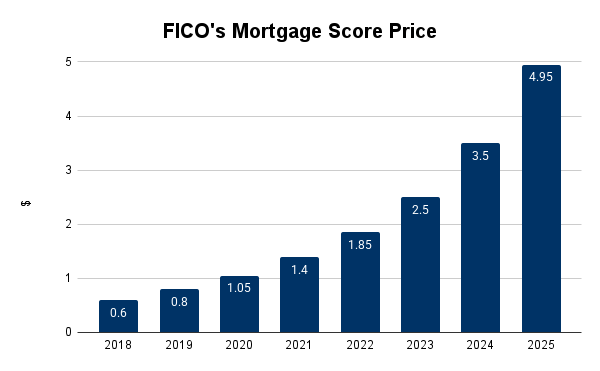
FICO has increased the price lenders pay for its scores aggressively over the years.
It is also changing how it sells those scores. In October 2025, FICO introduced a model that licenses scores directly to mortgage resellers, bypassing the credit bureaus.
2. New mortgage channels are opening.
FICO Score 10T becomes available to FHA lenders from January 1, 2027.
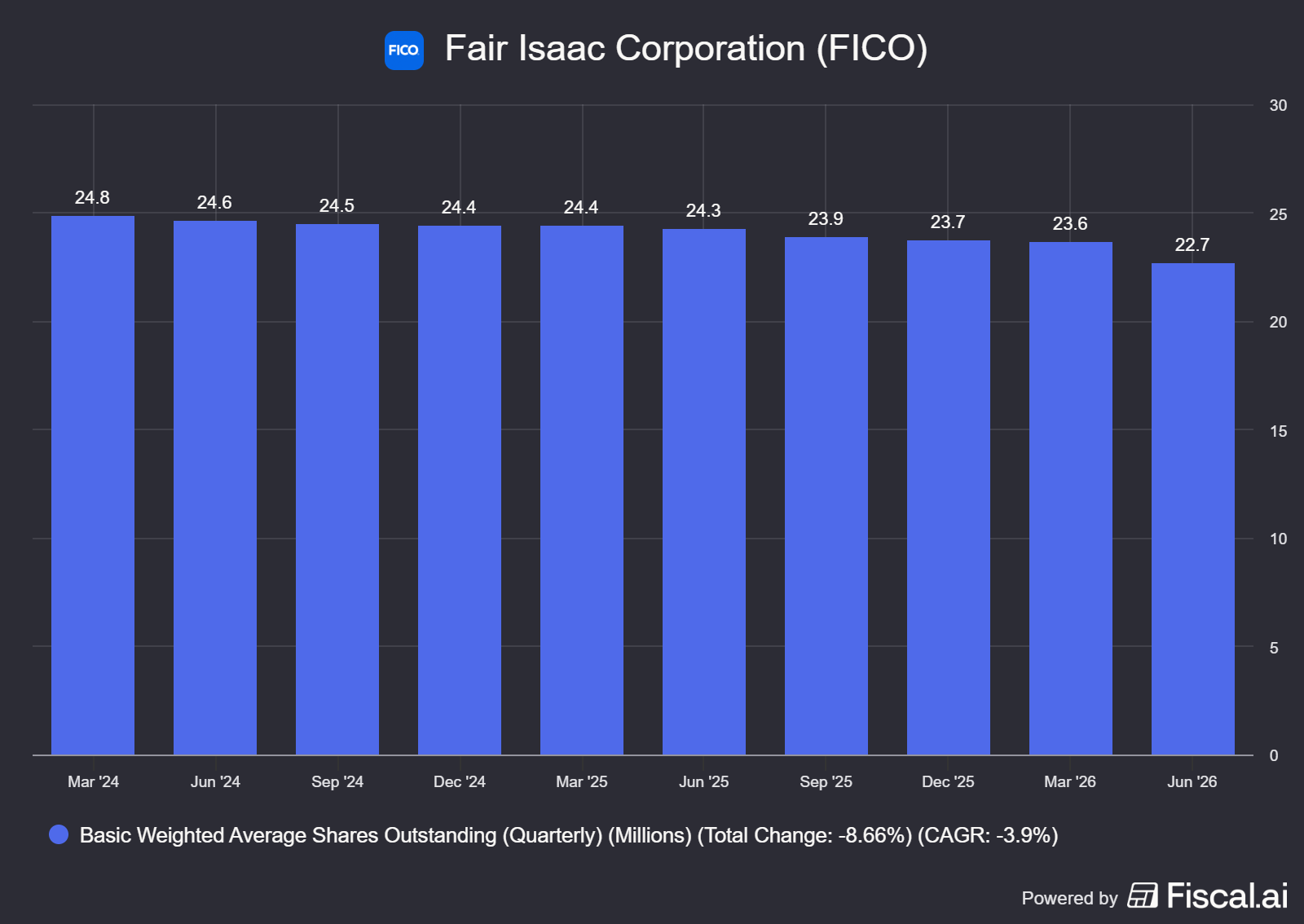
3. The share count is falling.
FICO announced a $1.5 billion accelerated share repurchase, funded through a term loan. The program is expected to be completed by September 30.
The Bull Case
Here’s the interesting part.
The business behind the stock market crash is still growing very quickly.
Fiscal Q3 2026 revenue rose to $674 million, up from $536 million a year earlier.
Free cash flow increased to $370.3 million, compared with $276.2 million the year before.
And Scores revenue grew 41% year over year.
That’s not the picture of a broken business, and competition remains relatively limited for now.
VantageScore, FICO’s main rival, has been allowed into the government-backed mortgage market for several months.
By August 31, VantageScore appeared in about 9% of Fannie Mae and Freddie Mac mortgage securitizations.
So the market is pricing FICO as if its moat has already disappeared.
The numbers don’t show that yet. But the market is forward looking, and hates uncertainty. Hence the huge historical discount for FICO.
⚠️ The Problem: FICO’s Pricing Power Is Under Attack
This is where we need to be careful. The biggest risk isn’t that FICO suddenly stops being used.
The bigger risk is that FICO loses its ability to keep raising prices.
And that pricing power has been one of the biggest drivers of its growth.
On September 3, FHFA Director Bill Pulte instructed Fannie Mae and Freddie Mac to allow all lenders to use VantageScore 4.0 immediately.
Previously, the rollout had involved 50 lenders.
FICO’s stock fell 16.68% the following day.
Wolfe Research had already warned that more than 20% of the mortgage market was exposed to what it calls “score arbitrage”.
That’s when lenders pull multiple scores and use whichever one is most favorable to the borrower.
There is another potential change too.
Pulte said the FHFA is seriously considering “bi-merge”, which would mean using data from two credit bureaus instead of three.
None of this necessarily kills the FICO thesis.
But it does challenge the assumption that FICO can simply continue increasing prices at the same rate forever.
That’s the question I would focus on before buying.
Investors must pay close attention to two things:
Vantagescore market share. Up until now, this has been a pilot with only 50 lenders. It will now be available to all lenders moving forward. 9% share from only 50 lenders could mean that FICO will lose a significant share of mortgages in the coming quarter and beyond.
Pricing power. Can FICO increase prices given the competition? The market thinks not, and at this point, it is probably priced in that they will have to lower prices to be competitive.
The market is very pessimistic on FICO currently, and that is where the opportunity lies if reality is not as dramatic as the current narrative.
The Valuation
FICO is an asset-light software business, so earnings and free cash flow tend to move together.
That makes both P/E and price-to-free-cash-flow useful ways to think about the valuation.
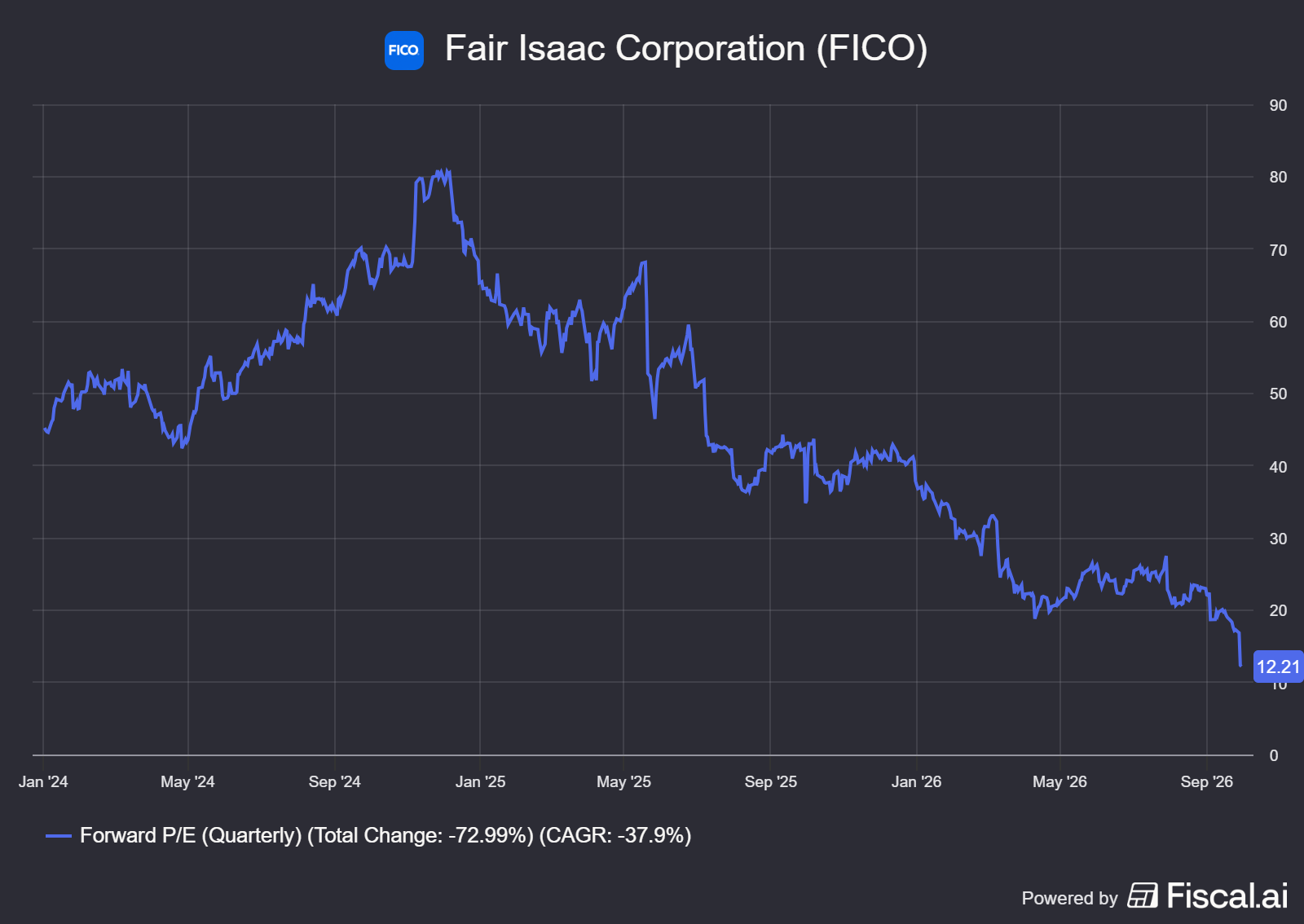
P/E: FICO trades at a staggering 12.21x forward earnings (Down from a top of +80x).
For comparison:
69x in 2025
81x in 2024
41x in 2023
33x in 2022
Its 10-year median is ~34.86x.
The valuation is at its lowest level ever.
And at that point it was not facing a existential threat.
This is currently a risky bet to make, since we don’t know the outcome for FICO.
But, if you have conviction to buy this business at 12x forward earnings, betting that the real outcome is not as pessimistic as Wall Street currently believes, there could be a significant upside (If you are right).
2. Intuitive Surgical 🤖
The best company in robotic surgery, at a much lower valuation
Intuitive Surgical created the modern robotic surgery market.
Today, the stock trades around $405, compared with an all-time high of $610.45.
Again, the question is whether the business has fallen as much as the stock.
The Business
Intuitive sells and leases its da Vinci surgical systems to hospitals.
The simplest way to understand the model is the classic razor-and-blades model.
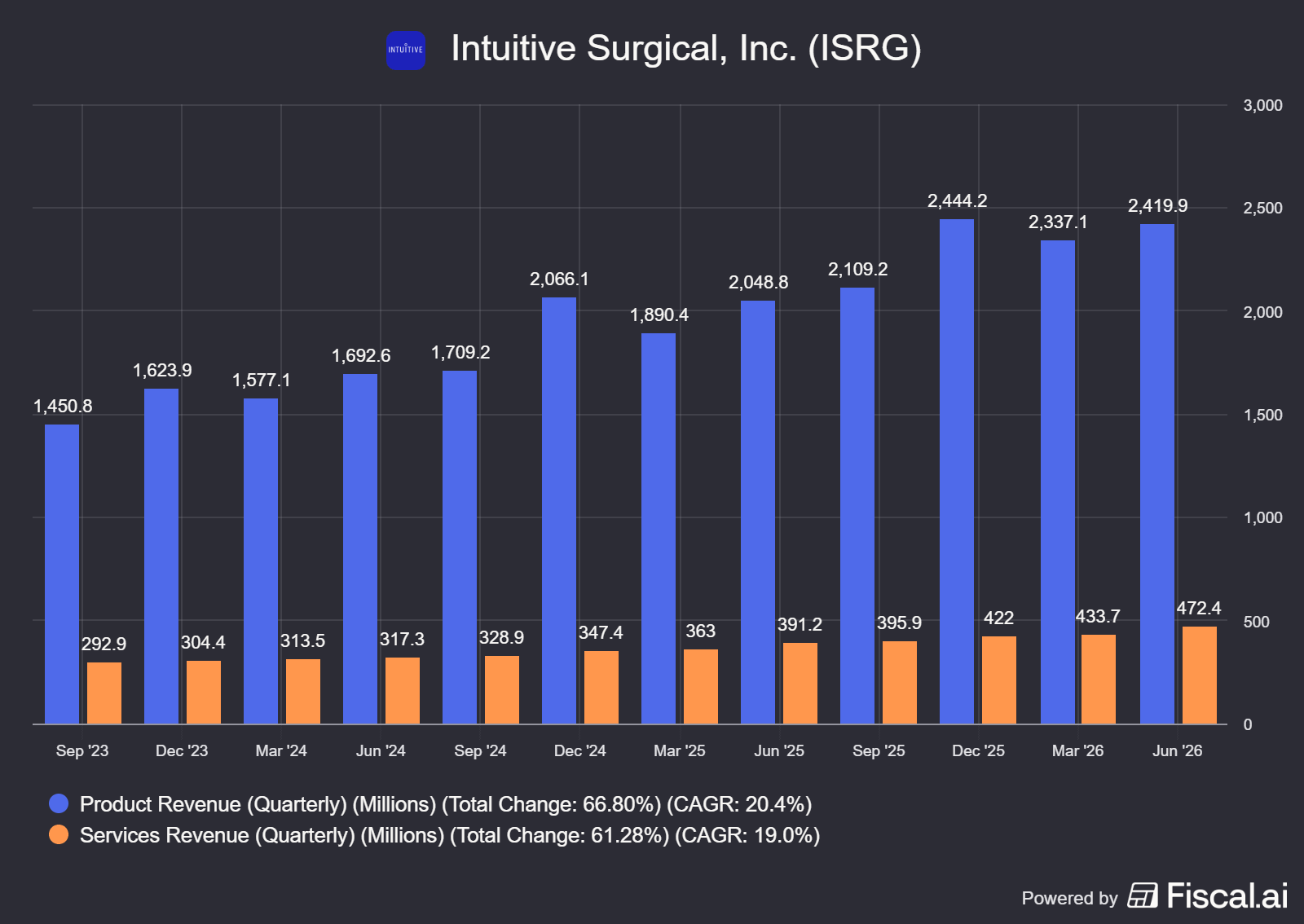
The robot is the razor. The instruments, accessories and service contracts are the blades.
Hospitals pay for those every time the robot is used.
That means Intuitive doesn’t just make money when it sells a robot.
It keeps generating revenue from that robot for years.
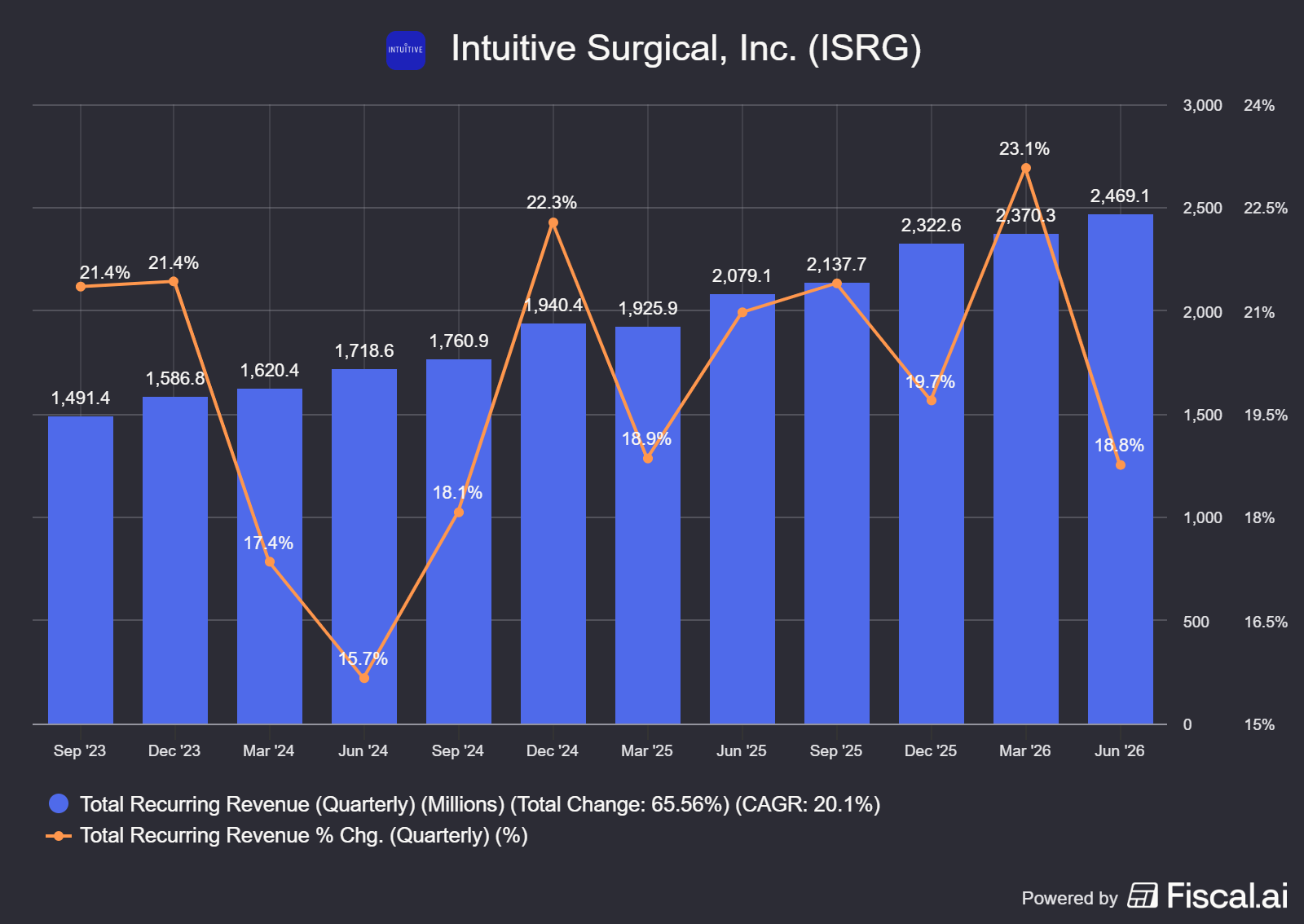
In Q2, recurring revenue reached $2.47 billion, up 19%, out of total revenue of $2.89 billion.
That recurring revenue is one of the most attractive parts of the model.
What’s Driving Growth?
There are three major drivers.
1. The da Vinci 5 upgrade cycle
Intuitive placed 468 da Vinci systems in Q2.
Of those, 246 were da Vinci 5.
About half of US placements were trade-ins, as hospitals upgrade to systems with more computing power and integrated sensing.
2. Ion
Ion, Intuitive’s robotic system for lung biopsies, continues to grow.
Procedures increased approximately 36%.
3. International growth
Japan expanded reimbursement for robotic surgery starting in June.
That helped double system placements there.
The Bull Case
This is the razor-and-blades model working exactly as you’d want it to.
Instruments and accessories revenue rose 18% to $1.73 billion in Q2.
That’s roughly 60% of total revenue.
And every robot installed in the field creates another stream of future revenue.
The installed base has now reached 11,710 da Vinci systems.
The profitability is also impressive for a hardware company.
Non-GAAP EPS increased 28% to $2.80.
Non-GAAP operating margin was 42%.
And the balance sheet is extremely strong:
$8.63 billion in cash and investments and a net debt position of -$5.22 billion.
You rarely get the chance to buy the dominant company in a category it created at a valuation that is significantly below its own historical average.
The Bear Case: US Procedure Growth Is Slowing
The main concern is the US. US da Vinci procedures grew 12% in Q2, down from 14% in Q1.
Management pointed to the expiration of enhanced ACA premium subsidies.
The idea is simple, when patients face higher healthcare costs, elective procedures are easier to postpone.
There are other pressures too.
US bariatric procedure volumes declined in the high single digits as GLP-1 drugs become more widely used.
And Medicaid work requirements expected in 2027 could create another headwind.
At around 35x earnings, slowing from mid-teens procedure growth to low double-digit growth would probably put additional pressure on the valuation.
That’s the risk.
The Valuation
Intuitive is highly profitable and doesn’t require huge amounts of capital to grow.
That makes forward P/E and price-to-free-cash-flow useful valuation tools.
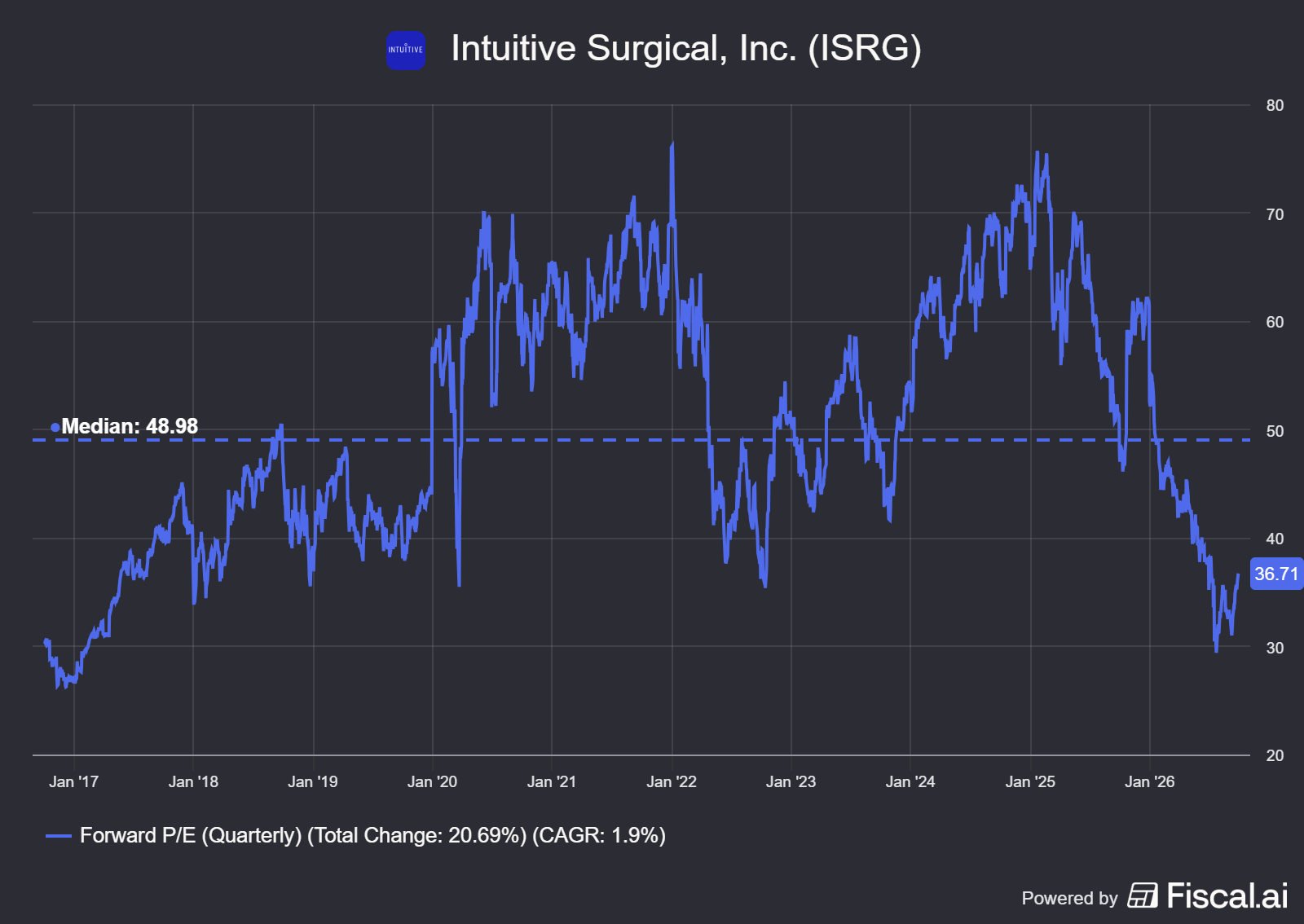
Forward P/E: The stock recently traded at around 30x forward earnings (Now closer to 36x):
The 10 year median is 49x.
Even the 36x forward PE is at a significant discount to the historical median.
So no, Intuitive isn’t cheap in absolute terms.
But it is much cheaper than this business has usually been.
And that’s what makes the setup interesting.
🔒 The rest of this month’s list is for premium members.
Picks 3 to 5 include:
A fintech delivering record results while its stock sits close to its lows.
A real estate data giant reaching a profitability inflection point that the market is underestimating.
And the best set up valuation wise from my own portfolio.
Brookfield Corporation has become a strange stock.
At first glance, the opportunity looks obvious.
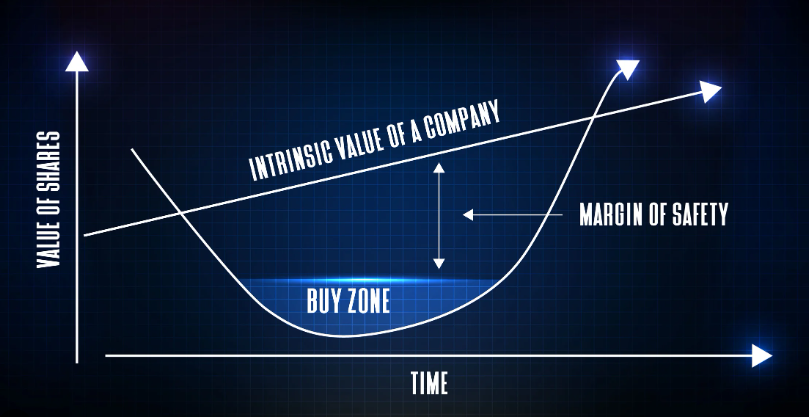
The shares trade at $37, while management says the company is worth $67 per share, a 43% discount.
Brookfield also owns a collection of businesses that are difficult to replicate:
One of the world’s largest alternative-asset managers
A growing insurance platform
Infrastructure
Renewable energy
Real estate
Private equity
And a large exposure to the build-out of AI infrastructure.
And management has a long history of compounding capital.
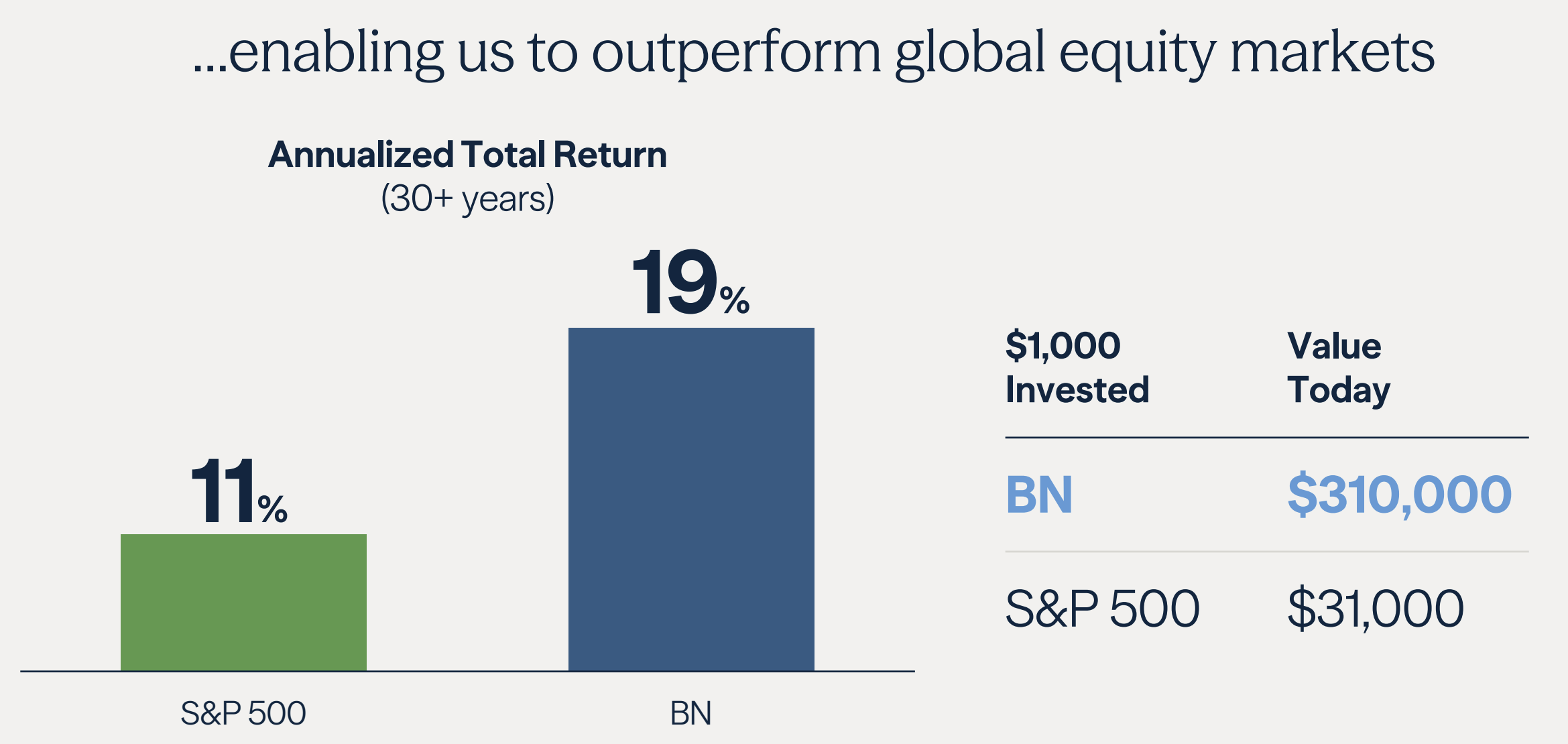
Over the past 30 years, management has compounded capital by 19%, versus ~11% from the S&P 500.
So why is the stock sitting near the bottom of its 52-week range?
Because the 43% discount is not quite what it looks like.
The market is not necessarily saying Brookfield’s businesses are worth 43% less than they are. It is saying something more discrete:
We don’t fully trust the way Brookfield calculates its own value, and we are not yet convinced that the growth promised for the next five years will actually show up.
Our work suggests the shares are probably trading at something closer to a 30% discount to a reasonable intrinsic value, rather than 43%.
A 30% discount for a quality compounder is still interesting.
But it is a very different investment case from simply buying a company at “half price.”
And for investors looking for 15%+ annual returns (Like we are), the difference is important.
Invest in Quality is a reader-supported publication. To receive new posts and support my work, consider becoming a free or paid subscriber.
The first thing to understand: Brookfield is not one business
Brookfield can be difficult to understand because there is a lot going on.
The simplest way to think about the company is that it sits in the middle of several large pools of capital.
It manages money for other people through Brookfield Asset Management, or BAM.
It earns money from its insurance businesses through Brookfield Wealth Solutions.
It also owns substantial stakes in operating businesses across infrastructure, renewable power, real estate and private equity.
And then there is Brookfield’s own balance sheet and permanent capital.
The result is a company where the headline financial statements can look very different from the underlying economics.
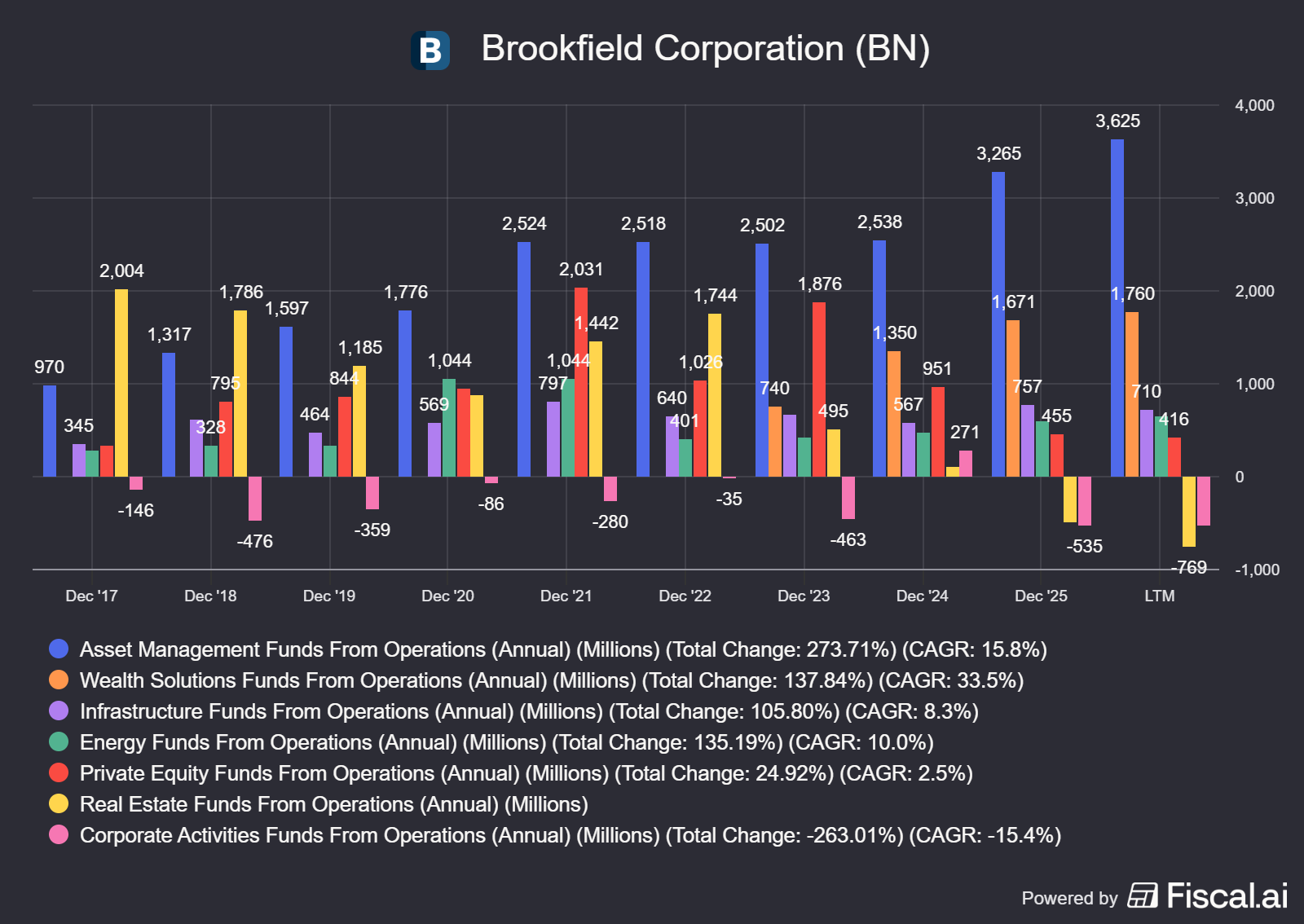
Here is an overview of the different business segments of Brookfield, and their contribution from its operations (There is a lot going on):
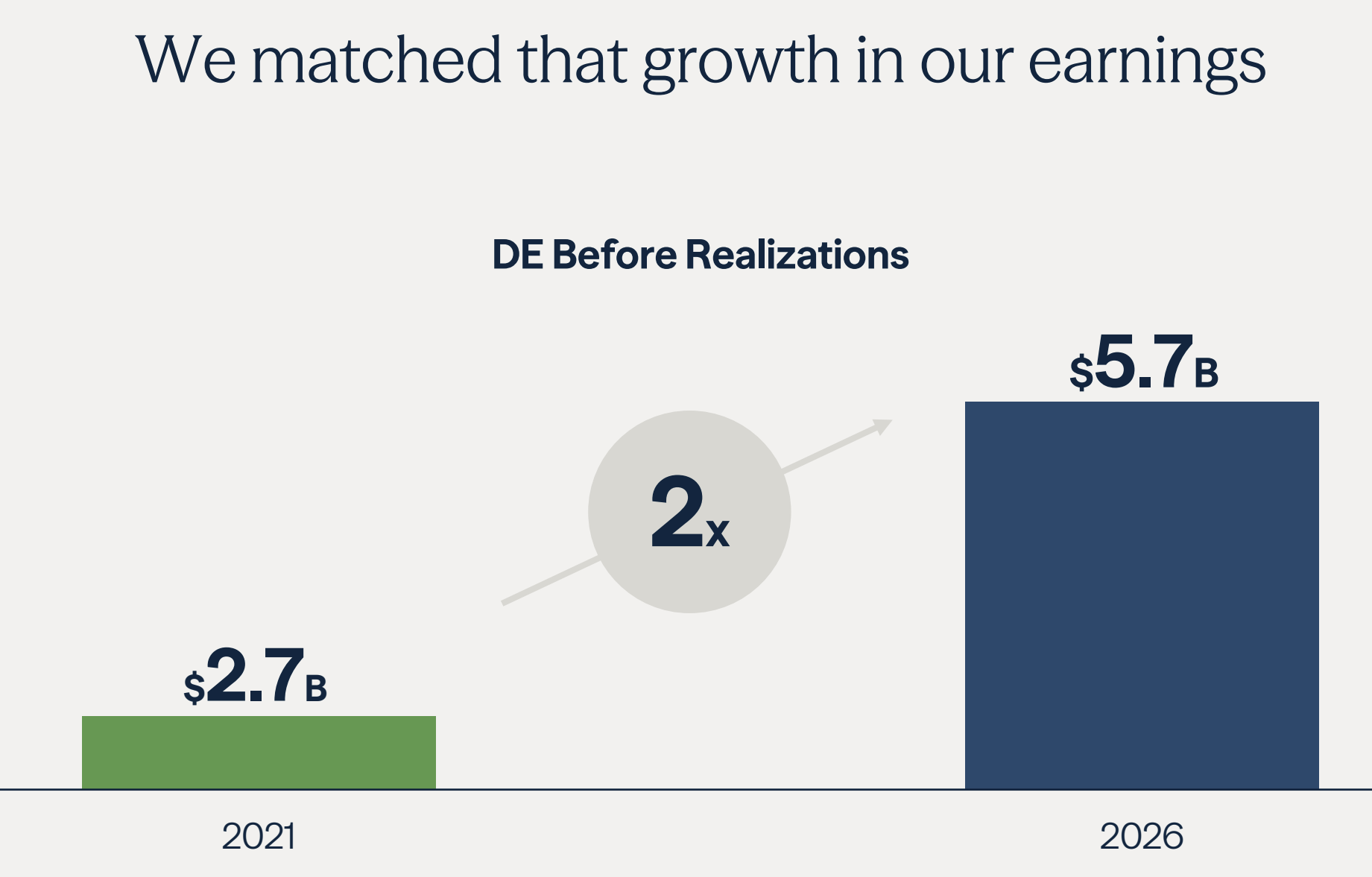
For the last twelve months through June 30, 2026, Brookfield generated $5.65 billion of distributable earnings before realizations, or $2.39 per share.
Including realized carried interest and other gains, total distributable earnings were $6.17 billion, or $2.61 per share.
The earnings mix is also useful.
Asset management contributed $2.94 billion.
Wealth Solutions contributed $1.76 billion.
The operating businesses contributed $1.55 billion.
Corporate costs took away $593 million.
That tells us something important.
Brookfield is increasingly a capital-allocation and asset-management machine, not simply a collection of operating assets.
That can be extremely powerful when capital is flowing in.
It can also make the company much harder to value.
The biggest attraction: Brookfield looks cheap
Let’s start with the bull case.
At $37.85, Brookfield trades at roughly 14.5x trailing total distributable earnings.
That is cheaper than several of its large alternative-asset-management peers.
BAM trades at a much higher multiple.
Blackstone is higher again.
KKR is also more expensive.
Brookfield Asset Management itself trades at more than 26x trailing distributable earnings.
So the market is clearly placing a lower valuation on the parent company.
Part of this makes sense.
Brookfield Corporation is much messier.
It owns listed subsidiaries, private assets, insurance companies, real estate and stakes in businesses that have their own capital structures.
There are also complicated related-party arrangements and several different share classes.
An investor buying a clean fee-earning asset manager has a much easier job.
With Brookfield Corporation, you have to work through the entire structure.
And the market charges you for that inconvenience.
The question is if this discount is too steep for the inconvenience, management’s answer is obviously yes.
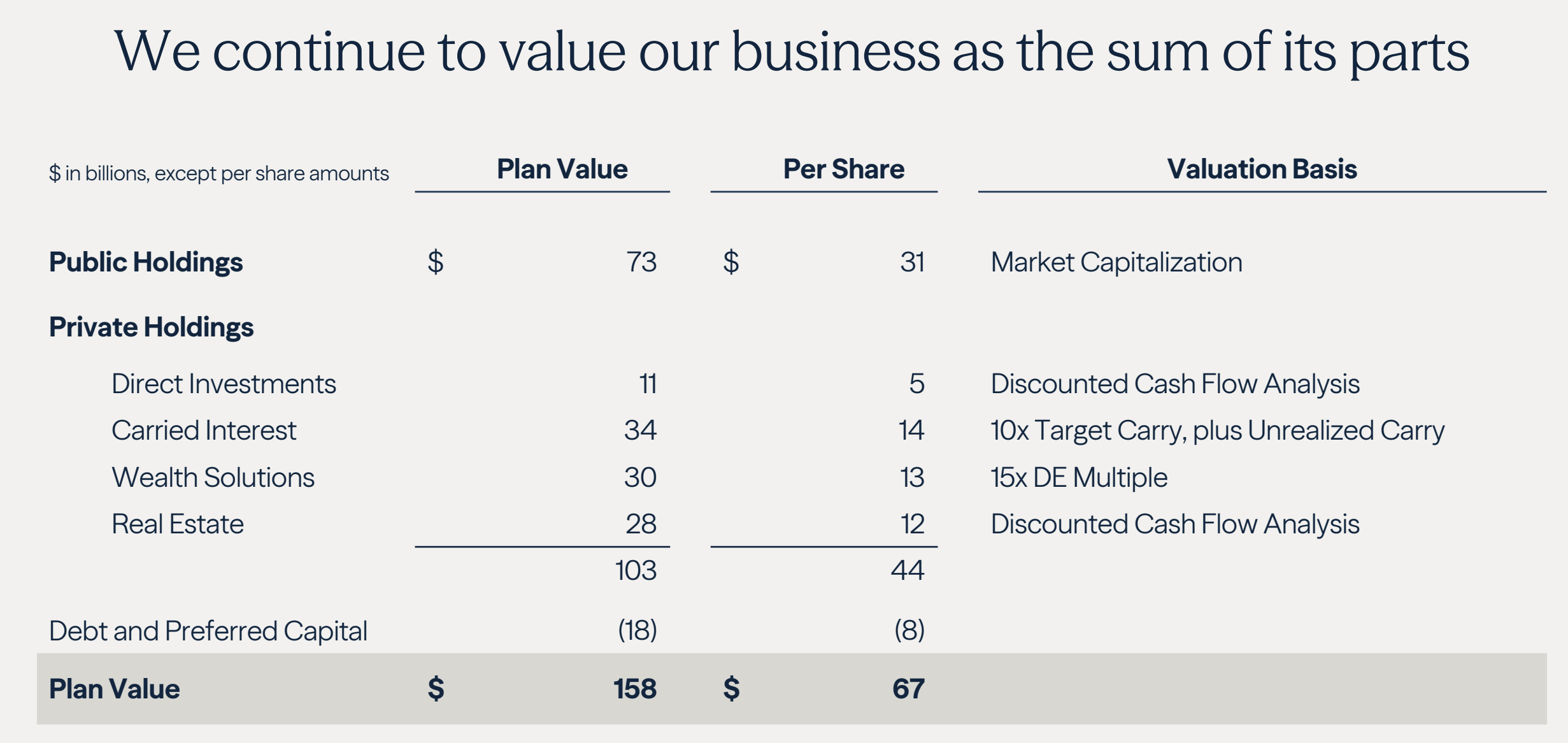
This is a breakdown of how management values the sum for all parts:
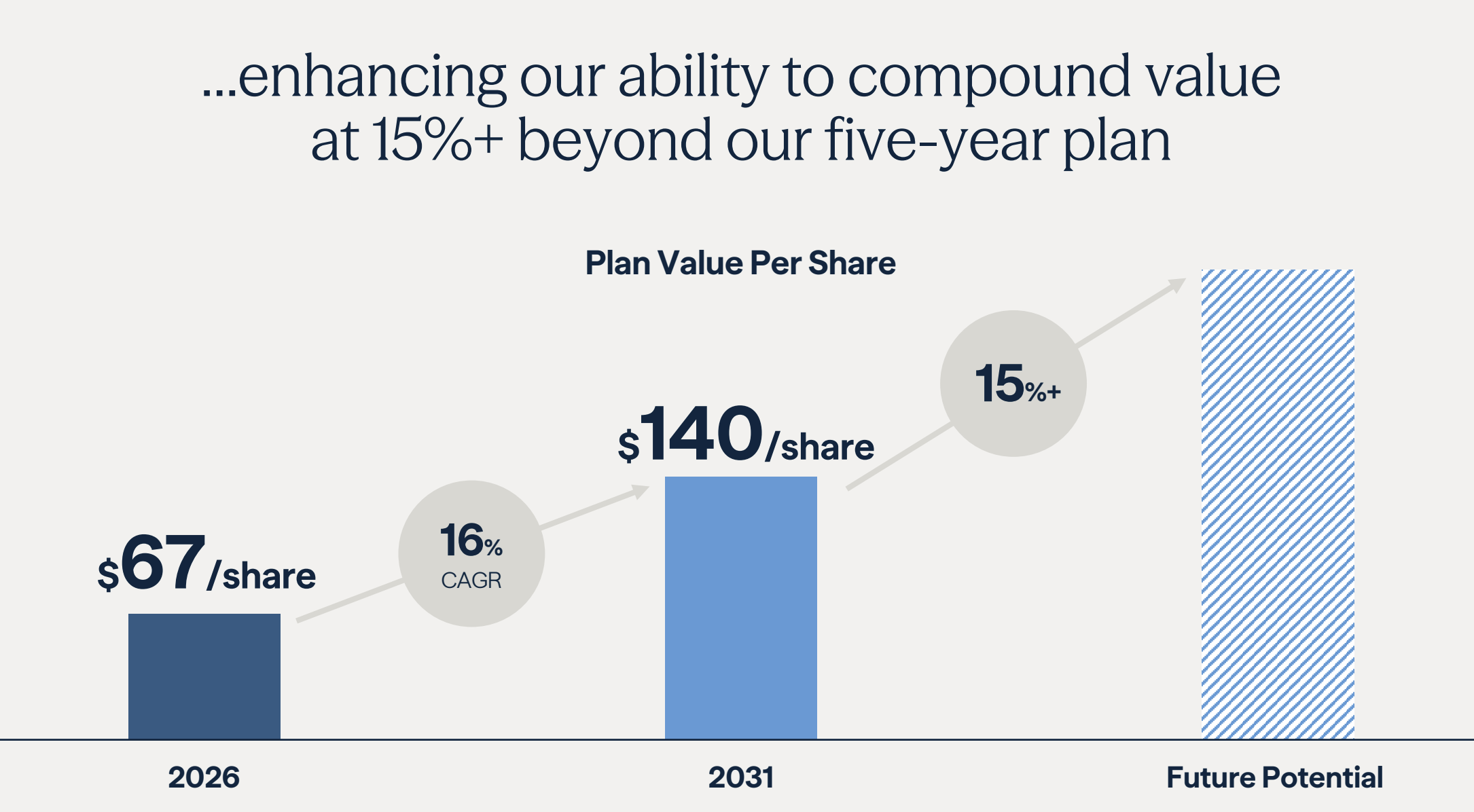
Brookfield puts its own plan value at $67 per share.
Against a stock price of $37.85, that is a ~43% discount.
Management is even more aggressive for its 2031 plans, to reach a plan value of $140 per share.
But this is where we need to slow down and go into the fundamentals.
Management’s $67 number is not the same thing as market value
Brookfield’s plan value is essentially a sum of the parts.
You value BAM.
You value Wealth Solutions.
You value the operating businesses.
You value future carried interest.
You subtract corporate debt and costs.
Then you divide the result by the share count.
That sounds simple.
The problem is that several of those inputs are not market prices.
They are Brookfield’s own assumptions.
This is especially important for the operating businesses and real estate.
Brookfield can look at an asset and say it is worth a certain amount based on what it believes a private buyer would pay.
That might be correct, but it might also be optimistic.
The market does not have to accept that number.
When we value Brookfield using more conservative, market-based assumptions, the range comes out around $30 to $50 per share, with a midpoint around $40.
In other words, the current share price is around the middle of a reasonable market-marked valuation range.
That does not mean Brookfield is expensive.
It means the “43% discount” is probably too aggressive.
Our conclusion is that the true discount is more likely somewhere around 20–35%.
Still meaningful, but investors should not build the thesis around getting $67 worth of assets for $37.
The more defensible thesis is:
You are buying a high-quality and increasingly powerful collection of businesses below a reasonable estimate of intrinsic value, but you are accepting a large complexity discount in exchange.
The biggest problem right now is not valuation
It is growth.
This is where the Brookfield story becomes much more interesting.
If you only looked at the five-year targets, you could come away thinking Brookfield is about to accelerate dramatically.
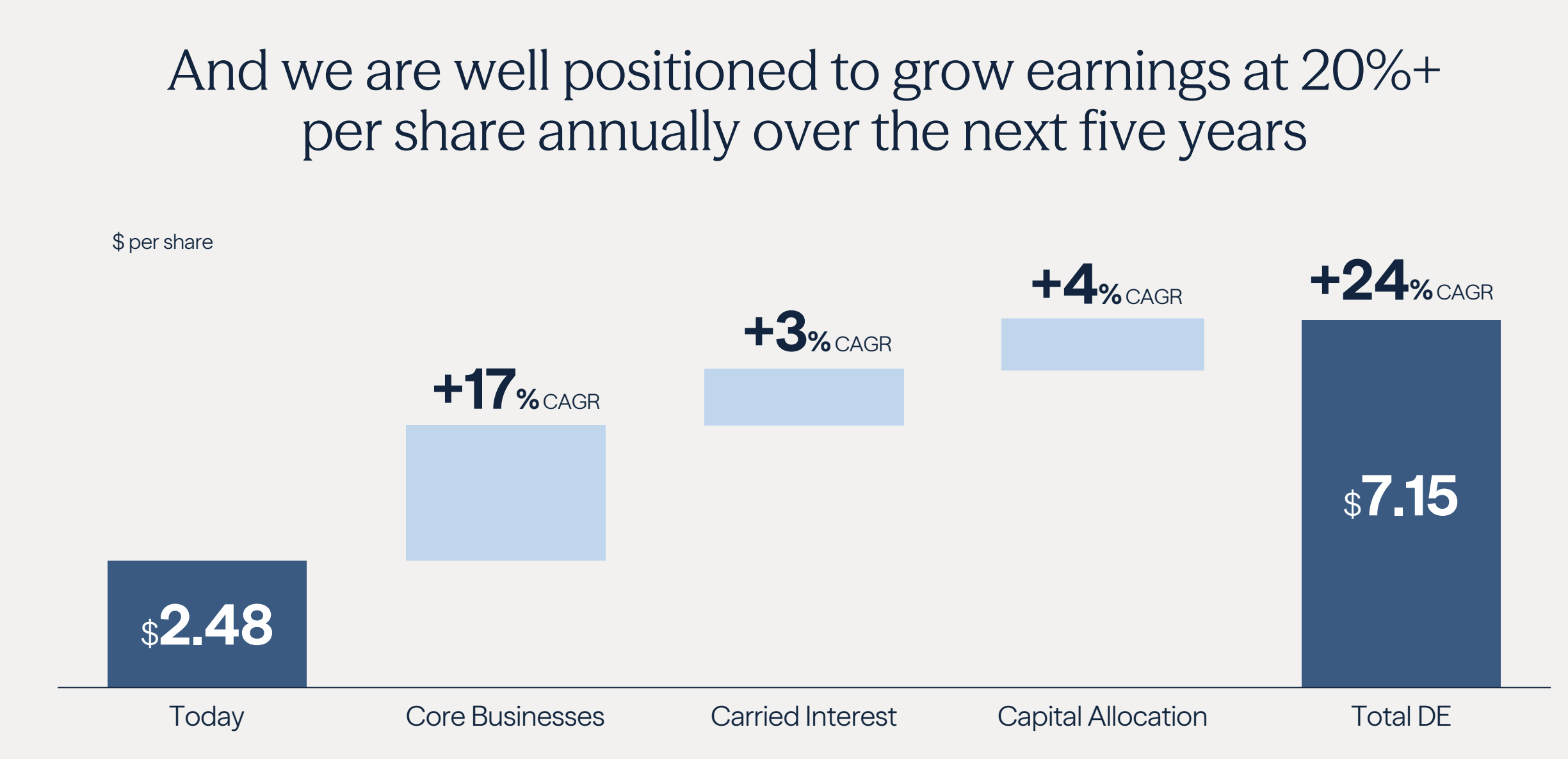
Management is targeting roughly 17% annual growth in core distributable earnings over the next five years.
Based on their track record from 2021 to 2026, this is believable, but you also have to believe that growth in distributable earnings before realizations will accelerate.
Wealth Solutions is expected to become a much larger earnings contributor.
Insurance assets are expected to rise substantially.
Fee-bearing capital at BAM is expected to continue growing.
Carried interest should increase as more funds mature.
And Brookfield is sitting directly in the middle of several major investment themes:
AI infrastructure.
Data centres.
Electricity demand.
Nuclear power.
Energy transition.
Private credit.
Retirement savings.
Insurance.
These are all potentially enormous markets.
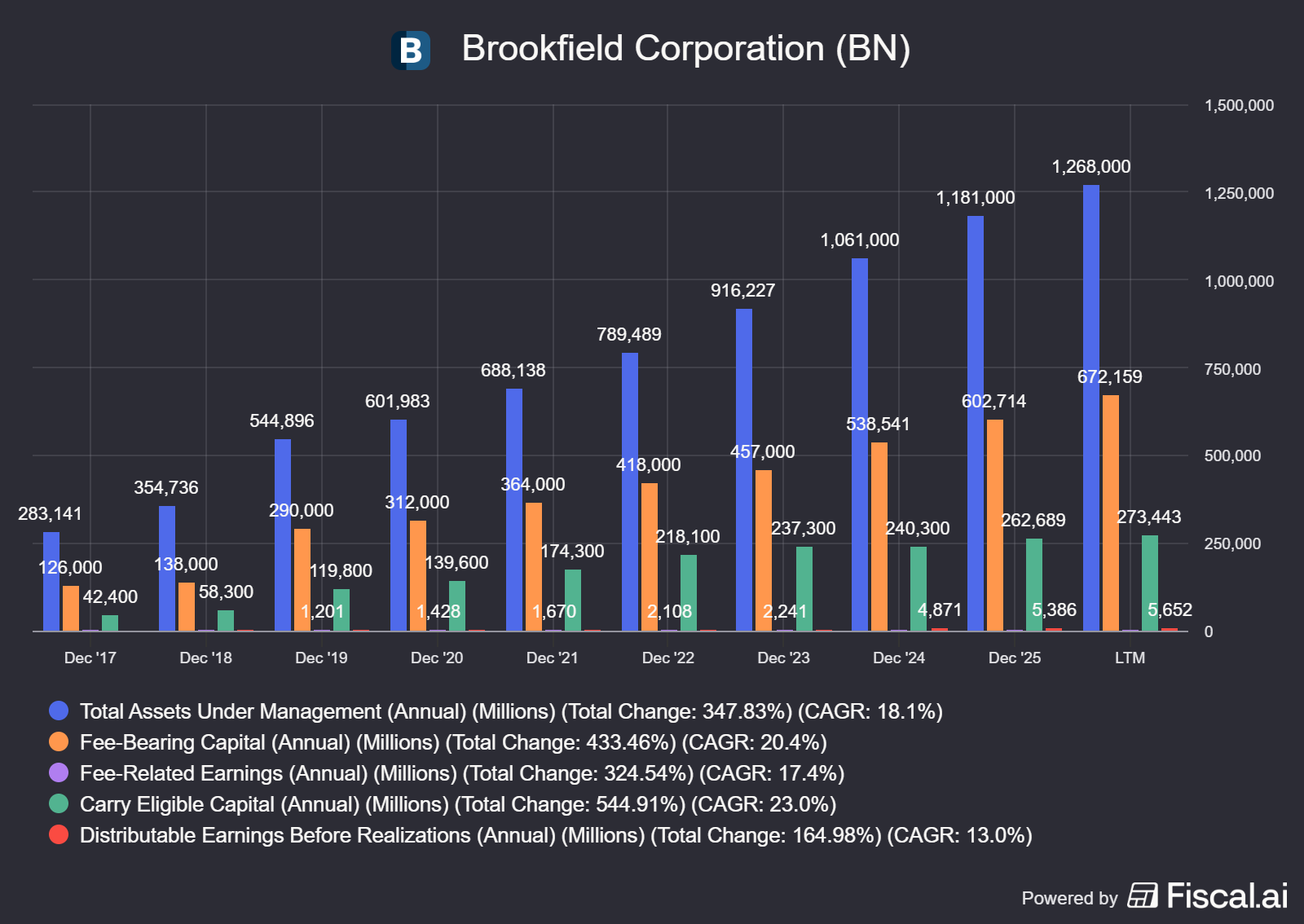
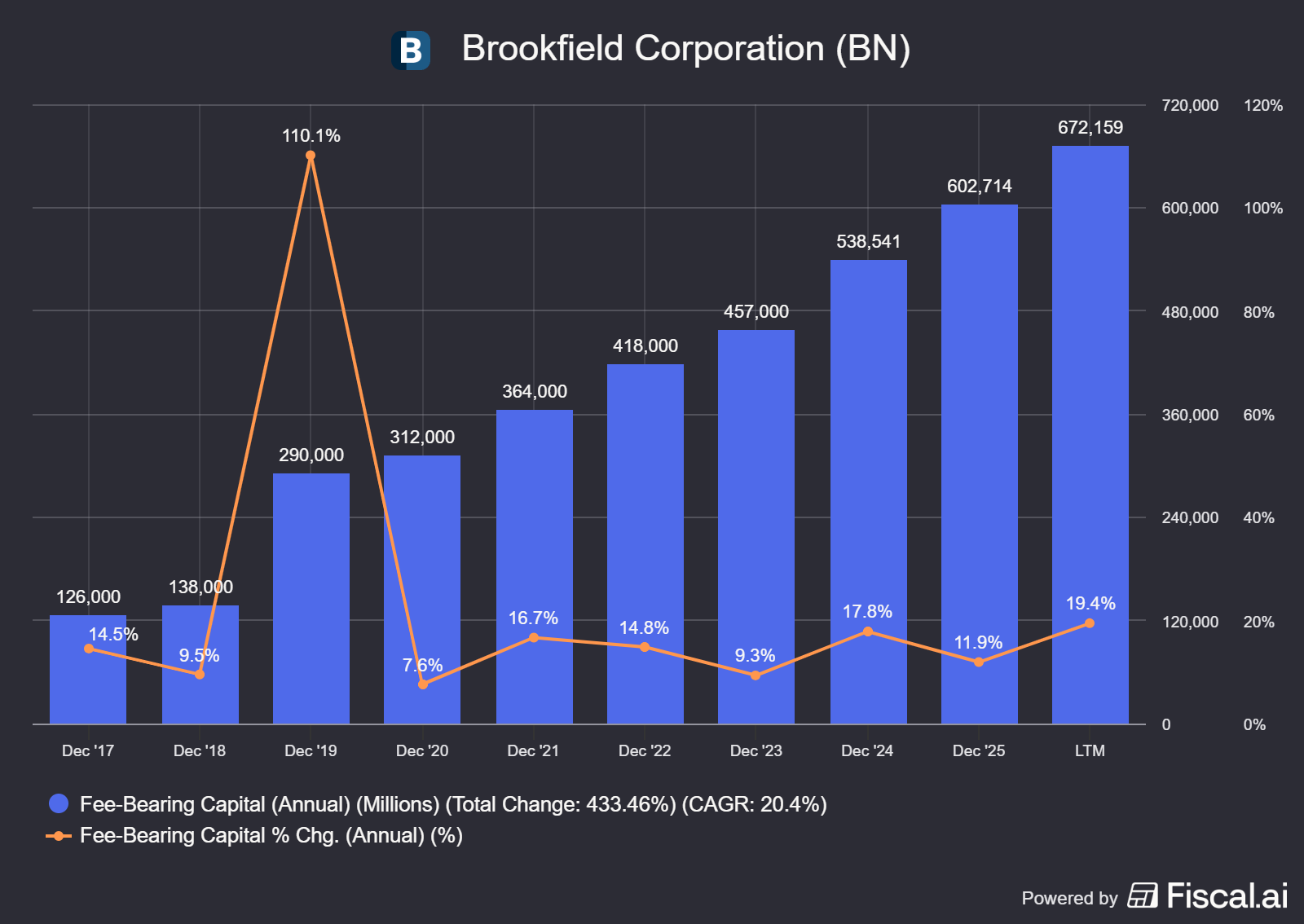
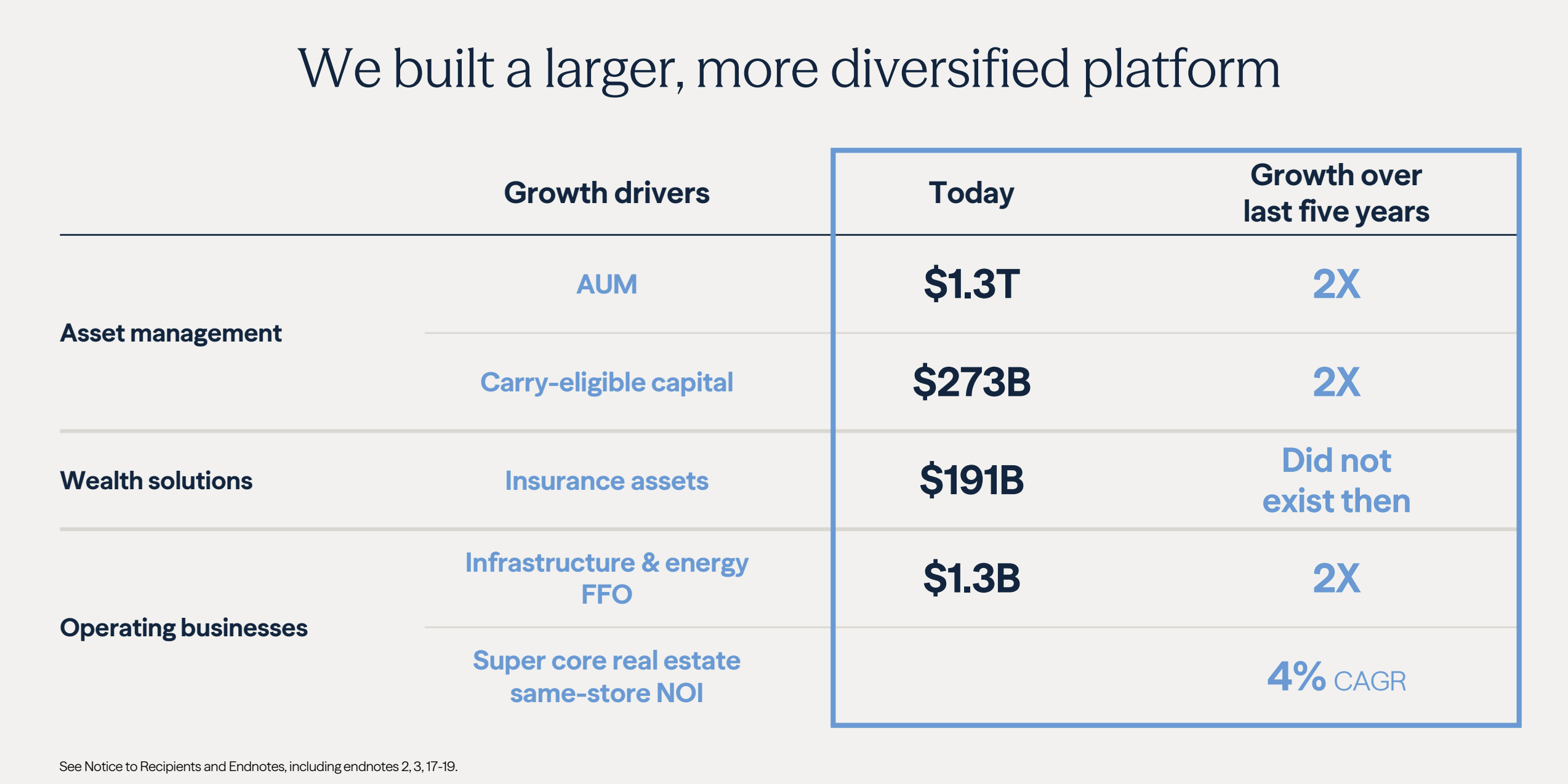
And, againa, if we look at Brookfield’s track record, their KPI numbers are backing this story, growing total assets under management by 18.1% since 2017, Fee-Bearing Capital by 20.4%, and Carry Eligible Capital by 23%.
The problem is that the acceleration is mostly still a forecast to be proven.
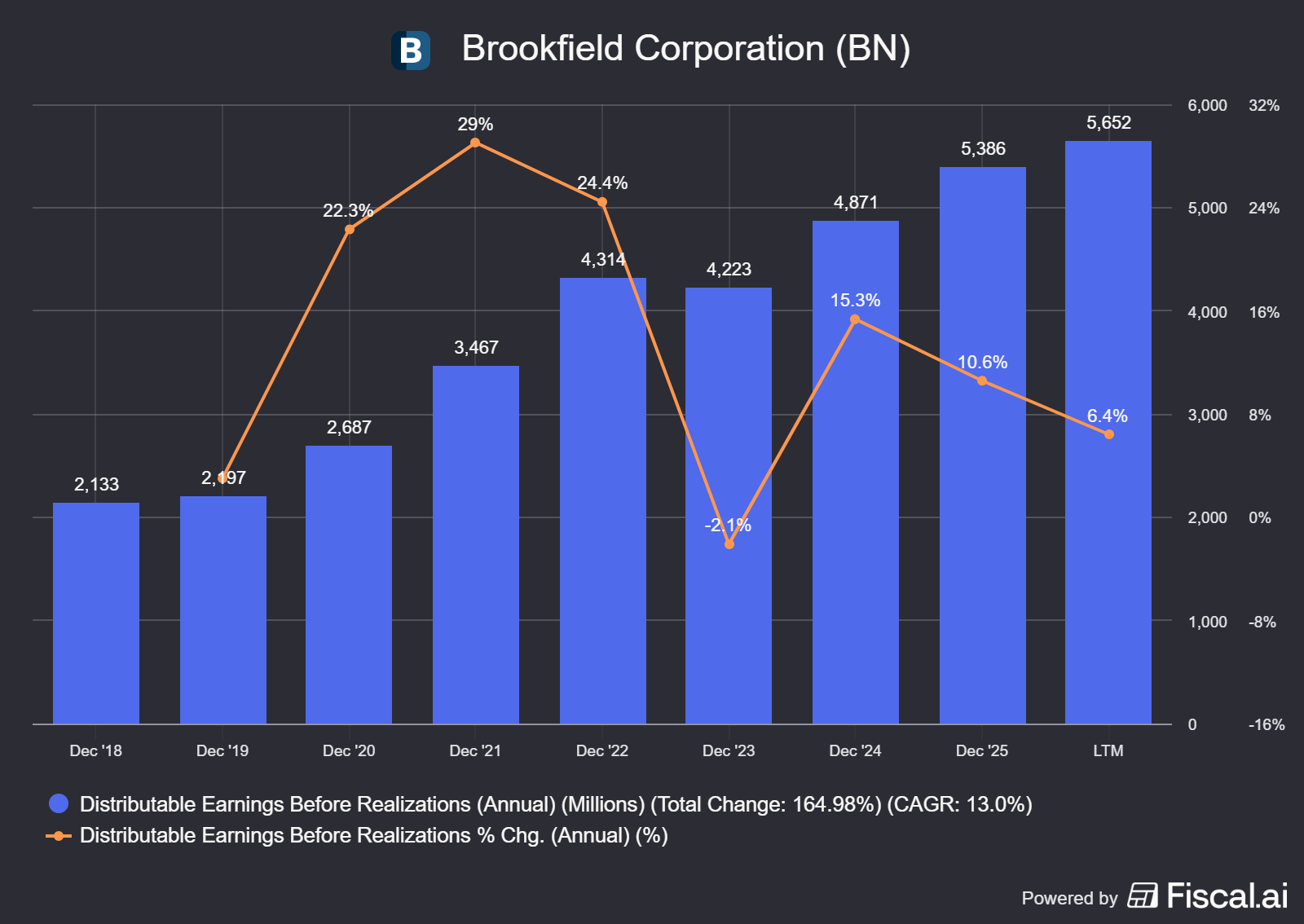
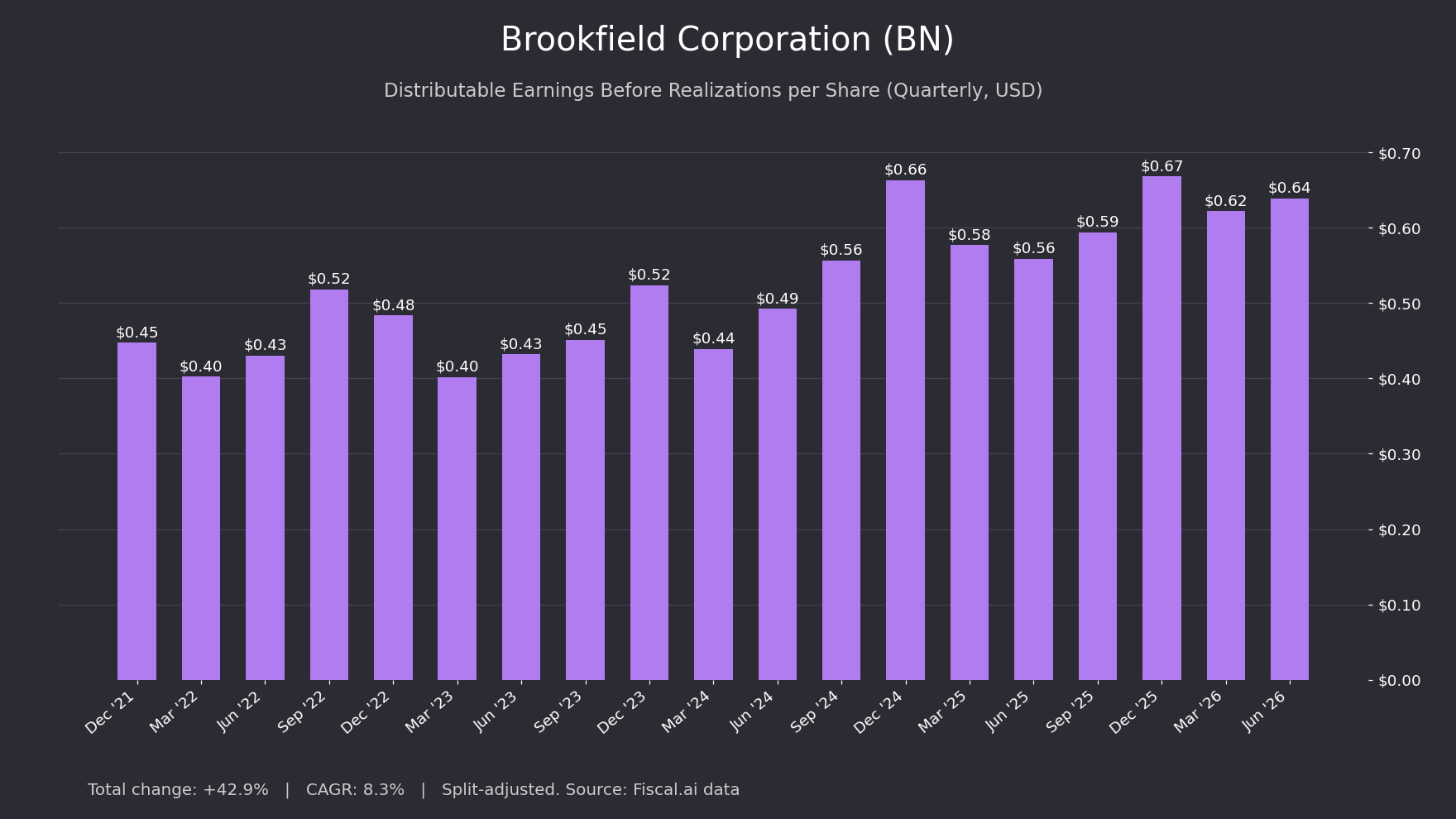
LTM distributable earnings before realizations per share increased only 6.4%.
The growth trend was strong in 2020-2022, but has since fallen:
6.4% is a long way from a sustainable 15%+ growth profile investors are being asked to believe in.
There are also some areas moving in the wrong direction.
Brookfield’s real estate earnings fell 27% year over year.
Plan value per share declined from $68 to $67 over the last year, at the same time that management had been targeting roughly 15% annual progress.
And the $140 plan-value target that was previously associated with 2030 has now moved to 2031.
This does not break the thesis, but it changes how we look at the business. The +15% growth story needs more proof and verification.
The next phase has to be demonstrated in the numbers.
Brookfield’s answer: the growth engine is only getting started
This is where the bull case becomes compelling.
Brookfield has several structural growth drivers that are difficult to ignore.
1. Asset management
BAM’s fee-bearing capital has grown to approximately $672 billion, growing at a steady clip between 10-20% annually.
The stated ambition is to push that beyond $1 trillion.
This matters because asset management is an attractive business.
Once the assets are raised, the manager earns fees without needing to put up most of the capital itself.
And if the fund performs well, Brookfield can earn carried interest on top.
That creates an attractive model:
More capital → more fees → more investment opportunities → more carried interest → more permanent capital.
The challenge is that fundraising alone is not enough.
We ultimately care about earnings per share.
Brookfield needs fee-bearing capital to translate into higher distributable earnings for the shareholder.
The good news is that fundraising remains strong.
Brookfield reported $77 billion of fundraising in Q2 alone and $163 billion over the last twelve months.
Two flagship funds, its latest private-equity and infrastructure strategies, were tracking toward the largest vintages in their respective series.
This supports the growth story, but the proceeds from the capital still needs to reach the income statement over time.
2. Insurance could become a much larger earnings engine
The second major driver is Brookfield Wealth Solutions.
This business owns insurance companies and invests the capital backing their liabilities.
Wealth solutions didn’t even exist 5 years ago, it has gone from 0 to $191 billion:
This business segment creates something Brookfield loves:
Long-duration capital.
Insurance companies collect premiums today and invest that money for many years before they need to pay claims.
Brookfield can therefore put that capital to work in the infrastructure, real estate, credit and other strategies it already knows well.
This creates a powerful flywheel.
More insurance assets mean more capital.
More capital means more investment income.
More investment income can support higher returns and more growth.
Insurance assets were around $191 billion at the end of the latest period.
Management is targeting something closer to $300–375 billion over the coming years.
That is a huge potential increase, with an important catch:
Insurance is one of the areas where we need to be particularly careful with the reported numbers.
Brookfield has highlighted attractive spreads, but parts of those spreads include unrealized gains.
That means some of the headline economics depend on asset values that have not actually been realized.
This does not make the earnings fake.
It simply means we need to understand exactly what is cash income, what is accounting income, and what depends on asset values continuing to rise.
That distinction matters much more in an insurance business than it does in a simple subscription company.
3. AI and power are becoming a real Brookfield opportunity
This may be the most exciting and headline friendly part of the story.
AI requires enormous amounts of electricity.
It also requires data centres, grid connections, transmission infrastructure, cooling systems, land and eventually more nuclear generation.
Brookfield already owns businesses connected to many of these areas.
And it is now moving aggressively into AI infrastructure itself.
One example is the planned $100 billion AI infrastructure build-out at the Paducah, Kentucky site.
When fully built, the project is expected to have up to 1.8 gigawatts of utility capacity and more than 1.2 gigawatts of compute capacity.
Then there is Westinghouse, Brookfield owns 51% of the nuclear company alongside Cameco.
The U.S. Department of Energy has provided a conditional commitment for up to $17.5 billion of financing related to long-lead equipment for up to ten AP1000 nuclear reactors.
Brookfield and Bloom Energy have also expanded a previously announced fuel-cell program from $5 billion to $25 billion.
And Brookfield is one of six major financial firms involved in an NVIDIA-led effort intended to mobilize more than $500 billion of third-party capital for AI infrastructure.
This is important:
Brookfield does not need to put $500 billion of its own money into AI infrastructure.
It can earn fees, carried interest and investment returns by helping finance and manage the capital.
That is the type of structure Brookfield likes.
The opportunity is therefore bigger than simply “Brookfield owns data centres.”
It is that Brookfield is trying to become one of the financial and infrastructure platforms through which the AI build-out gets funded.
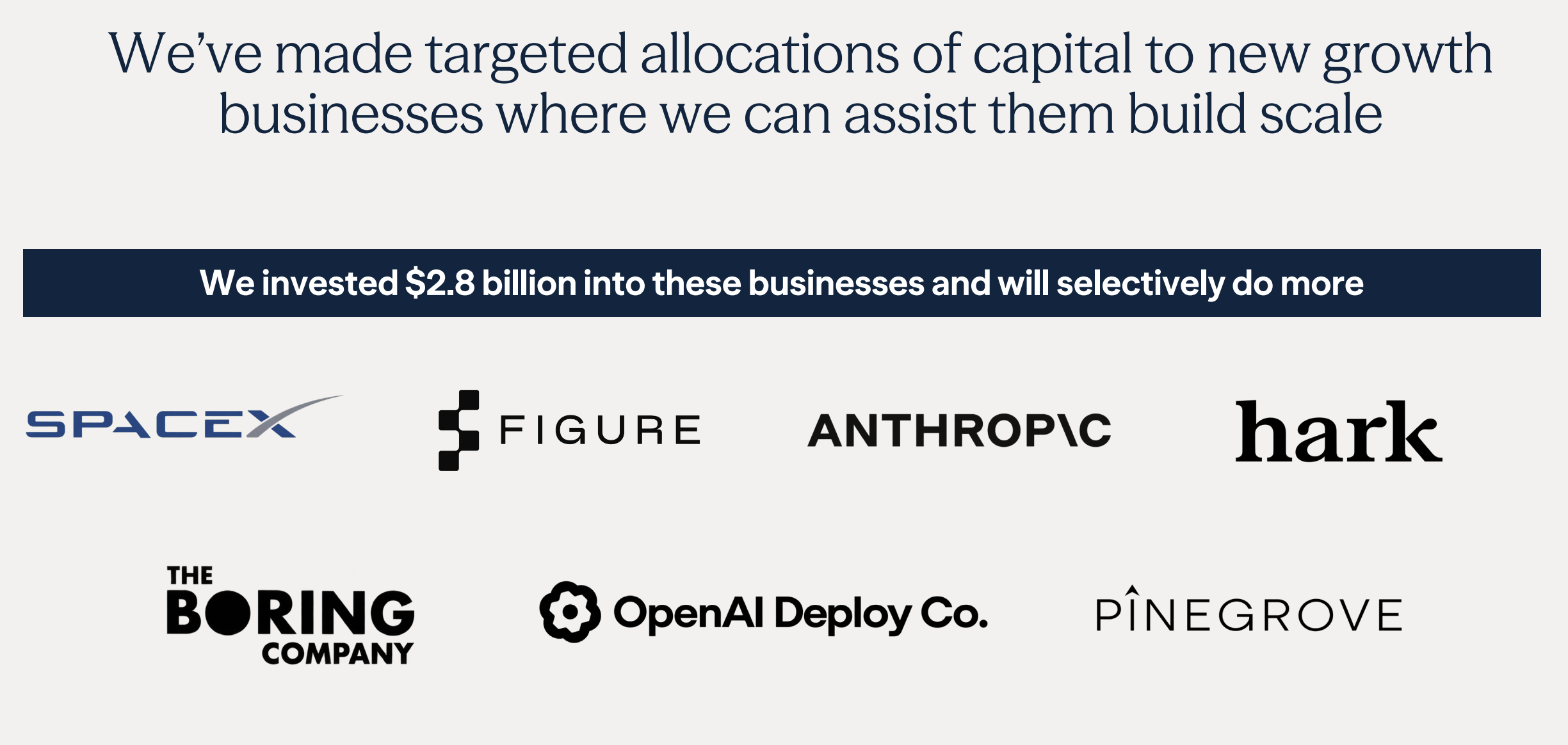
This story is further strengthened by Brookfield’s investment in leading AI and technology companies, such as SpaceX, Anthropic, and Open AI.
But there is a catch to the AI story
The AI opportunity is real, but the economics are not guaranteed.
The biggest risk is concentration.
The underlying projects depend on a relatively small number of very large technology customers and on continued AI infrastructure spending.
This is a large risk overhanging the AI theme for all participants currently.
There is also a degree of circularity in the story.
Brookfield helps finance the infrastructure → Infrastructure companies build the data centres and power assets → Technology companies rent or use those assets → Financial institutions provide the capital.
As long as the economics work, everybody benefits.
But if AI capital spending slows sharply, the entire chain can feel it.
There is another important point.
Much of Brookfield’s AI exposure is through funds and partnerships rather than directly on Brookfield Corporation’s balance sheet.
That reduces the balance-sheet risk.
It also means the economic benefit to BN is more indirect.
Brookfield may generate fees and carry without owning every dollar of the assets.
That is a feature of the model.
It is also why investors should not simply add up every AI-related dollar Brookfield announces and treat it as Brookfield’s own asset value.
The moat is not simply scale
Brookfield is sometimes described as another giant alternative-asset manager.
That misses something, its strongest advantage is the combination of capital and operating expertise.
Brookfield does not just finance infrastructure.
It owns and operates infrastructure.
It does not just invest in energy.
It owns renewable power assets and Westinghouse.
It does not just lend to companies.
Oaktree gives it one of the world’s major credit platforms.
It does not just invest in real estate.
It operates some of the world’s largest and most complicated real-estate assets.
That combination becomes especially valuable when opportunities get complicated.
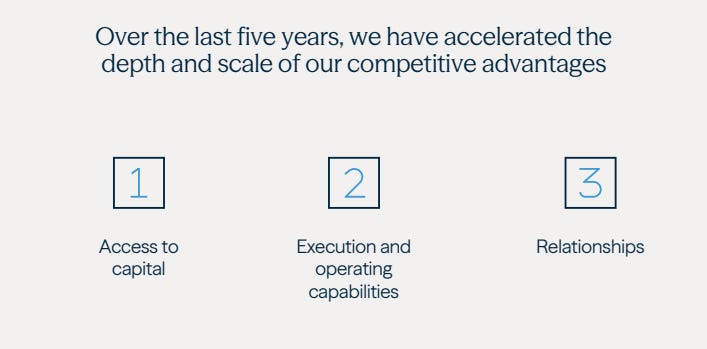
Management states that they have increased the depth and scale of their competitive advantage by building trusted relationships to get better access to capital and increasing the execution and operating capabilities of the organization.
This puts Brookfield in a unique position to be a key player in the energy and AI infrastructure build-out.
A government-backed nuclear development is not something that every private-equity firm can execute.
Neither is a multi-billion-dollar data-centre and power project.
Brookfield can bring financing, operatingexpertise, governmentrelationships and institutionalcapital together.
That is difficult to replicate.
Where the moat is weaker is transparency. Investors can easily see what a listed asset manager charges in fees.
It is much harder to independently verify the value Brookfield assigns to a private real-estate portfolio or operating asset.
And that is exactly why the market applies a discount.
Management: one of the strongest parts of the story
It is hard to discuss Brookfield without talking about management.
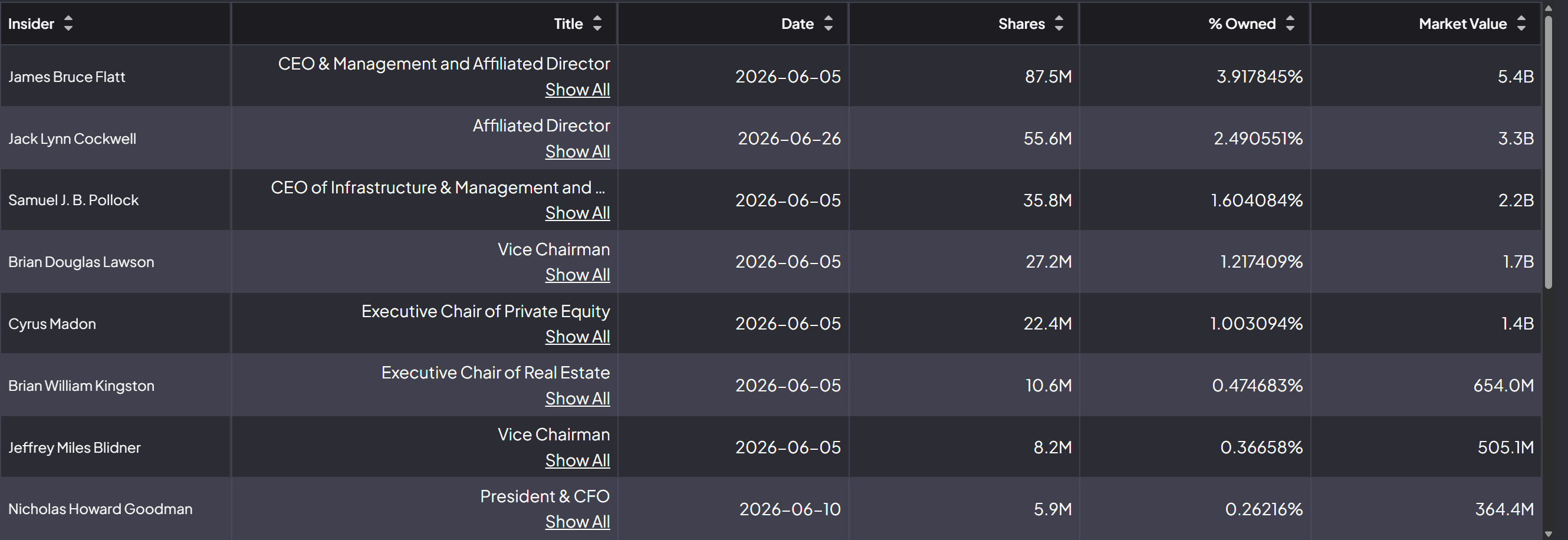
The partnership owns roughly 20% of Brookfield Corporation.
Bruce Flatt personally owns an enormous economic stake with 87.5 million shares, or 3.91% of the company.
The management group owns significant stakes in the business, this is exactly what we want in t compounder - the management’s incentives are 100% aligned with shareholders incentives.
The best possible outcome financially for the group, is that Brookfield is successful, this ensures that management make decisions like owners, and not just an executive manager with a compensation plan (Huge difference).
If Brookfield compounds shareholder value over decades, the people running the company become enormously wealthy.
That is the type of incentive structure long-term investors generally want to see.
And the historical numbers are strong.
Management says plan value per share compounded at roughly 16% over the last five years, from $32 to $67.
Distributable earnings per share grew from roughly $1.29 to $2.54 over the same period.
Brookfield also points to a more than 30-year annualized return of roughly 19%.
This is not a company with a five-year track record that suddenly decided to become a compounder. It has been doing this for decades.
But alignment does not eliminate risk.
Brookfield has a complicated ownership and governance structure.
Related-party transactions are part of the model.
The company has also continued to restructure itself through spin-offs, combinations and simplifications.
Minority shareholders have therefore had to trust management not only on capital allocation, but also on how assets are moved between related entities.
That is manageable when the results are excellent.
It becomes more uncomfortable when performance starts to slow.
Management recently put out its plan to compound at 20% annually for the next 5 years. If they are successful, we will look back at this moment and regret not buying more. If they miss their own guidance, the outcome can still be good.
The Brookfield / Wealth Solutions combination is more about simplification than value creation
A big part of the current story is the combination of Brookfield Corporation and Brookfield Wealth Solutions.
The transaction is complicated, but the economic point is actually quite simple.
The exchange is effectively 1:1.
BWS shares were already exchangeable into BN shares and were already reflected in the diluted share count.
So the combination does not suddenly create a new pile of value for shareholders.
That is important. Investors should not treat the transaction as some huge accretive deal.
The real benefits are structural. Brookfield gets a simpler corporate structure.
It gets more direct access to insurance capital. It gains potential index-inclusion optionality.
And it is expected to transition to U.S. GAAP reporting in 2027.
For a company that has struggled with complexity, that simplification could be a valuable unlock for how the market views and values the business.
But it is not worth paying a premium today simply because the corporate structure is becoming cleaner.
We don’t need Brookfield to hit every management target perfectly.
We do need evidence that the company’s earnings growth is moving back toward the level required to justify the valuation.
There are a few numbers we would watch very closely.
First: Distributable earnings before realizations per share
Not total distributable earnings.
Not gross fundraising.
Not AUM.
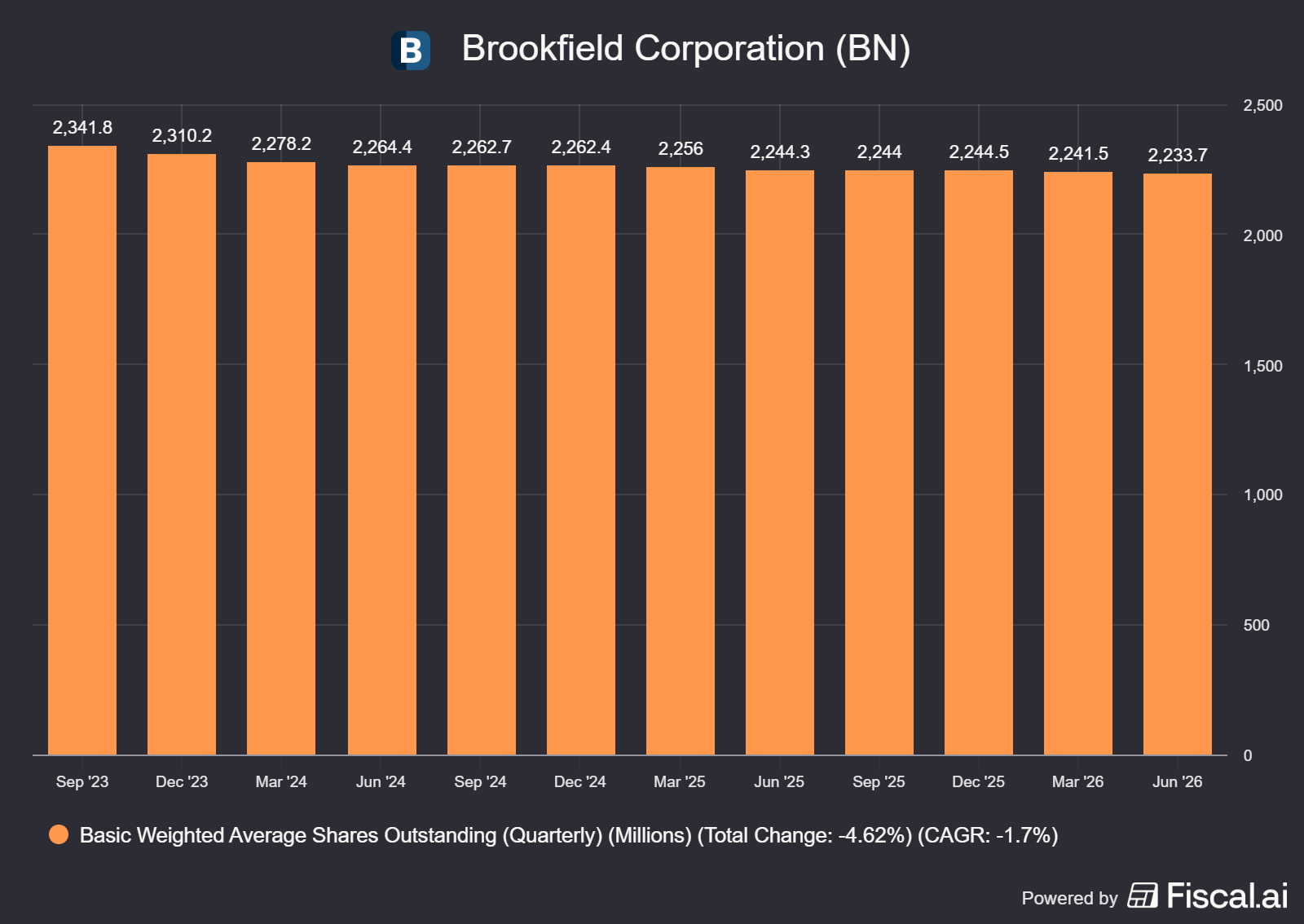
This number:
Divided by this number:
If we look at the DEBR per share since 2021, we can see that Brookfield has only compounded by 8.3%, we would like to see this number move above +12% (at the very least) to support a bull case.
This would give us confirmation that the growth engine is in tact, like management says it will be.
Second: carried interest
Brookfield is sitting on a large pool of unrealized carry.
Management now expects about $5 billion of carry realizations over the next three years.
That number used to be $6 billion.
So this is an area where we need to see delivery, holding management to their own words and guidance.
Third: Wealth Solutions
We want to see insurance assets grow while the underlying spread remains healthy.
And we want to understand how much of the reported spread comes from recurring economics versus unrealized marks.
Fourth: real estate
Real estate earnings fell 27%.
That does not necessarily mean the underlying assets are broken.
Occupancy remains above 95%, and some office assets are seeing strong rent growth.
But the earnings is a fact, and refinancing costs impacts the business.
Fifth: plan value
If Brookfield’s intrinsic-value model starts growing again, the market may become more comfortable with the company’s valuation.
If it remains flat while management continues to push the target into the future, investors will have more reason to question the model.
These are the numbers that matter much more than another press release announcing a large new fund.
The real valuation question
Here is where we land.
At today’s price, there are essentially three scenarios we have to assess.
For our proxy, we use distributable earnings before realizations per share. This is like the salary that Brookfield receives from its businesses, discounting one-off sales (One off sales are accounted for in the distributable earnings).
Case one: Brookfield disappoints
Growth remains weak, around 8% p.a.
Real estate remains under pressure.
Insurance produces lower-than-expected spreads.
The market continues to discount the complexity.
In that scenario, returns could be poor.
Our bear case produces roughly a 10% annualized return through 2031.
Case two: Brookfield delivers reasonably well
Distributable earnings grow around the mid-teens.
The valuation multiple stays roughly where it is.
The market stops punishing the complex structure.
That produces +15% annualized returns in our base case.
Case three: Brookfield delivers close to management’s plan
DE grows at +15% p.a.
Carry is realized as expected.
Insurance scales.
The market becomes more comfortable with the structure.
The valuation discount narrows, multiples expand slightly.
This is where the upside becomes significant.
Our bull case produces +20% annualized returns.
And if Brookfield actually reached its $140 plan value by 2031, the return would be dramatically higher, around 30% annually.
Keep in mind, that is management’s own plan value per share. It is optimistic, aggressive, and they are incentivized to push this number.
This is where we need discipline.
We should not value the stock today by assuming the bull case happens.
The 2026 plan has already been pushed back by a year.
The $140 target is now a 2031 target instead of a 2030 target.
And the three-year carry realization target was reduced.
The future may still be excellent.
But the market is asking Brookfield to prove it, before it commits.
So, what are we actually buying?
This is the question I think gets lost in all the Brookfield complexity.
We are not simply buying a cheap stock.
We are buying a bet on Brookfield’s ability to continue doing what it has done for decades:
Raise capital.
Allocate it into difficult, alternative assets.
Operate those assets well.
Recycle capital.
Raise more capital.
And earn fees, carry and investment returns along the way.
That model can compound for a very long time.
Brookfield also happens to be operating in several areas where the long-term investment opportunity is enormous.
AI infrastructure.
Power.
Nuclear.
Infrastructure.
Insurance.
Private credit.
Retirement savings.
Those markets do not need to grow at 20% forever for Brookfield to benefit.
They need to keep creating opportunities for a company with Brookfield’s scale and expertise.
The challenge is that Brookfield’s valuation is partly based on the assumption that the company will successfully turn those opportunities into earnings.
We don’t have enough evidence yet to say that acceleration is fully underway.
Our conclusion
Brookfield is an interesting (and complex) investment case.
But the investment case is more nuanced than the headline numbers suggest.
At $37, the stock is unquestionably trading below management’s stated value of $67.
We also believe there is a real discount to intrinsic value.
But the discount fully depend on Brookfields ability to seize the growth opportunities it has in multiple markets and business segments.
Our base-case return is around 15% annually over five years.
That is close to our long-term target, but not comfortably above it.
Getting above 15% requires some combination of:
Higher earnings growth, successful carry realization, continued insurance expansion, strong AI and infrastructure growth, buybacks at attractive prices, and some narrowing of the ‘complexity discount’.
That is a lot of moving parts. The upside is that most of those pieces are connected.
Brookfield is not trying to build 10 unrelated businesses.
It is building a system where more capital can feed into more assets, more fees, more carry and more permanent capital.
That is the part of the story we find most attractive.
The part we are less comfortable with is the gap between what management says Brookfield is worth and what an independent investor can reasonably prove.
How we would describe Brookfield:
A high-quality compounder trading at a meaningful discount, with a lot of future growth already dependent on management delivering on its next five-year plan.
That is still a very interesting setup. But we want the numbers to catch up with the story.
For now, the key question is not whether Brookfield has great assets. It clearly does.
The question is whether those assets can once again produce the 12–15%+ per-share growth that would make today’s valuation look obviously cheap in hindsight.
Figures and analysis above are based on Brookfield’s reported results and the September 2026 deep-dive research, with management targets clearly distinguished from independently marked valuation estimates.
Ready to take the next step? Here’s how I can help you grow your investing journey:
Go Premium — Unlock exclusive content and follow our market-beating Quality Growth portfolio. Learn more here.
Essentials of Quality Growth — Join over 300 investors who have built winning portfolios with this step-by-step guide to identifying top-quality compounders. Get the guide.
Free Valuation Cheat Sheet — Discover a simple, reliable way to value businesses and set your margin of safety. Download now.
Free Guide: How to Identify a Compounder — Learn the key traits of companies worth holding for the long term. Access it here.
Free Guide: How to Analyze Financial Statements — Master reading balance sheets, income statements, and cash flows. Start learning.
Get Featured — Promote yourself to over 24,000 active stock market investors with a 42% open rate. Reach out: investinassets20@gmail.com
Disclaimer:
This newsletter is for informational purposes only and does not constitute financial, investment, or other professional advice. The views expressed are solely the author’s opinions and may change without notice.
Investing in securities involves risk, including the potential loss of capital. Past performance is not indicative of future results.
The author may hold positions in securities mentioned. Readers should do their own research and consult a licensed financial advisor before making investment decisions.

 Login