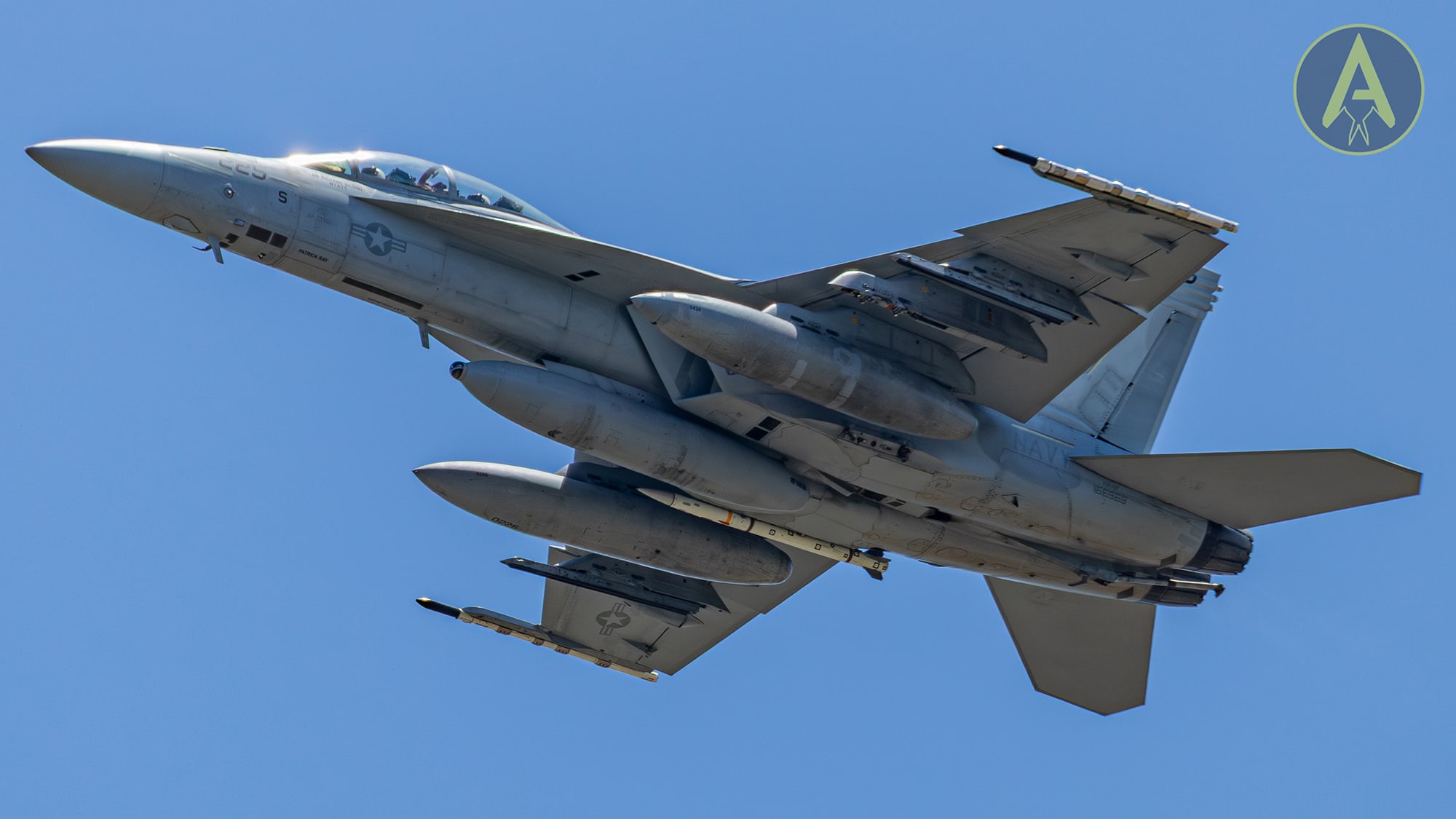
An Italian Air Force F-35B was spotted carrying the GPU-9/A 25mm gun pod, providing the first known visual confirmation of the pod being used by an F-35 operator outside the United States.
An Italian Air Force F-35B Lightning II was spotted for the first time with the GPU-9/A 25mm gun pod, confirming Italy as the first export operator of the system. Aviation photographer Diego Mor captured a photo of the aircraft as it prepared to land at Decimomannu Air Base on Sept. 30, 2026, and kindly shared it with us.
Decimomannu is located in Sardinia, near the ranges used by the Italian Air Force for weapons training. While this might point out to live-fire activities, it is unclear if these were actually conducted and, in that case, if they were part of the operational training of the pilots or an Operational Test and Evaluation (OT&E) campaign.
The acquisition of the gun pod by Italy was already expected, although a visual confirmation of the delivery was still missing. In 2024, we reported here at The Aviationist that the GPU-9/A’s 25mm rounds were included in a multi-year program for the acquisition of new weapons for the Italian Navy’s F-35Bs.
The Italian Navy is currently replacing its AV-8B+ Harriers with 20 F-35Bs, joining forces when needed with 20 other F-35Bs being delivered to the Italian Air Force. It is unclear, however, if the Navy is already employing the gun pod on its own F-35s.
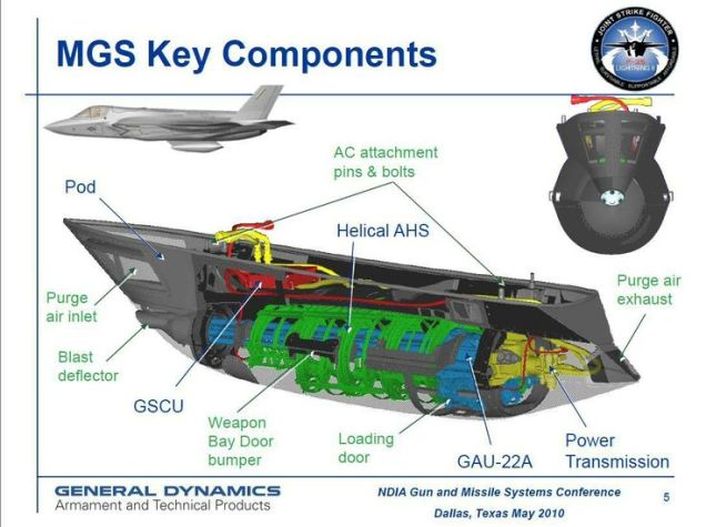
The GPU-9/A 25 mm gun pod, previously known also as the GAU-22A Gun Pod. | Source: Lockheed Martin
Italy is one of the three countries operating the Short Take-Off and Vertical Landing (STOVL) variant of the F-35 outside of the U.S., with the others being the UK and Japan. While the UK has confirmed that it has no plans to acquire or integrate the 25 mm gun pod on its F-35Bs, there is no information regarding the Japanese aircraft.
The GPU-9/A gun pod
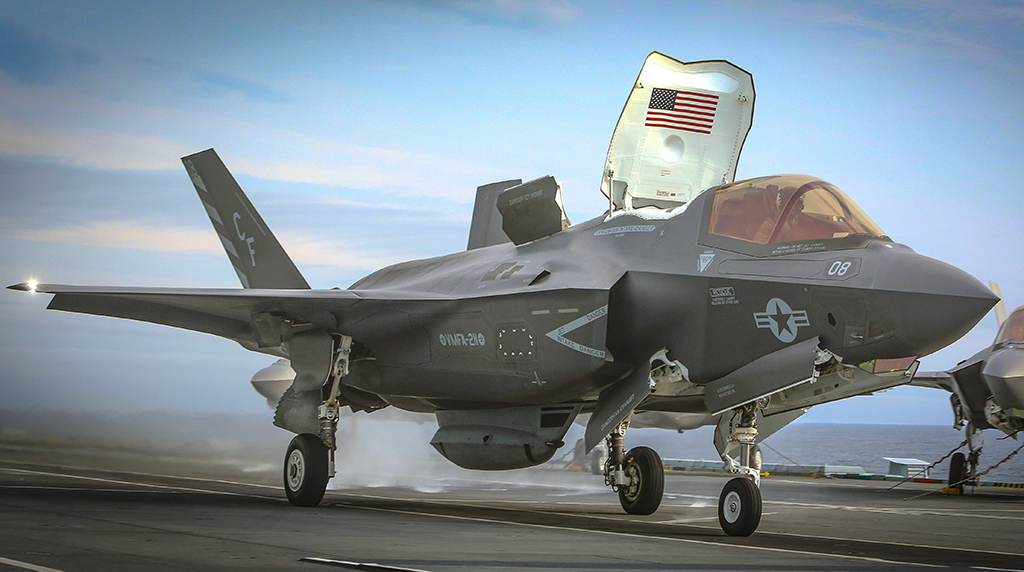
Contrary to the F-35A variant, the F-35B and F-35C don’t have the internal GAU-22/A 25mm cannon, and are thus forced to employ an externally mounted gun pod. The gun pod, technically known as the Gun Pod Unit (GPU) – 9/A has always been quite controversial, as both the F-35B and F-35C have to rely on this external device that, despite the “stealthy” shape is believed to induce a Radar Cross Section (RCS) degradation. It is worth noting that the variant used by the F-35C, although apparently similar, is designated as GAU-8/A.
Another controversy is related to the ammo carried in the pod, 220 rounds, which is less than the ammo carried by the aircraft replaced by the F-35 (300 rounds on the Harrier, 412 on the Hornet and 578 on the Super Hornet). It should be noted that the F-35A carries even less ammo, just 180 rounds.
The pod has its share of trouble, with some notable incidents, like the Class C mishap when a PGU-32/U Semi-Armor Piercing High Explosive Incendiary-Tracer (SAPHEI-T) 25mm round exploded after leaving the gun pod during a night CAS (Close Air Support) mission over the Yuma Range Complex.
A U.S. Marine Corps F-35B with the centerline gun pod clearly visible under the fuselage. | Source: U.S. Marine Corps photo by 1st Lt. Zachary Bodner
In July 2021, an USMC F-35B, which was deployed on the HMS Queen Elizabeth aircraft carrier in the Pacific Ocean, was forced to divert and land at Kadena Air Base because of unspecified issues with the gun pod, with the aircraft taxing to a remote area and with firefighters on standby as maintainers troubleshoot the problem.
The GAU-22 is reported to be more than 40 pounds lighter and requires 20 percent less overall space than the earlier GAU-12 5-barrel 25mm gun. The new GAU-22 weapon has a reported rate of fire of “up to 3,300 rounds per minute.”
One final point regarding the pod and its potential use by the Italian Air Force: it is not yet clear whether the F-35’s gun will be employed in both the air-to-ground and air-to-air roles, although the service may also be interested in exploring its use for counter-UAS missions.
At present, Italian F-35s, both the A and B variants, can only carry the AIM-120 AMRAAM (Advanced Medium Range Air-to-Air Missile) for air-to-air engagements. Italian F-35s have already supported both domestic and NATO QRA (Quick Reaction Alert) missions, and while they are expected to receive the AIM-9X Sidewinder in the future, using an advanced and relatively expensive air-to-air missile against a low-cost drone, such as those recently engaged by Italian Eurofighter Typhoons in the Baltic region, would not be a cost-effective solution in the long term. While using an F-35 to engage a Russian drone with the gun pod would still be a sub-optimal solution, it would nevertheless be preferable to expending an expensive air-to-air missile.
This means the Italian Air Force could be interested in using the gun pod not only against ground targets in a traditional CAS (Close Air Support) role, but also for counter-UAS missions, hence the need to test it in the Sardinian ranges.
Thanks again to Diego Mor for the photo he sent us. Make sure to follow him on Instagram for more!
A RAAF Super Hornet was spotted with an inert AIM-260 missile during the Gray Flag 2026 test event, few weeks after Australia announced the procurement of the new weapon.
A Royal Australian Air Force F/A-18F Super Hornet was spotted carrying an inert AIM-260 Joint Advanced Tactical Missile (JATM) during the Gray Flag 2026 large-force test event at Naval Base Ventura County Point Mugu. The photo was captured on Sept. 11, 2026, although it was only released on Sept. 30.
The sighting comes few weeks after Australia announced that it would become the first country to operate the AIM-260 JATM outside the United States. In August 2026, the Australian government said it is investing almost $736 million to acquire the new missile via foreign military sales (FMS).
The AIM-260 will be first integrated onto Australia’s F/A-18F Super Hornet, followed by the F‑35A Lightning II and EA-18G Growler. The government said “The acquisition of the AIM-260 JATM will provide Air Force platforms with a credible deterrent against airborne targets, complementing existing air-to-air missile capabilities and other surface-based missile capabilities across the Australian Defence Force (ADF).”
AIM-260 on Australian Super Hornet
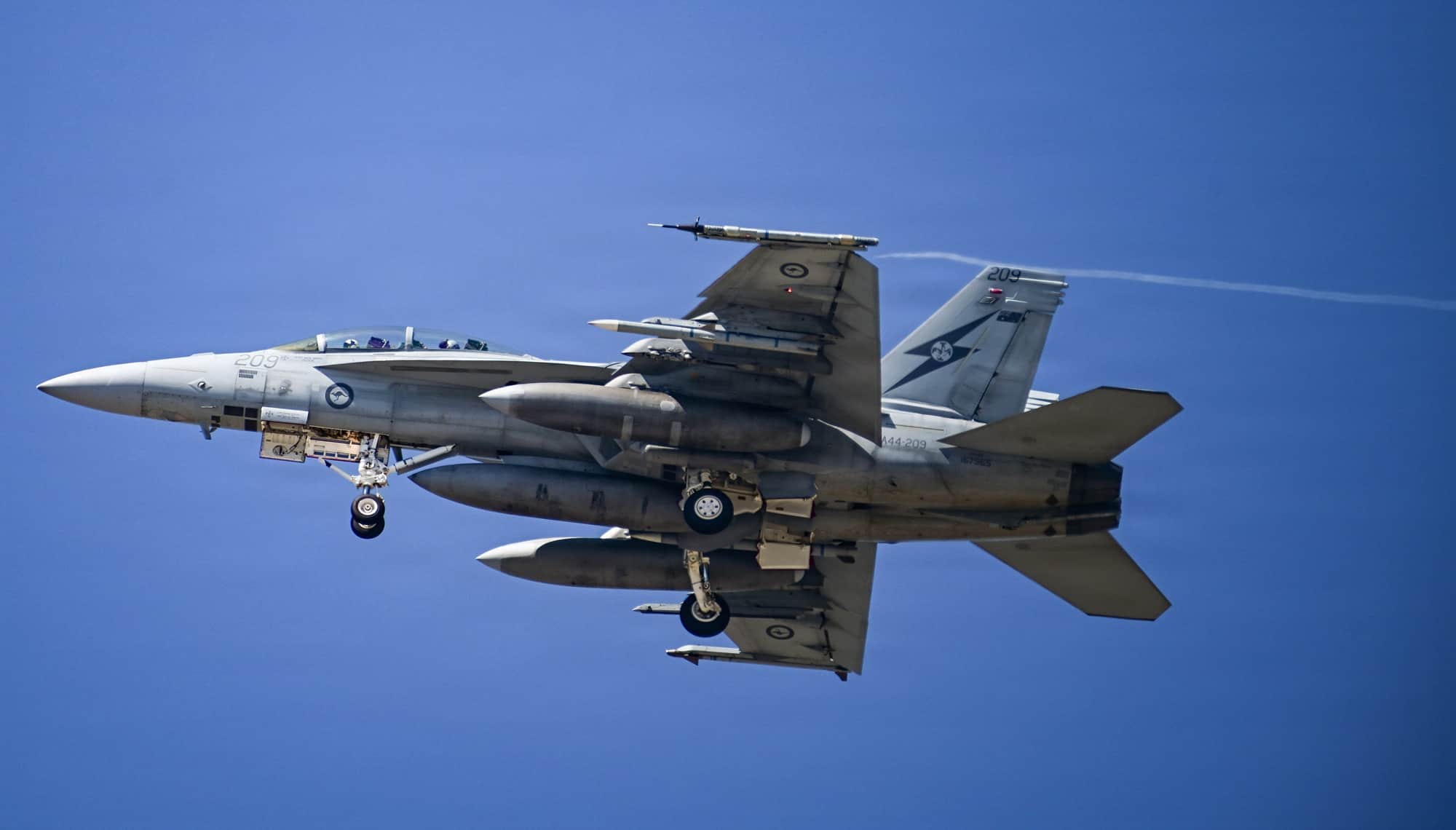
The photo captured at Naval Base Ventura County Point Mugu shows the F/A-18F Super Hornet, assigned to No. 1 Squadron, flying with a mixed loadout of inert air-to-air weapons. Similarly to the first sighting on a U.S. Navy Super Hornet, the AIM-260 can be seen installed on the weapon station 7, also known as “cheek station,” on the exterior of the air intake.
A Royal Australian Air Force F/A-18F Super Hornet assigned to No. 1 Squadron takes flight at Naval Base Ventura County Point Mugu during Gray Flag 2026, Sept. 11, 2026. | Source: U.S. Navy photo by Dana Rene White
The loadout also includes a CATM-9X (the inert training variant of the AIM-9X) on the right wingtip, as well as a CATM-120 (the inert training variant of the AIM-120 AMRAAM) on the weapon station 2, the left wing’s outermost pylon. The payload is completed by three external fuel tanks, a Tactical Combat Training System (TCTS) pod on the left wingtip and the AN/ASQ-228 ATFLIR targeting pod on the other cheek station.
Details about the test mission are not available, although there are no reports of live firing activity with the new weapon. The test mission might have involved the captive carry of the JATM in a representative operational scenario.
Gray Flag 2026
Gray Flag, held annually at Naval Base Ventura County Point Mugu, is the naval aviation test community’s premier large-force test event. This year’s edition, which ended on Sept. 25, was the largest to date, according to the Navy, with more than 750 sorties flown.
Gray Flag 2026 was hosted by the Naval Test Wing Pacific and Air Test and Evaluation Squadron (VX) 9, which led test execution with Naval Air Warfare Center Weapons Division. The latter manages the Gray Flag program and operates the Point Mugu Sea Range, a 36,000-square-mile instrumented range.
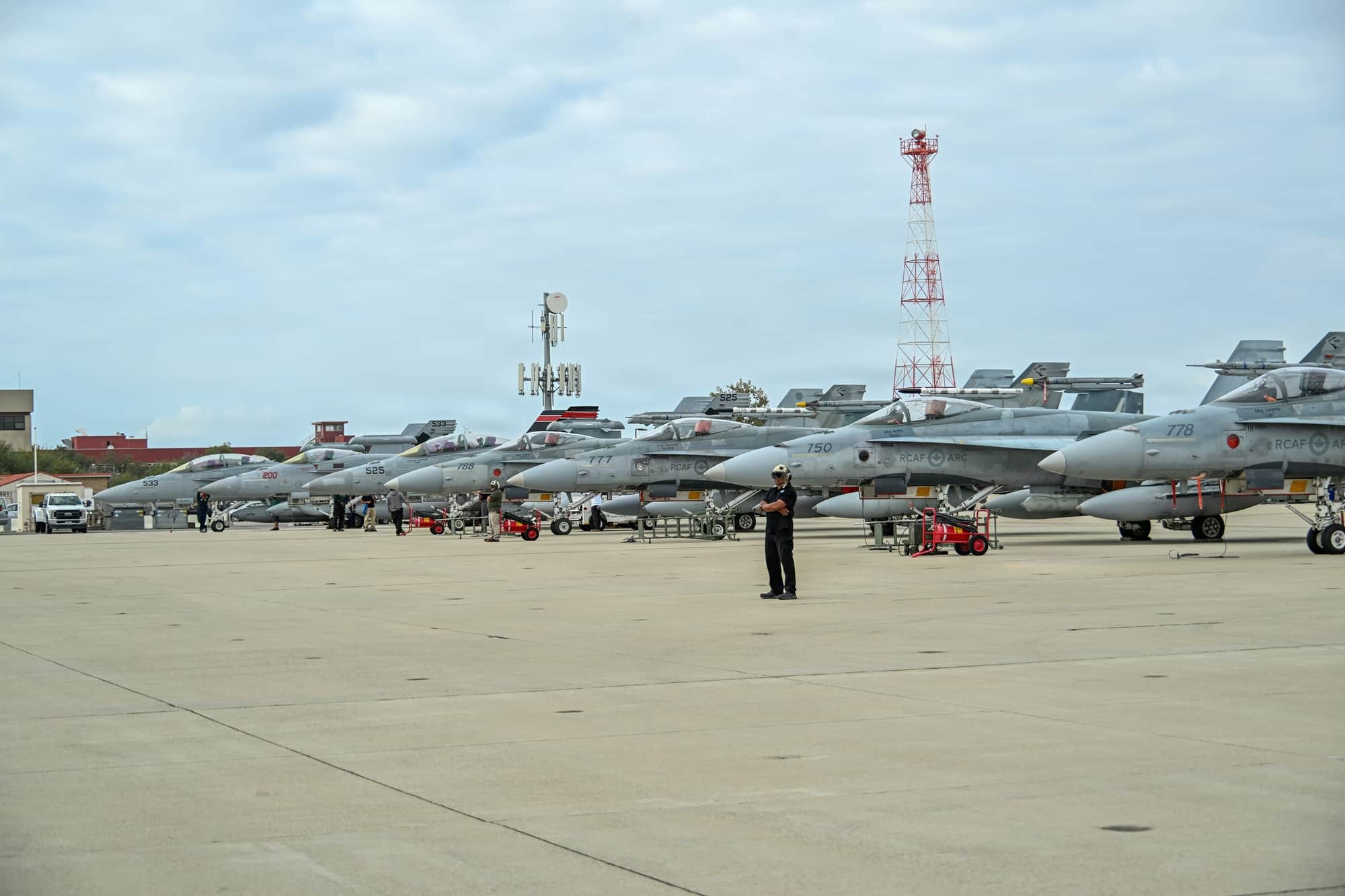
Royal Canadian Air Force CF-18 Hornets sit on the flight line at Naval Base Ventura County Point Mugu, Sept. 30, 2026. | Source: U.S. Navy photo by Katie Archibald
“Our range, combined with other test and training ranges around us, gives us the space and instrumentation to test new systems the way the joint force will use them,” said Rear Adm. Keith Hash, NAWCWD commander. “We want to find the problems here, fix them here and make sure what we send to the fleet works when the warfighter needs it.”
The service said the two-week event drew more than 3,000 participants from more than 150 organizations, and crews logged more than 2,000 flight hours covering hundreds of multi-domain test objectives for the fleet and joint force. U.S. Navy and Air Force test teams were joined by the Royal Australian Air Force, Royal Canadian Air Force and Royal Air Force.
“We leave much more informed with respect to future capabilities that enable Australia to shape our requirements for future projects and future platform upgrades that increase our lethality and survivability,” said RAAF Wing Commander Trent Baldry, commanding officer of No. 1 Squadron.
AIM-260 JATM
The existence of the AIM-260 Joint Advanced Tactical Missile was first revealed in 2019 by the Air Force, who is jointly developing the missile with the Navy. However, it was also revealed that the program had been ongoing for more than two years in 2019, meaning the program might have started in 2017 or earlier.
VX-31 F/A-18F carrying what appears to be an AIM-260 missile at Eglin AFB on May 13, 2026. | Source: Jonathan Tweedy
The AIM-260 is intended to serve as the primary long-range air-to-air weapon of both the U.S. Air Force and U.S. Navy in the coming years, becoming the successor to the AIM-120 Advanced Medium-Range Air-to-Air Missile (AMRAAM). The latter will continue to be developed, complementing the AIM-260.
The new missile will be compatible with the AMRAAM (Advanced Medium Range Air-to-Air Missile) dimensions, but with greater range, and is planned to be carried in the F-22 weapons bay and on the F/A-18 at first, with the F-35 to follow. The AIM-260 is also expected to be integrated on the U.S. Air Force’s upcoming unmanned Collaborative Combat Aircraft (CCA).
The missile is being developed and produced by Lockheed Martin. When the weapon was first unveiled, reports mentioned that AIM-260 production would overtake AIM-120 production by 2026, however, with the program’s details being highly classified and the recent boosts in the AMRAAM’s production, it is unclear if this goal still stands.
Initially, it was said the AIM-260 was also meant to counter the threat posed by the Chinese PL-15 and PL-17 missiles. The military in fact said the goal was to avoid foreign threats being able to outrange the AIM-120.
The project is an advanced state, with official saying in 2019 that flight tests would start in 2021 and Initial Operational Capability was expected in 2022, although the current timeline is unknown. Documents later showed that flight testing of the AIM-260 began as early as 2020.
A Flydubai Boeing 737 MAX 8 flying from Dubai to Tel Aviv diverted to Saudi Arabia after the two pilots reportedly became involved in a violent confrontation inside the cockpit.
A Flydubai Boeing 737 MAX 8 operating flight FZ1073 from Dubai International Airport to Ben Gurion Airport was diverted to Saudi Arabia on Sept. 30, 2026, after a serious incident developed inside the cockpit while the aircraft was enroute. The first hints about an ongoing incident arrived when the aircraft was noticed on flight tracking websites plummeting 14,000 ft in less than 30 seconds.
The aircraft later inverted the route and landed safely at Tabuk Airport, in northwestern Saudi Arabia, after transmitting a series of emergency signals. All passengers, approximately 174 – many of which from Israel, were reported safe and accounted for by Flydubai, while Saudi authorities said that both pilots sustained injuries and were taken to hospital.
Flydubai flight #FZ1073, a Boeing 737 MAX 8, registration number A6-FKF, flying from Dubai to Tel Aviv, diverted to Tabuk, Saudi Arabia, following an onboard security incident.
Timeline (UTC):
03:05 — Take off from Dubai
05:21 — Altitude fluctuations begin
05:22 — Aircraft drops… pic.twitter.com/xFS6138BIA
The incident initially triggered fears of a hijacking because the aircraft briefly transmitted the international transponder code 7500, which indicates unlawful interference. As a precaution, Israeli authorities scrambled fighter aircraft and held urgent security consultations while the airliner approached Israeli airspace.
Flydubai FZ1073, a Boeing 737 MAX 8, was diverted to Saudi Arabia after a serious cockpit incident during its approach to Tel Aviv on Wednesday.
The flight from Dubai to Ben Gurion Airport transmitted emergency squawk 7700 before switching to 7500, the international code for… pic.twitter.com/ufELugunfO
Following the landing, Israeli officials said that the aircraft had not been hijacked. Instead, the emergency appears to have resulted from a violent confrontation between the two pilots, which was stopped with the help of the cabin crew and passengers.
The flydubai flight that landed at Tabuk Airport in Saudi Arabia appears to have sustained damage to the rudder, likely due to the rapid plunge it took amid the incident. pic.twitter.com/A2paTx7TUf
Images which emerged following the landing show that the aircraft suffered substantial damage, with the rudder missing a large part. During the descent, the Boeing 737 reportedly exceeded its maximum operating speed.
A violent altercation and stabbing in the cockpit of a FlyDubai flight over Saudi Arabia this morning caused the 737-8 to plummet 18,400 feet in just under two minutes, exceeding its maximum operating speed by nearly 100 kts.
FZ1073 departed Dubai early in the morning, at 03:05 UTC, on a scheduled flight to Tel Aviv. According to publicly available flight-tracking data, the Boeing 737 was cruising at approximately 34,000 feet when it suddenly began a sharp descent at 05:22 UTC, according to data provided by Flightradar24 and AirNav Radar.
Between 05:22:07 and 05:22:36 flight #FZ1073 dropped from 30,875 feet to 16,750 feet (-14,125 feet in just 29 seconds) pic.twitter.com/hHfnX7cKWI
The aircraft reached approximately 15,000 feet in less than 30 seconds. This abrupt maneuver was followed by a sharp climb and another sharp descent, before the aircraft stabilized at approximately 15,000 feet and continued the flight toward Saudi Arabia.
The sequence was accompanied by a series of emergency transponder codes which were transmitted from 05:31 UTC, about ten minutes after the beginning of the first descent. The aircraft first transmitted 7700, the internationally recognized transponder code for a general emergency.
03:05 — Take off from Dubai International Airport
05:31 — Squawk changed to 7700
05:38 — Squawk changed to 7500
06:11 — Aircraft left Flightradar24 ground-based coverage
06:28 — Squawk 7700 received via satellite
06:58 — Last signal… pic.twitter.com/ChlUs4kRDU
Several minutes later, it briefly transmitted 7500, the standardized code which indicates possible unlawful interference, raising concerns that the aircraft could have been hijacked. The aircraft subsequently returned to 7700 before turning south and diverting toward Tabuk.
Meanwhile, Israeli fighter aircraft were scrambled as authorities attempted to determine what was happening aboard the aircraft. The incident also prompted urgent consultations involving Israeli officials, reportedly including Prime Minister Benjamin Netanyahu.
An Israeli official subsequently told Reuters that the emergency signals had been transmitted following a physical altercation between the two pilots.
What Happened in the Cockpit?
The precise sequence of events remains under investigation, but increasingly detailed accounts from Israeli officials and passengers point to a violent confrontation between the pilots. Reuters reported that two Israeli officials said the current Israeli assessment was that the incident may have been an attempted terror attack.
Following situation assessments and passenger testimonies, Israel is treating the incident as a full-fledged terrorist attack. It appears that the co-pilot repeatedly stabbed the captain. Once the attack began, several crew members and passengers managed to break through the… https://t.co/BXS4kIjGXk
“During the flight, as they were approaching Israel, one of the pilots stabbed the other pilot and, apparently, tried to crash the plane with its passengers on board,” said Netanyahu.
After speaking with passengers, the Prime Minister said a passenger and one of the crew members were able to break into the cockpit and overpower the pilot, while another crew member managed to stabilize the aircraft. The pilot who carried out the stabbing was arrested upon landing by Saudi authorities.
Israeli media have also circulated a photograph purportedly showing a passenger with a blood-soaked shirt. Reuters said it was unable to independently verify the photograph.
Meanwhile, Saudi authorities have confirmed that both the pilots were injured. The precise nature and severity of their injuries has not been fully disclosed, although authorities confirmed that both were transported to hospital for medical treatment.
Flydubai later sent two replacement planes to Tabuk, and all the passengers of flight FZ1073 have now departed Saudi Arabia.
Boeing has won the U.S. Navy’s F/A-XX competition for the sixth-generation carrier-based fighter, with a contract valued at more than $20B for the full-scale development phase.
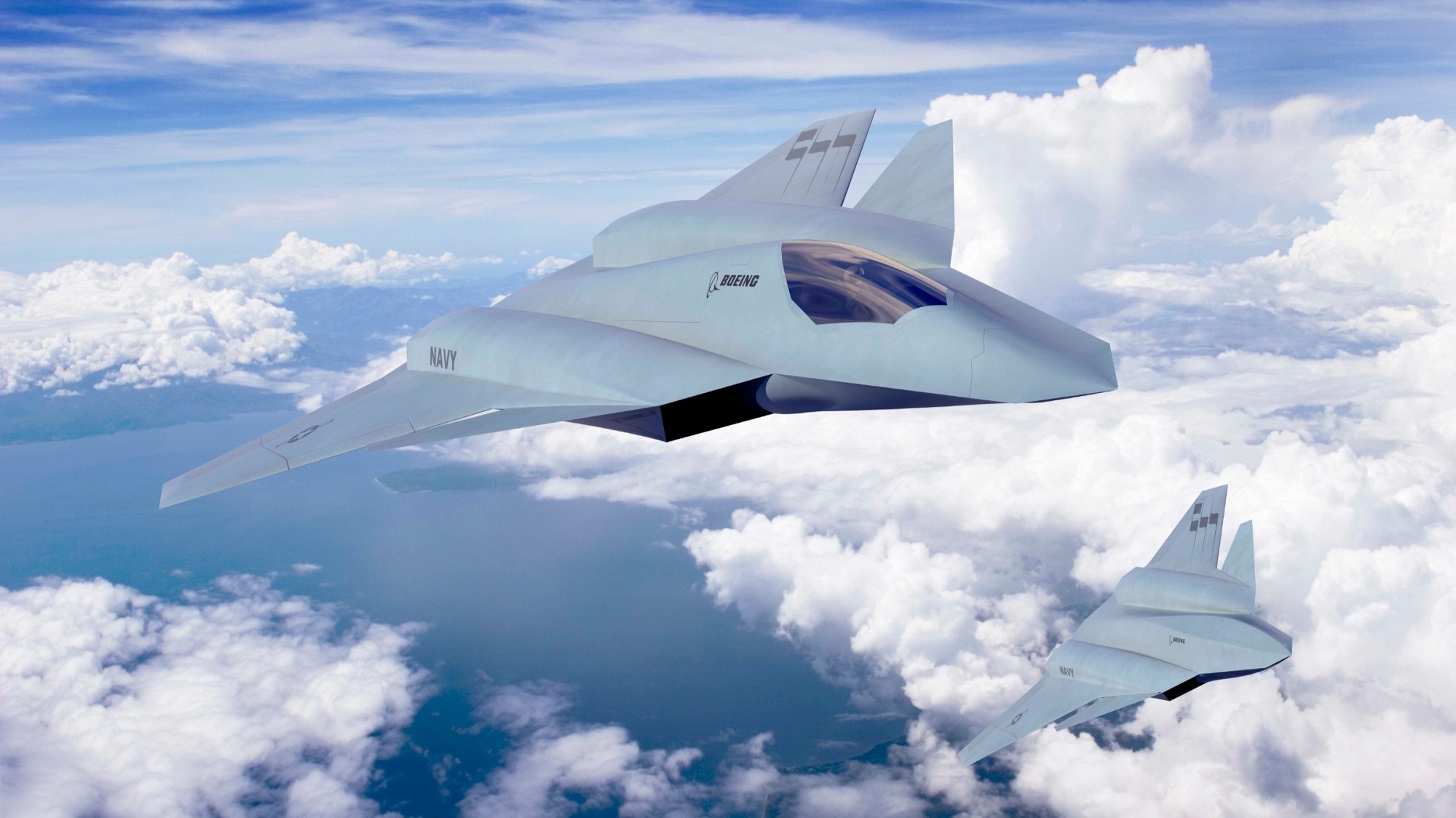
After months of wait, the U.S. Navy has finally announced Boeing as the winner of the competition for the F/A-XX sixth-generation carrier-based fighter as part of the service’s Next Generation Air Dominance (NGAD) program. With the award, Boeing will now develop and build the NGAD crewed fighter jets of both the Navy and Air Force.
The highly anticipated award comes after an imminent announcement was reported multiple times since March 2025, with the program apparently stuck in a limbo. The last such report mentioned the Navy would announce its selection by the end of August 2026.
Earlier this year, Chief of Naval Operations (CNO) Adm. Daryl Caudle warned that the Navy must accelerate development of F/A-XX to ensure it can penetrate future air defense environments over the next decade. “Our ability to fly with impunity with our existing airframes is fleeting,” Caudle said. “If I don’t start building that immediately, you’re not going to get it for some time.”
The announcement
In the statement released on Sept. 29, 2026, the Department of War said Boeing was awarded a contract valued at more than $20B for the full-scale development phase of F/A-XX. The contract covers multiple test aircraft for ground, airworthiness, systems, and weapons integration testing.
“The F/A-XX is a critical pillar in our commitment to maintaining peace through strength. F/A-XX will dominate contested airspace, extend operational reach, and deliver a decisive combat advantage for the warfighter,” said Michael P. Duffey, Under Secretary of War for Acquisition and Sustainment. “The F/A-XX platform represents a crucial, non-negotiable investment in America’s national security and long-term air combat capabilities. We are joining forces with Boeing to field these capabilities rapidly, ensuring our warfighters possess the lethal and highly networked systems required to deter aggression, project undisputed power, and secure absolute air superiority.”
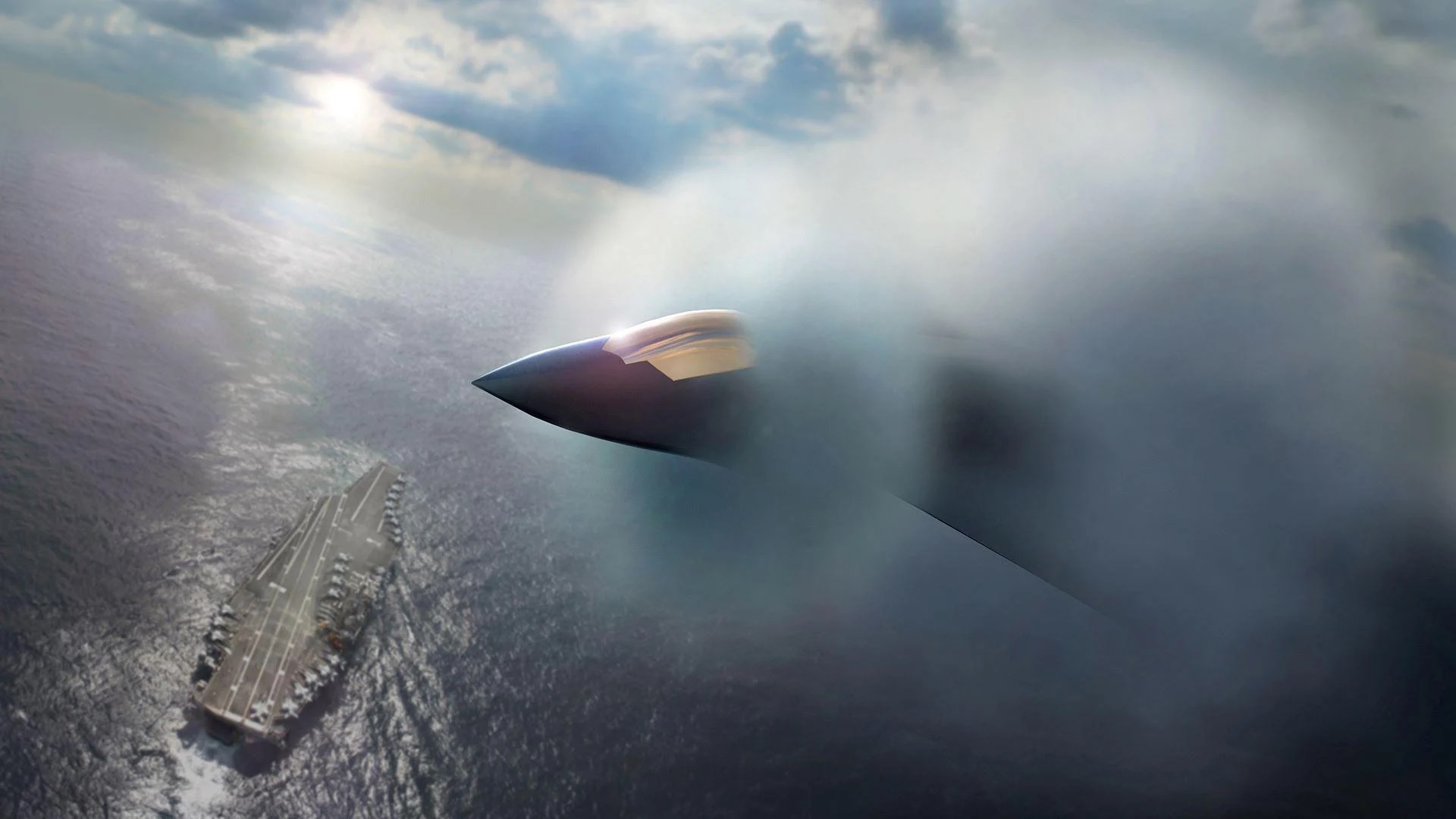
A rendering of Boeing’s proposed F/A-XX design. | Source: Boeing
The F/A-XX is expected to provide advanced carrier-based power projection, further extending the range of U.S. Navy aircraft carriers. The new fighter jet will augment and eventually replace legacy F/A-18E/F Super Hornets and EA-18G Growlers beginning in the 2030s, and operate alongside the F-35C and Collaborative Combat Aircraft (CCA).
“This achievement marks a new era for the U.S. Navy,” said acting Secretary of the Navy Hung Cao. “The Sixth-Generation fighter is a generational leap in air superiority and will provide the world’s best aviators with unparalleled capabilities to fight, win, and come home safe. We are excited to partner with Boeing, and for our warfighters to continue to dominate the skies and defeat our nation’s enemies.”
6th-gen edge.
Thank you, @USNavy, for continuing our partnership to design, build and deliver your F/A-XX aircraft. We’re honored to produce the 6th-generation fighter that will revolutionize advancements in naval aviation to maintain U.S. carrier air superiority.
The statement released by Boeing puts emphasis on the company’s work on the NGAD programs of both the Navy and Air Force.
“Delivering two advanced fighters in parallel was always our plan, and we invested accordingly. We are ready and able to build multiple concurrent future combat aircraft franchise programs,” said Steve Parker, president and chief executive officer, Boeing Defense, Space & Security.
History of the F/A-XX program
The F/A-XX is the strike fighter component within the U.S. Navy’s Next Generation Air Dominance (NGAD) Family of Systems (FoS). The requirement for this aircraft has been around since 2008, with a formal Request for Information in 2012, to replace the F/A-18E/F Super Hornet in the 2030s.
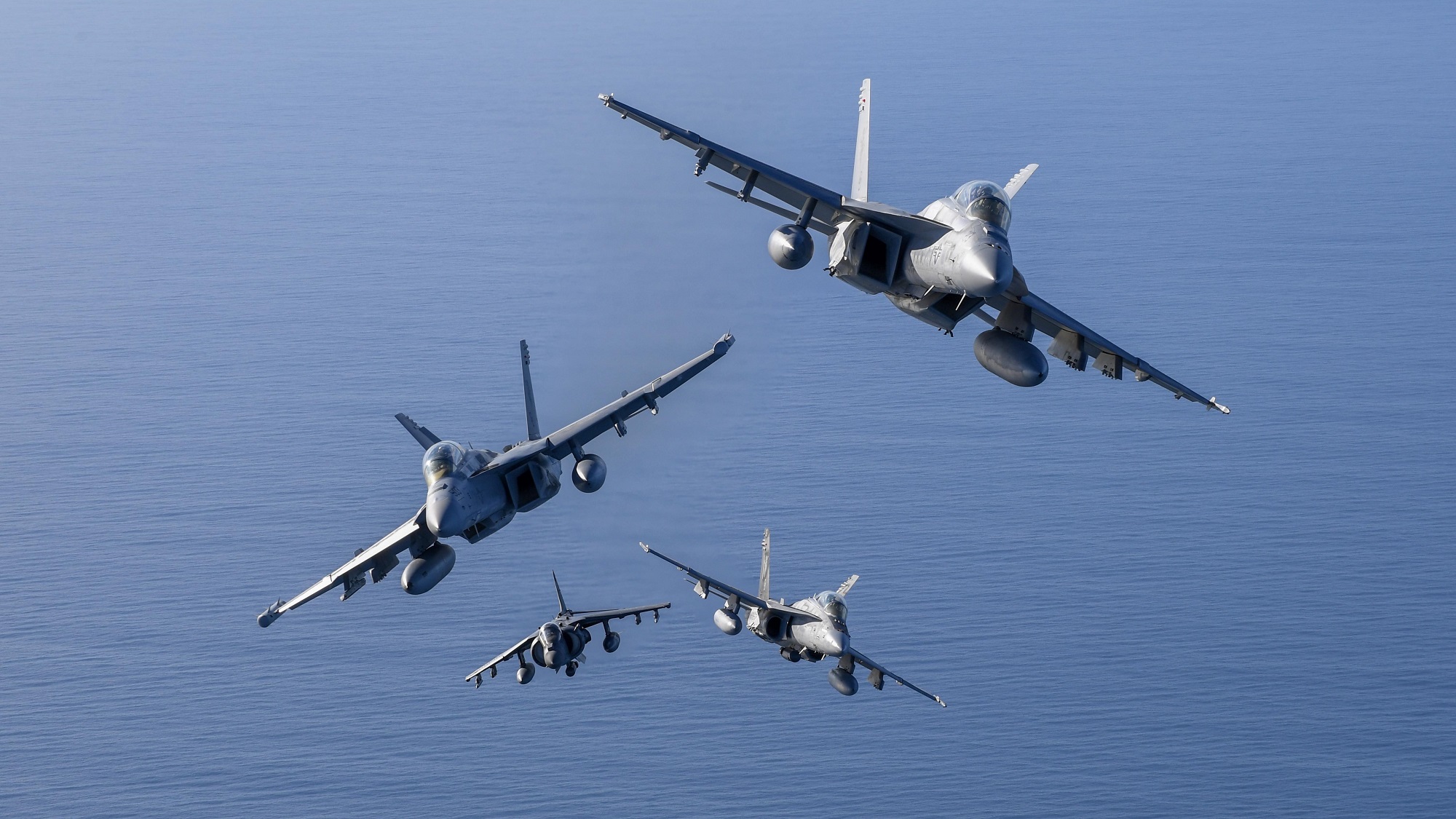
A formation of Air Test and Evaluation Squadron (VX) 31 “Dust Devils” aircraft, including an EA-18G Growler, AV-8B Harrier II+, an F/A-18F Super Hornet, and an F/A-18D Hornet, flies over Point Mugu’s Sea Range in Californati during a photo exercise. | Source: U.S. Navy
Later, the F/A-XX was included in the service’s NGAD program, which is a separate program from the identically named Air Force program. The Navy says that its “specific capabilities and technologies are under development, however analysis shows it must have longer range and greater speed, incorporate passive and active sensor technology, and possess the capability to employ the longer-range weapons programmed for the future”.
The NGAD FoS will include unmanned platforms with F/A-XX as the quarterback, exploiting the Manned/UnManned Teaming (MUM-T) concept to reduce risk to the manned aircraft, while simultaneously increasing capability, capacity, and survivability. The new MQ-25 Stingray will be the first unmanned asset to employ this capability, extending the strike range and enhancing maneuverability of the Carrier Air Wing.
Continued development of MUM-T will enable information sharing across a distributed force, increasing survivability, reducing risk to manned aircraft, and ensuring weapons capacity. The Navy is evaluating the appropriate mix of F/A-XX, manned and unmanned platforms to ensure the most lethal and affordable CVW possible, depending also on the maturity of autonomy and Machine Learning technologies.
The Navy envisions future unmanned air vehicles with survivable planforms, sensors, and robust autonomy able to find, fix, identify, track, engage, and assess land, sea, and air targets. These UAVs will be employed alongside manned aircraft and unmanned attritable assets to enable integrated kinetic and non-kinetic fires at tactically relevant ranges in multidomain operations.
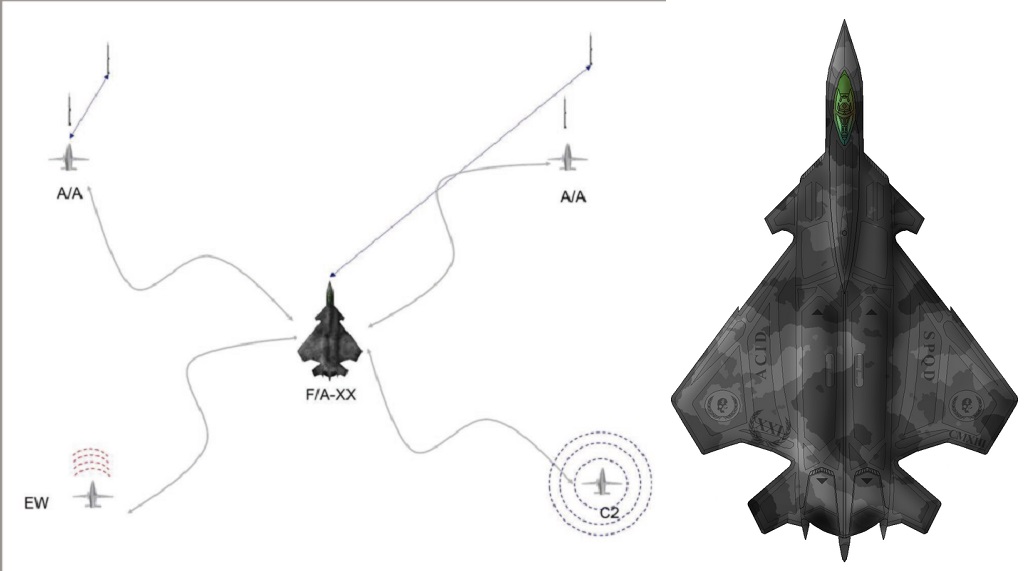
In a 2021 document, the Navy showed a fictional F/A-XX operating in a MUM-T environment with four drones, whose shape represents the MQ-25. Interestingly, the drones were shown employing Air-to-Air (AA), Electronic Warfare (EW) and Command and Control (C2) payloads, much like the Loyal Wingman drones currently being developed. This falls in line with the service envisioning Unmanned Air Systems (UAS) to fill refueling, communications relay, logistics, airborne electronic attack, strike, and ISR&T missions in the future air wing.
The F/A-XX placeholder design as shown by the U.S. Navy in its vision for 2030-2035, together with a better image of the original fictional design. (Images via U.S. Navy and Tapatalk) | Source: U.S. Navy
In 2024, in an interview released to Aviation Week, Rear Adm. Michael Donnelly, director of the air warfare division in the Office of the Chief of Naval Operations, said the Navy will develop its aircraft independently, a reverse of previous reports who said the Navy and Air Force would share the developments of their next generation aircraft programs.
The Navy’s decision to move forward independently might have shielded the F/A-XX from the results of the NGAD’s review and the subsequent decisions. The service is confident in the suitability and affordability of the F/A-XX and is committed to move forward with the program.
“We have to have an affordable platform to make it relevant to our force structure and force design, so we’ve got that in mind,” said Donnelly. “We think we’ve got an affordable solution that supports our force structure of the future.”
According to Donnelly, the F/A-XX program was on track for the Milestone B decision to move the Engineering and Manufacturing Development (EMD) phase by the end of fiscal year 2025.
“We feel really good through the concept development that we’ve got the right bracket for those requirements and the attributes we need to deliver the capability,” Donnelly says. “We’ll continue to look at that as we go through the next phases of the acquisition process and make smart decisions.”
An early artist’s render showing a hypothetical F/A-XX fighter-attack aircraft. | Source: Boeing
What F/A-XX Is Expected to Deliver
The Navy envisions F/A-XX as more than a simple replacement for the F/A-18E/F Super Hornet and the EA-18G Growler. The new aircraft is expected to combine stealth, extended range, electronic warfare, and command-and-control functions into a single next-generation platform.
Navy officials previously said F/A-XX is expected to have approximately 25% more range than the F-35C, as well as more advanced jamming capabilities than the Growler. Moreover, it is also designed from the outset to control multiple Collaborative Combat Aircraft (CCA), as noted by the CNO.
“The next-generation airframe, F/A-XX is so vital,” Caudle said. “It’s vital because of, one, the CCAs it will command and control. Its penetration – the Growlers won’t last forever, so it’ll be our electronic attack airplane as well. Its range will be coupled with the MQ-25 for clandestine refueling and organic refueling from the carrier.”
The aircraft is therefore central to the Navy’s future carrier air wing concept to maintain the service’s ability to project power in high-threat environments. In this mix of crewed and uncrewed platforms, the F/A-XX will be the quarterback, often said the Navy.
Navy’s and Air Force’s NGAD relation
According to Rear Adm. Donnelly, the new carrier-based fighter will be affordable, versatile and independent of Air Force-funded technologies such as an adaptive-cycle turbofan engine. While the service already said it would require a different airframe than the Air Force’s NGAD, other systems to be included were not mentioned.
The second rendering of the U.S. Air Force’s sixth generation fighter, the F-47. | Source: U.S. Air Force
Initially, the Navy appeared interested in the adaptive-cycle technology being developed for the Next-Generation Adaptive Propulsion (NGAP) program. In the past decade, however, propulsion plans for the two services have diverged, according to Donnelly.
“We’re looking at more of a derivative-type engine solution,” said Donnelly. “That’s just one example where we probably are different in many ways from the Air Force. In totality, they are two unique programs from an acquisition point of view and also going forward, so we’re relatively independent of each other at this point.”
Both programs appear to be under budgetary pressure, as both services are currently working on multiple large programs. In the Navy’s case, the 2025 budget for the new aircraft suffered a cut of 67%, with the $10.3 billion requested between 2025 and 2028 reduced to just $3.3 billion. The senate voted to restore $450 million to the budget but, even if approved, there would still a cut of 59% compared with last year’s budget.
Earlier this year, lawmakers agreed on the Fiscal Year 2026 Defense Appropriations Act to allocate $897 million specifically to F/A-XX, mandating the Pentagon to award a development contract aimed at accelerating initial operational capability. The wording used called out the Department of Defense for the slow pace of the program.
Another difference between the Navy’s and Air Force’s 6th gen fighter could be their roles. While the latter envisions its new aircraft mainly as an air superiority fighter, the Navy wants it to be multirole, optimized for air-to-surface strike but still capable of fleet defense.
“The central focus of its design is to be able to conduct long-range fires, sea control and those types of missions. Inherent in its design is its ability to participate in fleet defense,” Donnelly says. “We can’t afford to have a break-glass capability or a really unique single-mission or single-phase-of-operation focus.”
A final difference is the manned or unmanned debate. The Air Force left the door open for an optionally manned configuration, which was also the initial configuration proposed for the F/A-XX. However, the Navy has now opted for a fully manned platform.
“F/A-XX is intended to be a manned platform,” Donnelly says, noting that the “F/A-XX will really be our pivot point from a manned air wing to a hybrid future, with a manned-unmanned air wing.”
The U.S. Navy said that two Naval Aviators ejected from their EA-18G Growler following an arresting gear failure aboard the USS Eisenhower aircraft carrier and were promptly recovered by search and rescue forces.
The U.S. Navy announced that a recovery mishap aboard the USS Dwight D. Eisenhower (CVN 69) resulted in two Naval Aviators assigned to Carrier Air Wing (CVW) 3 ejecting from their aircraft. The service says that both were promptly recovered by search and rescue (SAR) forces and were safely returned to the ship to be evaluated by medical personnel.
Additionally, four shipboard personnel were also injured during the mishap and are receiving medical care. However, one Sailor is being evacuated to a Norfolk-area hospital for treatment of non-life-threatening injuries.
DSTY613 (MH-60S) brought the injured into Sentara Norfolk General Hospital last night.
The mishap happened at approximately 6:18 p.m. EDT on Sept. 28, 2026, as the Nimitz-class aircraft carrier was sailing off the coast of Virginia. According to USNI News, the USS Eisenhower is currently at sea for a carrier qualifications campaign, and left Naval Station Norfolk in the afternoon of Sept. 28.
The service did not release details about the aircraft involved in the mishap and whether it went overboard or stopped on the deck. The ejection of two Naval Aviators seemingly points to either the F/A-18F Super Hornet or the EA-18G Growler, the only two types of twin-seater aircraft currently in service with Carrier Air Wings.
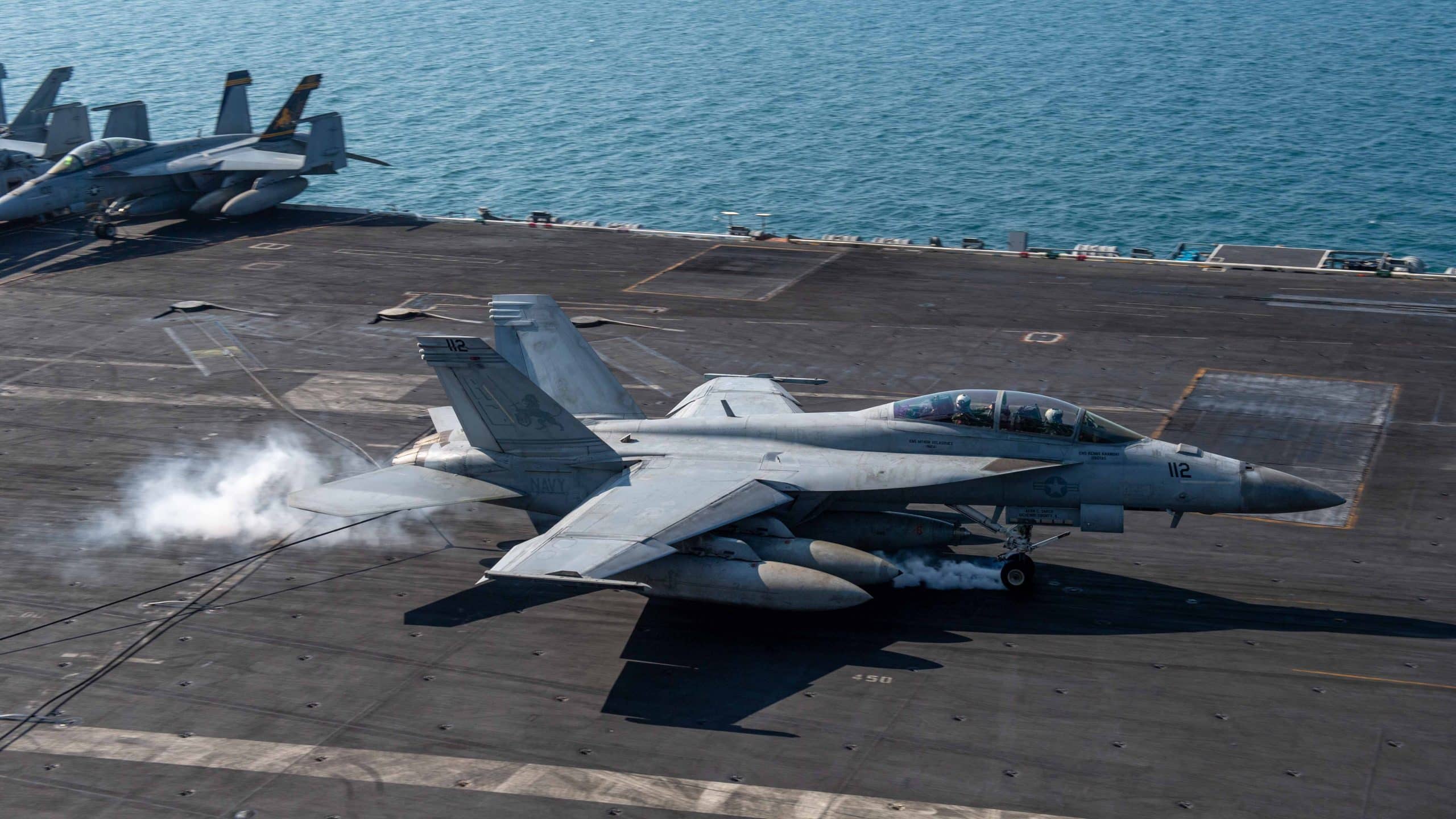
An F/A-18F Super Hornet, attached to the “Fighting Swordsmen” of Strike Fighter Squadron (VFA) 32, lands on the flight deck of the Nimitz-class aircraft carrier USS Dwight D. Eisenhower (CVN 69) in the Arabian Gulf, Dec. 10, 2023. | Source: U.S. Navy photo by Petty Officer 3rd Class Nicholas Rodriguez
CVW 3 is assigned one squadron of each aircraft, the Strike Fighter Squadron (VFA) 32 “Swordsmen” and the Electronic Attack Squadron (VAQ) 130 “Zappers,” respectively. The Navy did not mention the squadron involved.
In the past, similar outcomes have resulted from rare mishaps in which an arresting cable snapped during an arrested landing and struck deck personnel as it recoiled, much like a whip suddenly released under tension. However, we can’t confirm that this is what happened in this case, as the Navy has not released specific details about the mishap.
The carrier recently completed its Planned Incremental Availability (PIA) at Norfolk Naval Shipyard. A PIA is a scheduled period for an aircraft carrier to undergo extensive maintenance, repairs and modernization to meet future operational demands, spanning a wide array of overhauls and inspections.
Update
The U.S. Navy confirmed that the aircraft involved was an E/A-18G Growler attached to the “Zappers” of Electronic Attack Squadron (VAQ) 130. The two Naval Aviators were forced to eject following an arresting gear failure and were promptly recovered by search-and-rescue personnel assigned to Helicopter Sea Combat Squadron (HSC) 7.
UPDATE 1: At 6:18 p.m. EDT on Sept. 28, a mishap involving an E/A-18G Growler, attached to VAQ-130, occurred during aircraft recovery operations aboard the aircraft carrier USS Dwight D. Eisenhower (CVN 69) off the coast of Virginia.
The service said that a total of eight Sailors were evaluated by ship’s medical personnel following the incident, while one Sailor was flown to a Norfolk-area hospital for treatment of non-life-threatening injuries. The two aviators and two additional Sailors injured on the flight deck were flown to Naval Medical Center Portsmouth for follow-on evaluation.
An investigation into the causes of the mishap is ongoing.
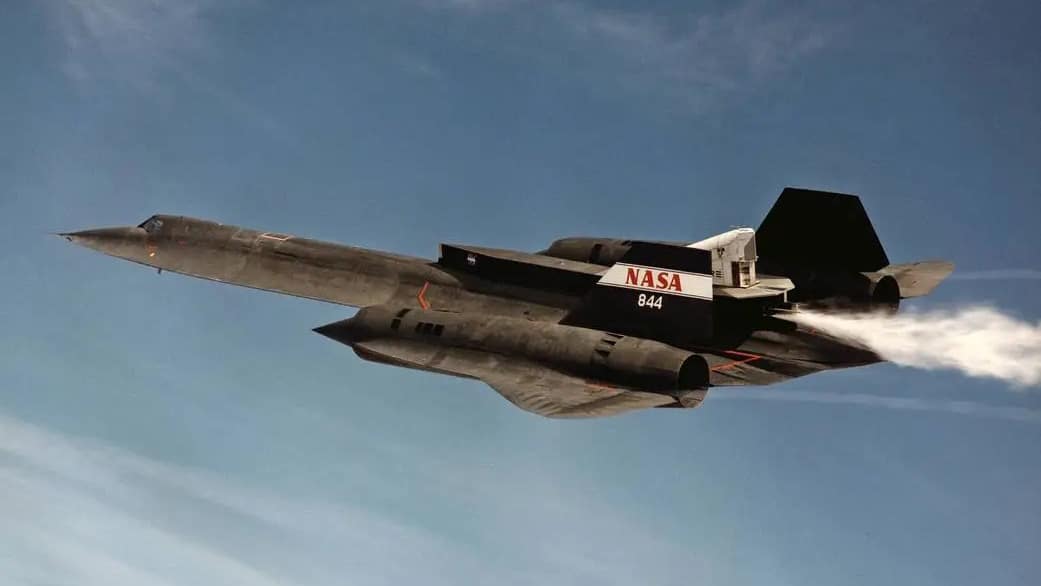
NASA quietly removed the SR-71 #844 from static display at the Armstrong Flight Research Center, where it sat since the type’s last flight in 1999, just as NASA Administrator Jared Isaacman is promising a new generation of high-speed X-planes.
An SR-71 Blackbird has disappeared from NASA’s Armstrong Flight Research Center at Edwards Air Force Base, California. The aircraft, NASA tail number 844, had been sitting on display outside the Armstrong facility for years since the last flight on Oct. 9, 1999.
Aviation Week and The War Zone were the first to report about the disappearance. According to Aviation Week’s Defense Editor Steve Trimble, commercial satellite imagery indicates that the Blackbird was no longer at its usual location since at least May 17, 2026.
Aviation Week subsequently reported that the aircraft was moved into a hangar earlier this year for an inspection. Sources familiar with the matter indicated that NASA had been exploring whether the SR-71 could potentially return to flight, although the agency said they have no additional information to share regarding the aircraft when contacted by The War Zone.
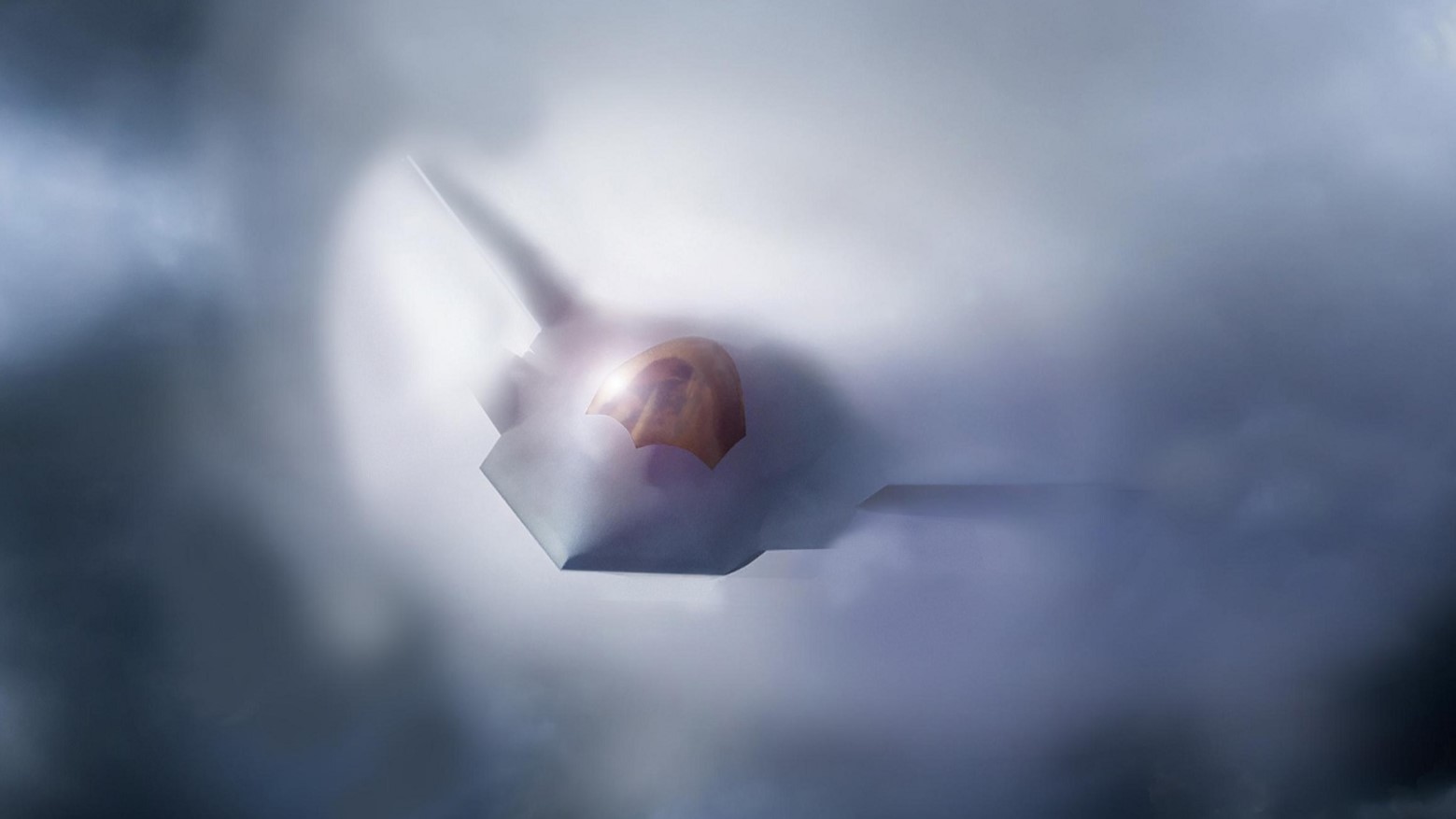
However, the timing is particularly intriguing. In fact, only few days before, NASA Administrator Jared Isaacman presented an image of a mysterious high-speed aircraft during the All-In Summit in Los Angeles. The slide, titled “Rebuilding our X-plane portfolio,” showed an aircraft emerging from clouds whose silhouette immediately recalled the iconic Blackbird.
Asked whether the aircraft shown was an SR-71, Isaacman cryptically replied: “You sure that’s a Blackbird?” He did not clarify what the aircraft actually was. Instead, he said that NASA was “getting back in the business of flying high and fast again.”
An unidentified aircraft appeared on a slide titled “Rebuilding our X-plane portfolio” during NASA Administrator Jared Isaacman’s All-In Summit presentation. | Source: NASA
However, information reported by Aviation Week in its ‘Check Six’ podcast suggests that there may be more behind the movement of SR-71 #844 than a routine change in display location.
The SR-71 that disappeared
The SR-71 #844 is not any Blackbird, as it was the final SR-71 to be produced and the last one to fly. The aircraft started its career with the U.S. Air Force, which assigned it the serial number 64-17980.
In 1990, this SR-71 was loaned to NASA by the U.S. Air Force. Throughout the 1990s, it was one of the Blackbirds operated by NASA as a high-speed and high-altitude research platform.
NASA’s final SR-71 flight took place on Oct. 9, 1999. Following the end of its flying career, 844 remained at what was then Dryden Flight Research Center, now Armstrong, where it eventually became part of the facility’s outdoor display.
Aviation Week Defense Editor Steve Trimble reported that sources indicated that 844 had been moved into a hangar for an inspection. Obviously, that alone would not establish that NASA is preparing the Blackbird to fly again as static display aircraft can require inspection, maintenance and preservation work after years in the open.
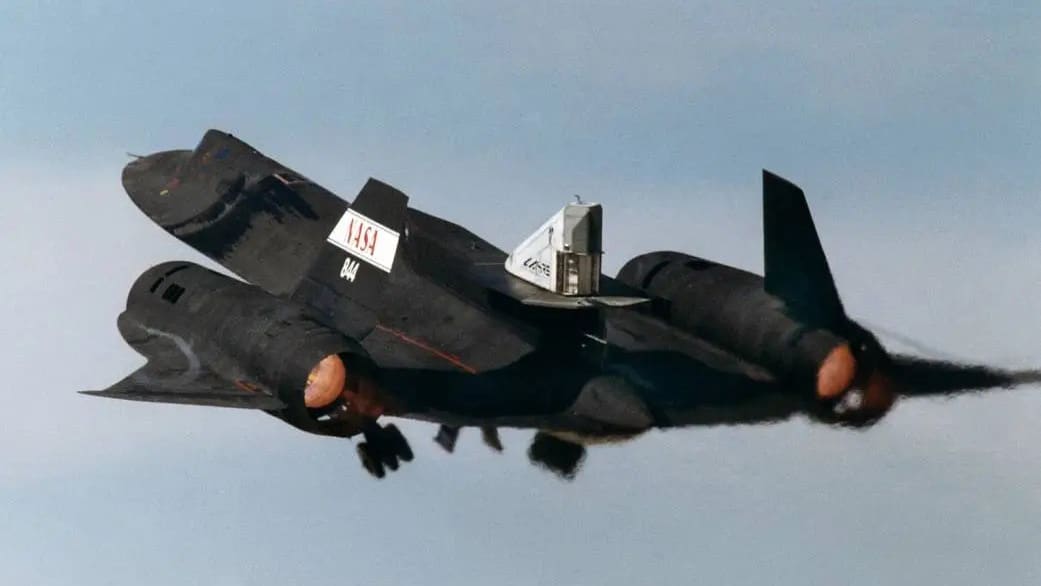
The Linear Aerospike SR-71 Experiment (LASRE) pod is seen on the upper rear fuselage of an SR-71 aircraft during take-off of the first flight to experience an in-flight cold flow test. | Source: NASA/Tony Landis
However, there is a significant detail which might change the story. In fact, according to Trimble’s reporting, NASA also contacted former members of the SR-71 program to determine whether they would be interested to participate in a potential return-to-flight effort.
That information has not been confirmed by NASA. If the reporting is accurate, any such effort has evidently not been publicly acknowledged; Trimble noted that he could find no identifiable funding line associated with it in available budget documents.
If NASA really were considering returning an SR-71 to flight, #844 has several characteristics that would make it an obvious candidate. As mentioned earlier, it was the last SR-71 built and also the last one to fly, and the Mojave Desert – where the Armstrong Flight Research Center is located – offers an environment which is highly favorable for long-term preservation.
Additionally, #844 benefited from upgrades introduced late in the Blackbird’s operational career, including the Digital Automatic Flight and Inlet Control System (DAFICS), which integrated flight and inlet controls and made the violent inlet ‘unstarts’ that had characterized earlier SR-71 operations increasingly rare.
Going higher and faster
The timing of the aircraft’s disappearance becomes even more interesting when considered alongside Isaacman’s recent comments. As we recently reported here at The Aviationist, during his September 2026 All-In Summit presentation, the NASA administrator described the agency’s intention to rebuild its X-plane portfolio.
The NASA SR-71A during cold flow testing as part of the Linear Aerospike SR-71 Experiment (LASRE) program. | Source: NASA/Carla Thomas
The X-59 QueSST, currently NASA’s most visible experimental aircraft program, is focused on demonstrating quieter supersonic flight. Isaacman made clear that he sees the aircraft as only the beginning of a broader effort.
At EAA AirVenture in July, Isaacman had already spoken about the SR-71 in the context of NASA’s historical X-plane portfolio. When asked about plans for a new crewed hypersonic aircraft or an SR-71 successor, Isaacman said the area was of significant developmental interest.
At another AirVenture panel, Isaacman was asked which aircraft he would like to fly but had never flown. His immediate answer was the SR-71 Blackbird. This led the moderator to ask whether he had the authority to bring one back, with Isaacman replying: “That’s classified.”
Obviously, none of those comments constitutes confirmation that NASA is restoring the SR-71 to fly again. However, they provide an intriguing backdrop to what is otherwise an unexplained move.
Why would NASA want an SR-71 again?
What makes the SR-71 interesting enough to NASA for a potential return to flight is its flight envelope. In fact, the SR-71 was designed to cruise at around Mach 3.2 and at altitudes approaching 85,000 feet.
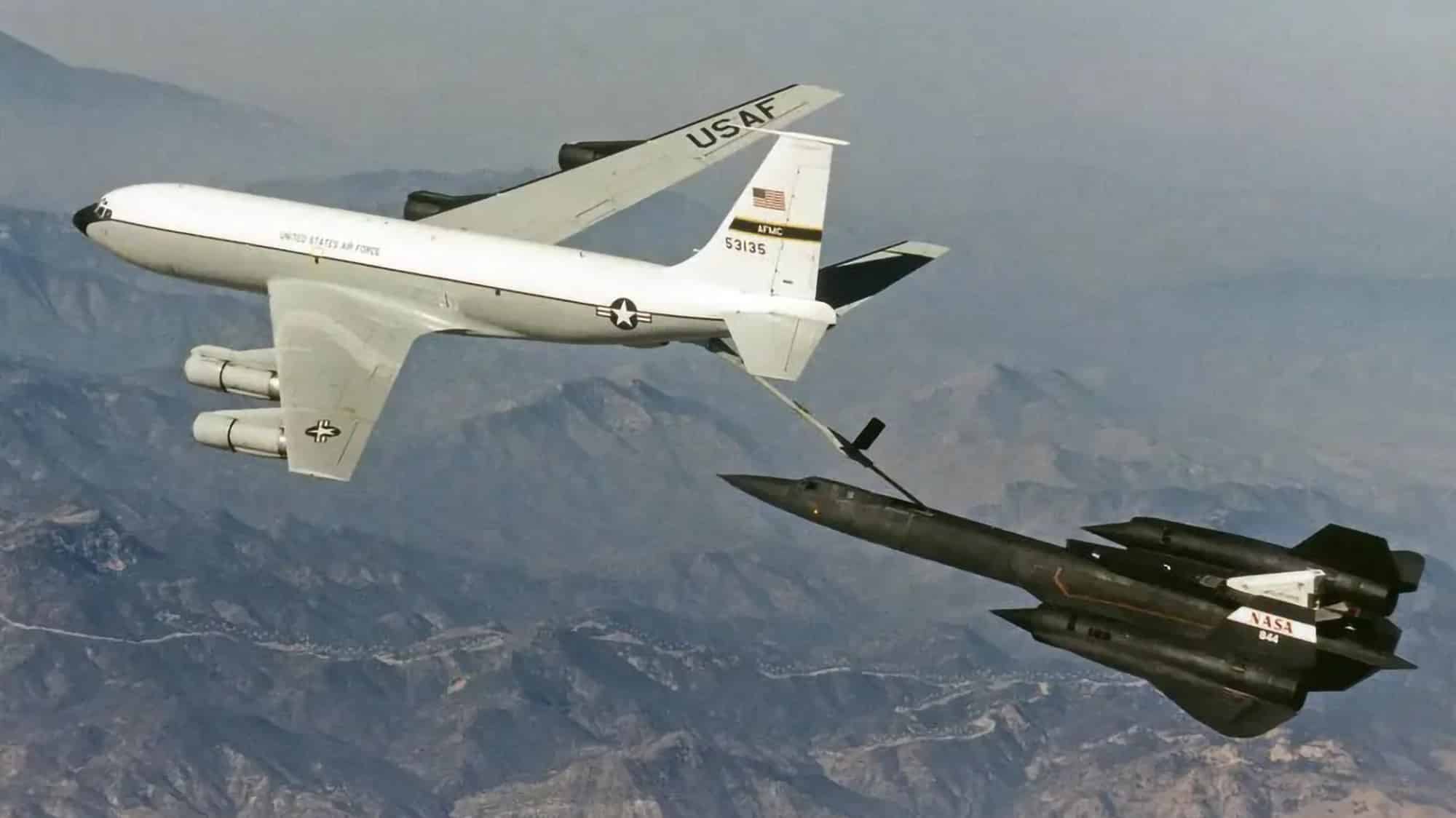
A NASA SR-71 refuels from a KC-135 tanker assigned to Edwards Air Force Base. | Source: NASA/Lori Losey
Its ability to operate at extreme speed and altitude made it an unusually useful research platform, and NASA used its Blackbirds for work involving aerodynamics, propulsion, structures, thermal protection materials, high-speed instrumentation, atmospheric research and sonic booms. None of the aircraft currently used by NASA can reproduce this combination of capabilities.
NASA operated SR-71s during the 1990s specifically because their performance opened research opportunities unavailable to conventional aircraft. Considering the ongoing research in the hypersonic flight regime, the Blackbird could potentially provide a unique bridge between conventional supersonic flight testing and the much more challenging regimes associated with hypersonic speeds.
The SR-71 could also conceivably serve as an airborne test or launch platform for experimental high-speed vehicles. There is historical precedent within the Blackbird family: the M-21, a modified A-12, was developed to air-launch the D-21 high-speed reconnaissance drone. Any comparable use of an SR-71 today, however, would require an entirely new integration effort.
However, NASA may not necessarily want an original SR-71 to become a conventional flying aircraft again. Instead, the agency could use the aircraft as a technological and aerodynamic reference for a new X-plane.
Isaacman’s comments suggest that NASA is interested in radical airframe and propulsion designs rather than simply incremental improvements to existing systems. A new aircraft could retain some of the fundamental aerodynamic principles that made the Blackbird successful while taking advantage of six decades of advances in materials, manufacturing, avionics, flight controls and propulsion.
A J58 turbojet used in the Lockheed SR-71s which NASA flew, during an engine run. | Source: NASA/Tony Landis
Bringing an SR-71 back would be an enormous undertaking
Returning an SR-71 to flight status is easier said than done. Because of its extreme operating environment and unique characteristics, the maintenance of the Blackbird required a substantial effort, with a dedicated support infrastructure that however disappeared after the fleet’s retirement.
The Pratt & Whitney J58 engines were designed around the aircraft’s unique operating requirements and used JP-7 fuel, a fuel with a high flash point and high thermal stability specifically produced for the SR-71. The last stocks of JP-7, which is no longer in regular production, were burned in 2002, although ten years later an unspecified quantity of JP-7 was produced again for the X-51 Waverider unmanned ramjet-powered hypersonic demonstrator.
Aviation Week also noted the economic challenge to return the SR-71 to flight. About two years after the final flight, the possibility of reactivating an SR-71 for intelligence missions was examined, with estimates reportedly reaching $40–45 million. Almost 27 after the final flight, the challenge would be considerably greater.
Could the SR-71 follow the F-117’s example?
While it remains unclear whether an SR-71 will ever return to flight, there is already a remarkable precedent for a supposedly retired aircraft continuing to play an important role years after leaving operational service: the F-117 Nighthawk.
The F-117 was officially retired in 2008, with the remaining aircraft transferred to the Tonopah Test Range in Nevada. Following retirement, the remaining aircraft were placed in Type 1000 recallable storage at Tonopah, preserving them in a condition that initially allowed for possible return to service. That requirement was eventually repealed in 2016, allowing the Air Force to begin divesting portions of the fleet.
Yet retirement did not mean the end of the Nighthawk’s flying career. Nearly two decades later, F-117s continue to fly regularly, supporting training as low-observable adversary aircraft and cruise-missile surrogates, while also being used for research, development, test and evaluation activities that may include support for next-generation programs. The Air Force has even taken steps to keep the type viable for years to come, including work associated with aerial refueling certification with the KC-46A.
In that respect, the F-117 offers an interesting parallel to what could potentially happen with the Blackbird.
Both aircraft emerged from extraordinarily advanced engineering programs and possess characteristics that remained relevant, or potentially useful, decades after they were designed. An SR-71 returning to the air would therefore not necessarily imply a return to its former reconnaissance mission. Like the F-117, it could instead serve as a unique test, research or development asset, exploiting capabilities that remain difficult to reproduce even decades after the aircraft was designed. A testament to another design that was remarkably far ahead of its time.

 Login