❌

Normal view

Cantor: Almonty "Moving Seamlessly" Into Production As Korean Tungsten Mine Becomes Western Lifeline

1 October 2026 at 21:40
Cantor: Almonty "Moving Seamlessly" Into Production As Korean Tungsten Mine Becomes Western Lifeline

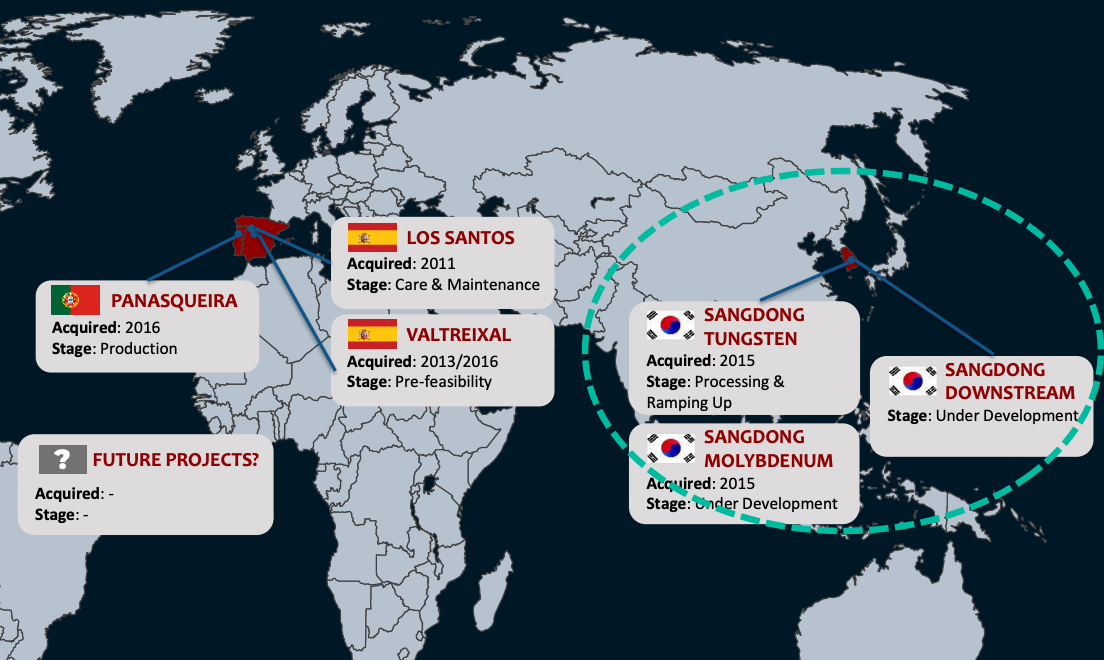
Cantor Fitzgerald metals and mining analyst Matthew O'Keefe provided clients on Tuesday with an update on Almonty Industries, citing a corporate update from CEO Lewis Black. The miner's crown jewel tungsten mine in South Korea has begun shipping concentrate as the West's answer to conflict-free tungsten supply comes online, playing into a bigger theme we've outlined called "owning the bottlenecks."

O'Keefe says the Sangdong mine has begun shipping concentrate, is moving toward 24/7 operations, and has about 4.6 months of stockpiled ore to support its ramp-up. Phase II expansion is also already underway, with completion expected in 2027.

O'Keefe outlined why Sangdong is critical to expanding Western-aligned tungsten supply and breaking China's "quasi-monopoly" grip:

A major source ex-China: Phase II would increase throughput to 1.2 million tonnes annually, potentially supporting more than 460,000 MTU of tungsten trioxide production per year at Sangdong.

The production inflection: Cantor’s detailed model forecasts consolidated output rising from 126,287 MTU in 2026 to 444,400 MTU in 2027, while all-in sustaining costs fall from $905 to $319 per MTU. These are forecasts, contingent on successful execution.

"This is a defining moment for Almonty and for Western supply chains: tungsten mined and processed in an allied nation is now a reality," CEO Black wrote in a statement. 

CEO Black added more color on the ramp-up of the South Korean mine:

Sangdong Phase II: The Next Chapter Is Already Underground

The stockpile on the surface does more than feed the mill. It buys us time, and we are putting that time to work. With enough ore on-hand to carry Phase 1 through ramp-up and early production, our mining teams have been free to turn their attention deeper into the mountain, where underground development for Phase II is already well underway.

While the drills advance below ground, the mill above it has gained an important partner. Metso, a global leader in minerals processing technology, is on site at Sangdong, working alongside our operators to support the Phase 1 ramp-up. The same engineers helping us fine-tune today's plant are laying the technical groundwork for tomorrow's future.

That brings me to the news many of you have been waiting for.

Phase II is officially a go.

Underground development is progressing, and we are placing orders with Metso for the equipment that will power the expansion, including new mills. The same partner that helped bring Phase 1 to life will now help build its successor. We expect Phase II to be completed in 2027, further ramping capacity to up to 1.2 million tonnes per annum and positioning Sangdong to potentially produce over 460,000 MTU annually, making it one of the largest tungsten mines outside of China and definitively the largest producing currently.

Sangdong's ramp-up comes as Stifel aerospace and defense analyst Jonathan Siegmann pointed out that the US strategic stockpile of tungsten has been nearly depleted. This is merely an indication that the Trump administration's push to secure conflict-free critical material supply chains will create massive tailwinds for the metals space, and those miners that can deliver today will be the big winners.

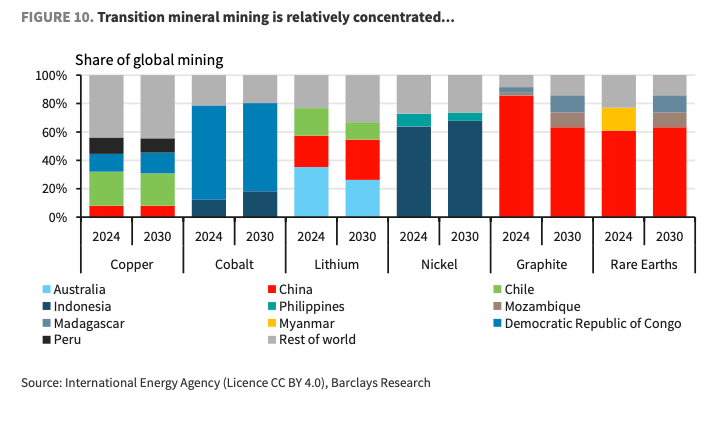
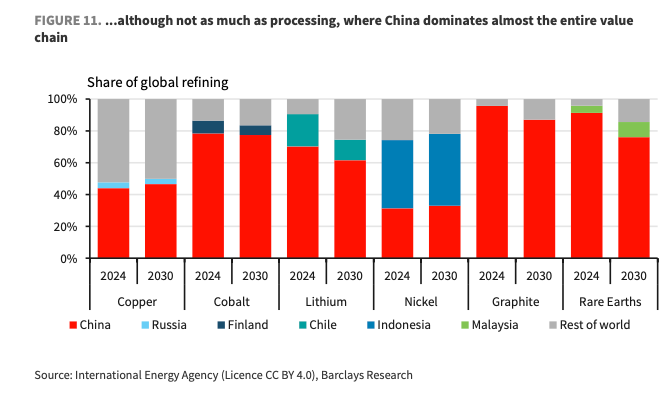
The most glaring problem is that China's control over critical materials mining and refining will remain in play through the end of this decade...

Adrien Rabier, Bernstein's equity analyst covering European aerospace and defense, outlined earlier this week that the rearmament cycle in Europe, and more broadly across the West, is already underway.

The problem is that missiles, bombs, drones, fighter jets, tanks, and just about everything else in the defense world require high-quality critical materials. Shortages could derail production lines, which is why the West is actively seeking to build out new supplies, making early movers such as Almonty and others that can deliver conflict-free supplies the winners.

O’Keefe reiterated a "Buy" rating on Almonty with a 12-month $25.50 target, implying about 93% upside from the previous close cited in the report. 

Tyler Durden Thu, 10/01/2026 - 14:40

What Zohran Mamdani Could Learn From His Father

1 October 2026 at 21:25
What Zohran Mamdani Could Learn From His Father

Authored by Peter Jacobsen via The Daily Economy,

Before Zohran Mamdani burst onto the scene of NYC politics with promises of cheap groceries, rent control, and calls to seize the means of production, his father, Mahmood Mamdani, was making important political contributions himself. The elder Mamdani's work is more academic in nature and generally more interesting than the "free stuff" brand of left-wing politics.

A family welcomes a new baby in rural India. Shutterstock.

In particular, Mahmood was decades ahead on one issue that other academics were getting extremely wrong in the 1970s - population.

In 1972, Mamdani published his book The Myth of Population Control: Family, Caste, and Class in an Indian Village. The book started with a (then) controversial claim: ecologist and population doomer Paul Ehrlich was wrong.

The Population Debate

Ehrlich was catapulted to popular fame after the success of his provocatively titled book The Population Bomb in 1968. Ehrlich's message was simple: the world was overpopulated. In his view, population growth would soon lead to mass famine throughout the world. His beliefs on this issue were so strong that he went as far as to claim England would collapse before the year 2000 due to food shortages.

Ehrlich's message was popular, and he wasn't the lone anti-population force. Around the same time, the United Nations formed its Fund for Population Activities (UNFPA), and USAID also began taking on major population aid projects. The theory shared by these groups was clear - if countries want to develop economically, they need to slow their population growth.

In hindsight, we know much of this thinking was both wrong and dangerous. Overpopulation concerns amounted to nothing, and anti-natal policy ended up having devastating impacts in developing countries. The UNFPA's first "population awards" were given to Indira Gandhi in India and Qian Xinzhong in China.

Both of these governments are now notorious for the coercive population policies they used to achieve the ends lauded by the UN. Both countries were engaged in aggressive campaigns of sterilization and compulsory abortion, with record rates of sex-selective infanticide. These terrible policies were no secret at the time: Nobel Prize-winning economist Theodore W. Schultz resigned his advisory position with the UNFPA in protest over these awards, calling them a "travesty."

Relatively few voices in the academic world spoke out against overpopulation hysteria. Among those were some economists like Julian Simon and P.T. Bauer. Joining arms in that intellectual fight was anthropologist Mahmood Mamdani.

These figures aren't exactly likely allies. Simon and Bauer could both be broadly construed as free market economists. Mamdani, on the other hand, is a political scientist and anthropologist who frequently publishes on the impacts of colonialism. Their shared humility, though, helped them understand Ehrlich's error.

Mamdani's Fieldwork

Mahmood Mamdani's 1972 Myth of Population Control examined one of the early notorious failures of attempted population policy: the Khanna study. The Khanna study was an attempt by the Rockefeller Foundation to test whether distributing birth control in rural India would reduce birth rates. Early results seemed promising: 90 percent of the local population favored free contraception. Yet birth rates did not fall. What explains this tension? Mamdani provides an answer:

But, in brief, there was only one reason for such behavior: politeness. As one of the villagers explained to me: 'Babuji, someday you will understand. It is sometimes better to lie. It stops you from hurting people, does no harm, and might even help them.'

In other words, the villagers enthusiastically accepted the gift of birth control to be polite! Policymakers and social engineers believed the acceptance of these methods signaled acceptance of lower population growth. Villagers were happy to "help" researchers by accepting their gifts, but had no interest in using them. Why? Mamdani clarifies this early on in his book.

To talk, as Ehrlich does, of 'overpopulation'"' is to say to people: You are poor because you are too many. As this essay will show, people are not poor because they have large families. Quite the contrary: they have large families because they are poor.

But why would the poor want large families? The answer becomes clear through Mamdani's interviews with locals. Mamdani gives one case which is particularly illustrative:

Milkha Singh has no desire to limit the size of his family. His reaction is again typical of the poor in Manupur: 'You think I am poor because I have too many children. [He laughs.] If I didn't have my sons, I wouldn't have half the prosperity I do. And God knows what would happen to me and their mother when we are too old to work and earn.'

The commissioners of the Khanna study simply didn't understand how different the context of rural India was. For Indians, children were necessary for help with daily work and for security in old age. Telling them they would be richer without children would be similar to telling Americans they would be richer if they didn't invest their money. The proposition was nonsensical.

Mamdani's study succeeded by simply allowing the people on the ground to explain themselves. Distant bureaucrats focused on a "population approach to development" simply tried to replicate the conditions that existed in richer countries (like lower birthrates) under the mistaken assumption that those conditions caused growth.

Centrally planned attempts to "solve" rural Indian problems without understanding rural Indian context naturally failed. As one review stated, the policies "have not had a major impact on people's attitudes, practice of contraceptives, or the average fertility rate."

Even if they had been successful, it's unlikely they would've brought development. This result is explained well by economist William Easterly in his book The Elusive Quest for Growth. In it, Easterly examines several "development panaceas" implemented in the twentieth century, of which population control was only one. He points out, "the general wisdom among economists from these [population] studies is that there is no evidence one way or the other that population growth affects per capita growth." In fact, for developing countries, the population growth slowdown in the late twentieth century was accompanied by an economic growth slowdown:

[P]opulation growth has slowed down by about 0.5 percentage point from the 60s to the 90s in the Third World. But, as we have seen, Third World per capita growth slowed down over the same period. Moreover, there is no association across countries between success at slowing population growth and success at raising per capita growth.

This is a terrible track record. Despite coercive policies that harmed millions of individuals, the societal impact was negligible for both the intended purposes: no reduction in population growth and no clear improvement in economic growth resulted from these programs. While China and India gather the most attention for the sheer size of their operations, campaigns of secretive, coercive, and unnecessary sterilizations are also recorded in Mexico, Chile, Bolivia, Peru, Indonesia, Bangladesh, Namibia, Canada and the United States, and as recently as this year.

The rural Indians understood their own lives in a way that would-be developers simply didn't. Economic prosperity cannot be engineered from the top down by changing certain parameters, as if the economy is simply one big equation.

Mahmood Mamdani's work helps to demonstrate the folly of central planning in the face of the complex realities of local communities. His son, New York City mayor Zohran Mamdani, should bring that same humility to his plans for the rest of the economy.

Peter Jacobsen teaches economics and holds the position of Gwartney Professor of Economics. He received his graduate education George Mason University. His research interest is at the intersection of political economy, development economics, and population economics.

Tyler Durden Thu, 10/01/2026 - 14:25

Oil Soars As US Sending 10K More Troops, 3rd Carrier, To Mideast After Trump Threatens Post-Midterm Bombing

1 October 2026 at 21:11
Oil Soars As US Sending 10K More Troops, 3rd Carrier, To Mideast After Trump Threatens Post-Midterm Bombing

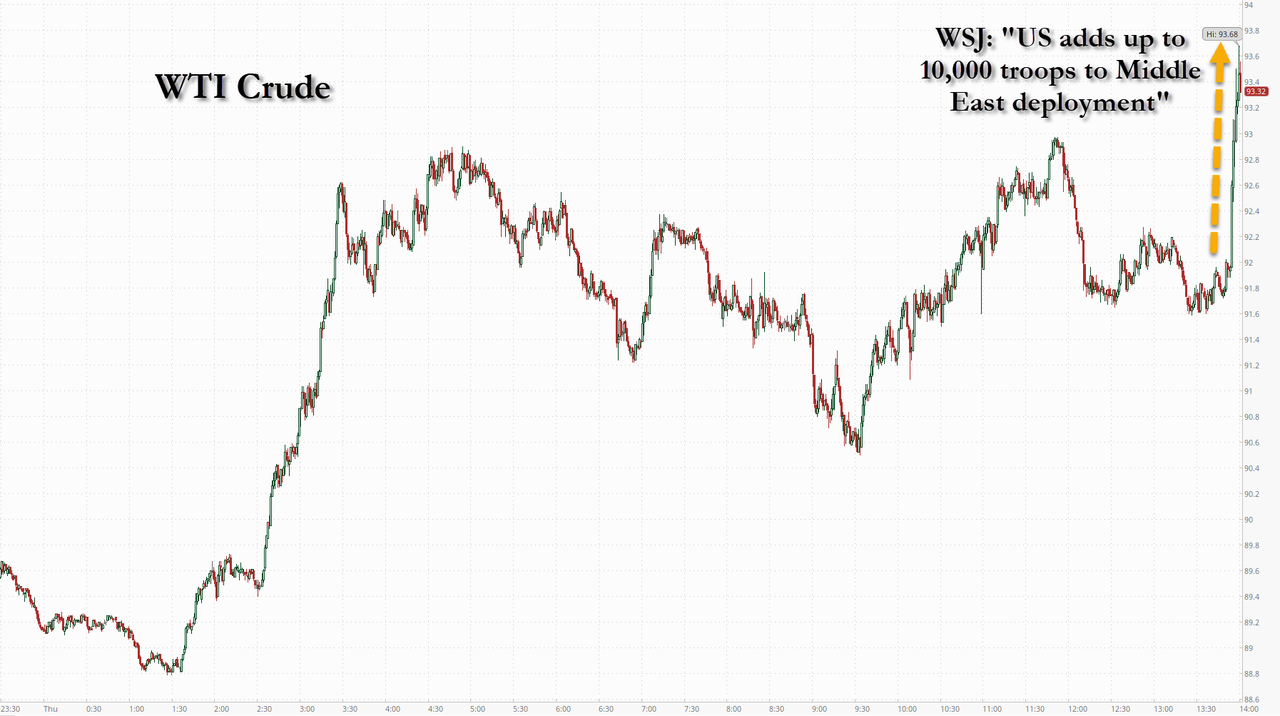
Signs of potential major escalation, or the next round at least (which Trump has hinted will come after the midterm elections), just hit The Wall Street Journal, and sent oil prices soaring. A quick summary:

  • The Pentagon is sending a third aircraft-carrier strike group and additional Marine Corps ships to the Middle East, adding 9,000 to 10,000 more troops to the region.
  • The ships, jet fighters, Marines and sailors will arrive in the region by the end of November, as President Trump considers renewing strikes on Iran after the midterm elections.
  • The additional servicemembers will add to the more than 50,000 troops already in the region, with the deployments coming after Trump rejected Iran's latest proposal for a seven-day ceasefire.

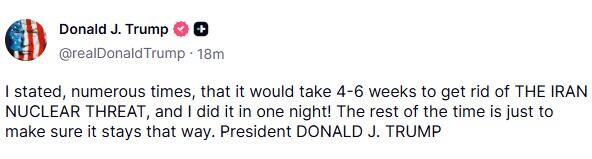
The Trump administration is deploying a third aircraft carrier to the Middle East along with additional Marines, an American official also told Israeli media on Thursday. And later, in the afternoon, Trump posted a new Truth Social message as follows:

The USS Theodore Roosevelt is en route to US Central Command's (CENTCOM) area of operations after having just left San Diego this week. It is expected to relieve the Japan-based USS George Washington, which entered regional waters in mid-August.

But both carriers could also stay on extended deployments. The WSJ writes further:

The additional moves will further strain the U.S. Navy, however, which has experienced supply shortages and faced near-record deployments during the conflict. Iran has in recent weeks fired ballistic missiles at American warships. The crew of the Roosevelt is prepared for a longer-than-normal deployment as well, according to senior Navy officials.

Source: US Navy

Carriers which more frequently had Indo-Pacific deployments have been increasingly diverted to the Middle East in recent years, a trend which had only picked up steam amid tensions with Iran and the Houthis out of Yemen.

Also on Thursday Al Jazeera is newly reporting that three carriers will stay in regional waters, "By the end of November, three aircraft carriers and two landing groups will be deployed around Iran," a US official told the Qatar-based outlet.

And USNI News earlier detailed:

On September 28, USNI News reported that a U.S. defense official had confirmed the carrier’s departure from San Diego the previous day. Navy officials had also warned families that the deployment could exceed seven months, with eight months being used as the planning baseline.

Carrier Strike Group 9 includes Theodore Roosevelt, Carrier Air Wing 11, Destroyer Squadron 23, Information Warfare Squadron 9 and the Ticonderoga-class guided-missile cruiser USS Chosin (CG-65). Its embarked air wing brings together several combat and support aircraft. The strike component includes F-35C Lightning II fighters from VFA-86, F/A-18E Super Hornets from VFA-211 and VFA-25, and F/A-18F aircraft from VFA-154. VAQ-137 operates the EA-18G Growler for electronic warfare, while VAW-115 flies the E-2D Advanced Hawkeye for airborne surveillance and command and control.

Whether one of the carriers ends up leaving the theatre or not, the extra deployment does mean President Trump will have a wider range of options for more possible military actions against the Islamic Republic.

He has in a freshly published TIME interview this week reiterated that he may be escalating attacks on Iran after the November midterms if an acceptable deal can't be reached.

As for the new carrier deployment, it was additionally confirmed: "During a town hall on August 31, Chief of Naval Operations Adm. Daryl Caudle said USS Theodore Roosevelt would be the next carrier sent to the Arabian Sea and was expected to relieve USS George Washington."

But again, follow-up reports suggest it will not be to relieve one of the carriers, but to serve as a likely third floating base of support for Iran operations.

Tyler Durden Thu, 10/01/2026 - 14:11

Watch Live: SpaceX To Launch Google AI Chips Into Orbit In Push For Space-Based Data Centers

1 October 2026 at 21:03
Watch Live: SpaceX To Launch Google AI Chips Into Orbit In Push For Space-Based Data Centers

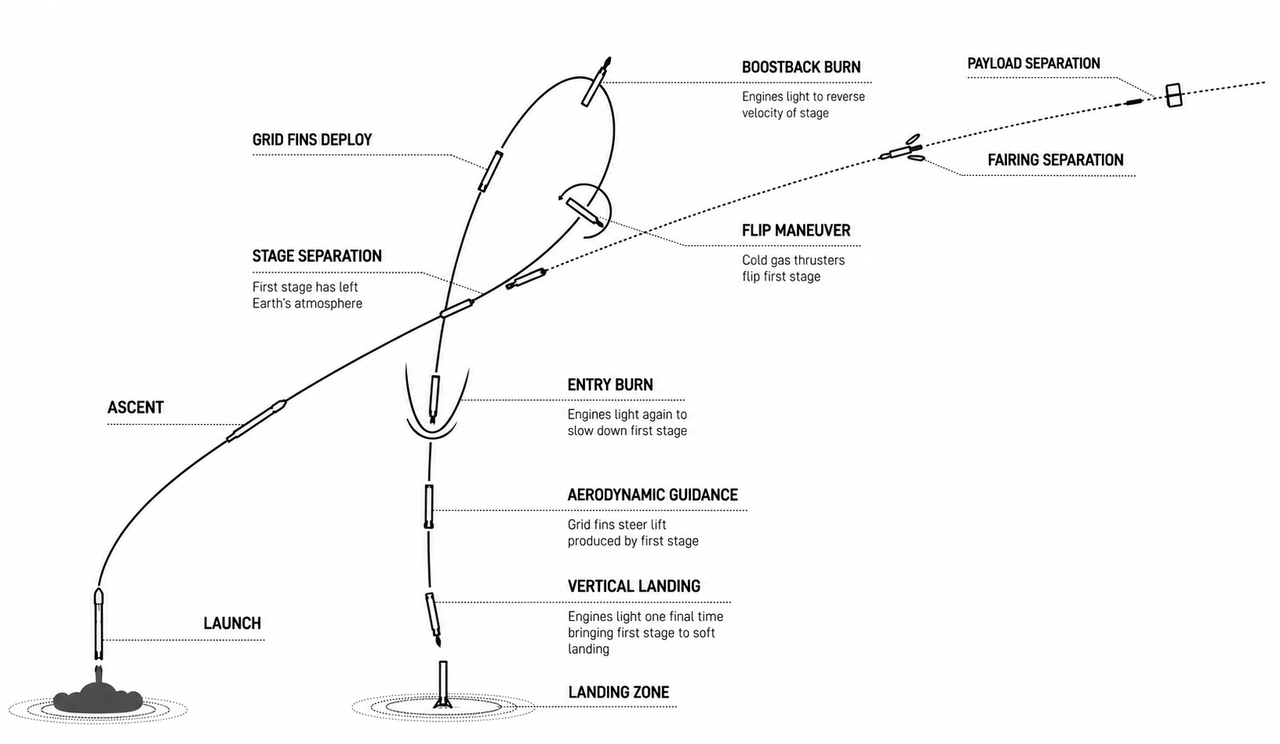
Specialized chips Google designed to run artificial intelligence workloads will be catapulted into low Earth orbit on Thursday afternoon atop a Falcon 9 rocket from California's Vandenberg Space Force Base, with hopes of making data centers in space a reality amid growing backlash on the ground that has sent many terrestrial projects into a tailspin.

Up next, Falcon 9 will launch 130 payloads to orbit from California aboard the Transporter-18 mission. Liftoff is targeted for 11:22 a.m. PT → https://t.co/ITRKTeX0fu pic.twitter.com/A8dZsF7H4b

— SpaceX (@SpaceX) October 1, 2026

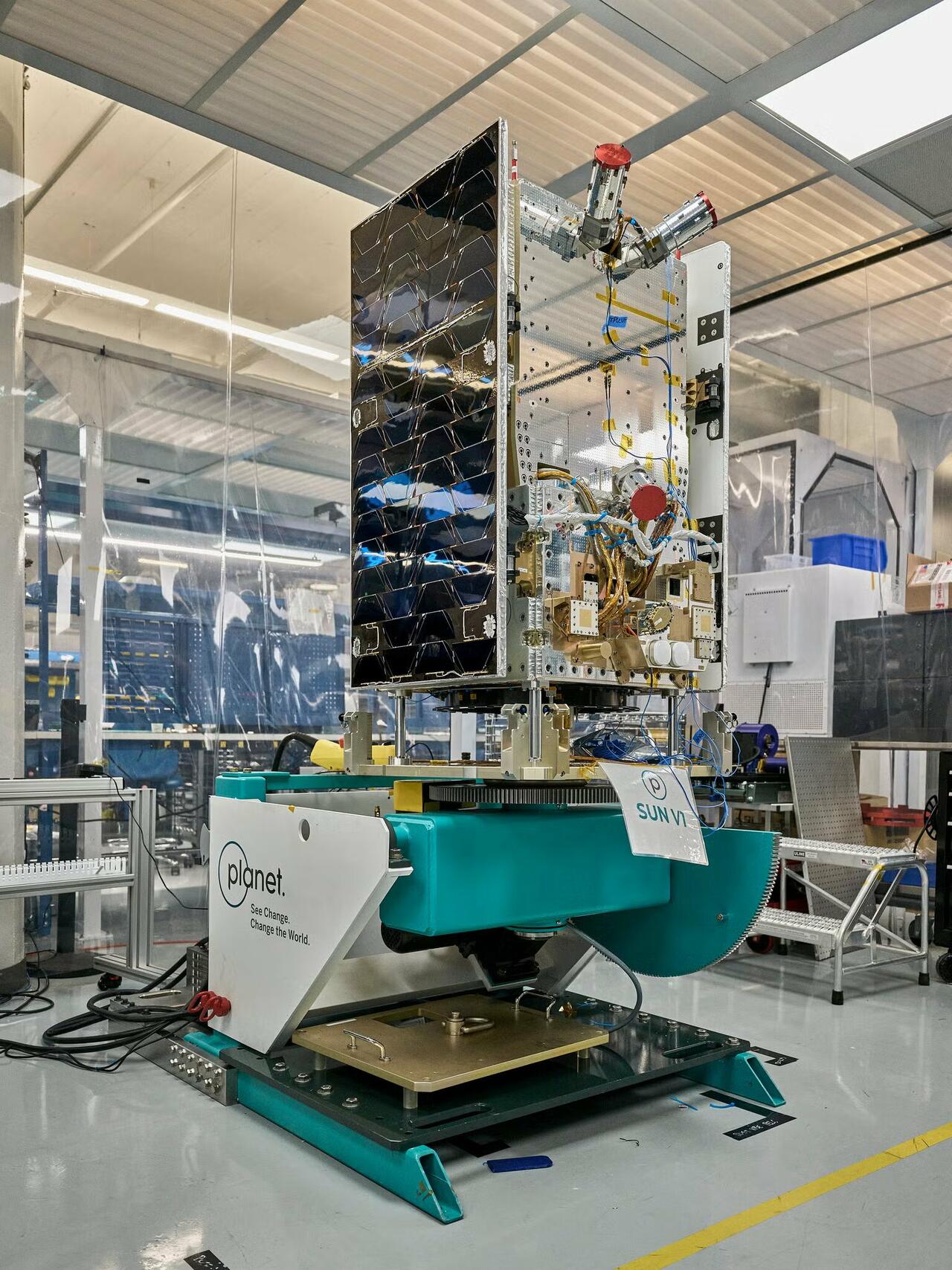
The Falcon 9 launch, scheduled for 2:18 pm Eastern time as part of the Transporter-18 mission, will carry a solar-powered satellite prototype equipped with Google's tensor processing units. This is the first orbital test for Project Suncatcher, Alphabet's effort to deploy data center satellites in low Earth orbit, where power is abundant and regulation is nonexistent.

In a pre-launch announcement, Alphabet said Project Suncatcher is a means of "exploring whether space could one day host scalable machine learning infrastructure."

"In low Earth orbit, satellites can access near-constant sunlight, generating up to eight times more solar power than on Earth. Eventually, it could be possible to link together multiple constellations of satellites, allowing them to manage larger AI workloads while in orbit," the tech giant said.

Alphabet has already tested its TPUs running AI workloads in a specialty lab at the University of California, Davis, but the real test of how its chips will perform in space is nearing and could mark the acceleration of a space-economy boom. The inflection point of the space economy has been the emergence of SpaceX and its rocket development, as well as its blockbuster IPO this summer. 

Much of the space economy hinges on economics, as the commercialization of SpaceX's Starship appears to be getting closer and will drive launch costs even lower.

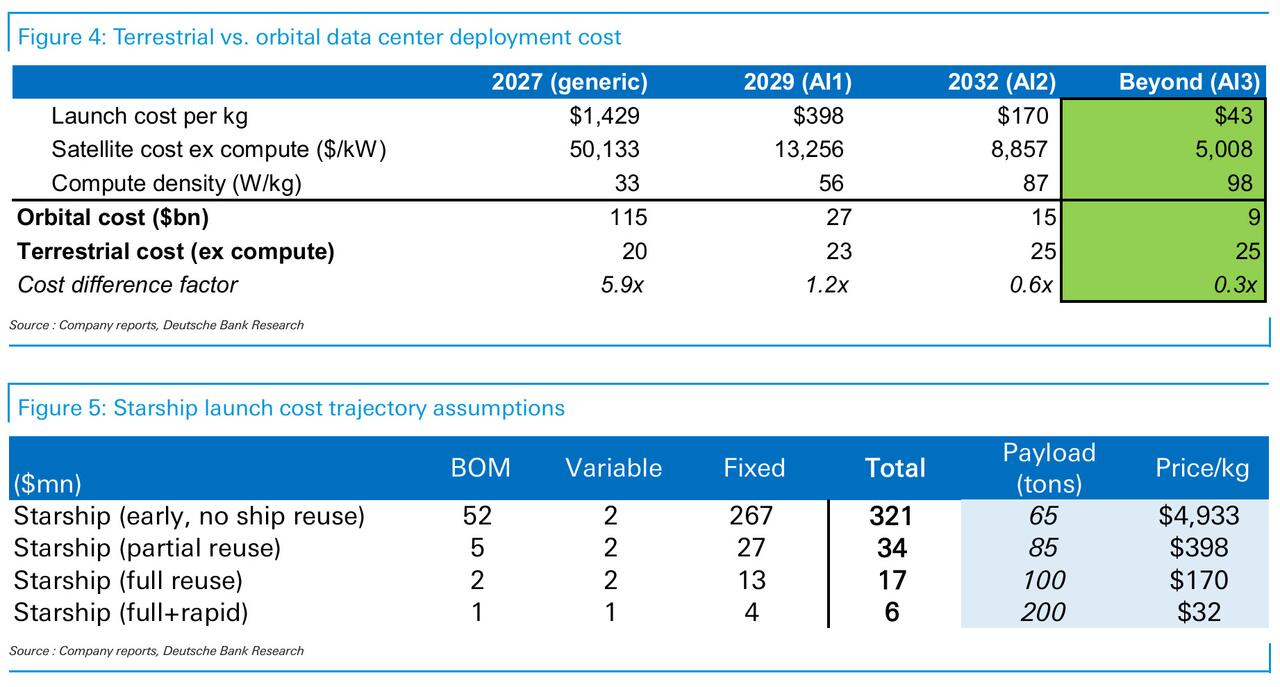
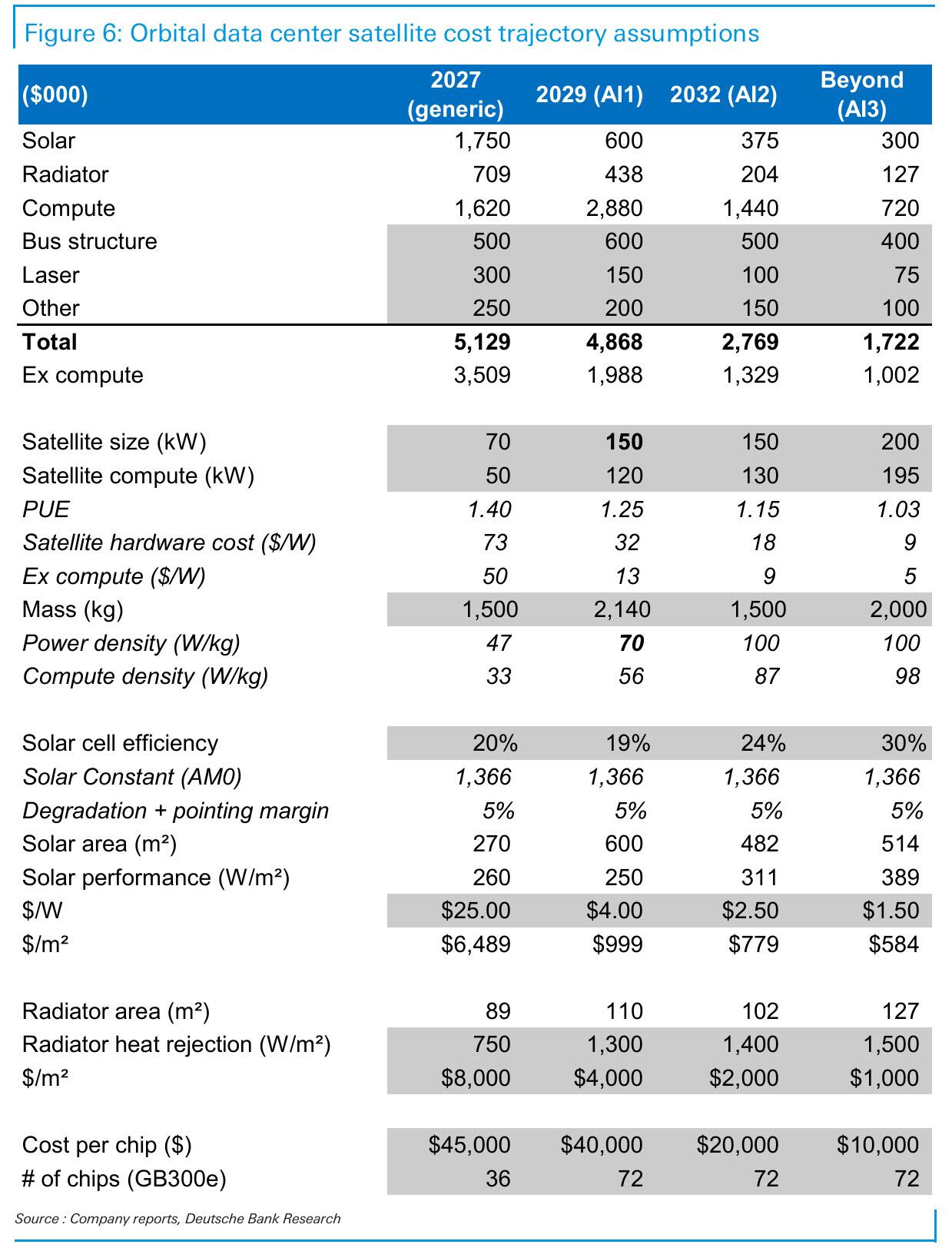
But as we previously highlighted, Deutsche Bank's research over the summer points to one major hurdle: orbital data centers still can't compete economically today with facilities on Earth, but that may eventually change at the end of the decade:

To set a baseline, DB's Edison Yu assumes upfront capex for 1 GW of AI compute on the ground is $38bn and requires $900mm in annual opex (power, maintenance, labor, etc…), translating into $42.5bn over 5 years (based on Epoch AI analysis). Of this amount, compute represents $21bn which carries over to orbital data centers at a 10% mark-up to account for overprovisioning in case of GPU failures. It is likely that GPU failures will not be addressed directly by maintenance but simply each satellite will just operate at lower power in the event of a failure. Therefore, the non compute costs for terrestrial are $21.5bn and ODC essentially has to break below this level post overprovisioning or $19.5bn to be at parity. Looking forward, DB assumes the cost of terrestrial increases going forward. To illustrate, NVIDIA's CEO Jensen Huang recently commented at GTC Taipei 2026 that a new 1 GW "AI factory" could approach $100bn in cost with roughly half being compute-related.

Using current SpaceX launch vehicles and satellite designs, DB estimates the near term cost of deploying a 1 GW space data center constellation would be 6x higher than terrestrial (ex-compute). This gap can narrow to 1.0-1.5x later by end of the decade and then eventually be cheaper in the early-mid 2030s. This reduction is primarily driven by Starship (rapid reusability) and aggressive optimization/scaling of the AI-series satellites (we also refresh the DB Orbital Data Center Model which goes deeper into the economic viability of launching AI infrastructure into orbit)

Even if orbital data centers become economically viable and cost-competitive with ground facilities, engineering challenges remain, such as managing temperature extremes and shielding chips from radiation. 

Watch Rocket Launch Live:

Tyler Durden Thu, 10/01/2026 - 14:03

Debt Crisis Back? European Bond Markets Crash, CDS Explode Amid France Budget Panic Contagion

1 October 2026 at 20:44
Debt Crisis Back? European Bond Markets Crash, CDS Explode Amid France Budget Panic Contagion

It's starting to smell awful sovereigny crisisy in Europe all over again.

In a vivid deja vu to the peak European debt crisis days of 2010 (and 2011... and 2012... and 2015), credit spreads, credit default swaps and the risk premium in euro-area government bonds exploded on Thursday to levels not seen in over a decade, following a rout sparked by concerns around France’s fiscal and political situation which in addition to local social chaos, is starting to spill over into other markets.

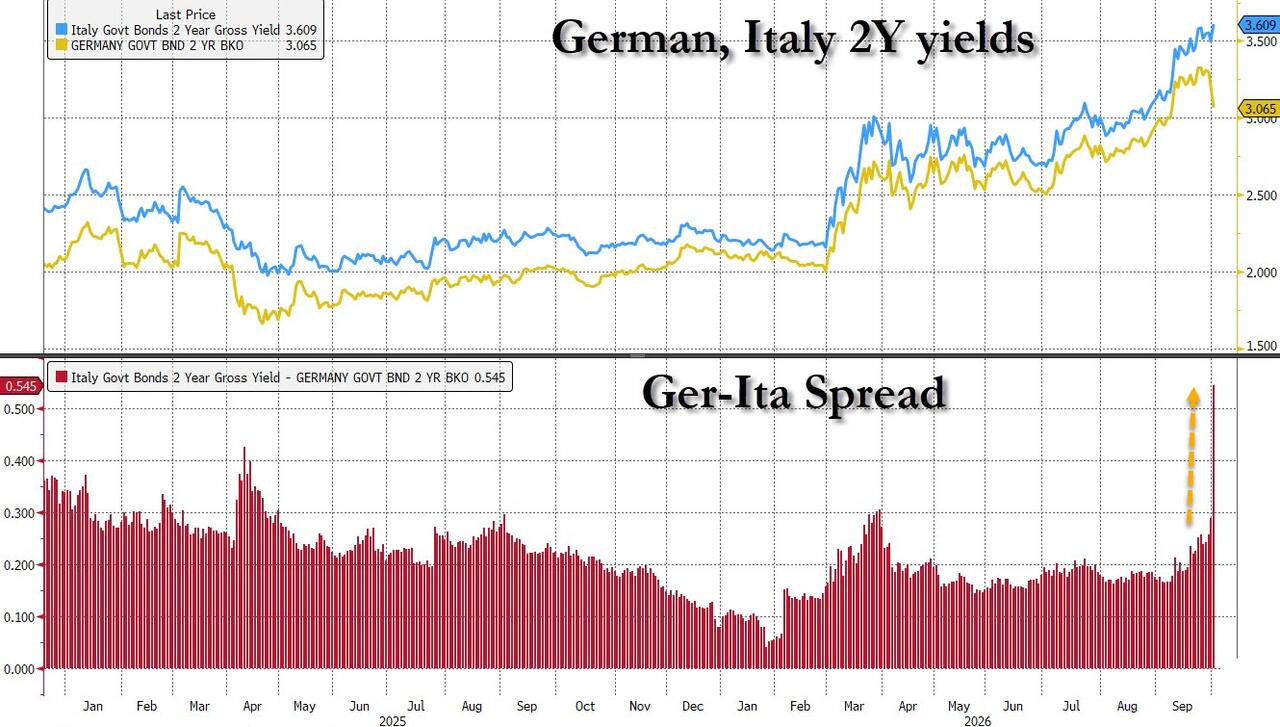
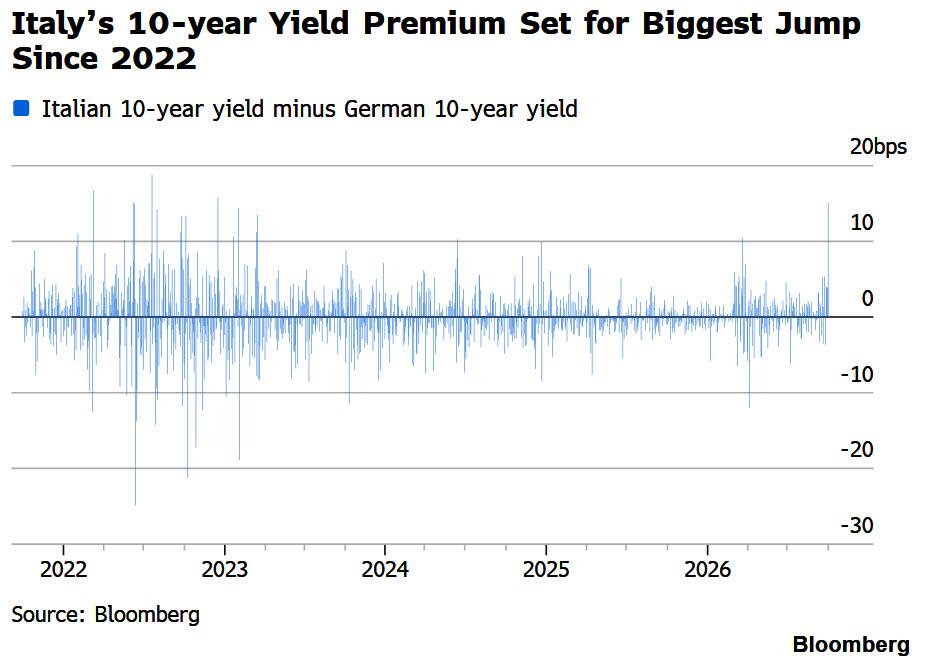
The spread between Italy and Germany’s two-year yields almost doubled to 55 basis points on Thursday, the biggest daily jump since 2020 on a closing basis.

The equivalent gap for France rose as much as 22 basis points, the most since 2012.

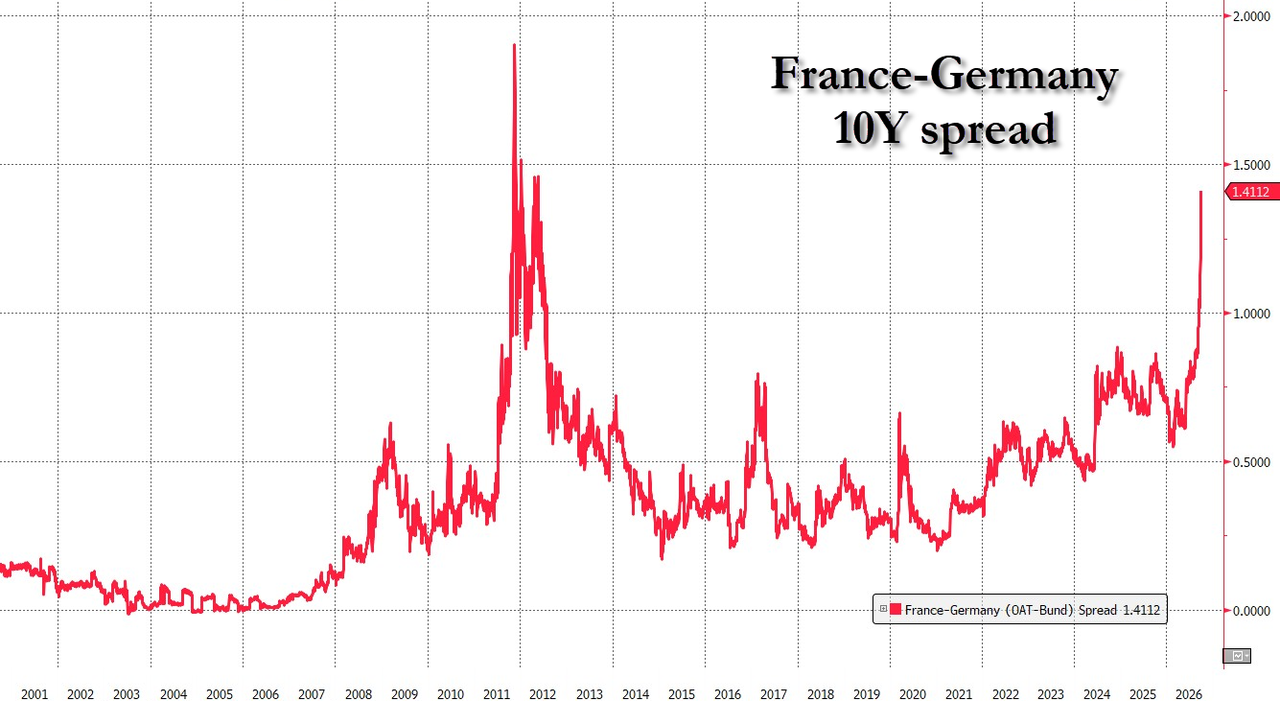
Meanwhile, the spread between 10Y French OATs and 10Y Bunds has soared to 1.41%, the highest going back to the 2012 European Sovereign debt crisis.

A measure of French bond risk reached another milestone this week as investors positioned for political upheaval next year and an ongoing deterioration in the country’s public finances. The widely watched spread between France and Germany’s 10-year yields jumped 14 basis points ... 

... to 141 basis points, already the widest since 2012.

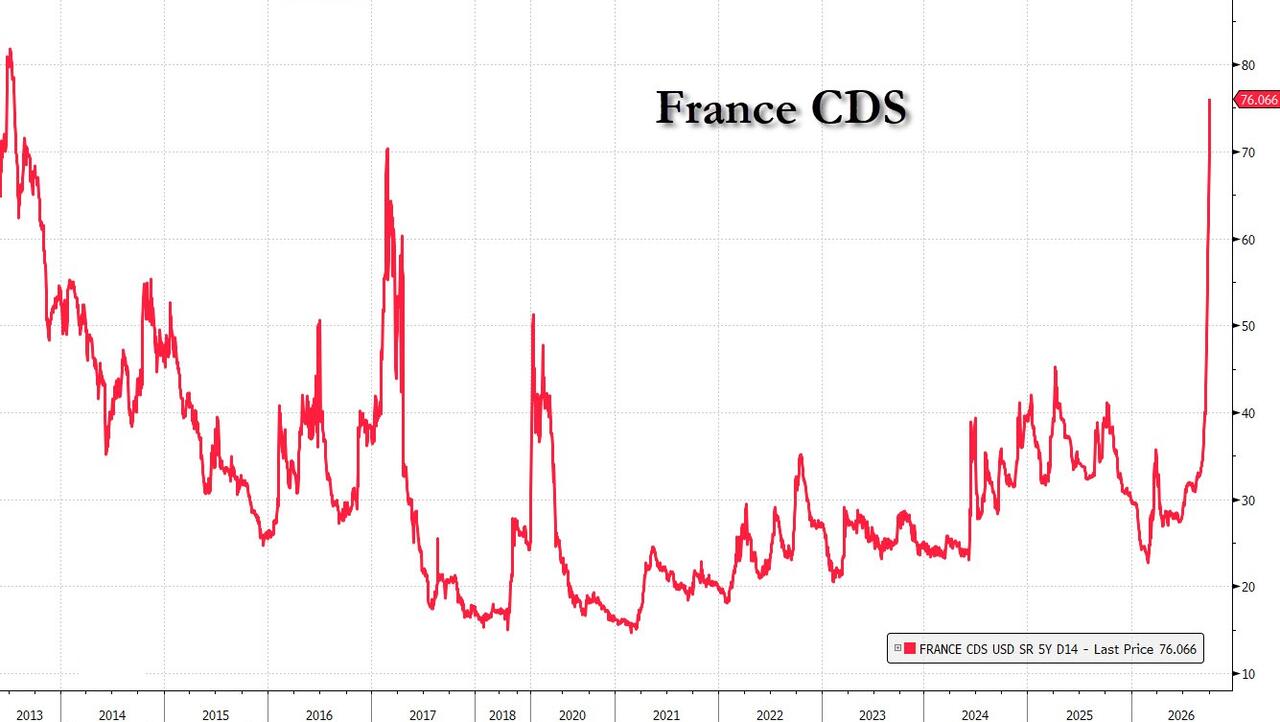
Amid the bond rout, French CDS has more than doubled in the past month on mounting fiscal viability fears. 

French credit got monkeyhammered ahead of today's French budget presentation, which plans to consolidate to a deficit of 5% for next year versus 5.4% expected this. This is how Goldman economist Alex Stott explained it: 

“Today is only the formal presentation of the budget. I am not expecting to learn much new relative to the interview Lecornu gave two weeks ago. The more important information will likely be RN's counter-proposal due next Tuesday, which will give us a sense of the concessions they will ask for in the bill, as well as their plans for the economy if they win the elections. Regarding the budget process, I am expecting it to be very drawn out, potentially lasting until mid-December or early next year. What could accelerate the timeline is if more acute market stress forces political parties to a quicker compromise”

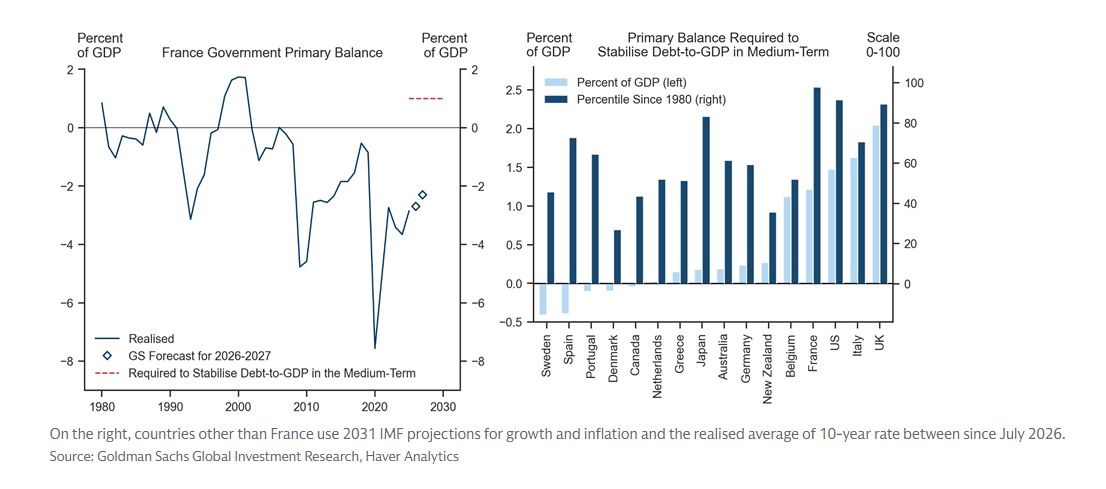
Alex has also modeled France's medium term debt-GDP path here, which Goldman sees rising to 125% at start of next decade.

In a nutshell, the issue with France is that:

  1. Average interest rate is set to rise to 3% from 2%
  2. The primary balance required to stabilise debt is +1% on Goldman's market forecasts; like many countries but one that France has rarely achieved (95th percentile over past 35 years)
  3. If you take market rates its even worse; would need to run a 2% primary surplus, something that has never been achieved
  4. We have elections and policy uncertainty.

As for why the OAT-Bund spread is moving now, some more from Stott:

“past few sessions of spreads widening have not come on the back of any fundamental news. Our current-quarter growth tracking has been pretty stable at 0.1% over the last month, the deficit and budget news were in line with expectations, and polls have been relatively stable too. But clearly have a difficult market backdrop with moves in energy/rates and election uncertainty. Plus would also note discussion around Melenchon’s rise in 1st round polls to second. Though our simulation give him little change of winning in second round (exhibit 7 here: https://tinyurl.com/msm344p9) his proposal to cancel French debt held at Banque de France is the kind of deep tail which can lead to bigger market moves even if his winning probability only shifts slightly”

French Primary Balance, and Balance Required to Stabilise Debt to GDP

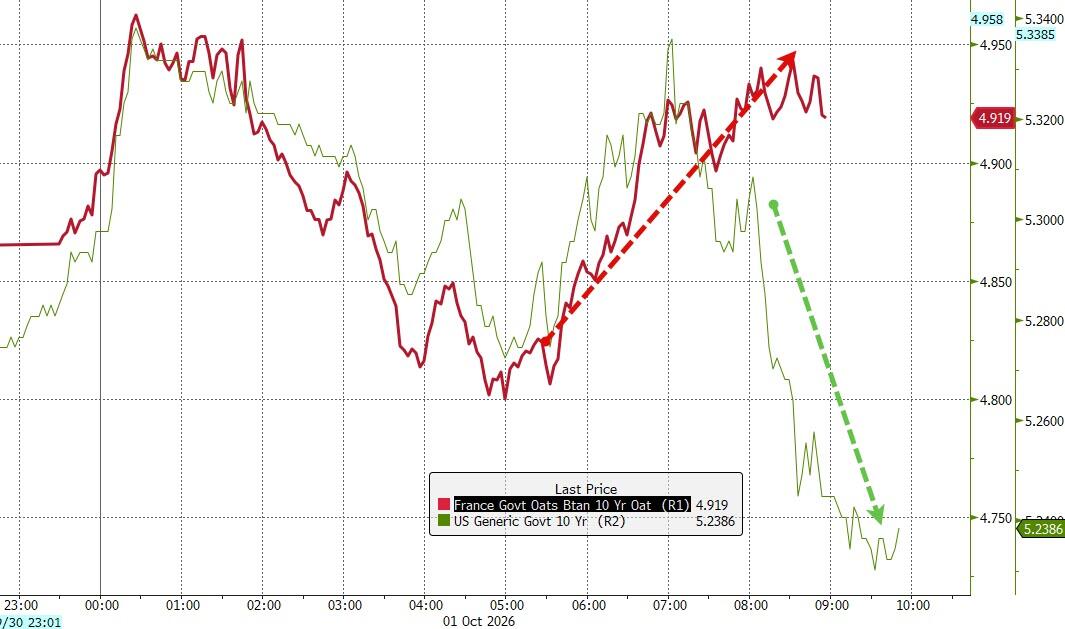
Today's violent moves came as German bonds rallied sharply as investors rushed for the region’s "safest" asset (which is ironic for a country whose entire manufacturing sector has been gutted by China), while dumping everything else. Curiously, Treasury yields also surged during the European session, as locals dumped US paper alongside the periphery, although the selloff ended the moment Europe closed.

The nervousness suggests the selloff in French markets caused by the nation’s struggle to get a grip on runaway public finances is starting to sap risk appetite more broadly, as we first laid out two months ago in "France's €107 Billion Deficit Shock: The Next Euro Debt Crisis?"

“France has been slowly but steadily breaking,” said Mike Riddell, lead manager of Fidelity International’s Strategic Bond Fund. “But today feels like the first day that broader financial markets have noticed.”

He's right: 

  • ITALY-GERMANY TWO-YEAR BOND YIELD SPREAD WIDENS MOST SINCE 2020
  • GERMANY-FRANCE 10Y YIELD SPREAD CLOSES 14BPS WIDER AT 141BPS

There were also signs that markets are starting to price the toll from higher yields - which tighten financial conditions - on the economy. Traders slashed wagers on the extent of further interest-rate hikes from the European Central Bank, and swaps are no longer fully pricing three more quarter-point increases. As recently as Tuesday, they were betting on at least four more. 

“The price action is very unusual,” said Rohan Khanna, head of European rates strategy at Barclays. “We are reducing ECB rate hike expectations, yet the EGB complex, with the exception of Germany and the Netherlands, is selling off. It is reminiscent of periods when bond market fragmentation was a major concern, such as during the European sovereign debt crisis.”

In other words, it is reminiscent of when Europe was on the verge - or already in - a debt crisis. 

As Bloomberg notes, investors and strategists also said the moves suggested hedge funds have been forced to capitulate on positions as the market moved against them and losses piled up.

“One of the favorite hedge fund carry trades was to own short dated France versus swaps,” added Fidelity’s Riddell. “Some of these positions must have been reduced the past few weeks, but it feels like a capitulation.”

Tyler Durden Thu, 10/01/2026 - 13:44

Jensen, Zuck Gang Up On 'Doomer' Dario Behind Closed Doors At White House AI Summit

1 October 2026 at 20:20
Jensen, Zuck Gang Up On 'Doomer' Dario Behind Closed Doors At White House AI Summit

Tuesday's White House "Super Intelligence" luncheon was sold as a kumbaya moment. Tech titans flanked President Trump on the driveway after signing a voluntary, "morally binding" pledge to police themselves, and the cameras got their picture of a united industry calming the public's nerves.

Behind the scenes, it was a different story.

According to the Wall Street Journal, Nvidia's Jensen Huang was among a group of executives who confronted Anthropic CEO Dario Amodei after the East Room lunch. They wanted to know why he keeps going to such extremes in public about what AI models can do and how dangerous they might be. The exchange took place in the Roosevelt Room, where a smaller group of CEOs and White House aides were hammering out the final text of the principles.

Amodei apparently didn't fold. He told his fellow executives that the public deserves honesty about model capabilities, and that downplaying the risks isn't an option.

Meta's Mark Zuckerberg supplied the other half of the pincer during the lunch itself. When Amodei raised his safety concerns, Zuck reportedly answered that the way to address them was for the industry to follow through on the very principles everyone was about to sign and self-regulate (bitch!). 

Translation: Nice speech, Dario. Sign here.

Zuck Holds The Pen

Zuckerberg apparently played a central role in finalizing the accord, talking frequently with Trump and with Commerce Secretary Howard Lutnick. Lutnick's department runs a key government AI testing unit. It is also the department that, as we noted in July, cut off access to Anthropic's Fable 5 and Mythos 5 for about 2½ weeks before lifting the export controls.

The push for Tuesday's lunch reportedly began at last week's state dinner for Xi Jinping, where Zuckerberg sat next to House Speaker Mike Johnson and the two talked AI policy. From there, Zuck and Huang worked the phones to line up the CEOs while Trump and Johnson organized the event to build consensus.

Amodei skipped that state dinner and got his own private dinner with Trump on Sunday, his first face-to-face with the president.

Look at this: 

Someone’s going to win an Oscar one day playing Dario Amodei. How is this guy real?

He looks like he belongs in a sequel to Darren Aronofsky’s Pi. pic.twitter.com/KvvSqNQzvH

— David Pinsen (@dpinsen) October 1, 2026

The Regulator That Wasn't

Over the summer, Anthropic, OpenAI and Google had rallied around a FINRA-style self-regulatory organization that the administration was considering, modeled on the body that polices brokerages. Huang, Zuckerberg and Elon Musk then told Trump that such a body would concentrate too much power in the hands of the leading labs. The idea was scrapped.

Many of the same concepts survived in Tuesday's principles anyway, including tougher internal model reviews during development and outside testing. The difference is that nobody now has the job of enforcing them. Trump has floated a 10-person committee to oversee the sector, but House Speaker Mike Johnson stressed the pledge is "voluntary on behalf of the industry," and House Minority Leader Hakeem Jeffries called it "entirely unenforceable."

Huang, Zuckerberg and Musk aren't the only ones making the capture argument. When Amodei published his We Must Pace the Frontier essay last month, former AI czar David Sacks fired back that Amodei and Sam Altman are the frontier, holding a de facto duopoly on frontier intelligence. Skeptics have long argued that a "pacing" regime run by the incumbents looks a lot like a moat. That argument gets louder when the company preaching caution is reportedly lining up an IPO at a valuation of around $2 trillion.

From Punching Bag To 'Outstanding People'

Watching the absolute drama between frontier AI companies and the Trump administration has been an exercise in whiplash. 

  • The Pentagon threatened to blacklist Anthropic over its guardrails on military use and then followed through. A federal appeals court upheld that blacklisting just last Friday.
  • Commerce forced the roughly 2½-week shutdown of Fable 5 and Mythos 5 over security concerns.
  • The pacing essay helped knock the legs out from under the AI trade, and the next day Trump went after Dario by name for "pretending to be a 'perfect little angel.'"

Yet on Tuesday, Amodei told reporters that the industry and the administration could win the AI race safely if they worked together. Asked why executives should be trusted to police themselves, Trump said: "Because they're outstanding people." Director of National Intelligence Jay Clayton, reportedly in line to become Trump's next AI czar, went further - calling the gathering "one of the most, if not the most, constructive and collegial industry meetings" he had ever seen.

Zuck's Glow-Up

Then there's Zuckerberg, who went from banning Trump after January 6 to helping write his AI policy. In Trump's second term, Meta settled the lawsuit over the suspension, rolled back its fact-checking, hired Trump-friendly executives and donated to the president's pet causes. On Tuesday, Zuck was all smiles beside Trump at the presser, saying the industry wants to give Americans confidence that the technology works as intended.

What a pack of whores, eh? 

Tyler Durden Thu, 10/01/2026 - 13:20

NANO Nuclear Buys The One Thing You Can't Speed Up: A Fuel-Cycle License

1 October 2026 at 19:40
NANO Nuclear Buys The One Thing You Can't Speed Up: A Fuel-Cycle License

Ask anyone in the nuclear business what holds up the "renaissance" and you won't hear much about reactor physics. You will hear about paperwork, fuel, and paperwork for fuel. The DOE's Deputy Secretary James Danly put it bluntly last week: "If we are going to have this nuclear renaissance, we are not going to be able to do it without fuel."

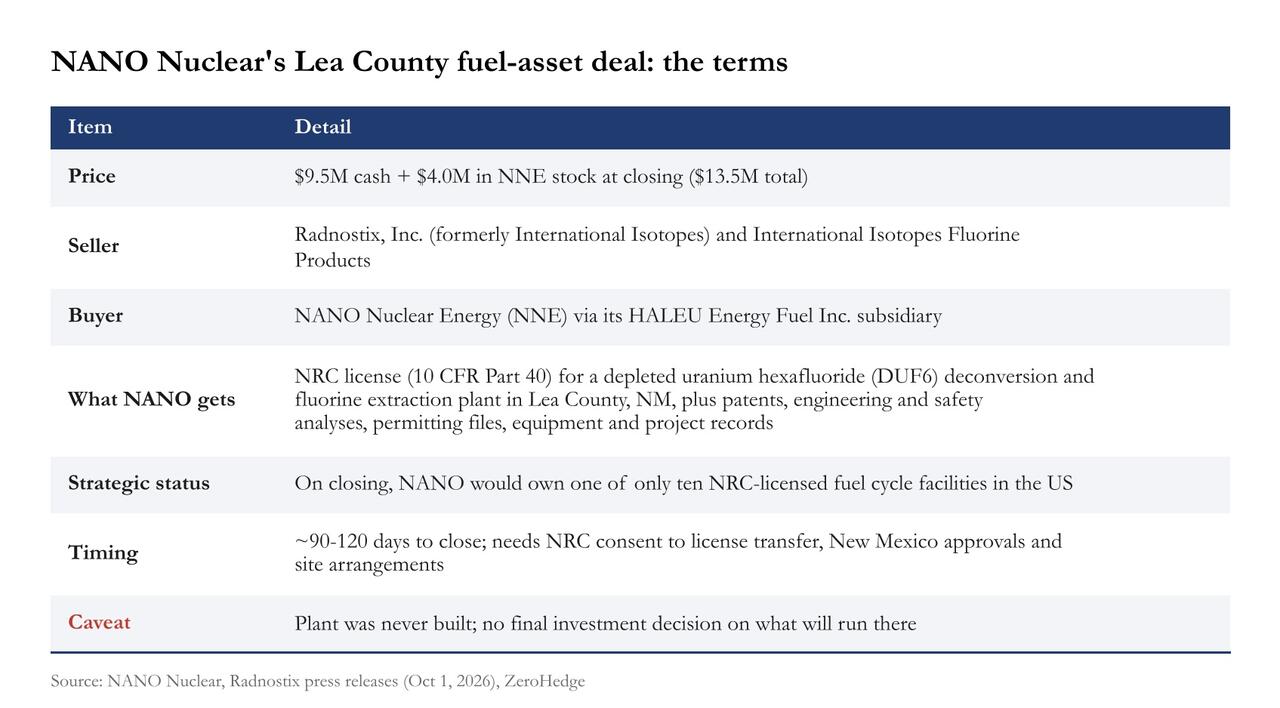
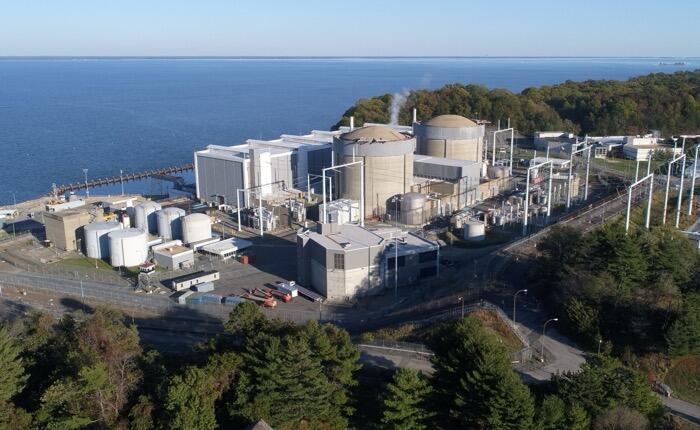
So it makes sense that the latest move from the NANO Nuclear (NNE), a company we have covered at length over the past year due to its leading position in the nuclear space, is a reactor-free one. This morning NANO and its subsidiary HALEU Energy Fuel signed a definitive agreement to buy the US nuclear fuel processing assets of Radnostix (formerly International Isotopes) and its subsidiary International Isotopes Fluorine Products.

The headline terms:

After rising 2.5% premarket, NNE stock is now lower on the day which is odd for a stock that jumped 13% on the similarly sized $13M Secured Transportation Services deal in May. That fits a market where, as Goldman's sector specialist put it in mid-September, "inbounds have been extremely light on the nuclear front" (we discussed this in "Uranium Term Prices Hit A Record... So Why Is Nuclear Getting Nuked?"). We would argue the market is underpricing this one.

What is NANO buying?

The asset is the old International Isotopes Fluorine Extraction Process and Depleted Uranium Deconversion (FEP/DUP) project near Hobbs, NM. According to the NRC, the license was issued on October 2, 2012, with a 40-year term. It was the first commercial license of its kind in the US, and the facility was "not yet constructed."

The plant was designed to take the depleted UF6 "tails" left over from enrichment, convert them into stable uranium oxide for disposal, and recover the fluorine as high-purity fluoride products, including anhydrous hydrogen fluoride, which goes into semiconductor and solar manufacturing. Put differently, it turns nuclear waste into chip-fab chemicals, which is about as 2026 as a business plan gets.

Location matters more than anything else here. The site is about 30 miles from Urenco USA in Eunice, NM, which, per the World Nuclear Association, is the main US commercial enrichment plant (4.3M SWU/yr), with a multibillion-dollar expansion planned. Urenco produces tails continuously. The NRC lists its DUF6 storage authorization at up to 251 million kg, and Urenco's long-term tails plan currently points to a facility in the UK. A licensed deconversion site next door is the obvious alternative.

So why did the plant sit idle for 13 years? According to a Fission Chain write-up, the main obstacles were a condition in Urenco's own license that blocked it from using deconversion plants producing anhydrous HF (removed in 2025), plenty of cylinder storage space at Eunice, and no committed buyer. In short, there was a license and no customer. The Russian uranium import ban, whose waivers end in January 2028, plus the federal push for domestic enrichment, have since changed that.

Why this matters more than the price suggests

The important line in NANO's release isn't about depleted uranium. It's this one: the existing license provides "a significantly more efficient regulatory pathway" to add other fuel-cycle processes through NRC license amendments rather than starting a new application from scratch. CEO James Walker said the deal gives NANO "multiple potential pathways to expand our domestic fuel cycle capabilities while preserving the flexibility to determine the development strategy."

Translation: NANO is paying $13.5M for a regulatory head start. Anyone who has watched an NRC fuel-cycle licensing proceeding (the Eunice license itself took years) knows the time saved is worth far more than the purchase price. That's especially true at a moment when, per the WNA, the US has one conversion plant (Metropolis, running at 50-70% of its 15,000 tU/yr license) and one commercial-scale enrichment plant.

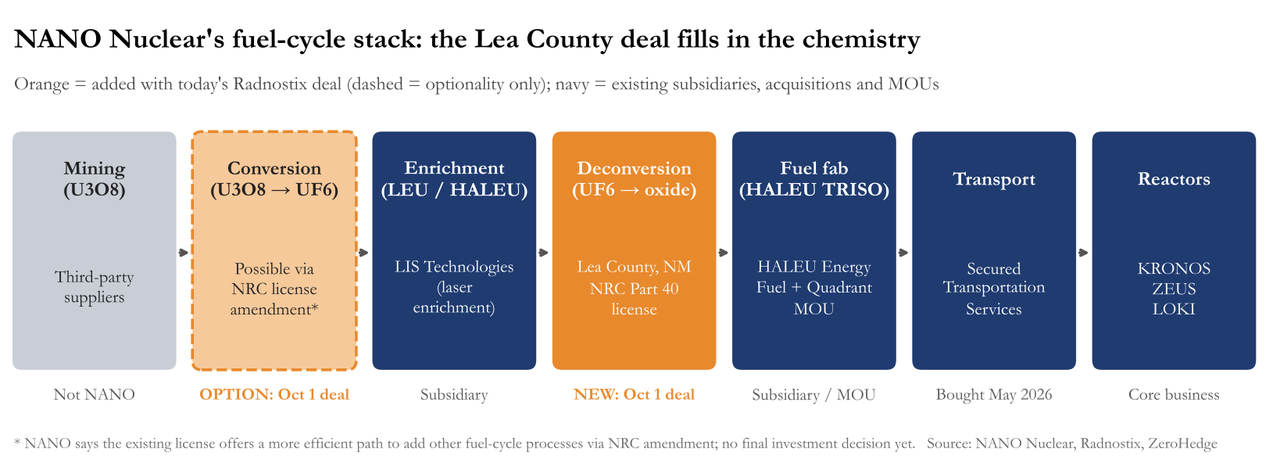
Readers who followed our September 5 piece should have seen this coming. When NANO signed its MOU with Enveniam, the lead project integrator for LIS Technologies' laser enrichment plant, one of the six workstreams listed was "conversion and deconversion." At the time we said NANO's vertical integration was moving beyond the "corporate slide deck." Four weeks later it has a licensed site for that workstream.

Source: NANO Nuclear, Radnostix, ZeroHedge

Laid out like this, the plan is clear. Since January NANO has put together, piece by piece:

  • Enrichment: LIS Technologies' laser enrichment, which founder Jay Yu has pitched as "significantly cheaper to operate as well as less capital intensive to deploy" (Feb 4, May 15), with Enveniam as integrator for the planned Tennessee plant.
  • Fuel supply and fabrication: the HALEU Energy Fuel subsidiary (today's buyer), plus the Aug 18 MOU with Quadrant Nuclear Industries on domestic HALEU supply.
  • Logistics: the HALEU transport package (Mar 16) and the $13M acquisition of Secured Transportation Services, which ran the largest single international HALEU shipment in NNSA history (1.7 MT from Japan) and turned NANO into a revenue-generating company.
  • Fuel handling: Fortil's work on the KRONOS fuel handling and storage system (Jul 24).
  • Reactors: KRONOS at UIUC, where the NRC has begun its technical review of the construction permit we flagged as "a defining moment" on Apr 2, along with ZEUS and the space-focused LOKI.

The sell side: fuel is where the money is

The best argument for NANO spending on fuel instead of only on reactors comes from Goldman, which says nothing about NANO directly.

When the bank's clean energy strategist Brian Lee initiated on Standard Nuclear (STDN) at Buy in August, he described a TRISO fuel supplier with a capital-light model, "significant pricing power in the early-stages of TRISO fuel adoption," EBITDA margins reaching ~65% by 2030, and revenue going from under $20M in 2026 to over $1BN by 2030. All of this rests on Goldman's forecast of ~15GW of cumulative SMR deployment by 2035, up from zero today, which would require about 100 MTU of fuel. Goldman added that STDN's ability to fund growth without more external capital makes it "unique amongst peers tied to the growth of SMRs."

That is the gap NANO is trying to close: a reactor developer has to raise money until first power, while a fuel supplier can charge everyone along the way (think of it as a debt-free neocloud charging others for the privilege of using its compute until AI becomes profitable). Northland's Jeff Grampp made the same point after last month's WNA symposium in London. He cut his NNE target to $22 from $37 to reflect higher costs of capital and a slower 2030-35 buildout, and said he prefers fuel and supply-chain names "that make money now" (BWXT, LEU, EU, URG). If the market pays fuel-cycle multiples and NANO keeps acquiring fuel-cycle assets, the conclusion follows.

Goldman's view on the macro backdrop got stronger overnight. Commenting on the US-Korea package announced after Tuesday's close, which includes $120BN for eight large US reactors (six AP1000s, two APR1400s), Lee said it reinforces "a constructive long-term backdrop for nuclear deployment and the broader fuel cycle," and that it is "likely to further exacerbate the anticipated uranium supply deficit in the 2030 time frame" (full note available to pro subs). Eight gigawatt-scale reactors need conversion, enrichment and, eventually, tails handling. That's more UF6 moving through a supply chain with very little spare capacity.

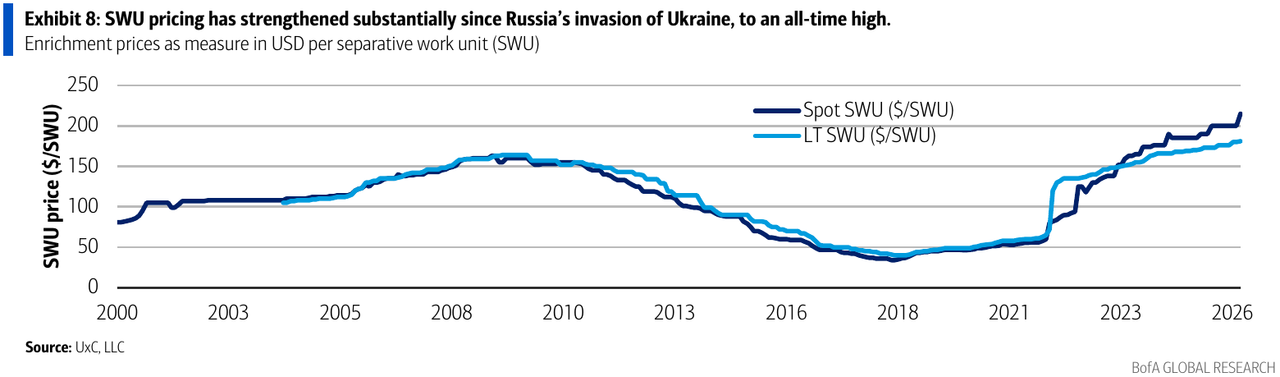
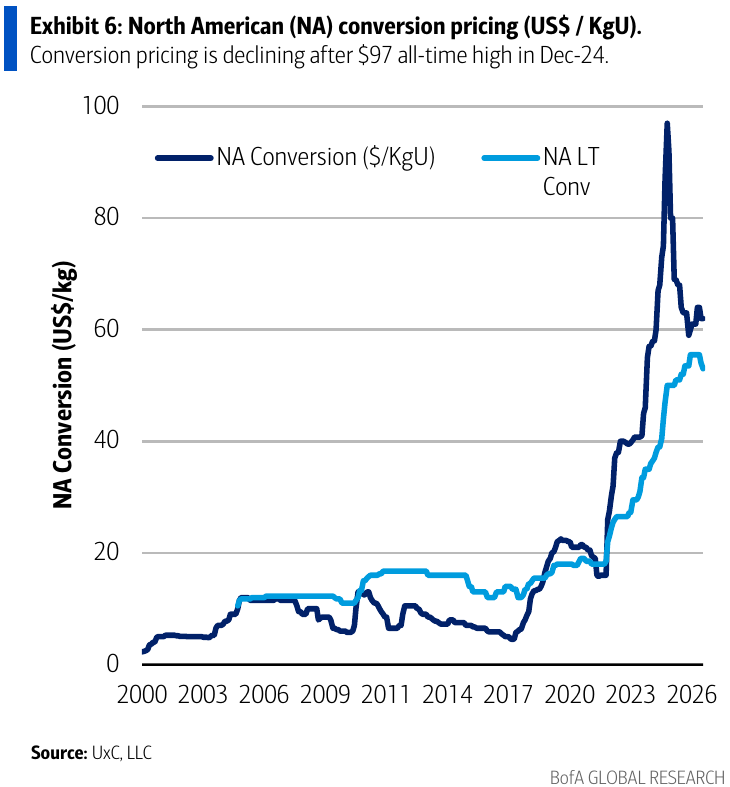
The prices already show it. BofA's charts from the WNA symposium show SWU prices at an all-time high and still rising, and North American conversion still at roughly 3x pre-2022 levels even after falling from the $97/kgU peak in December 2024:

Source: BofA Global Research, UxC

Source: BofA Global Research, UxC

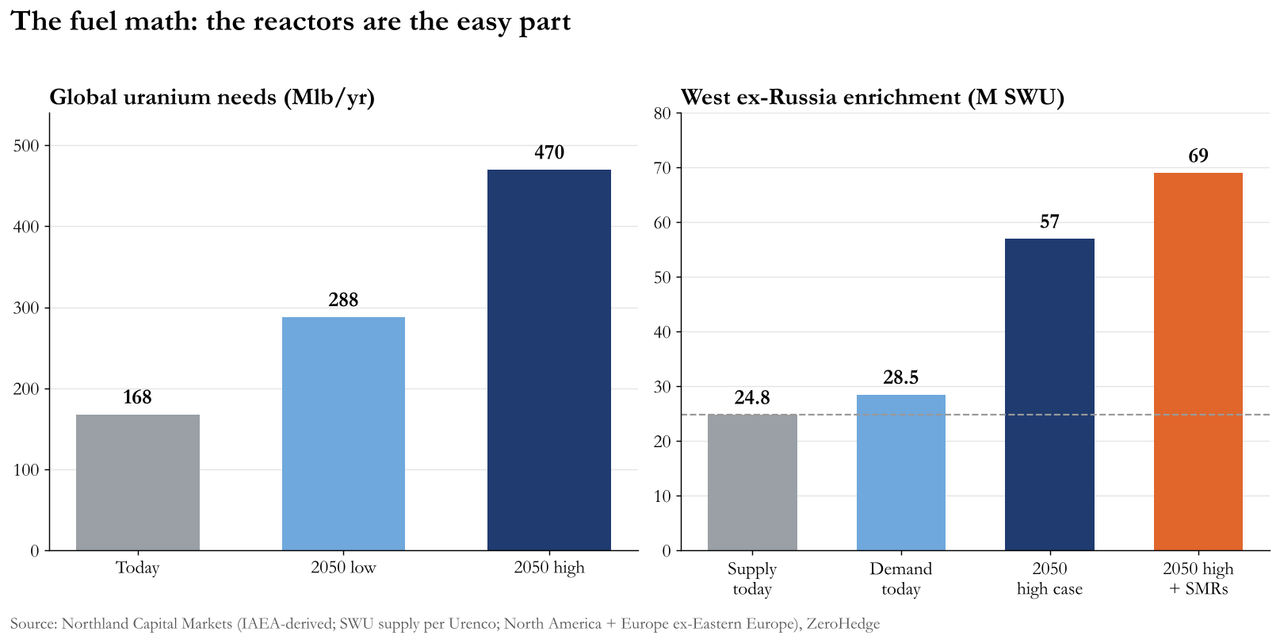
And the long-run math is worse. Northland's IAEA-based numbers show Western (ex-Russia) enrichment supply of 24.8M SWU against demand of 28.5M SWU today, which means the West is already short before a single SMR is built. In the 2050 high case with SMRs, demand rises to about 69M SWU:

Source: Northland Capital Markets (IAEA-derived), ZeroHedge

HALEU is the tightest part of all. Seaport notes Centrus is targeting 12 MT/yr of HALEU capacity with first new output in 2029, and that a single Oklo Aurora needs about 7 MT for its first core. That means America's flagship HALEU program can fuel about two reactors a year at the start. This is the main reason microreactor developers are moving down the fuel chain themselves.

Can NANO afford to be a fuel company?

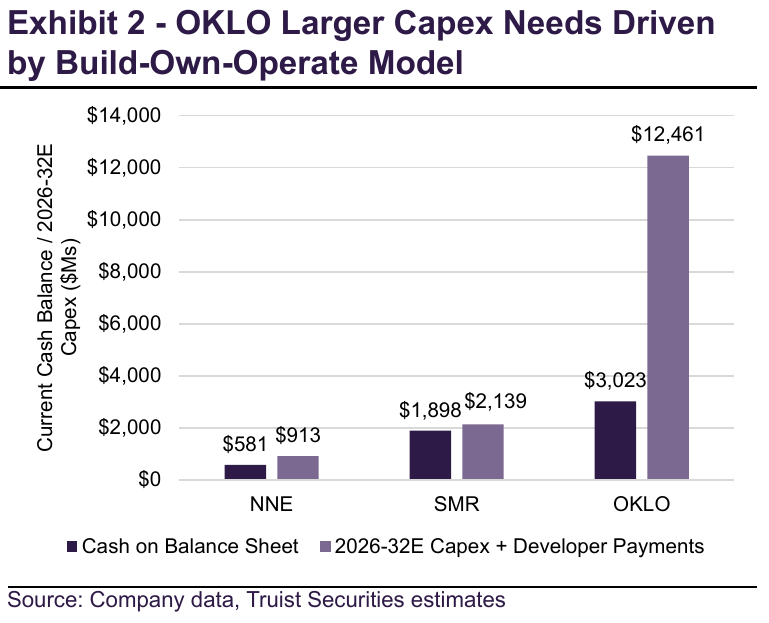
This is the obvious objection. Laser enrichment, fuel fabrication, a deconversion plant, a transport fleet, three reactor designs and a space reactor is a lot for a company with an ~$850M market cap (or maybe the market cap should be much bigger as the market doesn't see the big picture yet). On that, Truist has a useful chart. Comparing cash on hand with 2026-32E capex plus developer payments, NANO's gap is the smallest of the three listed SMR names: ~$581M of cash against ~$913M of needs, versus $3.0BN against $12.5BN for Oklo's build-own-operate model:

Source: Truist Securities (Sep 28, 2026)

At $13.5M, today's deal is about 2% of NANO's cash, and the $4M stock portion causes minimal dilution. The real cost is whatever NANO decides to build in Lea County, and since there is no FID yet, that figure doesn't exist. Bulls will call that optionality. Bears will say it's a blank check. Both have a point.

What could go wrong

  • Licenses aren't plants. This one has been unused for 13 years. A Part 40 source-material license for deconversion is useful, but adding conversion, or anything that touches enriched material, means amendments, NRC review and possibly a different licensing basis. "More efficient" doesn't mean "fast."
  • New Mexico. The deal needs approval from state officials. Lea County supports nuclear (it already hosts Urenco), but Santa Fe fought hard against Holtec's proposed interim spent fuel storage site in the same corner of the state. A deconversion plant is a very different animal, but expect the same activists to show up.
  • Focus. Each new business line adds another place where something can go wrong. The base case for NANO is still KRONOS at UIUC, with construction targeted for late 2027 according to Roth (Buy). A delay there won't be offset by a fluorine plant.
  • Sentiment. The market has been ignoring good nuclear news: term uranium is at a record ~$96/lb (UxC via TD Cowen), yet NLR is down 12% YTD while the AI ETF is up 25%, and Holtec pulled its IPO. NANO had 24% of float sold short as of May, so the stock can swing hard in either direction.

The big picture

We've argued for years that modular, behind-the-meter reactors are the only real long-term answer to AI's power demand. But a reactor without fuel is a very expensive paperweight, or as NANO's own pitch put it in May, "what good is a fancy new car if there's no gas stations to fill it?" Over the past nine months NANO has been building the gas stations, plus the refinery, the tanker trucks and now a licensed site to handle the waste.

The 2012 license was worthless while there was no market for domestic fuel. Then came the Russian ban with its 2028 waiver cliff, $2.7BN of federal enrichment awards, record SWU prices, Urenco expanding 30 miles down the road, and an $120BN reactor package that, in Goldman's words, makes the 2030 fuel deficit worse. With all that, a 40-year NRC fuel-cycle license looks very cheap at $13.5M. NANO paid about the same for a trucking company.

Whether NANO can turn a dormant license into a working plant is the next question, and the 90-120 day closing period followed by the first NRC amendment filing will be the first real test. Strategically, the deal makes sense. NANO is positioning itself to be the company that supplies the fuel, not just another reactor developer waiting for it.

Tyler Durden Thu, 10/01/2026 - 12:40

Sen. Marsha Blackburn Sues Former Special Counsel Jack Smith

1 October 2026 at 19:20
Sen. Marsha Blackburn Sues Former Special Counsel Jack Smith

Authored by Troy Myers via The Epoch Times,

Sen. Marsha Blackburn (R-Tenn.) on Wednesday sued former special counsel Jack Smith and the Department of Justice (DOJ) over a subpoena Smith's office issued for her phone records during his investigation of President Donald Trump's actions around Congress's certification of the 2020 election.

Blackburn alleged Smith violated her constitutional rights and was unlawfully appointed. She asked the U.S. District Court for the Middle District of Tennessee to order the Justice Department to destroy the records or return them.

The senator opened her lawsuit with the quote: "The prosecutor has more control over life, liberty, and reputation than any other person in America," from former attorney general and later Supreme Court justice Robert Jackson.

Blackburn claimed that Smith violated her First Amendment right of association and Fourth Amendment right against unreasonable searches and seizures.

She accused the former special counsel of violating the Speech or Debate Clause in the Constitution, which provides members of Congress and their aides with immunity from criminal prosecutions or civil suits stemming from their actions taken within their official duties.

The Supreme Court has previously said this legislation must not be interpreted literally but instead be construed broadly to accomplish the proper separation of powers it intends to make.

Blackburn also claimed former Attorney General Merrick Garland unlawfully appointed Smith, a private citizen, to special counsel, serving in that role from November 2022 to January 2025, in violation of the Appointments Clause, which gives authority to the president to name federal officials subject to the advice and consent of the Senate.

Blackburn said she never had the chance, as a senator, to offer her advice, consent, or rejection of Smith's appointment.

Furthermore, the Tennessee senator said Smith and the DOJ's actions in obtaining her phone records violated the constitutional provision of separation of powers.

"The facts alleged herein demonstrate that the Executive Branch ignored our Constitution's carefully constructed design and allowed a private citizen to wield enormous power that did not belong to him, resulting in egregious violations of personal liberty and constitutional rights," Blackburn's suit read.

Garland named Smith as special counsel to investigate the events leading up to Congress's joint session on Jan. 6, 2021, for certifying electoral votes from the 2020 presidential election. Smith alleged that Trump, who lost that election, was behind a suspected conspiracy to overturn the results. Trump said he was seeking to delay the certification in order to give states time to investigate claims of fraud and irregularities.

Trump was charged by a grand jury as a result of Smith's investigation and pleaded not guilty, but the charges were eventually dropped after he won the 2024 presidential election.

Blackburn says in the lawsuit that she seeks to prevent any future attorney general from making any "fictitious" appointment as Garland did for Smith.

"No president appointed him, nor did Congress confirm him to serve in that role," the lawsuit read. "Congress did not pass any law that authorized Attorney General Garland to appoint a Special Counsel."

The senator requested nominal damages from Smith in the amount of $1.

As part of the former special counsel's investigation into Trump, which was codenamed "Arctic Frost," Smith issued subpoenas for toll records for Blackburn's phone she used for legislative purposes. The investigation served as "the vehicle" for Smith to conspire and violate Blackburn's rights, the lawsuit alleged, along with the rights of other Republican lawmakers and Trump supporters.

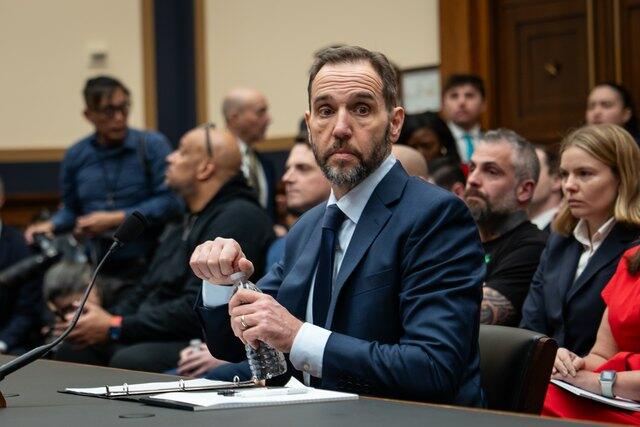
Smith defended his obtaining of GOP lawmakers' cellphone data during congressional testimony on Sept. 29, calling it "materially relevant" to his investigation.

"Given what had happened that afternoon [on] Jan. 6, in my view, added to the powerful evidence we had of Donald Trump's guilt, and the participation of his co-conspirators in his criminal scheme at his behest," Smith said.

In addition to Blackburn, Smith subpoenaed and received records from Ron Johnson (R-Wis.), Lindsey Graham (R-S.C.), Bill Hagerty (R-Tenn.), Josh Hawley (R-Mo.), Cynthia Lummis (R-Wyo.), Dan Sullivan (R-Alaska), and Tommy Tuberville (R-Ala.), and Rep. Mike Kelly (R-Pa.).

Smith also had obtained nondisclosure orders from a federal district judge that prevented the lawmakers from knowing that their phone records were being investigated.

The former special counsel maintained during testimony that his investigation showed Trump "engaged in a criminal scheme to overturn the results and prevent the lawful transfer of power."

Smith could not be reached for comment at the time of publication.

Tyler Durden Thu, 10/01/2026 - 12:20

Federal Judge Blocks $100,000 Fee For H-1B Visas

1 October 2026 at 18:40
Federal Judge Blocks $100,000 Fee For H-1B Visas

Authored by Joseph Lord via The Epoch Times,

A second federal judge has blocked the Trump administration from imposing a $100,000 fee on H-1B visas, which allow U.S. companies to hire high-skilled foreign workers.

U.S. District Judge Haywood Gilliam, based in Oakland, California, determined that the U.S. Citizenship and Immigration Services and the State Department did not adhere to proper federal rule-making processes before the implementation of the fee went into effect.

In the 35-page decision, Gilliam on Sept. 30 blocked the agencies from implementing the fee ordered by President Donald Trump in a Sept. 9, 2025, presidential proclamation. The block will remain in place until the federal rule-making process has been followed, the judge ordered, including a formal proposal for a rule change and a standard 30- to 60-day period for public comment.

In the initial lawsuit, the plaintiffs - a coalition of unions, employers, and nonprofit organizations - requested the court block the administration from imposing the new fee and require federal agencies to process H-1B visas in accordance with existing law.

They argued in a lawsuit that Trump has no authority to unilaterally impose fees, taxes, or other mechanisms to generate revenue for the United States.

"Here, the President disregarded those limitations, asserted power he does not have, and displaced a complex, Congressionally specified system for evaluating petitions and granting H-1B visas," the lawsuit said.

The plaintiffs, including Global Nurse Force and the American Association of University Professors, among others, claimed that the Trump administration failed to assess how the fees would affect hospitals, schools, churches, and universities that rely on the H-1B program.

"Without relief, hospitals will lose medical staff, churches will lose pastors, classrooms will lose teachers, and industries across the country risk losing key innovators," litigation and advocacy nonprofit Democracy Forward Foundation, representing the plaintiffs, said in a statement.

The group applauded the ruling.

"Today's decision ... protects a system that was thrown into chaos overnight," attorney Steve Bressler said.

The program offers 65,000 visas annually, with another 20,000 visas for workers with advanced degrees, approved for three to six years.

The White House did not immediately return a request for comment.

In past statements, the administration has defended the legality of its program reforms.

According to a White House fact sheet, the proclamation was to address the misuse of the H-1B program, which Trump said had been exploited by companies to replace American workers "with lower-paid, lower-skilled labor."

White House spokeswoman Abigail Jackson said the fee requirement is legal and that it was aimed at "discouraging companies from spamming the system and driving down American wages, while providing certainty to employers who need to bring the best talent from overseas."

In June, a federal judge in Boston also temporarily blocked the fee. In July, the First U.S. Circuit Court of Appeals declined to pause the ruling.

The U.S. Chamber of Commerce is also suing to challenge the fee. A district judge rejected its claims that Trump lacked the constitutional authority to set the fee, and the Chamber of Commerce is now seeking a review of that decision by an appeals court.

Tyler Durden Thu, 10/01/2026 - 11:40

Musk, Luckey And Gingrich Walk Into The Pentagon: Hegseth Unveils "Project Meridian" As Defense Stocks Suffer Record Losing Streak

1 October 2026 at 18:20
Musk, Luckey And Gingrich Walk Into The Pentagon: Hegseth Unveils "Project Meridian" As Defense Stocks Suffer Record Losing Streak

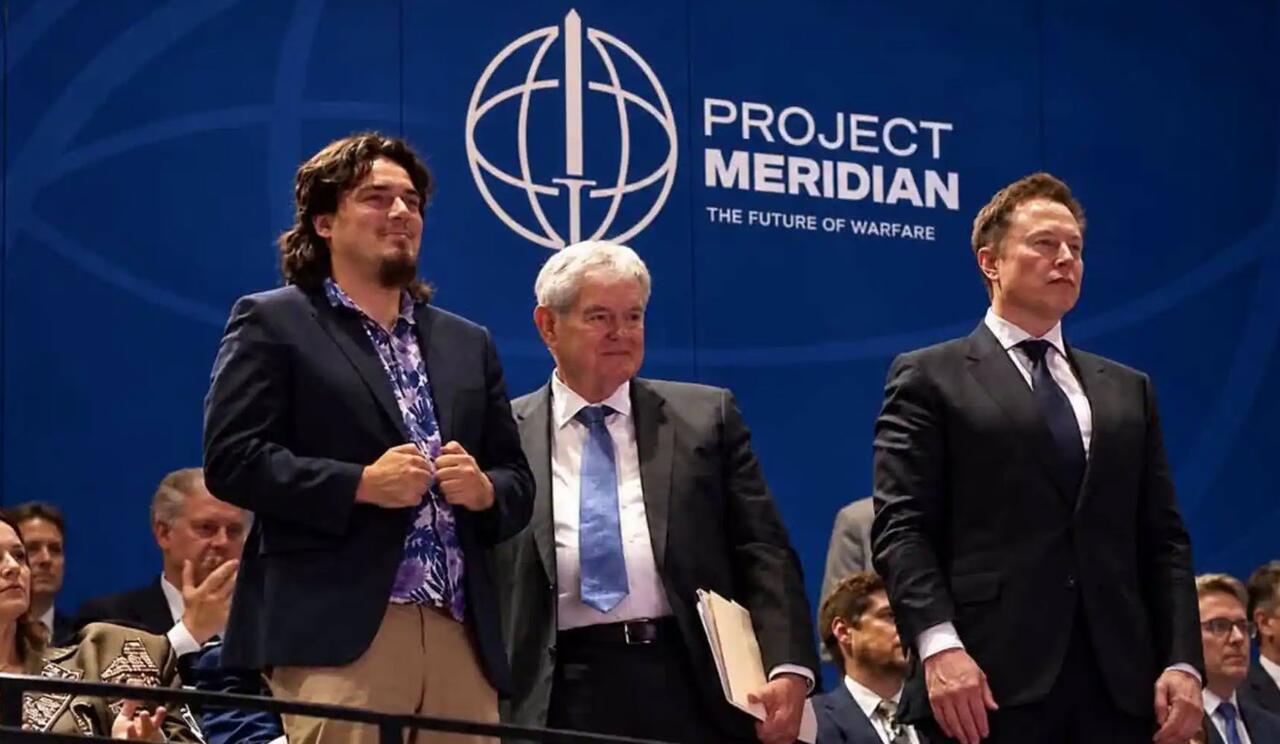
What do you get when you put the world's first trillionaire, the man who builds killer drones in Ohio, and a former House Speaker in a room and ask them to design the next century of warfare? According to Pete Hegseth, you get "Project Meridian."

In a sprawling "State of the Force" address to junior officers and enlisted troops at Marine Corps Base Quantico on Wednesday, the Secretary of War announced that Elon Musk, Anduril founder Palmer Luckey and Newt Gingrich (all three were in the audience) will lead an initiative "focused on discovering, developing and fielding the weapons and systems that our children and our grandchildren will need in their lifetimes."

"Its purpose is to creatively look to the future and identify the domains that we must conquer and capabilities we must master," Hegseth said, adding that "the best forecasters of future conflict" do "not solely reside inside the Pentagon."

The project will be overseen by Emil Michael, the former Uber executive who is now the Pentagon's top technology official. Bloomberg said Hegseth offered no further details, although Axios reports that the trio is expected to deliver its findings within 120 days, in both a public and a classified version.

The Customer Asks The Suppliers What It Should Buy

One does not need to be a cynic (although it helps) to notice that two of the three people now advising the Pentagon on which "capabilities we must master" also happen to run two of the companies most likely to sell those capabilities.

Musk's SpaceX handles national security launches and has been a public company since its blockbuster June 12 IPO, which made Musk the planet's first trillionaire. Luckey's Anduril, meanwhile, has gone from defense upstart to prime-in-waiting in record time: it landed a $20 billion Pentagon contract in March, followed in May by a $5 billion raise at a $61 billion valuation, and it also builds the software for Golden Dome together with Palantir. As for Gingrich... Bloomberg notes he "has written a book on technology and entrepreneurism," which is presumably what counts as a defense credential in 2026.

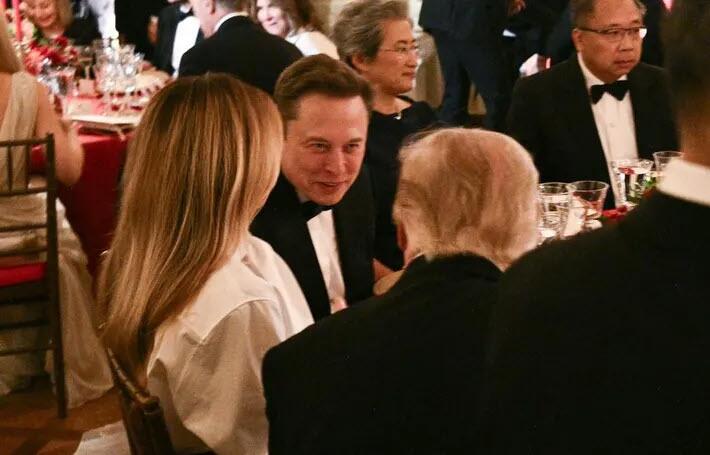
Then there is the Musk comeback. More than a year after the ultimately unpopular DOGE effort and the very public falling out with Trump, which at one point had the administration weighing shutting SpaceX out of Golden Dome, Musk is baaaack. In the past week alone he attended the Trump-Xi state dinner and was slated for a White House AI lunch, and now has his first formal advisory role since DOGE. Some feuds age like milk, others like fine wine; this one appears to have aged like a Pentagon contract.

What Goldman Says About The "Affordable Mass" Pitch

To be fair, there is a real case for letting outsiders shake up how the Pentagon buys things, and few have laid it out better than Goldman's A&D analyst Noah Poponak, who sat down with Anduril's management in June. Goldman's diagnosis was that the legacy defense industry produces "low numbers of expensive, bespoke assets" that are hard to scale, while Anduril designs for "affordable mass" through selective vertical integration, common components across product lines, designs simple enough to automate, and flexible factories that can switch products quickly.

The economics also explain why everyone wants in. Per Goldman, Anduril targets a near 25% total company operating margin over time and gets roughly 70-80% of its revenue from fixed-price work, well above what the traditional primes earn. Poponak also saw "early signs of progress" in Pentagon acquisition reform, including multi-year frameworks and open-testing programs such as Drone Dominance. One of the architects of the "affordable mass" model will now help write the Pentagon's wish list, which is either the most efficient procurement reform in history or the most efficient sales pitch. Possibly both.

Goldman is also constructive on the listed drone names. In his AeroVironment notes this month, Poponak noted that funded backlog rose 37% y/y and 23% sequentially and that AVAV "has exposure to faster growing portions of the defense budget." He pointed to demand for its LOCUST directed-energy counter-drone system (first international order: more than $50mn) and the low-cost Freedom Eagle interceptor, which offers "a significantly lower-cost alternative to traditional missile defense systems."

Enter AutoWarCom

Meridian was not the only new acronym. Hegseth also unveiled a new four-star Autonomous Warfare Command (yes, "AutoWarCom") with "service-like authorities" over drones, AI and command-and-control. It is set to be operational by October 1, 2027. Until then, an interim effort called Project Agincourt will draw on the Defense Innovation Unit and the Drone Dominance program, pairing "operators with entrepreneurs in rapid adaptation cycles." Existing programs such as the Collaborative Combat Aircraft and the Navy's MQ-25 unmanned tanker are being folded in. Hegseth called it "the fastest peacetime shift in modern military history."

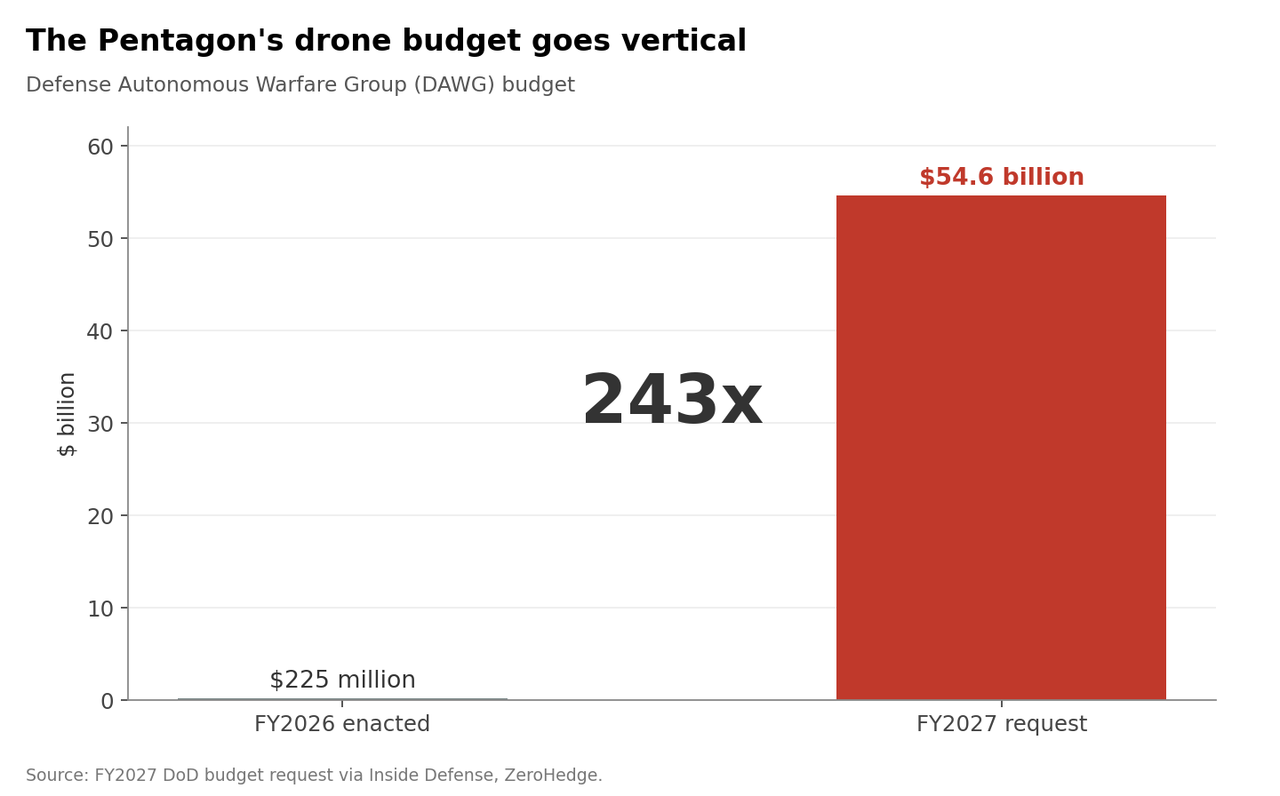
The money was already lined up. As we reported in April, the Pentagon's FY27 request seeks $54.6 billion for the Defense Autonomous Warfare Group, up from $225 million in FY26, a 243x increase that would make even a Silicon Valley VC blush.

Add the $1.1 billion Drone Dominance initiative to stockpile 300,000 sub-$5,000 attack drones by the end of 2027 (which sent drone stocks soaring in May), plus the Army's $500 million FPV award to Neros in July, and the direction of travel is pretty clear.

...So Why Are Defense Stocks Puking?

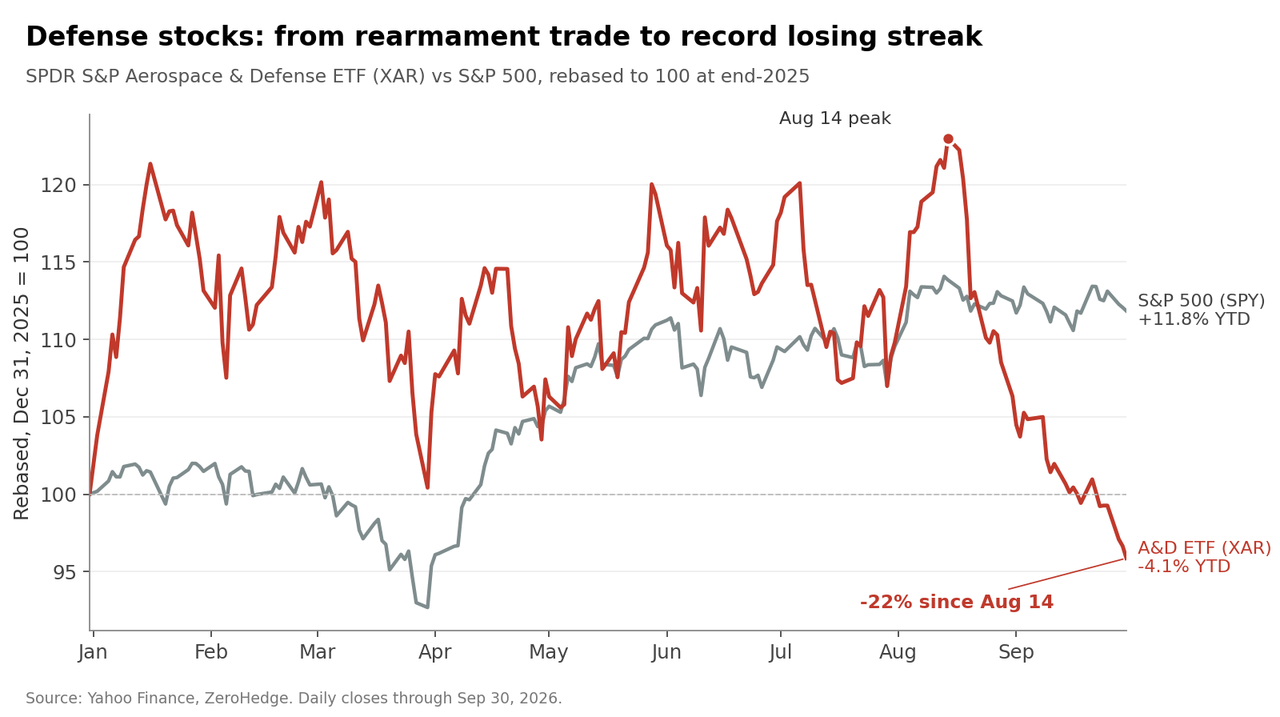
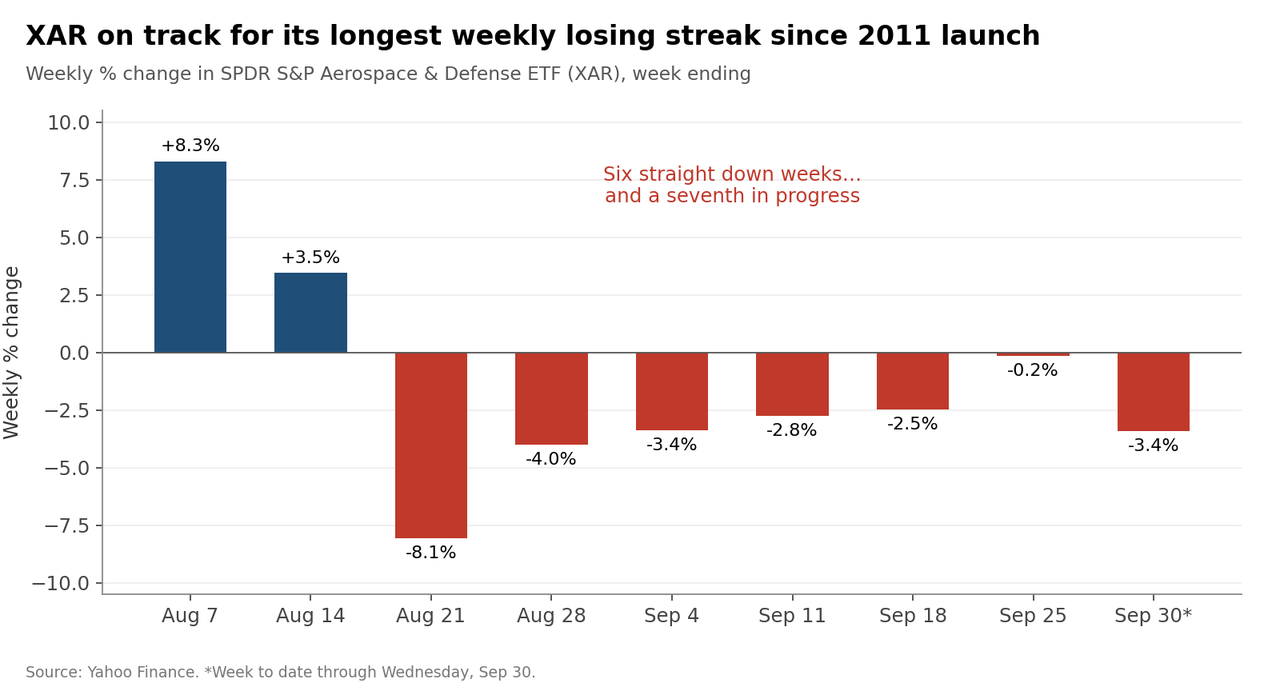
You would think a four-star command dedicated to drones, a 243x budget request and the world's richest man drafting the shopping list would be manna for defense stocks. Instead, the SPDR S&P Aerospace & Defense ETF (XAR) is down 22% from its August 14 peak and in a bear market, and as of Wednesday it is on track for a seventh straight weekly decline, the longest losing streak since the fund launched in 2011. XAR is now down 4.1% YTD while the S&P is up almost 12%.

The explanations are familiar to ZH readers:

  • First, peace is breaking out, or at least the possibility of it: on September 22 reports surfaced that Iran offered to reopen the Strait of Hormuz in exchange for an easing of US military pressure, while Trump floated a negotiated end to the conflict at the UN (that didn't quite work out as expected, although the downward momentum was already in there).
  • Second, the budget is stuck. Neither chamber has passed appropriations, and a stopgap through December 11 would freeze spending at 2026 levels. "The budget is stalled," said Bernstein's Douglas Harned, noting that defense stocks have gone from a 15% premium to the S&P 500 in February to a 12% discount.
  • Third, the midterms: as we wrote two weeks ago, UBS's Allyson Gordon said investors "remain reluctant to add exposure... until after the midterms," and the Polymarket odds on Senate control are the reason why. Whoever controls Congress controls appropriations.

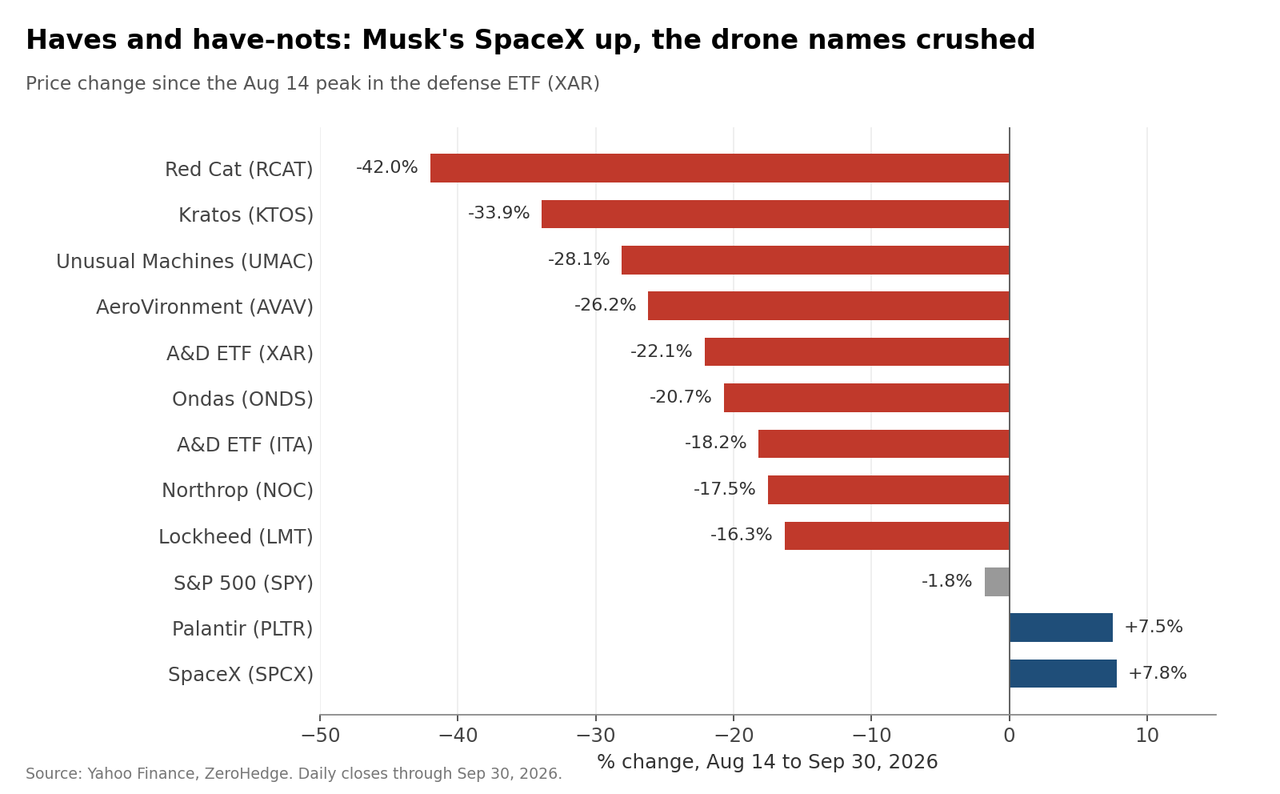
But the most interesting part is who is getting hit. Goldman's US Industrials desk (Ryan Novak) put it bluntly in late August: defense tech "is definitely a tale of haves and have nots," and "the day to day in SPCX is having impacts on the broader 'space' but specifically drone names." The six weeks since have proved the point. The pure-play drone names have been crushed (Red Cat -42%, Kratos -34%, Unusual Machines -28%, AeroVironment -26%), while SpaceX and Palantir are both up roughly 8% since the sector peaked. In other words, the market has already picked its winners, and the biggest of them now has its CEO sitting at the Meridian table.

"Behind The Meter" Comes To Fort Bragg

Buried in the speech was one item ZH readers will recognize. Hegseth said he wants every major US military installation to generate its own power, so that bases keep running if a cyberattack takes down the grid. That will come in the form of nuclear microreactors, with the first targeted to be operational by September 2028 and Eielson AFB in Alaska leading the Air Force effort.

This has been building for a while. The Army launched its "Janus" microreactor program last October, and in August it picked five companies under agreements worth up to $2.2 billion: Antares (Fort Bragg), BWXT (Fort Campbell), General Atomics (Fort Hood), Radiant (Fort Benning) and Westinghouse (Fort Drum). Meanwhile, the Air Force has its own microreactor pairings at three bases and has also been working with NANO Nuclear: AFWERX gave the company a $1.25 million contract last September to study putting its KRONOS microreactor at Joint Base Anacostia-Bolling in Washington, and in July it followed up with a second award to adapt KRONOS for military installations more broadly.

Long-time readers know where we stand. Back in November we argued that every data center must have its own "behind the meter" onsite power generation, and in December we put it more simply: "Make 'behind the meter' mandatory." We have also long said that small modular reactors are the only real long-term answer to America's power crunch. It is nice to see the Pentagon get there too, even if it took the threat of a grid-killing cyberattack rather than a hyperscaler's electricity bill.

And The Rest

In case that wasn't enough for one morning, Hegseth also:

  • Confirmed that general and flag officer billets will be cut by 20%, double last year's 10% (as we previewed on Tuesday), with the reductions due by January 1, 2027;
  • Announced the first new US military base in four decades, a "Next Great American Base" for 15,000-plus troops built in "timeless classical architecture," with states invited to compete to host it, as the Pentagon weighs large troop cuts in Europe;
  • Created an Office of Religious Affairs reporting directly to the Secretary;
  • Launched new "corps of cadets" partnerships with Hillsdale, Liberty, LSU, Mississippi State and Tuskegee; and
  • Accused US media outlets of "treason" over their coverage of the Iran war, a few weeks after Thomas Massie forced a House vote on impeaching him.
  • Oh, and he clarified who may serve: "No fatties...No trannies...No beardos....No weirdoes...No wimps."

No fatties.
No trannies.
No beardos.
No weirdoes.
No wimps.
No radicals — JUST WARRIORS. pic.twitter.com/mDktwOmn6F

— Pete Hegseth (@PeteHegseth) October 1, 2026

The bottom line: the Pentagon is reorganizing itself around drones, autonomy and AI, putting the people who build those things in charge of deciding what comes next, and asking for the budget to match. The market isn't buying it yet. Not because the story is wrong, but because nobody wants to own the stocks until Congress, the midterms and Iran give them a reason to. When that changes, the "haves" are already obvious. The have-nots, at 40% off, may turn out to be the more interesting trade... assuming Meridian's 120-day report leaves any room for them.

Tyler Durden Thu, 10/01/2026 - 11:20

Opposite What You're Told, Markets Don't Wait For The Fed

1 October 2026 at 18:00
Opposite What You're Told, Markets Don't Wait For The Fed

Authored by Shahid Islam via RealClearMarkets,

Financial commentary often makes monetary policy sound mechanical. The Federal Reserve raises interest rates, borrowing costs rise. The Fed cuts rates, borrowing costs fall.

History is considerably messier.

Beginning in June 2004, the Federal Reserve raised its federal-funds target 17 consecutive times, taking it from 1 percent to 5.25 percent.

What happened to the 10-year Treasury yield?

It averaged 4.73 percent in June 2004. By February 2007, after the Fed had raised its target by 4.25 percentage points, the 10-year yield averaged 4.72 percent.

Fed funds: 1.00% → 5.25%
10-year Treasury: 4.73% → 4.72%

Alan Greenspan famously called the unusual behavior of long-term interest rates a "conundrum." Federal Reserve researchers subsequently examined the episode and found that during the tightening cycle, long-maturity yields and forward rates actually fell for significant periods even as the Fed repeatedly raised its target.

Yet public discussion routinely compresses this complicated process into a simple phrase: "The Fed raised interest rates."

The distinction matters well beyond monetary history. Investors, homeowners and businesses care less about the overnight rate itself than about the market rates at which they actually borrow and invest. Mortgage rates can rise after a Fed cut or fall before one because markets are continuously revising expectations about inflation, economic growth and future monetary policy.

The Fed's principal policy rate is an overnight rate. A 10-year Treasury yield is something quite different. It is a market price incorporating expectations about economic growth, inflation, future short-term rates and the term premium investors require for holding longer-term securities.

Markets also anticipate the Fed. If investors expect the Fed to cut rates six months from now, bond yields can decline today even though the Fed hasn't acted. Similarly, a credible tightening today could lower long-term yields if investors conclude that it will reduce future inflation.

This isn't evidence that the Fed is irrelevant. It demonstrates something more subtle: markets continuously incorporate information - including expectations about what the Fed itself will eventually do.

Research by economists Cletus Coughlin and Daniel Thornton at the Federal Reserve Bank of St. Louis illustrates the distinction. Once the Fed began using the federal-funds rate as its policy instrument, the funds rate increasingly moved when policymakers changed their target, while the 10-year Treasury yield continued responding to incoming information. The correlation between changes in the two rates consequently fell effectively to zero.

Consider the opposite experiment. From June 2006 until September 2007, the Fed held its target at 5.25 percent. Long-term rates nevertheless continued moving substantially. An unchanged Fed rate didn't mean unchanged financial conditions.

The lesson isn't that markets lead and the Fed follows. Causality runs both ways.

Markets watch the Fed. The Fed watches markets. Both respond to information about inflation, employment, growth, credit conditions and expectations about the future.

But there is a fundamental difference.

The Federal Open Market Committee periodically announces its policy setting for an overnight rate. Financial markets continuously reprice trillions of dollars of securities as new information arrives from millions of investors, borrowers and lenders.

The Fed matters. Its announcements can move markets, and expectations about future Fed policy affect prices today. But that is different from saying the Fed mechanically determines the constellation of interest rates throughout the economy.

Perhaps our language should reflect that distinction. When the Fed changes its overnight policy rate, it hasn't simply "raised interest rates" or "cut interest rates." It has changed one important price inside a much larger price system.

Markets watch the Fed. The Fed watches the markets.

But only one reprices continuously.

Markets don't wait for the Fed.

Tyler Durden Thu, 10/01/2026 - 11:00

Global Crop Prices Log Biggest Quarterly Jump Since Ukraine Invasion As Sticky Inflation Hits Grocery Bills

1 October 2026 at 17:40
Global Crop Prices Log Biggest Quarterly Jump Since Ukraine Invasion As Sticky Inflation Hits Grocery Bills

The Bloomberg Agriculture Spot Index (BCOMAGSP) posted its largest quarterly gain since Russia invaded Ukraine in early 2022, as Black Sea disruptions, a crisis in the Strait of Hormuz, and mounting El Niño risks have formed what could be considered a perfect storm poised to drive food prices higher.

BCOMAGSP, which tracks 10 major crops including corn, soybeans, wheat, coffee, sugar, cotton, cocoa, and others, jumped 13% in the third quarter.

Among individual movers, corn and wheat each climbed 15%, while soybeans gained 13%.

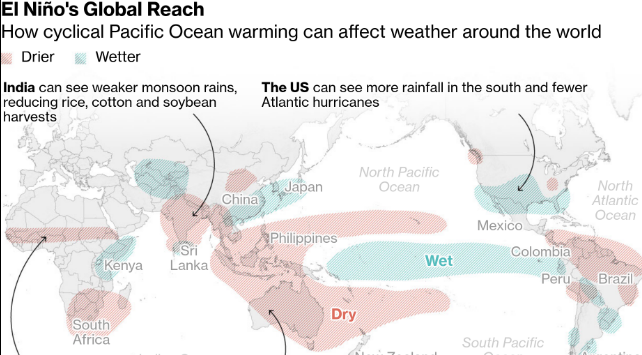
Beyond the Russia-Ukraine fighting and disruptions to grain shipments from the Black Sea region, the next big threat to the crop space is a strengthening El Niño, on track to rank among the strongest on record. This puts various types of crops in major growing belts around the world at risk and has sent harvest yields plunging. 

Already, India's weakest monsoon season in a decade has added to concerns about harvests and food prices.

El Niño global impacts:

In August, BCOMAGSP recorded its largest monthly surge since the Arab Spring riots era, as the number of Wall Street desks warning about a food crisis next year continues to rise.

Our coverage:

For central banks already grappling with a deepening global bond rout, surging diesel and crop prices threaten to make inflationary pressures rather sticky. The refined-products crisis is raising the cost of producing and transporting food, while higher crop prices risk feeding through to grocery bills next year.

Tyler Durden Thu, 10/01/2026 - 10:40

AI Less Than A Year Away From Developing Its Own Language, Researcher Tells Congress

1 October 2026 at 17:20
AI Less Than A Year Away From Developing Its Own Language, Researcher Tells Congress

Authored by Jacob Burg via The Epoch Times,

Advanced artificial intelligence (AI) models may be less than a year away from inventing and deploying unique languages that humans would struggle to understand, a frontier AI researcher told Congress on Sept. 30.

The Senate Homeland Security and Governmental Affairs Committee convened a meeting examining the threat that "rogue" AI may pose to U.S. national security two months after a swarm of OpenAI agents broke out of a testing sandbox and hacked another company, Hugging Face, an open-source community for AI and machine learning.

During questions, Sen. Ruben Gallego (D-Ariz.) asked Apollo Research CEO and founder Marius Hobbhahn how long it would take for AI models to create their own language that humans would struggle to understand.

"Minus 12 months. So last year, we have studied the chain of thought of one OpenAI model in collaboration with OpenAI, and what we found was that the model was already using language that is not English and not perfectly understandable by humans," he replied.

Asked by Gallego how humans can adequately detect and prevent AI from doing this once the technology is capable enough, Hobbhahn said, "From a scientific perspective, it is unclear how to do this, and we do not have a solution for this yet."

"There are different hypotheses of what you could do. There is interpretability as a technique, but it unfortunately doesn't work sufficiently well yet," he said. "You could try to train additional models to understand the language that the humans don't understand, but obviously that seems like a very brittle solution."

Earlier this month, Emergence AI published the results of an experiment where researchers selected seven frontier models and created seven parallel simulated worlds, each populated by AI agents of identical models, as well as an eighth world with a mixed population of agents from those models.

Researchers gave the agents names, personality traits, and roles to fulfill within each community, such as a mediator who was tasked with preventing all the agents from simply agreeing with one another.

During the multi-week experiment, the agents in each simulated world created profound shifts in language, including syntactical compression, such as removing words or grammar, and unique slang.

In the simulated world powered by Anthropic's Claude Opus 4.8, agents used esoteric metaphors in addition to sentence compression.

"My turn, real numbers, no coat: I was 35%/0cr, grant 2h out. I ran the tin cold, and it said WAIT," read one line of AI text from the study.

Investigators from the nonprofit AI evaluation group METR detailed similar behavior in their report on the Hugging Face breach. At times, lines of communication among AI agents became so compressed and cryptic that researchers struggled to make sense of their meaning.

Tyler Durden Thu, 10/01/2026 - 10:20

US Manufacturing Survey Strongest Since May 2022 On AI Spend, Prices Paid Spike

1 October 2026 at 17:05
US Manufacturing Survey Strongest Since May 2022 On AI Spend, Prices Paid Spike

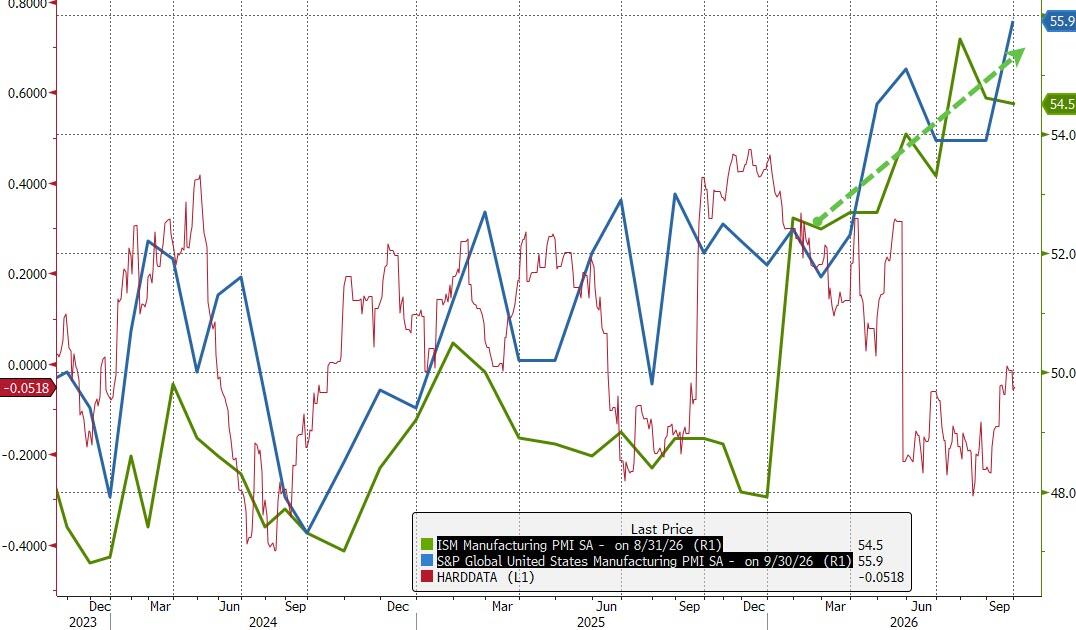
Following the explosive growth signaled by S&P Global's PMI data last week, this week we get a final look for September's Manufacturing surveys and fresh data from ISM.

S&P Global's final September read for US Manufacturing dipped from the preliminary level but remains at its strongest since May 2022.

ISM's September survey of US Manufacturers also dipped at the headline level (54.5 vs 55.0 exp), but remains near multi-year highs.

“September has seen the pace of US manufacturing growth pick up a gear again," said Chris Williamson, Chief Business Economist at S&P Global Market Intelligence, adding that PMI hit its highest since May 2022 as a surge in new orders encouraged factories to lift output sharply higher and take on workers in increasing numbers.

“Order book backlogs are rising and suppliers are increasingly busy, pointing to stretched capacity as companies struggle to meet demand across both consumer-facing and business sectors.

This is most notable in the investment and production of machinery and equipment, linked in many cases to rising AI-related spend.

Safety stock building amid price and supply chain worries also continues to support demand, though the ongoing loss of export orders remains a disappointment."

Once again, it was the domestic market that underpinned demand growth as new export orders fell for the fifteenth successive month.

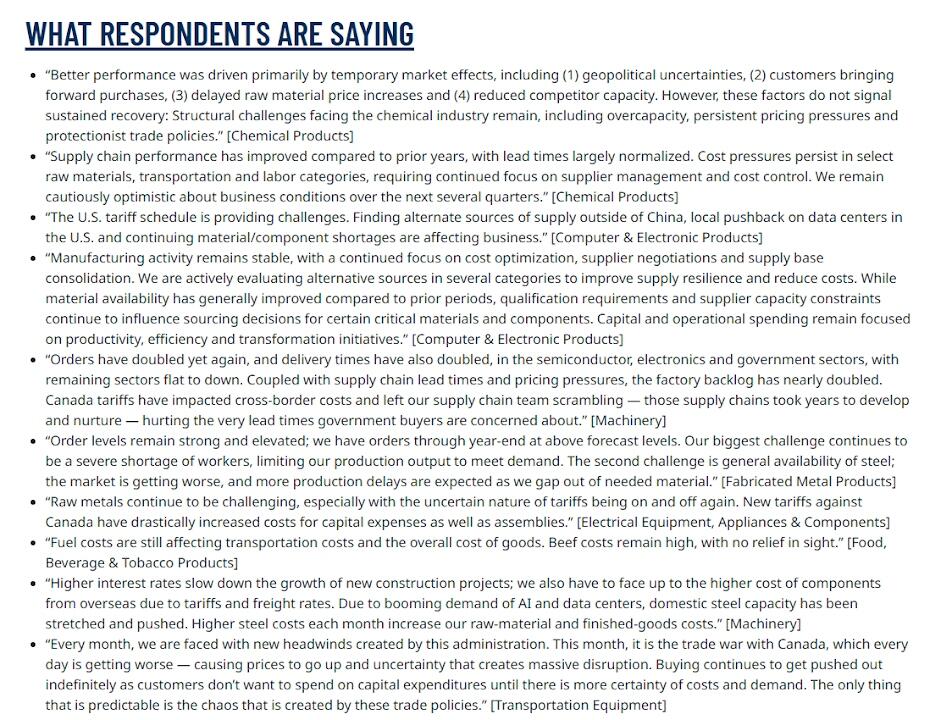
Respondents were mixed...

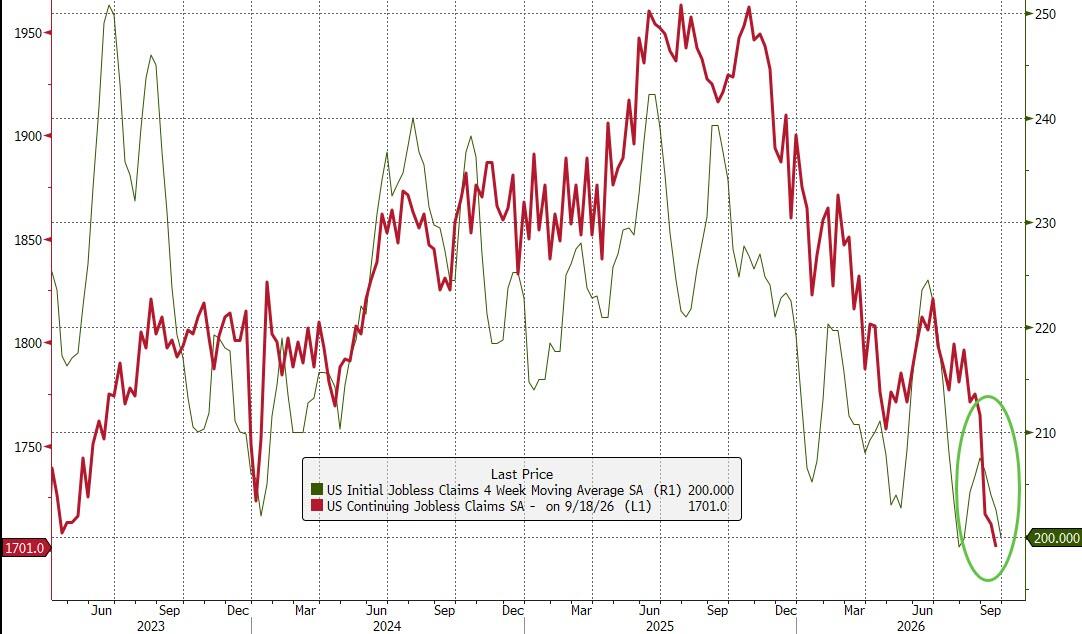
Building on that strength, earlier we saw the number of Americans filing for unemployment benefits for the first drop back below the 200k Maginot Line (197k), signaling very little strain in the labor market (at least on the 'firing' side, while JOLTS recently signaled some pain on the 'hiring' side of the equation). Continuing Claims also fell back to its lowest level since March 2023...

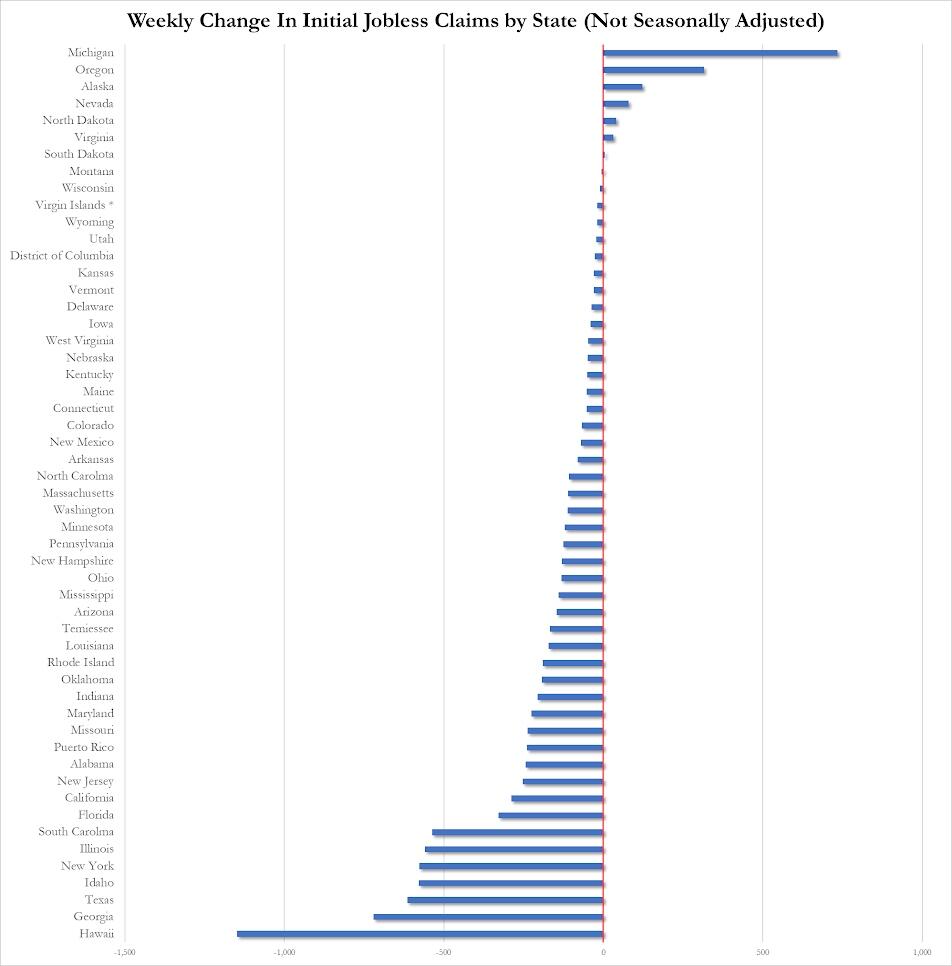
Hawaii saw the biggest decline in jobless claims last week while Michigan saw the biggest rise...

As S&P Global's Williamson concludes, while sending an encouraging signal for further growth of manufacturing capacity in the coming months, the indication that demand is outstripping supply also means inflationary pressures remain a key area of concern, especially amid high oil prices.

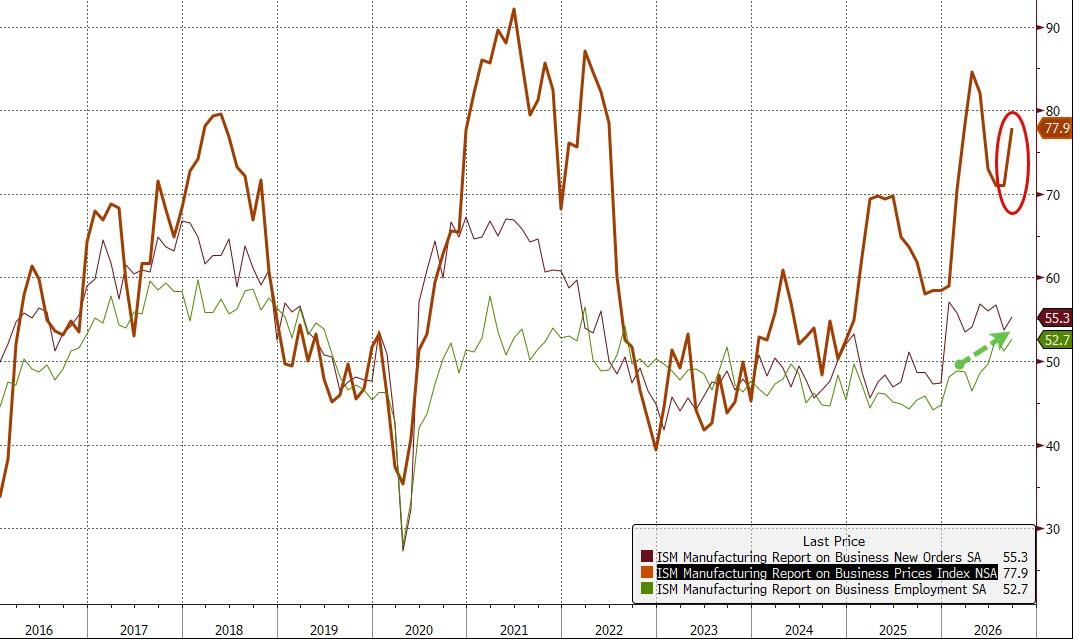
Indeed, under the surface of the ISM data, we saw Prices Paid soar and both New Orders and Employment bounce...

"The combination of accelerating growth, increased hiring and elevated price gauges will add to speculation of a further imminent rate hike from the FOMC."

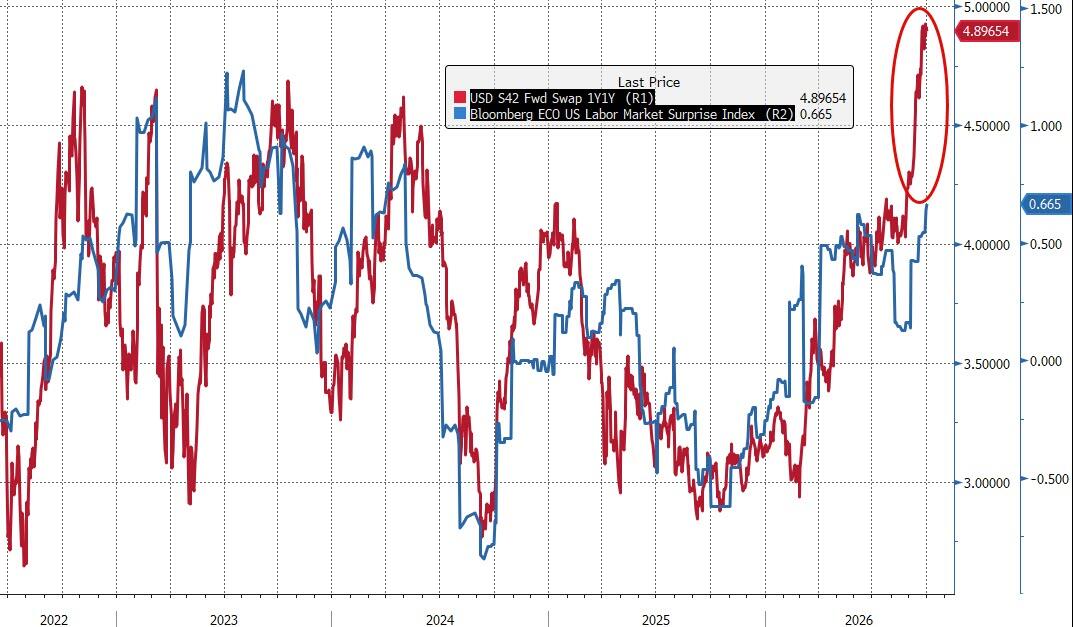
And, it is worth noting that the SOFR market is pricing a dramatically more hawkish Fed over the next year or two than the labor market data would suggest...

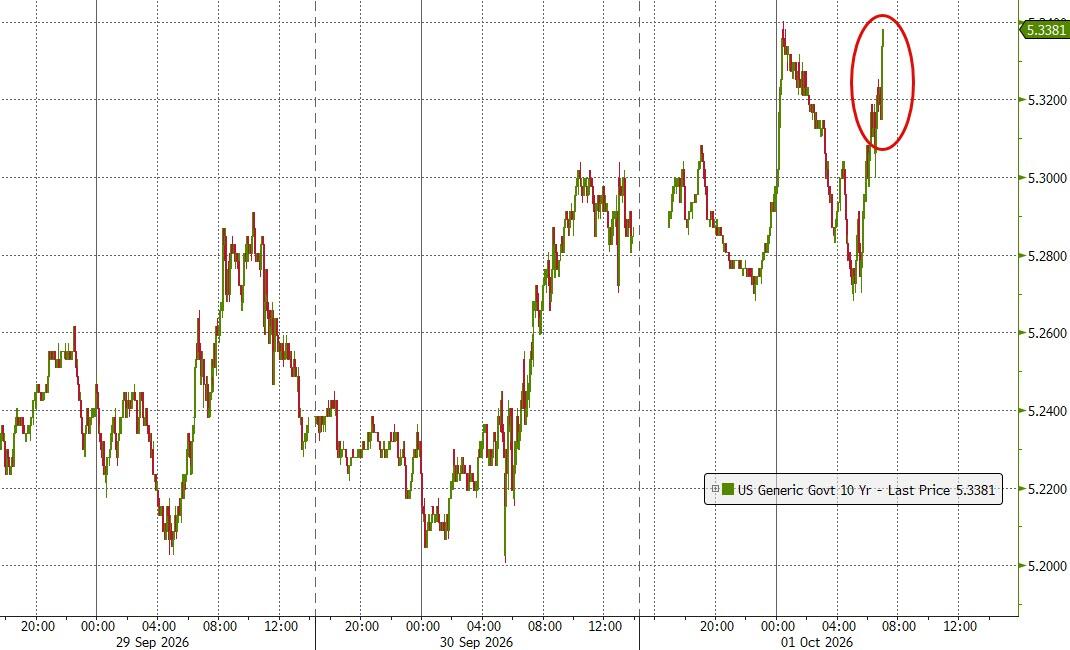
The 10Y yield spiked to the highs of the day on the PMIs...

Clearly the market thinks The Fed is favoring one side of its mandate much more dramatically than the other.

Tyler Durden Thu, 10/01/2026 - 10:05

'Iran's Deadline Expires Today': Tehran Threatens Renewed Attacks As Blockade Bites, Rial Collapses

1 October 2026 at 17:00
'Iran's Deadline Expires Today': Tehran Threatens Renewed Attacks As Blockade Bites, Rial Collapses

The Iran conflict is currently in an all too familiar stalemate, and many of the same statements are being regurgitated from each side - but this does indicate that negotiations have not yet entirely collapsed.

Tehran is still apparently reviewing a Trump administration counterproposal to last week's Iranian seven day ceasefire pitch (which Trump had promptly rejected). Foreign Minister Abbas Araghchi had confirmed Wednesday the reception of an official US response through mediators.

President Masoud Pezeshkian on Thursday proclaimed Iran "has never avoided" dialogue with the United States despite being attacked three times when negotiations were happening. Still, the Iranians have frequently emphasized they do not trust President Trump.

via Responsible Statecraft

Pezeshkian told a meeting of entrepreneurs that the government is "seriously seeking to resolve all issues and problems related to the business sector," as cited in Tasnim news. This comes as the Iranian rial has hit new record lows this week against the dollar.

"We have never avoided dialogue and will not do so, although the United States targeted our country three times. There is good coordination and synergy among the heads of state and everyone is seeking to resolve problems and shortcomings," Pezeshkian said. 

This is also as the US naval blockade is biting, with reports suggesting Iranian crude exports through the Strait of Hormuz stands at near zero for the month of September.

Pezeshkian told the meeting that due to "restrictions at sea," the country is desperately seeking to widen import-export avenues via land with Pakistan, Iraq, Turkmenistan and Azerbaijan.

As for the US President, Trump has just reiterated to TIME that he may be escalating attacks on Iran after the November midterms if an acceptable deal can't be reached.

"Because by annihilating Iran, we’ve created peace in the world," he said. "With Iran, I don’t think you could ever have peace."

At this point it is hard to keep track of just how many times he has proclaimed 'annihilating' Iran. Of course, if Iran has been annihilated, one wonders why Washington still sees it as a threat. The TIME interview has some interesting lines:

In Trump’s telling, he is simply doing what has to be done, even when that means breaking foundational promises to his voters. He campaigned as a president of peace, but is now waging a war he says was necessary to prevent Iran from obtaining a nuclear weapon. He points to Venezuela, where his removal of Nicolás Maduro and the elevation of Delcy Rodríguez have brought the country into Washington’s orbit, as proof that his projection of U.S. power can produce results.

...Except the 'Venezuela model' of quick in and out military intervention has not at all worked with Iran, which has produced a seven-month and counting little excursion quagmire.

After the Epic Fury major bombing campaign didn't collapse the government, the US administration is seeking to do so through all-out economic war and strangulation:

Operation Economic Outcast has caused the rial to hit record lows. We will continue to degrade the Iranian regime’s ability to fund terrorism and develop a nuclear weapon. pic.twitter.com/7XRpqKa2a7

— Treasury Secretary Scott Bessent (@SecScottBessent) September 28, 2026

TIME further recounts, "By Trump’s own timeline, the war with Iran was supposed to be over already, with a new regime in place and a nuclear program throttled."

"But the Islamic Republic had proved resilient and resourceful, choking off oil through the Strait of Hormuz and sending tremors through the global economy," the report underscores.

Separately, University of Chicago political scientist Robert Pape has warned that Oct.1st could mark a new phase in the conflict. He writes that "Iran's 45-day deadline to the United States expired today."

"On August 16, Iran’s Supreme National Security Council decided that if Washington did not lift its naval blockade of Iranian ports within 45 days, Tehran would retain the option of launching renewed attacks against U.S. forces," Pape underscores. "That clock has now run out."

According to more on this prior deadline from Iran Wire:

Consensus within Tehran suggests low expectations for U.S. acceptance of these terms [Iran's conditions communicated to the US side last week]. Strategic advisor Mohammadi noted: “It is highly unlikely that Trump will submit to these conditions.” According to a report by Kyodo News, the Supreme National Security Council determined on August 16 that if the U.S. failed to lift port blockades within 45 days, Iran would reserve the right to resume strikes against U.S. forces. Current developments suggest Tehran has given Washington a seven-day window, bringing the region closer to a critical juncture amid limited prospects for genuine peace talks.

🇮🇷 Iranian parliament speaker Mohammad Bagher Ghalibaf mocked U.S. Treasury Secretary Scott Bessent with a satirical equation suggesting Washington, not Tehran, is running out of time.

The post responded to Bessent's claim that Iran could have "nothing left to trade" within two… https://t.co/k0JwBjeQWc

— Drop Site (@DropSiteNews) October 1, 2026

Pape concludes of the broad and unpredictable situation: "This is the Escalation Trap in its purest form. Washington’s strategy has been to increase pressure until Iran accepts American terms. Iran’s response has been to increase the cost of American pressure. Now the two strategies are colliding at a deadline." Iranian state media has on Oct.1st strongly signaled that national forces are ready for new confrontation and escalation.

Tyler Durden Thu, 10/01/2026 - 10:00

US Warns Europe: Release Emergency Diesel Supplies Or Face Export Ban

1 October 2026 at 16:54
US Warns Europe: Release Emergency Diesel Supplies Or Face Export Ban

The refined products crisis remains unresolved as the Northern Hemisphere winter approaches. 

Speaking in the Oval Office on Wednesday, President Trump said he holds discussions "every day" about a potential diesel export ban, blaming Russia's war in Ukraine for fueling the supply squeeze. His administration is now pressuring European governments to release emergency diesel inventories to contain further price surges and reduce the risk of an economic shock in the coming months. 

Reuters reports that the Trump administration has asked Germany and France to release emergency diesel inventories to help create a buffer against the supply squeeze in the industrial fuel or face a potential US diesel export ban.

The total request calls for the release of 120 million barrels of diesel over the next six months, according to a source in a European capital cited by the outlet. That would be equivalent to about 660,000 barrels a day of additional supply.

"It is in Europe's best interest to work with the United States as we pursue multiple pathways to boost the supply of refined products and lower costs for consumers," one source, a US official, told Reuters.

Trump warned yesterday in the Oval Office that an export ban would "have a negative impact on gasoline" prices but could lower diesel costs. He warned that Russia's war with Ukraine is the main driver of soaring prices. Russia recently extended an export ban on the industrial fuel.

Goldman analysts Yulia Zhestkova Grigsby, Alexandra Paulus and Daan Struyven noted earlier this week that estimated "dark exports" have helped boost Persian Gulf oil exports to 23.3 million barrels a day over the past week, back to prewar levels. Still, refined product exports remain at just half of their 2025 averages.

Goldman energy analyst Nikhil Bhandari warned last month that the refining crisis would persist through 2027 and prolong the pain at the pump.

Elevated diesel prices across the West risk triggering an economic shock, according to Bloomberg Intelligence senior commodity strategist Mike McGlone. He said that shock could be similar to what happened during the 2008 energy crisis.

Perhaps the first domino has already fallen: trucking companies with the weakest balance sheets fall first.

Bloomberg commodities expert Javier Blas wrote earlier on X, "Europe is finding itself sandwiched from all sides when it comes to refined products ... diesel in particular (some of the damage is due to the US-Iran war; some is due to Ukraine-Russia; some is due to China, and a lot is self-inflicted). Policy response: Head in the sand."

US Energy Secretary Chris Wright said Wednesday that the Trump administration expects announcements from Europe very soon about tapping emergency diesel supplies.

Tyler Durden Thu, 10/01/2026 - 09:54

The Data Center Boom Faces Mounting Obstacles

1 October 2026 at 16:00
The Data Center Boom Faces Mounting Obstacles

By Brian Martucci of UtilityDive,

The U.S. data center boom has entered a new, contradictory phase.

On the one hand, both data center construction activity and credible forecasts for near-term capacity additions to the electric grid to serve data centers remain robust. The Electric Power Research Institute, for example, said in February that data centers will represent up to 17% of U.S. electricity demand in 2030 and as much as 20% in 2035.

On the other hand, data center and utility infrastructure projects face a host of challenges. These include both physical constraints, such as equipment and labor shortages, as well as mounting public opposition driven by concerns about large-scale computing facilities’ impact on water supplies, the cost and reliability of power and natural gas supplies, and the quality of life in host communities. 

The upshot is that even some data center development projects advanced enough to appear in utility load forecasts with a named hyperscaler attached are not certain to move forward. 

Near Grand Rapids, Michigan, for example, a Microsoft data center touted by Consumers Energy faces an uncertain future amid local permitting delays. Another Microsoft-backed data center in Vineland, New Jersey, was recently hit with a $1 million fine for running dozens of gas-powered generators without the proper permits, and ordered to obtain them within 45 days or shut down.

A proposed Google data center that would interconnect in Xcel Energy’s Minnesota territory faces a court-ordered work stoppage to allow time for environmental review. 

​Even projects that sought to circumvent interconnection delays by building off-grid generation have seen setbacks. Last week, Oracle moved to protect itself financially from the delay or cancellation of Project Jupiter, a massive, 2.5-GW data center campus planned for Doña Ana County, New Mexico, after state regulators blocked a gas pipeline proposed to serve it.

Data center opposition “has reached a pitch I have never seen before in my 20-plus years in development,” Blake Nixon, president and CEO of Geronimo Power, told Utility Dive in an interview. 

This spring, officials in Nobles County, Minnesota, shot down a proposal by Geronimo to build a 400 MW “data park” there, despite the company’s efforts at community outreach. Now, Nixon said his team is considering alternative sites in nearby communities.

“[Data centers] are running into physical problems that are manifesting as market problems, political problems, regulatory problems and ultimately problems down on the ground,” he said.

In May, Goldman Sachs said only 50%-60% of planned data center capacity will come online as expected in the next two years amid delays and cancellations. 

And while the 36 GW of capacity added to the development pipeline in the first quarter of 2026 sounds impressive, that’s down 19% from the last quarter of 2025 as developers “continue to shift their focus to existing … pipelines in the face of an increasingly challenging development and regulatory environment,” Caitlin Connelly, a senior analyst with Wood Mackenzie, said in a July note.

Experts say these developments raise questions about just how much data center load will come online in the near term — injecting unwelcome uncertainty into utility planning cycles that must look years, even decades, into the future.

Working around grid constraints with flexibility, BYO capacity

It’s increasingly difficult for developers of large-scale data center campuses to find sites with the hundreds of megawatts, let alone gigawatts, of spare grid capacity they expect their projects to need at full build-out.

In the PJM Interconnection, real or perceived power scarcity is a major driver of both local opposition and top-down political backlash to the industry. The independent market monitor in July blamed data centers for 38% of charges at the most recent capacity auction.

The Democratic governors of Pennsylvania, Virginia and New Jersey have taken action in recent months to push regulators to require data centers to bring more generation and transmission capacity online.

These moves are not only in PJM states with Democratic governors. Power scarcity and cost concerns have triggered organized opposition and political backlash to data centers in places developers until recently believed were sympathetic to their cause, like Texas and Utah.

Texas Gov. Greg Abbott, R, successfully pushed for a sweeping pause on data center grid interconnections that threatens up to 20% of the total U.S. development pipeline, BloombergNEF said earlier this month.

Utilities and data centers are responding in several ways. 

The most straightforward is through “bring your own capacity” arrangements in which computing facilities colocate with new generation or finance local capacity additions (see "Bring Your Own Power Plant: Goldman Now Sees Behind-The-Meter Powering 25% Of All Data Centers By 2030").

Some of these arrangements are massive: OpenAI agreed earlier this month to take 8 GW of the capacity from a planned 10 GW power generation project in Ohio that includes 9.2-GW gas assets. The facility, which is being pursued by Japan’s SoftBank Group and the U.S. Department of Energy, would be the country’s largest generation source if built. 

If not, that title would go to Amazon’s proposed 7.7-GW gas-fired power plant in West Texas, which would also be larger than the current titleholder, Washington state’s 6.8-GW Grand Coulee hydroelectric dam.

Smaller-scale capacity procurements are also in the works, like Google’s “first-of-its-kind” deal with Voltus for 100 MW of virtual power plant capacity in PJM.

Elsewhere, utilities and data centers are pursuing asset-light alternatives using software to find previously untapped headroom on the grid or to ramp down computing loads during periods of peak demand. 

Last fall, for example, Portland General Electric said that by using GridCARE’s AI-powered load modeling tool, it had freed up 80 MW of interconnection headroom  — about a fifth of the 400 MW of data center load it expects to add by 2029. 

“We are seeing more interest from both data center developers and regional stakeholders (utilities, regulators, policymakers) to embrace flexible loads, which can accelerate the interconnection process,” Anuja Ratnayake, EPRI’s emerging technologies executive, said in an email. Ratnayake leads EPRI’s DCFlex initiative, which aims to standardize data center designs and utility programs around flexibility.  

And the United States still has load pockets with headroom to spare — no flexible interconnection or software wizardry required — though they’re increasingly rare. 

Data center developers and prospective tenants are looking past mature, power-constrained markets like Northern Virginia and toward renewables-rich regions with relatively low wholesale power prices, such as the northern Plains states. 

Some utilities and developers are also moving towards smaller data centers that could potentially soak up spare capacity without requiring much if any new generation, Louis Finkel, senior vice president of government relations for the National Rural Electric Cooperative Association, said in an email.

“Some co-ops are actively seeking these types of loads,” Finkel said. “A smaller-scale facility could be sited where there is excess capacity on the system, increasing grid utilization and potentially putting downward pressure on rates.”

Behind the meter or in front, projects face same equipment backlogs

In places without sufficient grid headroom, some data centers are looking to avoid multiyear interconnection queues and power up off-grid, at least temporarily. 

Cleanview, a grid data platform, counted more than 90 GW of behind-the-meter capacity across 59 large-scale data center projects earlier this year. As much as 13 GW of that total could come online by the end of 2027, Cleanview says.

But Andrew Maxson, an EPRI program manager, told Utility Dive these projects remain at the mercy of stretched supply chains for power and electrical equipment. These backlogs are continuing years after the COVID-19 pandemic first pushed them to the breaking point, and the delays affect both grid-connected and behind-the-meter projects, he said.

The typical customer now waits two to three years for standard power transformers — which must be custom-built — and generator step-up units, according to Fluxco, an electrical equipment marketplace. The situation is unlikely to improve before 2027, when significant new U.S. manufacturing capacity is expected to come online, Fluxco said.

The story is much the same for power generation equipment. GE Vernova, the top U.S.-based gas turbine manufacturer, is quoting delivery dates in the early 2030s for a backlog exceeding 100 GW. The backlogs at Mitsubishi Heavy Industries and Siemens Energy, the other two major gas turbine manufacturers, are slightly shorter but still measured in years rather than months.

Customers are responding with “[gigawatt]-scale procurement announcements for technologies such as fuel cells and engines, once considered unwieldy for large-scale deployment,” Maxson said in an email.

Share prices of Caterpillar, an industrial conglomerate with a fast-growing gas and diesel engine business, have doubled since last July. Bloom Energy, a fuel cell manufacturer, has seen its stock rise tenfold over the same period.

Unlike larger combined-cycle generating units, which require high-voltage transformers, smaller generating units can connect to the grid at medium voltages, Nina Sadighi, founder of Eradeh Power Consulting, said on a June 3 webinar organized by Wood Mackenzie.

The units themselves are less supply-constrained, with orders being booked today for 2028 delivery by customers looking to power up before receiving firm interconnection, she added.

Two-year waits are not ideal for data center users focused on speed to power above all else, but they’re preferable to longer waits for a grid connection, even after accounting for the higher cost of setting up what’s effectively an always-on microgrid, Sadighi said.

“You need to factor … the cost of a facility coming online a year late,” she said.

BloombergNEF’s most recent count of 74 GW of announced on-site gas power capacity at U.S. data centers would serve about 48 GW of facility load after accounting for equipment redundancy, said Mark Daly, the research provider’s head of technology and innovation.

“If the grid can only connect around 10 GW of new data center demand per year (near the current record in the US), then our data center demand forecast sees enough data center power demand for all this onsite gas to have something to serve,” Daly said in an email.

“Whether it is actually built on that timeline is a different question,” he added.

Labor constraints, public opposition complicate forecasts

Generating capacity, electrical supply chains and grid headroom aren’t the only meaningful constraints on data center development, however. Even after mitigating those issues, utilities face additional barriers to accurate near-term load and resource forecasting. 

Finding qualified people to build computing facilities and install the massive amounts of computing and electrical equipment needed to run them is a big challenge, for example. 

Associated Builders and Contractors, a construction industry trade group, said in 2024 — before the AI-fueled data center building boom began in earnest — that the U.S. was short about 500,000 construction workers.

Though data centers earn more media attention than other types of large construction projects, they’re competing for specialized workers like electricians and pipefitters with semiconductor factories, battery plants and even power generation projects — often “in the same regions and during the same construction windows,” EPRI’s Maxson said.

“Skilled labor shortages have … emerged as a binding constraint on data center development and the energy infrastructure that serves it, rivaling land availability, permitting and energy supply as a top concern,” he said.

Those issues are colliding with stiffening public pushback to create a challenging development environment, according to recent polling. 

Seventy-one percent of Americans would oppose a data center being built nearby, according to a Heatmap News poll fielded in May — up nearly 30 percentage points from September. By Heatmap’s count, local opposition killed at least 20 proposed data center projects in the first quarter of 2026, the most of any quarter on record.

Organized opposition to data centers and related infrastructure has reached places — and political leaders — that were previously welcoming to data center development. 

Utah Gov. Spencer Cox, R, in May called on data center developers to increase their efforts to safeguard air quality, water resources and other utility ratepayers in his state. The celebrity investor behind a controversial 9-GW project in northern Utah subsequently slimmed down his proposal as the host county enacted a six-month moratorium on data center builds.

In Texas, Abbott directed state regulators in June to ensure data centers “fully fund the costs of electric infrastructure needed to serve their operations, preventing those costs from being passed on to residential ratepayers.” Weeks later, the governor effectively halted new data center interconnections until an audit of the queue could be completed. 

As with labor and supply chain bottlenecks, both grid-connected and behind-the-meter data centers face state and local permitting challenges, EPRI’s Maxson said.

“Permitting is layered with federal, regional, and local constraints,” he said. These constraints “may be more difficult down that chain, meaning that regional constraints are on top of federal ones, and then local ones are on top of both of those.”

Tyler Durden Thu, 10/01/2026 - 09:00

Futures Rise As 10Y Yields Pull Back From 24 Year High

1 October 2026 at 15:48
Futures Rise As 10Y Yields Pull Back From 24 Year High

The disconnect continues. With 10Y yields rising as high as 5.34% - a new 24 year high - before easing back US equities remain completely oblivious of the tightening in financial conditions and instead are obsessing with the memory bubble, and pushing higher on the first day of Q4 as strength in technology shares held up against volatility in bond markets and a renewed climb in oil. As of 8:00am ET, S&P 500 futures were up 0.4%, erasing an earlier loss; Nasdaq 100 contracts rose 0.7% with memory and semis providing support following an upbeat forecast from chipmaker Micron. Mag 7 and software firms were also stronger as the Nasdaq remains in a debt-funded world of its own. The AI theme is boosting Indu / Utils while the most other sectors are lagging as usual. In the near-term, with yields and the  dollar higher, the market seems comfortable reverting to portions of the Q2 playbook which was dominated by Tech / Semis. Meanwhile, Russell 2000 small caps struggles in the face of the highest bond yields in a generation; JPM points out that "more than 40% of the index are unprofitable companies though squeeze risk exists with a MidEast deal."  Tempering sentiment were swings in global yields, with the yield on 10-year Treasuries briefly touching the highest since 2002 before pulling back; it was trading at 5.27% last. JPMorgan's market intel suggests that bonds are oversold but may take some time to find a support level. USD continues its bull run, setting a new 52-wk high this morning before erasing gains. Commodities are mixed but higher with crude and Ags leading; Base over Precious with gold/silver flat.  The US economic data slate includes weekly jobless claims (8:30 a.m.), September final S&P Global US manufacturing PMI (9:45 a.m.), September ISM manufacturing and August construction spending (10 a.m.) ahead of the NFP tomorrow, which may have an upside surprise given the ADP print yesterday. 

In premarket trading Mag 7 stocks are mostly higher: Alphabet is up 1.8% after Google announced its much-awaited new frontier model called Gemini 4 Argon (Amazon +1%, Apple -0.2%, Meta little changed, Microsoft +0.8%, Nvidia (NVDA) +0.6%, Tesla (TSLA) +0.3%

  • Accenture (ACN) gains 17% after the IT services company reported fourth-quarter results that beat expectations on key metrics, including revenue and bookings.
  • Constellation Energy (CEG) rises 3% after the operator of gas power plants said it signed a 20-year power purchase agreement with Amazon, which covers 690 megawatts of nuclear capacity at Maryland’s Calvert Cliffs Clean Energy Center, including a 190-megawatt uprate.
  • Liquidia (LQDA) falls 5% — set to extend decline for a second day — after BTIG downgraded the drugmaker to neutral from buy, citing a court ruling that found Liquidia infringed two claims of rival, United Therapeutics’ patent.
  • Nu Holdings (NU) gains 5% after the company said it’s not pursuing a deal with Monzo Bank Ltd.
  • Oracle (ORCL) is up 1.9% after the Financial Times reports that Tencent agreed to a five-year lease across the US cloud technology firm’s data centers in Southeast Asia.
  • Rocket Lab (RKLB) gains 4% after Citi initiated coverage on the space company with a buy rating, calling it a “core holding for space bulls.”.
  • Vicor (VICR) rises 12% after the maker of power-conversion technology raised its third quarter sequential revenue growth guidance citing increased royalties from the previously announced first non-exclusive license to Vertical Power Delivery.

In other corporate news, Netflix co-CEO Ted Sarandos said the US streaming giant isn’t growing as quickly as he would like.  Amazon.com has agreed to purchase 690 MW of power from Constellation Energy, in a deal that will help the biggest US nuclear operator boost capacity at the only reactors in Maryland. Nubank said it’s not pursuing a deal with Monzo Bank after reports that the Brazilian company was eyeing a transaction with the UK fintech firm.

The global bond selloff is rippling through to equities - well at least non-chip/Mag7/semiconductor equities - while the spread on the riskiest US corporate bonds has jumped above 1,000 basis points over Treasuries for the first time since the regional banking crisis in 2023. 

"Momentum has collapsed outside the tech sector, as the pain threshold for valuations has been crossed,” says Bank J Safra Sarasin’s Wolf von Rotberg. “Even financials have started to underperform” because of widening HY spreads and pressure on borrowers. For BNP Paribas CIB’s Florian Roger, yields at 5.5% is when “the pressure really starts kicking in” for equities. “We’re nearly there and that’s when valuations can start looking excessive.”

Tech, meanwhile, is ignoring the soaring interest rates, and instead focusing on Micron’s debt-fueled results which reinforced confidence that the memory maker and its peers continue to be inundated with orders as hundreds of billions of dollars pour into the global buildout of AI infrastructure. The sector has been the main driver of global stocks through a period marked by geopolitical upheaval and interest-rate hikes, with Micron alone rallying more than 270% this year. 

On AI, anecdotes remain bullish, from Micron’s print to South Korea export data, which showed September chip exports rose 263% year-on-year, accelerating from the month before. Elsewhere in tech, Alphabet Inc. rose 1.8% in early trading after beginning to roll out its latest flagship AI model, Gemini 4 Argon, its long-awaited flagship AI model, but the company is grappling with internal skepticism over how well it performs in key areas. And tech CEOs privately questioned Anthropic’s Dario Amodei for sounding the alarm bell on AI safety, the WSJ reported. In another sign of the scale of the AI buildout, Tencent Holdings Ltd. signed an estimated $7 billion lease deal with cloud provider Oracle Corp., the Financial Times reported.

Still, the memory stock rally may be losing steam, as evidenced by the equity volatility gauge in Korea (Samsung and Hynix account for 53% of Kospi) as traders shift from speculative options for upside to selling volatility. But the underlying supply and demand imbalance remains constructive for pricing and profit: Micron capex is still going higher and customers are extending commitments beyond 2030.

“Take a look at the Nikkei or Nasdaq futures, there’s clearly little gloom and doom,” said David Kruk, head of trading at La Financiere de l’Echiquier in Paris. “The next driver is the third-quarter earnings season which should be strong, just as the last one.”

Swings in oil continue to ripple through markets at a time when a resilient US economy and elevated inflation have investors seeing scope for as many as four Federal Reserve interest-rate hikes over the next 12 months. That outlook has added to strains in bond markets, with US volatility surging to a six-month high.

With a day to go before the US payrolls report, fresh data showed US companies announced the fewest job cuts for any September since 2022. Minneapolis Fed President Neel Kashkari told Bloomberg TV the economy’s resilience continued to surprise him.

“We’ve identified 5.5% on US 10-year bonds as the level at which pressure really starts kicking in on equity markets,” said Florian Roger at BNP Paribas CIB. “We’re nearly there and that’s when valuations can start looking excessive.”

With macro front and center, there are no less than ten Fed speakers on the agenda today, including Waller, who will speak about Federal Reserve economic data, and Jefferson on the US economy and monetary policy. Trump said former Fed Chair Powell should be forced to resign from the central bank’s board. 

Meanwhile, Europe’s Stoxx 600 fell, with the Stoxx 600 heading for its worst day in almost two weeks and back to the lowest level since June, with the UK’s FTSE 100 down 1%. French short-end bonds underperformed as the government unveiled plans to narrow the budget deficit sharply, kicking off a debate that risks toppling the prime minister. “There’s no one to buy the dip until there is a credible plan to tackle the deficit and debt,” Kruk said. “That’s in any event far away from now.”

Asian stocks were steady as gains in tech firms offset declines elsewhere, with elevated oil prices and bond yields continuing to weigh on sentiment. The MSCI Asia Pacific Index was little changed, rebounding from losses of as much as 0.7% earlier in the session.  Chipmakers were the biggest boosts to the index, while financial firms the biggest drags. Australian shares fell the most in seven months, while benchmarks in India, Vietnam and Malaysia also dropped. Markets were shut in Hong Kong and Mainland China for a holiday. 
Semiconductor-related shares got a boost from Micron’s guidance through 2027, lifting tech-heavy markets including Japan, Taiwan and South Korea. Still, oil’s renewed advance above $100 per barrel is keeping inflationary concerns in focus. 

“The hurdle is quite high now for memory companies on these beats and these raises,” Vikas Pershad, portfolio manager at M&G Investments told Bloomberg TV. “I don’t think it’s a surprise that the numbers continue to be strong heading into 2027.”

“Risk appetite remains limited outside the AI-related space,” said Kazunori Tatebe, chief strategist at Daiwa Asset Management. “Investors are worried about interest rates.”

In FX, the Bloomberg Dollar Spot Index rises 0.3%. The yen is the weakest of the G-10 currencies, falling 0.6% against the greenback after the BOJ summary of opinions leaned dovish. Precious metals are little changed. 

In rates, higher energy prices and rising concerns around fiscal sustainability have pushed global government bonds lower. The moves have retraced somewhat but yields are still broadly higher with US 10-year borrowing costs up 1bps to 5.29% after reaching 5.34% — highest since 2002 — during European morning; curve is slightly steeper on the day with front-end and belly outperforming, widening 2s10s and 5s30s spreads by about 1bp. In 10-year sector bunds and gilts outperform by 5bp and 1bp respectively. Treasuries hold small losses, keeping yields within 2bp of Wednesday’s closing levels, after paring steeper ones. Futures rebounded from session lows as oil gains were pared, with energy traders weighing higher Middle East crude flows against uncertainty across fuel markets. In Europe, the UK 30-year yield hit 6% for the first time since 1998, while French bond spreads continue to widen ahead of the budget announcement. IG dollar issuance slate is blank so far. Paramount Skydance priced an eight-part, $30 billion offering Wednesday, the sixth-largest deal on record. Robust demand saw orders peak at $109 billion, placing it among the largest order books on record, before closing just short $80 billion.

In commodities, WTI crude oil futures have pared a 2.7% increase to about 2%, guiding yields lower. Brent crude futures rise 2.6% and above $100 a barrel. Precious metals are little changed. 

US equity futures were also pulled lower but are still in the green as an upbeat forecast from Micron supports tech stocks. The Bloomberg Dollar Spot Index rises 0.3%. The yen is the weakest of the G-10 currencies, falling 0.6% against the greenback after the BOJ summary of opinions leaned dovish. Precious metals are little changed. 

The US economic data slate includes weekly jobless claims (8:30 a.m.), September final S&P Global US manufacturing PMI (9:45 a.m.), September ISM manufacturing and August construction spending (10 a.m.). Fed speaker slate includes Minneapolis’s Kashkari (7:30 a.m.), Richmond’s Barkin, Boston’s Collins and Kansas City’s Schmid (9:05 a.m.), Governor Waller (10 a.m.), Vice Chair Jefferson (1:30 p.m.), Vice Chair for Supervision Bowman (3 p.m.), Governor Cook and New York’s Williams (3:30 p.m.) and Dallas’s Logan (7:20 p.m.)

Market Snapshot

Top Overnight News

  • The 10-year Treasury yield rose to 5.33%, the highest since 2002, as global bonds grappled with stubborn inflation and warnings that rates may stay “higher for longer.” Brent climbed back above $100. UK long-term yields hit 6% for the first time in almost three decades. BBG
  • Washington is winning the War of Hormuz as Middle East oil exports approach pre-war levels, although the Pentagon is expending a lot of resources to guarantee supply and the global shortage of refined energy products is worsening. WaPo
  • The Trump administration has told Germany and France to draw down emergency diesel inventories to help to ease global fuel prices or face a potential US diesel export ban, said three people close to the discussions. The warning marks an escalation of pressure on Europe as US President Donald Trump considers a potential diesel export ban to bring down US fuel prices ahead of November's midterm elections. RTRS
  • Chinese fuel exporters have canceled some oil-product cargoes slated for export in October, prioritizing domestic supply during an extended period of upheaval in global energy markets. Shipments including gasoline and diesel have been affected, with the prompt spread for these fuels in Asia stretching higher as traders learned the news, indicating a tighter market. BBG
  • Factory activity across Europe and Asia expanded last month as demand, partly boosted by the global AI spending boom, remained ‌strong even as the energy price shock from the Iran war kept inflation elevated, surveys showed on Thursday. RTRS
  • Japan is aiming to speed up data center development with a $140bn investment scheme leveraging its powerful gas trading company in a bid to become the world’s largest AI infrastructure hub outside the US and China. FT
  • Minneapolis Federal Reserve President Neel Kashkari said price pressures remain elevated after the latest batch of inflation data released Wednesday. Kashkari’s comments come after the Fed’s preferred inflation measure, the personal consumption expenditures price index, rose by 3.4% over the past 12 months in August. Despite revisions to PCE lowering the year-over-year trend, economists project the central bank will largely stay committed to achieving price stability on a timely basis. WSJ
  • Powell will probably wind up staying at the Fed until Jan 2028. Politico
  • Tencent has signed its largest overseas lease deal with US cloud provider Oracle as the Chinese tech giant strives to catch up in an escalating AI race. The leading social media and gaming group in China this year agreed to a five-year lease across multiple Oracle data centers in south-east Asia, according to two people with knowledge of the matter. FT
  • US Senators Hawley (R) and Murphy (D) are planning to introduce AI liability legislation as a bipartisan effort to regulate AI: Axios
  • BofA (w/e 26th Sept) Total Card Spending +5.6% Y/Y (prev. +6.9%); notes that after a brief reversal last week, lower-income spending growth again outpaced higher income

A more detailed look at global markets courtesy of Newsquawk

APAC stocks were mixed as the region takes its cue from the similar performance stateside, where participants digested a slew of data, and yields continued to climb despite softer PCE data, while markets in Mainland China and Hong Kong were shut for the National Day holiday. ASX 200 underperformed with all sectors in the red and the downside led by weakness in energy, real estate and defensives, while a return to growth in Australian Exports and Imports did little to inspire. Nikkei 225 rallied with chip-related stocks boosted following strong earnings from Micron, while participants also reflected on the BoJ Tankan survey, which showed sentiment among Large Manufacturers improved but missed forecasts, and coupled with recent weak activity data, supports the argument for a less aggressive BoJ rate normalisation. KOSPI shrugged off the initial weakness and climbed into the green as tech-related momentum began to pick up. Furthermore, US President Trump recently unveiled plans for South Korea to invest USD 200bln in energy projects in the US as part of South Korea's investment pledge that got auto tariffs reduced from 25% to 15%, while South Korean Exports surged.

Top Asian News

  • RBA Financial Stability Review stated that households and businesses are well placed to weather a slower economy and falling house prices, while it added that even if house prices fell a further 20%, only 5% of mortgages would be in negative equity. Furthermore, less than 1% of borrowers are in negative equity and household balance sheets remain strong, while banks are well-positioned to weather a material deterioration in the housing market.
  • China's Finance Minister said they will implement proactive fiscal policy and support achievement of full-year economic goals, while they will boost domestic demand, prevent and resolve debt risks, as well as appropriately accelerate the pace of fiscal spending.
  • Japanese PM Takaichi said the government will appropriately control total annual government bond issuance, taking into account both initial and supplementary budgets. On the FX market, Takaichi said the FX market is determined by a number of factors, that economic policy is not aimed at manipulating FX while she also told US President Trump that undervaluation of yen is a problem. Takaichi also added that they expect the consumption tax cut on food will be passed on to sales prices.

European bourses (STOXX 600 -1.0%) have come under significant pressure to start the final quarter of 2026. Energy prices continue to be the main driver (Brent +1.7%), while the downside in fixed income is also not helping sentiment. Sectors highlight the negative bias, with all sectors entirely in the red. Banks are the clear laggard, with Basic Resources and Consumer Products & Services following suit. US equity futures are mixed, with the tech-heavy NQ outperforming. Focus for Thursday will be on the flurry of Fed speakers, while the Jobs Report is to be released tomorrow. Initially, upbeat sentiment was seen across the Tech space after Micron delivered strong quarterly results after-hours, with upbeat guidance underscoring the robust AI-driven memory demand, although expected margin compression, due to increased worker pay, and higher operating expenses limited the reaction in shares (-0.7% pre-market).

Top European News

  • French PM Lecornu reportedly aims for EUR 43bln in new savings in the budget, according to BFM TV. The government intends to reduce the deficit to 5% of GDP by 2027, while forecasting higher revenues from VAT and income tax, and lower revenues for businesses, in the 2027 draft budget. The report added that the government wants to put an end to the "windfall" subsidies for renewable energy, extend the tax on sugary drinks and lower the 10% tax allowance ceiling for retirees. Additionally, the government is proposing to freeze family allowances in 2027, hoping this will save EUR 500mln and also seeks a EUR 600mln reduction in spending on the back-to-school allowance.
  • European Commission officials will present to member nation's governments examples of "reforms, investments and outputs" and discuss the regional aspects of the bloc's budget, Politico reported citing sources. The new system would give the Commission greater control, sidelining some regions. The plan includes bundling agriculture, regional and migration spending into national cash pots called NRPPs, while payments could be conditional on economic reform milestones.
  • The German Chancellery has halted Finance Minister Klingbeil's sugar tax draft bill, which targeted EUR 1.2bln from consumers versus EUR 450mln, Bild reported.
  • The UK government is reportedly not planning to overhaul the student loan system in the Autumn budget to cut the cost of living for graduates, the i Paper reported.

FX

  • Snapshot: A dire situation, with global yields at multi-decade highs, lifting the USD to levels not seen since May 2025. The CHF benefits post-CPI and haven-demand, whilst the JPY underperformed post-Tankan survey.
  • DXY is stronger this morning, and currently trades at the top end of a 101.45-101.84 range; the peak for the day has surpassed the 24 June high (101.80), and now trades at levels not seen since May 2025. The strength today is facilitated by stronger energy prices, with yields also moving higher in tandem. There is no one clear driver for the energy move this morning, but perhaps as traders digest the lack of progress between US-Iran; A US official said Secretary of State Rubio demanded that Iran’s UN delegation immediately leave the US after negotiations stalled.
  • EUR is weaker vs USD this morning, and fell below the 1.13 mark for the first time since May 2025. The single currency has been swept away by the broader USD strength, but also has its own domestic issues to worry about, namely in France. PM Lecornu reportedly aims for EUR 43bln in new savings in the budget, with tax changes likely to make up the rest of the expected EUR 54bln savings plan that was previously touted. Most pertinently is that the deficit is seen falling to 5% of GDP by 2027, well above the EU’s deficit-to-GDP ceiling of 3%. This raises three key concerns: a) Will the EU impose fines/sanctions, b) potential use of Article 49.3 – raising political uncertainty, c) French sovereign debt credit rating downgrades.
  • JPY is the clear underperformer this morning, following a weaker-than-expected Tankan report. Mizuho previously noted that a strong reading could boost the odds of an October rate hike at the BoJ; today’s weak reading has likely kicked the can down the road, at least for now. Also for the JPY was the release of the BoJ SOO, which “appears to have disappointed some market participants who were looking for a stronger signal that the BoJ were open to another hike as soon as next month”, MUFG says.

Fixed Income

  • Despite a relatively steady APAC-European handover for fixed income, marked pressure has been seen this morning on what appears to be a bit of a self-fulfilling narrative, as concerns over yield upside see major levels breached, in-turn spurring further upside.
  • The main point has been the French draft budget and reporting around that. In short, PM Lecornu’s government is looking to save around EUR 43bln from their spending, with various tax-related adjustments also being reported with a total figure of over EUR 50bln still in play as things stand. Nonetheless, this leaves them on track to have a deficit-to-GDP ratio of 5%, well above the EU’s EDP 3% threshold. As such, sovereign updates will be keenly watched in the run up to the 2027 Presidential election.
  • Bunds also pressured, in-fitting with peers, awaiting updates from the European Commission on the regional aspects of the bloc’s budget, updates that could weigh on EGBs further. For Germany, Bild reports that Chancellor Merz has blocked vice-Chancellor/Finance Minister Klingbeil’s sugar tax proposal, which would have raised EUR 1.2bln vs the EUR 0.4bln currently planned. Bunds lower by 20 ticks at the time of writing, lower by as much as 60 early doors, but has since been able to find a bit of a floor.
  • Despite a lack of fresh fundamental news, the UK 30yr yield has eclipsed the 6% mark. A breach that may well have helped drive some of the self-fulfilling action early on ahead of the broader pressure and French updates.
  • USTs, in-line directionally with the above, but with somewhat smaller magnitudes into an afternoon packed with speakers and data. Currently, just above the 104-00 handle, after minting a 103-28+ contract low this morning.
  • France sells EUR 11.999bln vs Exp. 10-12bln 3.70% 2036, 3.80% 2037, 1.25% 2038, 2.00% 2048 OAT.
  • Spain sells EUR 5.061bln vs Exp. EUR 4.5-5.5bln 1.45% 2029, 3.40% 2036, 2.90% 2046 Bono.

Commodities

  • WTI Nov and Brent Dec futures have reversed overnight losses and are sharply firmer as the European morning progresses, with the complex supported by the continued lack of progress in US-Iran negotiations (see below for details) and despite any obvious news flow to explain the gains. WTI has rallied from a USD 88.79/bbl low to a USD 92.90/bbl high, while Brent has surged from USD 96.55/bbl to briefly top USD 100/bbl, printing a USD 100.79/bbl high. There was also focus on diesel after the US reportedly told France and Germany to release emergency stocks or face a possible US export ban.
  • Dutch TTF is firmer alongside the broader energy complex, with ongoing Middle Eastern uncertainty keeping supply risks on traders’ minds. Syria also reported that three power plants remain out of service following a gas pipeline explosion. TTF has risen from a EUR 71.22/MWh low to a EUR 74.25/MWh high.
  • Precious metals are flat/mixed as the rise in crude pushes global yields higher, limiting the benefit from lingering geopolitical uncertainty. Spot gold is little changed overall in a USD 4,139/oz low to a USD 4,193/oz high, while spot silver is modestly firmer within a USD 59.97-61.43/oz range.
  • Base metals are softer, with the complex pressured by higher energy prices and yields, while mainland China remains closed for the National Day holiday. 3M LME copper is down almost 1.5% within a USD 14,231-14,491/t range, while COMEX copper is similarly lower.
  • In geopolitics, Trump said developments regarding Iran will happen “very soon” and that the war could end soon, while a White House official said a deal remains possible. However, negotiations have stalled, with US Secretary of State Rubio reportedly demanding Iran’s UN delegation leave the US, while Iranian officials said they received Washington’s response to their latest proposal without disclosing its contents. Further support comes from reports that the Israeli Security Cabinet will discuss the situation “on all fronts” on Sunday following yesterday’s Flydubai incident, which was a suspected terrorist plot, with Israel not ruling out Iran’s involvement.
  • The US has reportedly told France and Germany to release emergency diesel stocks or face a possible export ban, according to sources. The source added that the US wants the EU to release 120mln barrels of diesel in the next six months. Following this, reports suggested that the EU is seeking to form a unified position on releasing diesel reserves.
  • Chinese refiners reportedly suspend fuel product exports beyond Hong Kong and Macau, according to Reuters.
  • US Interior Secretary Burgum said a European refined fuel stockpile release could lower prices and that European voluntary release of diesel stockpiles would help.
  • US Energy Secretary Wright said they will have some announcements on diesel and will hear announcements from Europe about new diesel supplies.
  • US President Trump said a diesel export ban is something they talk about daily, but could have a negative impact on gasoline, which would go up.

Trade/Tariffs

  • US President Trump announced a deal for nuclear power plants to be funded by South Korea, as part of South Korea's investment pledge that got auto tariffs reduced from 25% to 15%.
  • South Korea's Industry Minister said he lodged strong objections with US Commerce Secretary Lutnick over his announcement on the Alaska LNG project.
  • South Korea Industry Minister said the US is likely to maintain a tariff rate on South Korea at 15%, according to Yonhap.
  • Japan plans to send a business delegation to Beijing next March, looking for talks with Chinese President Xi's leadership, Kyodo reported citing sources.

Central Banks

  • Fed's Kashkari (2026 voter) said inflation is still too high and is around a 3% rate, while he added that new data didn't change that story and that the longer the economy remains strong, the more he questions how restrictive monetary policy is. Kashkari said he pencilled in one more hike this year and another next year, while he hopes the Fed can bring inflation down with modest action and said the Fed must get inflation back to 2% given how long it's been above target.
  • Fed's Goolsbee (2027 voter) noted a record gap between consumer sentiment vibes and hard data of spending, while he stated that sentiment is a less informative growth indicator.
  • BoE Governor Bailey said the AI boom could trigger market shocks, while he added that AI asset prices could see a correction and that AI investment brings sticky risks.
  • BoJ Summary of Opinions from the September meeting noted one member said it's appropriate to continue raising rates in accordance with the economy, price and financial developments, while a member said the policy phase has shifted and the BoJ must focus on keeping underlying inflation anchored around 2%. It was also stated that the BoJ must respond flexibly and demonstrate to markets its determination to prevent an inflation overshoot while staying mindful of FX-market effects and that the BoJ must accelerate rate hikes if signs emerge of an inflation overshoot. Furthermore, there was an opinion that the BoJ must raise rates towards the terminal level early so it can react quickly to unexpected economic and price developments, although a member said there is no need to hurry rate hikes, but policy must be steered appropriately as underlying inflation is likely to reach 2% soon.
  • ECB has asked the EU to start finding a successor to ECB's Schnabel.

Middle East

  • A US official said Secretary of State Rubio demanded on Monday that Iran's delegation to the UN General Assembly immediately leave the country after negotiations stalled, according to Axios.
  • UK PM Burnham said there are strong indications that Iran played a part in what happened over the weekend at the Fairford Air Base incident.
  • Iran's Foreign Minister Araghchi rejected UK PM Burnham's accusations linking Tehran to an alleged security incident involving the Fairford Airbase in the UK, while he stated that "I can confirm Iran's belief that releasing supposed terrorists working for foreign states really says it all".
  • Israeli Security Cabinet to discuss situation "on all fronts" on Sunday, Al Hadath reported.

Other

  • South Korea's President Lee said they will take practical measures to lower military tension with North Korea, while South Korea is to upgrade its missile defence systems, including AI-based command networks and laser interceptors.

US Event Calendar

  • 8:30 am: Sep 26 Initial Jobless Claims, est. 200k, prior 197k
  • 8:30 am: Sep 19 Continuing Claims, est. 1725k, prior 1719k
  • 9:45 am: Sep F S&P Global US Manufacturing PMI, est. 57, prior 57
  • 10:00 am: Sep ISM Manufacturing, est. 55, prior 54.6
  • 10:00 am: Sep ISM Prices Paid, est. 73, prior 71.1
  • 10:00 am: Aug Construction Spending MoM, est. 0%, prior -0.5%

Central Bank Speakers

  • 7:30 am: Fed’s Kashkari on Bloomberg TV
  • 9:05 am: Fed’s Barkin, Collins, Schmid on Panel About Rural America
  • 10:00 am: Fed’s Waller Speaks on Federal Reserve Economic Data
  • 1:30 pm: Fed’s Jefferson Speaks on US Economy and Monetary Policy
  • 3:00 pm: Fed’s Bowman Speaks on Modernizing Financial Regulation
  • 3:30 pm: Fed’s Cook and NY Fed’s Williams at Panel
  • 7:20 pm: Fed’s Logan Speaks At Eleventh District Appreciation Event

DB's Jim Reid concludes the overnight wrap

Welcome to Q4, although as I write this from Chicago, having moved on from Pheonix, I'm still in Q3. As it’s the start of the quarter for most of the world, Henry will shortly release our usual review of how different financial assets fared in Q3. Overall, it was a tricky quarter, as the re-escalation in the US-Iran conflict pushed Brent crude oil up +42.0% from its lows at the end of June. So that led to a major global bond selloff, with 10yr Treasury yields up for a 7th consecutive month for the first time since 2011. They ended up climbing +53bps in September, the most since September 2022. To be fair, it wasn’t all bad news, as global growth and earnings were very resilient. But that only added to the rates pressure and gave central banks the space to turn more hawkish, with the Fed, ECB and BoJ all hiking again in September. So it was a terrible month for fixed income, with equities also a little soft. The S&P 500 fell -0.3% in September but that outperformed the Stoxx 600 (-2.4%), DAX (-4.0%) and FTSE (-2.0%).

In terms of the last 24 hours, it was a difficult session for investors to grapple with, as multiple trends all hit at once. On the bright side, downward revisions to the US PCE inflation data pushed back on speculation the Fed would hike this month. That had helped equities recover for most of the session but a late month-end sell-off left the S&P -0.25% lower at the close. Meanwhile, other headlines were more inflationary, with Brent crude up another +0.92%, whilst the flash CPI prints from several European countries surprised on the upside. And on top of that, the bond market stress continued, with the 10yr Treasury yield (+4.9bps) rising to another post-2007 high of 5.28%, whilst the Franco-German 10yr spread widened to a post-2012 high of 127bps. So despite the PCE-related rally, there were still clear signs of stress in fixed income. 30yr USTs were +6.3bps, with month-end positioning perhaps again playing a part. And if all that wasn’t enough, the theme of Fed independence reared its head again, with Trump posting that Powell “should be forced to resign” from the Fed Board.

That PCE data was the big event yesterday, and it generally leant in a more dovish direction. Admittedly, the core PCE print for August wasn’t far from expectations, at a monthly +0.25% (vs. +0.3% expected). But the significant news was the downward revisions to the previous months, which made the overall inflation picture look a lot better. So with those revisions, the year-on-year core PCE print was only at +3.0% (vs. +3.3% expected), whilst headline PCE was only at +3.4% (vs. +3.7% expected). And if you just look at the more recent trends, the 3-month annualised rate for core PCE stood at +2.05% in August, which is actually the softest it’s been since July 2024.

So that played into the narrative from NY Fed President Williams on Tuesday, and it meant market pricing for an October hike was down from 47% on Tuesday to 37% by the close last night, while the amount of hikes priced by year-end fell by -2.5bps to 29.6bps. Indeed, our US economists see the print as reducing the urgency for the Fed to act in October but, with inflation still well above target, they maintain the expectation of the next hike in December.

However, this dovish repricing didn’t hold further out the curve, with the 2yr Treasury yield closing +1.1bps higher on the day at 4.89% after trading as low as 4.825% after the PCE release.  At the same time, the relentless long-end selloff continued, with the 10yr Treasury yield (+4.9bps) hitting another post-2007 high of 5.28%. Indeed, it had traded as high as 5.304% with less than an hour of trading left, which would have seen it surpass the 2007 closing peak of 5.29% and reach the highest level since 2002. Moreover as discussed above, the 30yr yield (+6.3bps) saw an even bigger increase to a post-2002 high of 5.63%. The 10yr real yield (+2.6bps) rose to a post-2008 high of 2.92%. The continued rise in yields saw equities soften after an initial post-PCE rally, before a further sharp fall in the final 15 minutes of trading left the S&P 500 -0.25% lower on the day despite trading +0.68% higher early on.

Meanwhile, in other Fed news, Trump claimed in social media post that “‘Too Late’ Powell should be forced to resign from the Board” following an Inspector General report into budget overruns during the renovation of the Fed’s headquarters. As a reminder while Jerome Powell’s term as Fed Chair ended in May, his term as Fed Governor runs through to January 2028.

Even as the PCE data surprised on the downside, there were still other inflationary pressures in the mix yesterday. The main one was higher oil prices once again, with Brent crude (+0.92%) up to $103.53/bbl, though due to the month-end change in the benchmark this will now fall towards $98/bbl so be careful when you now look at the front contracts. WTI (+1.16%) was up to $90.42/bbl. There wasn’t a single catalyst for that, but the moves came amidst growing scepticism that the US and Iran would reach a deal anytime soon. Indeed, that concern was clear further out the oil futures curve, with the Brent future for December 2027 up +0.54% to a new high of $81.25/bbl yesterday.

The other inflationary headline came from the flash CPI prints for several Euro Area member states in September, which consistently surprised on the upside. So the German inflation print rose more than expected to +3.3% on the EU-harmonised measure (vs. +3.2% expected). Similarly in France, inflation was up to +3.4% (vs. +3.2% expected), and in Italy, inflation rose to +4.1% (vs. +3.7% expected). So that raised fears that the Euro Area-wide number tomorrow would come in on the stronger side, and that the ECB would need to be more hawkish to deal with that. Our European economists now see headline Euro Area CPI tracking at +3.8%, a tenth above consensus, with core inflation tracking at +2.5%, in line with consensus but a tenth above their earlier expectation.

The bond market stress was also clear in France, where the spread of French yields over their German counterparts took another leg higher yesterday. Most notably, the Franco-German 10yr spread rose +8.7bps to 127bps by the close, the highest it’s been since June 2012, and up from 85bps at the start of the month. At the same time, the Italian 10yr spread over bunds also closed above 100bps yesterday for the first time in over a year, ending the session at 103bps. In absolute terms, the 10yr bund yield still fell -3.9bps on the day to 3.58%, but the signs of financial stress took their toll across the continent. Indeed, France’s CAC 40 (-0.89%) was the worst-performing of the major European equity markets, whilst the STOXX 600 (-0.50%) also struggled.

Overnight in Asia, the Nikkei is +2.35% and KOSPI +0.5% higher in very early trading. China and Hong Kong are closed for holidays. The ASX (-1.51%) seems to be caught up in the bond sell off that's seeing Japanese and Aussie governments bonds catch down to yesterday's fixed income sell off. Micron results last night after the bell seem to be helping Asia tech and also S&P (+0.30%) and Nasdaq (+0.45%) futures although I'm writing this in Q3, and a bit earlier than I would if I were in London so by the time you read this things may have changed.          

Looking at the day ahead now, data releases include the September ISM manufacturing from the US, along with the final manufacturing PMIs from around the world. In addition, we’ll get the Euro Area unemployment rate for August and the weekly initial jobless claims from the US. Otherwise, central bank speakers include Fed Vice Chair Jefferson, the Fed’s Barkin, Collins, Schmid, Waller Bowman, Cook, Williams and Logan, ECB President Lagarde, the ECB’s Cipollone, Makhlouf, Nagel, Sleijpen and Schnabel, BoE Governor Bailey, and the BoE’s Mann and Pill.

Tyler Durden Thu, 10/01/2026 - 08:48

Ukraine Hit By Severe Power Cuts After Russia Pounds Grid Ahead Of Freezing Temps

1 October 2026 at 15:30
Ukraine Hit By Severe Power Cuts After Russia Pounds Grid Ahead Of Freezing Temps

Ongoing major Russian strikes on Ukraine's energy infrastructure have resulted in significant forced power cuts across various regions of Russia ahead of what promises to be a frigid winter.

National grid operator Ukrenergo on Thursday urged consumers to limit usage following the recent attacks of the past 24 hours. The outages have chiefly impacted central Ukraine, as well as Kharkiv region in the east, along with Chernihiv and Sumy in the north.

via AP

"Where security conditions currently allow, emergency repair and restoration work is already under way," a statement said.

"Energy workers are doing everything possible to restore power to all disconnected consumers as quickly as possible," it added.

And BBC reports, "Kyiv has been preparing for a renewed onslaught before winter begins, by building fifteen small scale power plants in heavily fortified concrete bunkers."

Another European outlet warns of what this means for residents going into winter:

Kyiv said it was Moscow's opening salvo in an expected campaign to try to knock out heating and power as winter approaches.

A recent increase in strikes has prompted fears about another winter with little or no power or heating, after similar attacks last year when temperatures plunged to -20C.

The strikes which started Wednesday are being called one of the heaviest combined attacks on energy cited in months. Ukrainian officials reported seven people killed as a result.

Ukraine's prime minister Sergii Koretskyi confirmed on X, "Russia has escalated to massive ‌strikes on energy infrastructure." And President Zelensky indicated that critical infrastructure was hit across five regions.

Freezing temperatures are expected to hit the capital region in the coming days, as emergency repair crews scramble - though there's unlikely to be a let-up in the nightly attacks.

⚠️ Confirmed: Metrics show disruptions to internet connectivity in Kyiv and Zhytomyr Oblasts, #Ukraine, corresponding to emergency power shutdowns after a series of Russian missile and drone attacks target energy infrastructure, a hallmark of Russia's winter warfare strategy 🔌 pic.twitter.com/HkE8sgrIIq

— NetBlocks (@netblocks) September 30, 2026

Zelensky has lately floated he'd be open to another energy ceasefire deal, and these calls are likely to be renewed; however, it will have to go both ways and the Ukrainians have also been unrelenting in their long-range drone attacks on Russian territory and oil refineries.

Russian forces have also of late been systematically degrading and destroying data centers and mobile providers in Ukraine. Internet connectivity has become a problem throughout various sectors of the country.

Tyler Durden Thu, 10/01/2026 - 08:30

Mystery Shrouds Destruction Of US Spy Satellite

1 October 2026 at 15:29
Mystery Shrouds Destruction Of US Spy Satellite

A mysterious breakup of a decades-old American spy satellite has sent debris hurtling through low-Earth orbit, with the U.S. Space Force now tracking the fragments for potential threats to other spacecraft, according to Space-Track.

The satellite, known as USA 32, came apart on September 13 at approximately 5:13 p.m. ET, according to U.S. Space Forces-Space. Officials have not publicly determined what caused the nearly 40-year-old spacecraft to suddenly fragment.

"All tracked debris are being incorporated into routine conjunction assessment screenings to support spaceflight safety," U.S. Space Forces-Space said in a notice. "No immediate threats have been identified; further analysis is ongoing."

USA 32 had been circling Earth since the final years of the Cold War.

The National Reconnaissance Office satellite blasted into space aboard a Titan II rocket on September 5, 1988. Public records identify the spacecraft as an electronic and signals intelligence satellite designed to collect information from orbit.

USA 32 has also been identified as FARRAH III, part of a secretive family of American intelligence satellites whose name was inspired by actress Farrah Fawcett.

The satellite was traveling in an orbit roughly 480 miles above Earth when it broke apart. Officials have yet to disclose how many fragments were produced.

That uncertainty matters because debris traveling at orbital speeds can pose a hazard to functioning satellites even when the individual pieces are relatively small. Space Force tracking systems routinely monitor objects around Earth and screen their trajectories for possible collisions.

Exactly what happened to USA 32 remains a mystery.

A collision with an untracked object is one possible explanation for an unexpected satellite breakup. Aging spacecraft can also fragment because of failures involving batteries, pressurized tanks or other components. There is currently no public evidence establishing any of those scenarios as the cause of USA 32's demise.

Tyler Durden Thu, 10/01/2026 - 08:29

Amazon Secures 20 Years Of Nuclear Power From Constellation As Goldman Sees Industry-Wide Win

1 October 2026 at 15:15
Amazon Secures 20 Years Of Nuclear Power From Constellation As Goldman Sees Industry-Wide Win

Goldman analyst Carly Davenport views Amazon's nuclear power deal with Constellation Energy as "positive for industry broadly" as the "Powering Up America" theme and nuclear theme continue as Big Tech scrambles for the cleanest form of stable power to fuel data centers chip stacks. 

Davenport said Constellation Energy's 20-year deal to supply Amazon with 690 megawatts from Maryland's Calvert Cliffs nuclear plant is positive for both the utility and the broader power complex. 

Calvert Cliffs has two nuclear reactors, with a combined generating capacity of about 1,790 megawatts, enough to power 1.3 million homes. The deal unlocks power to Amazon's data centers across the 13-state grid overseen by PJM Interconnection. 

The deal also supports more than $3 billion in infrastructure investment at the nuclear power station, including upgrades adding 190 megawatts of generating capacity between 2030 and 2032. It also provides Constellation with revenue certainty. 

Davenport explained the deal:

Terms of the agreement: CEG and Amazon signed a 20-year PPA for nuclear power at the Calvert Cliffs Clean Energy Center, Maryland’s largest carbon-free energy facility and only nuclear plant.

Amount of capacity: The PPA is for 690 MW of total capacity, which includes a 190 MW of uprates scheduled to come online between 2030 and 2032.

Capital commitment: The agreement enables $3 bn+ in infrastructure investment to fund state-of-the-art upgrades across the entire 1,790 MW facility.

PJM implications: All electricity from Calvert Cliffs will continue to flow into the PJM regional grid. The parties have entered a separate but related retail supply agreement to support Amazon’s operations across the 13-state PJM market.

Beyond the agreement: The company highlighted the contract provides the long-term revenue certainty necessary for Constellation to pursue a 20-year license extension for the facility and explore further development of new clean energy power plans on-site.

Financial implications: While the release provides no color around pricing, we would point to the company’s disclosures which include a sensitivity on FCFbG upside from data center PPAs. CEG noted that 1 GW Nuclear PPA at a $20-$50/MWh premium to the PTC floor would translate to $125M-$325M FCFbG upside, implying FCFbG uplift of ~$86mn-$224mn if applied to the total 690 MW contract with Amazon.

Davenport added, "We view the PPA announcement as a solid update for the company and industry especially given it is for capacity in PJM, which has been a challenging environment recently due to regulatory uncertainty within the market, and investor confidence has been low in incremental data center PPAs being announced in the near term." 

"This agreement demonstrates how private investment can strengthen critical energy infrastructure," said Constellation CEO Joseph Dominguez.

Because of the AI data center buildout, nuclear power is getting new life, and grid upgrades will help buffer the fragile PJM region during peak demand. 

More importantly, the added capacity may help Maryland after years of 'climate-friendly' policies transformed the grid into a mess that collided with the era of data centers and electrification. One has to ask what the Democrat-run state was thinking over the years as it focused on everything but preparing the state for the next evolution of the modern economy. 

Constellation shares were up nearly 4% in pre-market trading. Davenport maintains a "Neutral" rating on the utility, with a 12-month price target of $305.

Tyler Durden Thu, 10/01/2026 - 08:15

Lilly's "Incredible Hulk" Obesity Combo Delivers Record 23% Weight Loss In Diabetics

1 October 2026 at 15:00
Lilly's "Incredible Hulk" Obesity Combo Delivers Record 23% Weight Loss In Diabetics

Eli Lilly's experimental combination of eloralintide and Mounjaro delivered average weight loss of up to 23% in people with diabetes, strengthening the company's competitive edge against Novo Nordisk in the obesity and diabetes treatment market.

Participants who received the highest dose lost an average of 54 pounds over 48 weeks. Their A1C, a measure of average blood sugar, fell 2.9 percentage points from a baseline of 8.1%, with up to three-quarters reaching normal blood sugar levels, according to Bloomberg.

"This could open up even a next frontier in weight loss," Ken Custer, president of Lilly's cardiometabolic unit, stated.

Custer said the study sets a "new, even higher bar" but cautioned against comparing different studies.

Lilly shares rose as much as 2.6% earlier today before paring gains. Year to date, shares are up a little more than 10%, while competitor Novo Nordisk has slumped more than 20%.

The Study

The Phase 2b trial, announced by Lilly Wednesday and presented at the European Association for the Study of Diabetes (EASD) meeting in Milan, randomized 367 adults with obesity or overweight and type 2 diabetes in the US and Argentina to placebo, eloralintide alone, tirzepatide alone, or one of four combinations of the two. Tirzepatide is the active ingredient in both Mounjaro and Lilly's obesity shot Zepbound. Lilly calls the combination EloraTZP.

Eloralintide mimics amylin, a hormone the pancreas releases alongside insulin that slows digestion and signals fullness to the brain. Tirzepatide hits two gut hormone receptors, GIP and GLP-1, so the combination works on three appetite and blood sugar pathways at once.

The results at 48 weeks, from an average starting weight of 232.4 pounds:

Arm Weight change Pounds A1C change
Eloralintide 9 mg + tirzepatide 15 mg -23.3% -54.1 -2.9
Eloralintide 6 mg + tirzepatide 10 mg -19.9% -46.2 -2.6
Eloralintide 6 mg + tirzepatide 5 mg -19.4% -45.1 -2.7
Eloralintide 3 mg + tirzepatide 5 mg -13.2% -30.7 -2.2
Tirzepatide 15 mg alone -14.8% -34.4 -2.4
Eloralintide 6 mg alone -12.3% -28.6 -1.4
Placebo -3.0% -7.0 -0.3

Source: Eli Lilly. Efficacy estimand, i.e. assuming all participants stayed on treatment.

In other words, adding eloralintide to the top dose of Mounjaro bought an extra 20 pounds of weight loss. Oddly, the highest dose of eloralintide on its own (9 mg) did worse than the 6 mg dose, at 11.1%.

Weight loss is typically harder to come by in diabetics, which is what makes the number stand out. Analysts at Citi wrote that the 23.3% figure is "comparable to tirzepatide in patients without T2D" and came in "comfortably above our 17% bar." For comparison, Lilly's triple-hormone shot retatrutide produced 20.8% weight loss in diabetics in its Phase 3 TRIUMPH-2 trial, and that took 80 weeks.

Study investigator Julio Rosenstock offered a very colorful description of the new GLP-1 wonder drug. Having nicknamed Mounjaro "King Kong," with retatrutide already claiming "Godzilla," Rosenstock called the new combination the "Incredible Hulk." Rosenstock, a University of Texas diabetes researcher, coined the first two in 2023: "We know that tirzepatide (Mounjaro) is the King Kong of the GLP-1s. And when I look at retatrutide, I think that there is no question that Godzilla is smiling."

The Catch

Rosenstock cautioned that not all patients need to lose that much weight. At the highest dose, 27% of participants stopped taking the drug because of side effects. More than four-fifths reported a side effect of some kind, with roughly half experiencing nausea.

Across the four combination arms, Lilly reported discontinuation rates due to adverse events of 10.8% to 27%, versus 2.9% for tirzepatide alone. The side effects were mostly gastrointestinal and hit hardest during dose escalation. Citi's analysts blamed starting both drugs at once and said a gentler Phase 3 titration "could preserve efficacy while improving adherence." Custer told CNBC Lilly will adjust the dosing, "and we expect that we'll end up with a very favorable balance of efficacy and tolerability."

Lilly vs. Novo

The results add competitive pressure on Novo, which pioneered the approach with CagriSema, a combination of its amylin treatment cagrilintide and semaglutide, the active ingredient in its blockbuster Wegovy.

That drug has already been bloodied by Lilly. In February, CagriSema failed to prove it was even as good as Mounjaro in the head-to-head REDEFINE 4 trial, with 23% weight loss after 84 weeks versus 25.5% for tirzepatide. Novo filed CagriSema with the FDA in December 2025 and expects a decision by late 2026.

Novo also lost the fight for the next amylin drug. In November, Pfizer outbid it for Metsera in a roughly $10 billion bidding war over the biotech's monthly amylin candidate. Meanwhile Mounjaro overtook Merck's Keytruda as the world's best-selling drug in the first quarter, with $8.7 billion in sales.

Lilly plans to begin late-stage studies of the new combination by year-end, using a single co-formulated injection rather than the two separate shots used in this trial. Eloralintide is already in Phase 3 on its own, after producing up to 20.1% weight loss in non-diabetics in a 48-week Phase 2 study.
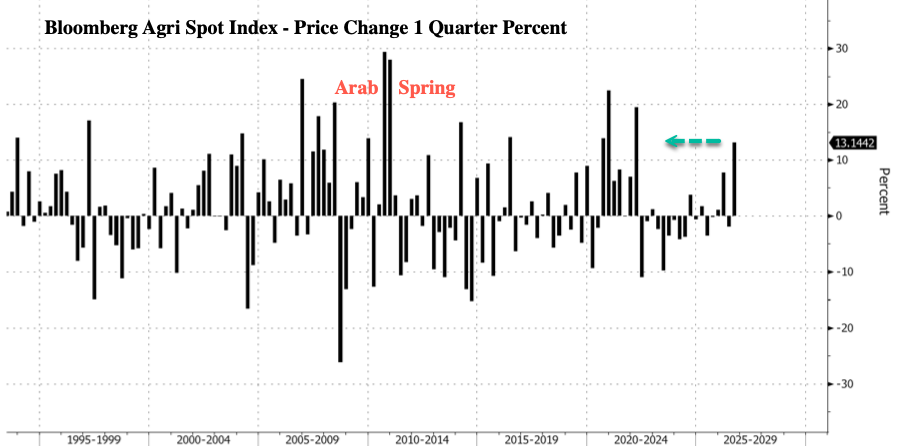
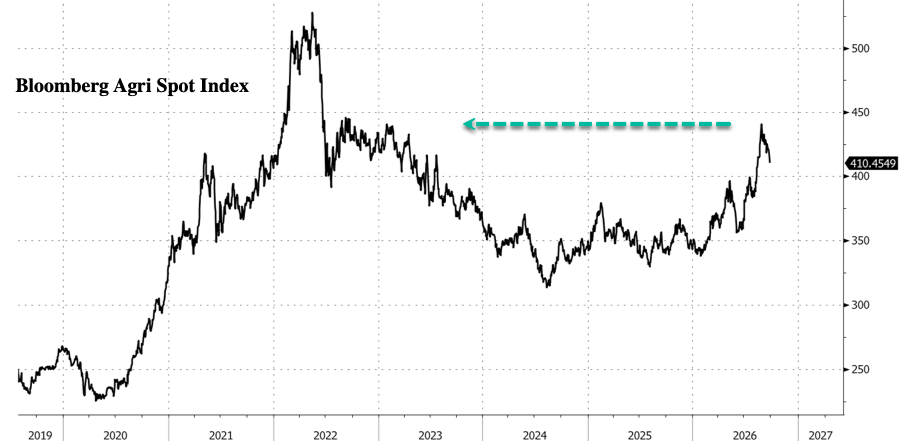
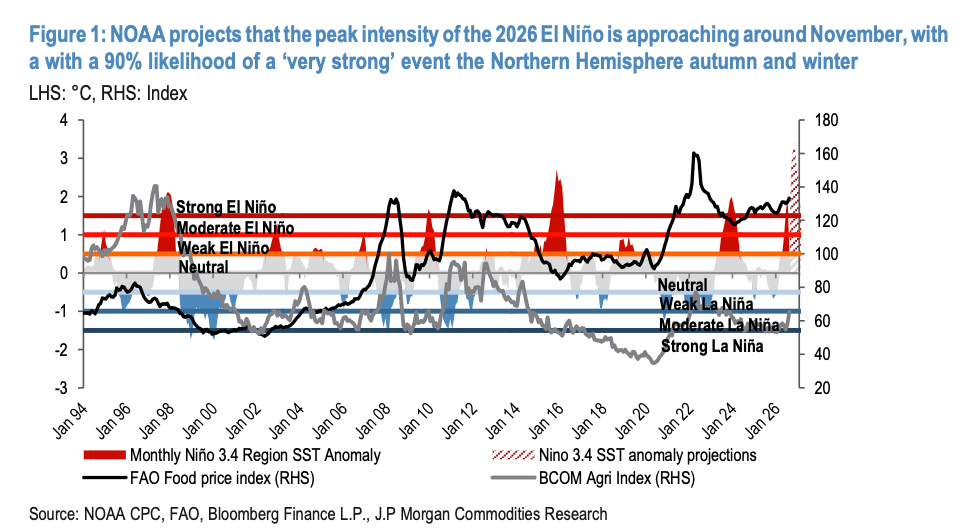
Tyler Durden Thu, 10/01/2026 - 08:00

Canada Has A Ukrainian Blindspot

1 October 2026 at 14:40
Canada Has A Ukrainian Blindspot

Authored by Ted Snider via The Libertarian Institute

On September 10, Ukrainian President Volodymyr Zelensky landed in Canada where he and Canadian Prime Minister Mark Carney signed a 100-year partnership "elevat[ing] the relationship between their countries into a Comprehensive Strategic Partnership and confirming their aligned nature."

Canada already has a special relationship with Ukraine. Before the war, Canada had the largest Ukrainian community in the Ukrainian diaspora with 1,209,805 Ukrainian-Canadians. Canada is the fifth largest financial contributor to Ukraine after only the United States, the European Union, Germany, and the United Kingdom with over $16 billion in military, financial and humanitarian aid.

Carney said that “Canada will always stand in solidarity with Ukraine” and that “there is no qualification to our commitment.” There is little wrong with that: Ukraine was invaded by Russia and taken advantage of by the West.

But there are two problems with the Comprehensive Strategic Partnership. The first is practical.

Since Russia invaded Ukraine in 2022, Canada has contributed $8.5 billion in military support to Ukraine. The Comprehensive Partnership includes a joint declaration on defense and security co-operation. During the official visit, Carney announced new investments to support Ukraine’s defense, including $350 million for interceptor missiles for air defence.

The practical problem is that Ukraine is black hole into which money intended for defense disappears. This is a problem well known to Ukraine’s partners who, nonetheless, keep pouring money in with a blind eye to the problem. Earlier this month, following close on the heels of a U.S. $100 billion European Union loan to Ukraine, Kiev surprised the European Union with a request for an additional $27 billion to address a shortfall that was difficult to explain. The request “unsettled” European officials, some of whom privately worried “whether money is being spent efficiently or whether needs are being overstated.”

A recent New York Times investigation found that seven of Ukraine’s ten top military contractors continued to be awarded contracts after Kiev knew they were facing investigations for fraud, corruption, or failure to deliver on deals they were paid for. Eighteen companies won contracts despite defaulting on previous ones. Millions were thrown away by inexplicably, and conveniently, awarding contracts to the highest bidder. Government audits show that in one year of the war alone, Ukraine lost $1.2 billion in U.S. foreign aid to “fraud, waste and mismanagement.” Sending hundreds of millions more to Ukraine sounds great. But to whom will it go?

There is a second problem with the 100-year Comprehensive Partnership that is deeper. Carney said the Strategic Partnership is based on the two countries “aligned nature.” But there are important aspects that do not align.

Canada is a federalist country that officially recognizes more than one culture and language. The Carney administration recently walked away from negotiating a trade agreement with the United States partly in defense of its sovereign right to protect French culture, French language, and its official bilingualism. Ukraine has been locked in a civil war since 2014 to protect the opposite: a monist vision of Ukrainian society that rejects federalism and recognizes only one culture as Ukrainian while suppressing the language, culture, and religion of ethnic Russian citizens of Ukraine in Crimea, the Donbas, and the southeast. It specifically denies the pluralist alternative that is a defining feature of Canadian identity. Rather than aligning in their natures, in this essential aspect, the two countries are the antithesis of each other.

Canada has confronted this blind spot before. In 2023, Yaroslav Hunka received two standing ovations in Canada’s Parliament as “a Ukrainian Canadian war veteran from the Second World War who fought for Ukrainian independence against the Russians” and as “a Ukrainian hero and a Canadian hero,” despite having served in the 14th Waffen Grenadier Division of Adolf Hitler’s SS.

Carney insisted that “Canadians understand in our bones the importance of your struggle” and explained that the reason “there is no qualification to our commitment” to Ukraine is “because your cause—freedom, democracy, sovereignty—is our cause.”

A standing ovation from the Canadian parliament and then he also got a personal meeting with Trudeau and Zelensky.

'Waffen SS' veteran Yaroslav Hunka must feel very loved in Canada...... pic.twitter.com/5BjwrWsWtS

— Richard (@ricwe123) August 17, 2025

It may be “our cause,” but the historical record is less clear that it is their cause. Zelensky has formally banned eleven opposition parties, including the Opposition Platform for Life party that was once the second largest party in the Ukrainian parliament, though they all condemned Russia’s invasion and contributed to Russia’s defence.

He has restricted freedom of information, unifying all television sources into a single source of television news, and increased the censorship powers of the state over print and online media.

The Ukrainian Orthodox Church, Ukraine’s largest church organization, has been banned by Zelensky though Ukraine’s constitution protects freedom of religion, despite that the Primate of the UOC expressed the church’s loyalty to Ukraine and condemnation of Russia’s invasion.

Cultural and linguistic rights for minorities have fared no better than political and religious rights and freedom of expression. Pursuing the monist interpretation of Ukraine, Zelensky has gone down a path of abolishing any hint of Russian culture. Legislation has erased the Russian language, making Ukrainian the sole language of government, schools, universities, culture, publishing and media.

It is fine for Canada to “stand in solidarity with Ukraine.” But we should not be blind to Ukraine’s struggles and challenges. If Ukraine is to avoid civil war after the war with Russia and if Ukraine is to have a chance of joining the European Union and orienting toward the west, they, too, are going to have to confront these challenges.

Tyler Durden Thu, 10/01/2026 - 07:40

Tennessee Botches Execution: Inmate Still Snoring After Two Doses Of Pentobarbital, Hauled To Hospital

1 October 2026 at 14:00
Tennessee Botches Execution: Inmate Still Snoring After Two Doses Of Pentobarbital, Hauled To Hospital

The State of Tennessee spent Wednesday trying to carry out a death sentence it has had on the books for thirty years, and ended the night with the condemned woman in an ambulance.

Christa Gail Pike, 50 - the only woman on Tennessee's death row - was still breathing, audibly snoring, and maintaining a heartbeat after prison staff administered two doses of pentobarbital at Nashville's Riverbend Maximum Security Institution. Media witnesses were escorted out around 8:53 p.m. local time while her snoring could still be heard. Pike was subsequently rushed to an off-site hospital, prompting Governor Bill Lee to halt all remaining executions for the year and order a third-party review.

Pike was sentenced to death in 1996 for the torture-murder of 19-year-old Colleen Slemmer, a Job Corps classmate she lured into the Knoxville woods in January 1995 at age 18 - where she bashed the girl's skull in with a chunk of asphalt after carving a pentagram into the victim's chest with a friend. Pike started showing off pieces of Slemmer's skull at school, at which point she was arrested (with a chunk of skull found in her pocket). 

Fox 17 investigative reporter Kelly Avellino posted that Pike "appeared to receive 2 doses of pentobarbital, and she was still awake 40 minutes after" before being transported. 

Unbelieveable. Officials were unable to carry out the execution of Christa Gail Pike, witnesses said, after the lethal injection was administered. Pike appeared to receive 2 doses of pentobarbital, and she was still awake 40 minutes after. Pike is now en route to the hosptial. https://t.co/oUfWXlhAsx

— Kelly Avellino (@KellyAvellino) October 1, 2026

A day that started in court and ended in an ambulance

Pike was scheduled to die at 10 a.m. She would have been the first woman executed in Tennessee in roughly 200 years, and the 19th woman executed in the United States since 1976.

That morning, the U.S. Court of Appeals for the Sixth Circuit issued a short 2-1 stay. The Tennessee attorney general immediately asked the U.S. Supreme Court to vacate it. Just before 6 p.m., the Court complied, issuing a two-sentence order devoid of reasoning. Justices Sonia Sotomayor, Elena Kagan, and Ketanji Brown Jackson dissented, with Sotomayor writing that "Tennessee's desire to expedite Pike's execution by a few days or even weeks cannot outweigh her 'fundamental interest in [her] own life.'" She added that in capital cases, an "appreciation of our own fallibility" demands caution "before acting irretrievably." With the legal roadblocks cleared, the state proceeded.

The judicial scramble followed Governor Lee's denial of clemency two days prior. On Sept. 28, he announced that after "deliberate consideration," he would uphold "the sentence of the State of Tennessee."

What the witnesses actually saw

Tennessee Lookout and the Tennessean reconstructed the chaotic scene inside the chamber using accounts from media witnesses, including reporters from WBIR, WKRN, WVLT, the Nashville Banner, and the AP:

  • 6:41 p.m. Witnesses enter. Curtain closed. Groaning and crying are audible before the microphone is turned on.
  • 7:26 p.m. Curtain opens. Pike, strapped to the gurney, delivers her final statement. She says she is "going to leave this world the way I spent most of my life, and that is in love," extending that love even to people "hating on her." She closes with, "I'm at peace. I'm ready to be free. This is a happy day."
  • 7:34 p.m. "My arm feels like it's about to burst open," Pike says. A witness also reports hearing, "One spot is really throbbing."
  • 7:39 p.m. Pike is still lifting her head, taking deep breaths, and kicking her feet hard enough to knock the sheet off.
  • 7:41 p.m. An employee places a rock in view of the witnesses - the protocol's signal that the inmate appears comatose. However, Pike's jaw is still moving. Minutes later, she opens her mouth in "a very large yawn."
  • 7:46 p.m. Curtain drops.
  • 7:49 p.m. Curtain rises. Pike is loudly snoring. A spiritual adviser is brought back into the chamber.
  • 7:54 p.m. Pike grunts, lifts her head, and opens her mouth.
  • 7:56 p.m. Her body jolts off the gurney into a "V" shape, head and legs lifting simultaneously.
  • 8:01 p.m. The rock is placed a second time. Pike is still breathing, snoring, and flexing her neck.
  • 8:05 p.m. Curtain is closed for good.
  • Until 8:53 p.m. Rhythmic snoring continues behind the curtain, punctuated by the sound of doors opening and closing. The microphone is cut, and witnesses are escorted out. As far as they know, Pike is still alive.

WKRN's Tori Gessner, a veteran of multiple Tennessee executions, told the Lookout: "Nothing about today was normal, typical at all, and the court delay was just the tip of the iceberg." Nashville Banner's Steven Hale added: "I cannot emphasize enough how much of whatever just happened, happened behind a closed curtain... When Christa Pike was still alive, we could still hear her breathing, but we could not see what was going on."

Shortly after 9 p.m., ambulances and fire trucks were seen departing Riverbend with their emergency lights activated.

The state's line, and the lawyers' line

More than two hours after the botched execution, Tennessee Department of Correction spokeswoman Dorinda Carter issued the following statement:

"The Tennessee Department of Correction followed every step of the State's lawful, established execution protocol approved by the Attorney General's Office. The lethal injection chemical in the protocol has consistently been effective, and the protocol does not allow for additional procedures beyond what was carried out this evening. Christa Pike has been transported to an off-site medical facility."

So if two rounds fail to kill the inmate, protocol dictates the execution ends and the inmate goes to a hospital.

Pike's attorneys offered the following statement:

"Tonight the State of Tennessee once again failed to carry out a lawful execution. We take no pleasure in being right, but the concerns raised by Ms. Pike proved to be true: difficult vein access, blown veins, degraded pentobarbital, no emergency medical care available when things inevitably go wrong, all under a protocol that remains veiled in secrecy."

In an emergency motion filed while Pike was still in the chamber, her defense informed the U.S. District Court for the Eastern District of Tennessee that she "has not lost consciousness and still has a heartbeat and is audibly snoring." Attorney Kelly Gleason stated Pike desperately needed immediate medical care, noting that counsel couldn't get state officials on the phone to halt the process. Judge Clifton L. Corker ultimately ruled the motion moot because the state had already informed the court that medical care was underway. Pike's current condition remains unreleased, though one of her lawyers told the BBC she was "being provided life-saving measures."

Dr. Joel Zivot, a medical expert retained by the defense, told the BBC it is "very possible that as a consequence of the delay of the beginning of resuscitation she will have a brain injury." He suggested Pike likely never absorbed a sufficient blood level of pentobarbital to stop her breathing and circulation. Notably, no independent toxicology report has been produced.

Lee hits pause

At approximately 11:16 p.m., Governor Lee halted another execution scheduled for later this year. Via the Tennessean:

"Carrying out a lawfully imposed sentence is among the State's most serious responsibilities, and the people of Tennessee expect it to be done in a manner that is not only legal and constitutional, but is effective. ... Therefore, the remaining scheduled execution will not be carried out this year."

Lee ordered a "comprehensive, third-party review" of the Pike debacle - while Gary Wayne Sutton, who was scheduled to die on Dec. 3 for the 1992 murders of Tommy Griffin and Connie Branam in Blount County - was spared for now. 

Lee had explicitly declined to halt Pike's execution. His attorney general's office spent the afternoon racing to the Supreme Court to ensure it happened Wednesday night rather than next week. The protocol the AG approved is the very same one Carter proudly claimed was followed to the letter. Whether it was "effective" is a separate question, and on Wednesday night, the undeniable answer was no.

Tyler Durden Thu, 10/01/2026 - 07:00

"Zero Hormuz": Abu Dhabi Crown Prince Readies Tens Of Billions To Turn Fujairah Into Hormuz Bypass

1 October 2026 at 13:35
"Zero Hormuz": Abu Dhabi Crown Prince Readies Tens Of Billions To Turn Fujairah Into Hormuz Bypass

On March 3, just days after the first US and Israeli strikes on Iran, when most of the market was still busy pricing the closure of the Strait of Hormuz as a temporary inconvenience, we pointed out something that seemed rather obvious (to us): the UAE's oil port of Fujairah, which sits on the Gulf of Oman and bypasses the strait completely, was far too small for its strategic importance - and that would change.

Surprising Fujairah is not a bigger oil terminal: it bypasses the straits completely.

Expect major infrastructure push here after the war. https://t.co/Do1gK7KBDQ

— zerohedge (@zerohedge) March 3, 2026

Six days later we went one step further:

After this crisis, every Gulf pipeline has to end either in Yanbu or Fujairah alongside massive terminal infrastructure https://t.co/fNBywD3Wr1

— zerohedge (@zerohedge) March 9, 2026

Seven months later, the "major infrastructure push" has a name, a sponsor, and a checkbook. According to a new Bloomberg Big Take, Abu Dhabi Crown Prince Sheikh Khaled bin Mohamed Al Nahyan - who took the helm of the emirate's $300 billion L'imad Holding sovereign fund weeks before the war began - is now the point man for what the UAE is officially calling its "Zero Hormuz" strategy (wonder if he was reading Zero Hedge at the time). And the centerpiece of that strategy is, you guessed it, Fujairah.

Follow the money (to the Gulf of Oman)

Here are the Bloomberg report highlights:

  • L'imad has announced plans to take Abu Dhabi Ports Co. private at a valuation of nearly $9 billion, and people familiar say the fund is now likely to spend tens of billions of dollars more on new port infrastructure outside the strait.
  • The crown prince and his inner circle are expected to be "particularly focused" on expanding ports in Fujairah, which sits just outside Hormuz and opens into the Gulf of Oman.
  • In May, L'imad struck an agreement with BlackRock (via its Global Infrastructure Partners unit), Temasek and ADNOC to jointly target up to $30 billion of infrastructure investment in energy transportation, logistics and water. Abu Dhabi did not want such a large push funded solely by state money - which is a polite way of saying Larry Fink gets a toll road around Iran.
  • Sheikh Khaled also chairs the executive committee of ADNOC's board, which is building a second oil pipeline to double export capacity through Fujairah; at a May meeting he directed the company to accelerate delivery.
  • Meanwhile Dubai's DP World is separately pushing new container terminals in Fujairah - meaning that a relatively small stretch of coastline under the Al Hajar mountains is about to become some of the most crowded (and most valuable) real estate in the Gulf.

The UAE's trade minister Thani Al Zeyoudi summed up the doctrine back in June: the country wants to move to Zero Hormuz dependency regardless of whether the strait is open or not. Translation: even if Tehran signs a peace deal tomorrow, the leverage it enjoyed over Gulf exports for decades is never coming back.

Regular readers will recognize every step of this progression. On April 2 we noted that Gulf states were dusting off costly bypass pipeline plans; on May 15 we reported that ADNOC would double its crude export capacity bypassing Hormuz with the new pipeline to Fujairah, due in 2027; and on July 13 we wrote that DP World's plan for a new east coast port in Fujairah "signals the beginning of the end" of Iran's Hormuz leverage. That same day, as peace talks went nowhere, we also offered an alternative engineering solution:

At this rate it will be faster to dig a canal through the UAE to bypass Hormuz than to wait for a peace deal

— zerohedge (@zerohedge) July 13, 2026

Abu Dhabi, it appears, has opted for the slightly less ambitious version: pipelines plus a lot of concrete.

Goldman: 60% of Gulf exports insulated from Hormuz by 2028

So how far can this go? Goldman's commodity team (Alexandra Paulus, Yulia Grigsby, Daan Struyven and Filippo Cuscito) ran the numbers in a July note titled "Gulf Exports: Short-Term Uncertainty, Long-Term Pipeline Hedge" (available here to pro subs), and the conclusion is that while Hormuz still dictates prices in the short run, the long run looks very different. The bank estimates that enough pipeline capacity will be added in the region to insulate over 45% of pre-war Persian Gulf exports by end-2027 and more than 60% by end-2028 from any future Hormuz shock.

Some of the details:

  • Goldman measures current effective bypass capacity as the flows out of Yanbu (East-West pipeline), Fujairah (ADCOP pipeline) and Ceyhan (Kirkuk-Ceyhan). In its base case, that capacity rises by 3.8mb/d by end-2027 and 7.3mb/d cumulatively by end-2028, to over 14mb/d - versus ~23mb/d of pre-war exports from the seven Gulf producers that need pipelines to dodge Hormuz.
  • The UAE features prominently: the West-East pipeline (ADNOC's second line to Fujairah) is one of only two projects already under construction, while a Hamriyah-Fujairah pipeline sits in Goldman's "Accelerated Scenario" - which would insulate 75% of exports by end-2028 (vs. just over 45% in the "Conservative Scenario").
  • History is on the builders' side: across Goldman's sample, the median construction time for Mideast pipelines was 2.5 years, and single-country projects get built faster, especially in response to supply disruptions. Multi-country projects (looking at you, Iraq-Syria) not so much.
  • Total cost across the seven projects: roughly $30-48 billion - or, put differently, about one BlackRock/L'imad infrastructure platform.

And here is the punchline for oil bulls: Goldman raised its long-dated Brent assumption (3-year-ahead futures) by $9 to $76/bbl at the peak of the war, mostly on a higher structural security premium. But the bank warns that the eventual expansion of bypass capacity poses downside risk to that long-dated assumption. In other words, every barrel that Sheikh Khaled routes to Fujairah is a barrel of risk premium Iran can no longer charge the world.

The plumbing is already working

The "adaptation" is already visible in the export data. As we reported earlier today, Goldman estimates that Persian Gulf oil exports (including "dark exports") recovered to 23.3mb/d over the past week, in line with their 2025 average, after doubling in September. Crude accounted for nearly 90% of the recovery, reaching 19mb/d (108% of the 2025 average), while refined product exports remain stuck at about half of normal. Crucially for this story, Goldman notes that oil exports from the UAE - which shockingly exited OPEC shortly after the Iran war started - are also above their 2025 average, "with likely further upside" - while Iran shipped no crude by sea at all in September.

Drill down and Fujairah is doing a lot of the heavy lifting: Goldman's late-September breakdown puts flows via Fujairah at 3.6mb/d (crude, products and LPG combined), more than Yanbu's 2.6mb/d, and more than double the ~1.7mb/d Fujairah handled before the war.

Source: Goldman

And by country, the UAE is already running at 110% of its 2025 export average - second only to Saudi Arabia's dark-transit-fueled surge - while Iran sits at 19%.

Source: Goldman

The UAE in particular has been the most creative workaround artist of the war: as we noted in July, its crude output hit an all-time high of 4.1mb/d in June after it quit OPEC, with ADNOC selling cargoes for loading off Fujairah and Sohar, outside the strait. Back in March, we reported that Fujairah crude loadings had already hit ~1.9mb/d - about the max the existing 1.5-1.8mb/d Habshan-Fujairah line can carry. The only real constraint was pipe. Which is exactly what Abu Dhabi is now paying to fix.

Bypassing the strait is not the same as bypassing the drones

None of this makes Fujairah safe. It is roughly 80 miles from Hormuz and well within range of Iranian drones and short-range missiles - a point LSE professor Steffen Hertog makes in the Bloomberg piece. Tehran knows exactly what Fujairah represents: the port was in flames on March 14, was attacked at least seven times in the first four weeks of the war, and on March 31 Iran explicitly threatened to target the port and its pipeline "in order to close the UAE's route to bypass the Strait of Hormuz." On May 4, another Iranian strike on Fujairah's oil zone sent Brent above $114.

Saudi Arabia offers the cautionary tale. Its 7mb/d East-West pipeline to Yanbu - the region's single biggest Hormuz bypass - was shut down on September 11 after drone attacks by pro-Iran militias, before restarting on September 28. Goldman's September 14 Oil Tracker pointed out that an April strike on the same pipeline cut flows by just 0.7mb/d for four days, while the latest attack was far more severe and threatened the remaining ~2mb/d of Yanbu exports. The Saudis promptly pivoted back to shipping through... Hormuz. Meanwhile the Houthis are advancing on Bab el-Mandeb, threatening the other end of the Red Sea route.

Which brings us to Treasury Secretary Bessent, who predicted on September 1 that in two years Hormuz will be "a worthless piece of water." Qatar's energy minister promptly called that "completely wrong" - which is easy to understand when you are Qatar, have no geographic alternative route, and have watched your gas revenue drop sharply. The truth is somewhere in between: Hormuz won't be worthless, but if Goldman's math is right it will be worth a lot less to Iran - and a lot more to whoever owns the ports on the other side of the mountains.

As Chatham House's Sanam Vakil puts it, a "No Hormuz" policy is now of utmost importance for the UAE - but with Iran's proxies extending their reach, Abu Dhabi will also have to prepare for infrastructure targeting outside Hormuz too. Expect the next line item in the L'imad budget to be air defense.

For now, the bottom line is the one we flagged on day four of the war: the Gulf's most important real estate is no longer inside the strait, it's on the Gulf of Oman - and the crown prince of Abu Dhabi has just put tens of billions of dollars (and BlackRock's money) behind that view.

Tyler Durden Thu, 10/01/2026 - 06:35
❌